
Use a two-axis risk matrix (urgency × impact) scored on a four-tier scale, with a mandatory log entry for every request, to triage and prioritise urgent repairs across your portfolio without letting safety-critical work slip through.
Apply this now (next 60–120 minutes):
- Tag safety risks first. Any report involving gas, structural failure, electrical fault, or loss of heating in winter goes straight to Tier 1 regardless of other factors.
- Isolate where necessary. If a hazard cannot be made safe remotely, instruct the tenant to isolate the supply and log the instruction with a timestamp.
- Capture evidence immediately. Request photos from the tenant, record the intake time, and note the property address, fault description, and who reported it.
- Assign an SLA tier and communicate it. Every job needs a response target before you close the intake call.
SLA targets by tier:
| Tier | Category | Response target | Resolution target |
|---|---|---|---|
| 1 | Emergency | Attend within 4 hours | Make safe same day |
| 2 | Urgent | Attend within 24 hours | Resolve within 7 days |
| 3 | Scheduled | Acknowledge within 48 hours | Resolve within 28 working days |
| 4 | Planned | Schedule at next opportunity | Resolve within agreed programme |
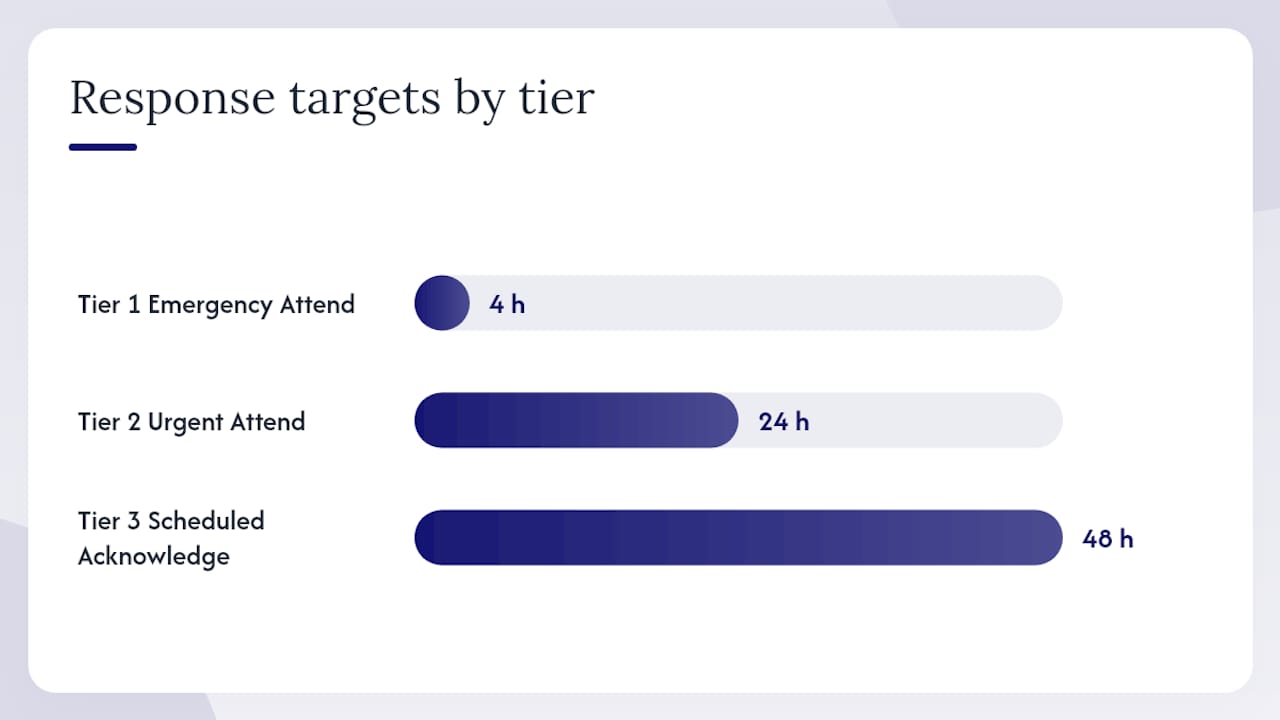
These windows align with local authority repair priority guidance, which sets emergency response at 24 hours and routine works at 28 working days. Tightening Tier 1 to four hours reflects the reality of gas and structural emergencies in occupied homes.
Table of Contents
- Why does poor repair prioritisation cost you more than the repair itself?
- What counts as "urgent" in the UK, and how does urgency differ from impact?
- How does a four-tier prioritisation framework work in practice?
- What does a repeatable triage workflow look like for incoming requests?
- How do you turn reactive repairs into a planned preventive maintenance schedule?
- What are realistic costs and timelines for urgent versus routine repairs?
- What records do you need to keep, and which KPIs defend your decisions?
- Which tools and templates help you implement the framework quickly?
- How 777pcm applies this framework across landlord portfolios
- Key takeaways
- Why most prioritisation systems fail before they get started
- How 777pcm manages urgent repairs and PPM across your portfolio
- Useful sources and official guidance
Why does poor repair prioritisation cost you more than the repair itself?
Reactive-only maintenance is expensive in ways that rarely appear on a single invoice. An emergency call-out for a burst pipe typically costs significantly more than the equivalent planned repair, once you factor in out-of-hours labour rates, water damage remediation, and temporary accommodation if the property becomes uninhabitable. Across a portfolio of ten or more properties, that multiplier compounds quickly.
The legal exposure is equally serious. Under the Housing Act 2004 and the Housing Health and Safety Rating System, local authorities can serve improvement notices, prohibition orders, or take emergency remedial action where a Category 1 hazard exists. The cost of council enforcement, including the authority's own remedial costs being charged back to the landlord, can far exceed what a timely repair would have cost. Awaab's Law, which applies to social housing providers and sets strict timescales for investigating and fixing damp and mould, signals the direction of travel for the wider sector.
Tenant safety and reputation matter too. Properties with unresolved repairs attract Housing Ombudsman complaints, negative reviews, and higher void rates as tenants leave rather than wait. A well-maintained property supports rental demand in ways that are difficult to recover once a reputation for slow repairs takes hold.
Pro Tip: Use void windows strategically. When a property becomes vacant, group any outstanding Tier 3 and Tier 4 repairs with the standard void works. A single contractor visit during the void costs a fraction of separate call-outs once a new tenancy begins.
What counts as "urgent" in the UK, and how does urgency differ from impact?
These two terms are often used interchangeably, but they measure different things. Urgency is the speed of response required: how quickly must someone attend before harm occurs or the situation worsens? Impact is the consequence of delay: how many people are affected, how severely, and what is the cost of inaction?
A complete gas leak scores maximum urgency (attend immediately) and maximum impact (risk to life, potential multi-unit effect). A cracked socket cover scores high urgency (electrical shock risk) but medium impact (single room, no immediate structural consequence). Separating the two axes stops you from deprioritising a low-visibility fault that carries serious consequences.
How HHSRS categories map to urgency and impact
The HHSRS establishes 21 hazard categories and scores each on the likelihood of harm and its severity. A Category 1 hazard (the highest band) implies that the local authority has a duty to act and may use emergency remedial action where there is imminent risk of serious harm. For your triage purposes, any fault that would likely generate a Category 1 score under HHSRS should default to Tier 1 in your matrix.
Full HHSRS scoring must be carried out by a trained assessor. HHSRS operating guidance confirms that baseline indicators can be used for preliminary assessments, but formal scoring for enforcement purposes requires a qualified officer. For day-to-day triage, your property manager can apply the baseline indicators; escalate to a trained assessor when a formal inspection or enforcement response is likely.
Common fault examples: urgency and impact at a glance
| Fault | Urgency | Impact | Tier |
|---|---|---|---|
| Complete gas leak | Immediate | High (life/safety, multi-unit) | 1 — Emergency |
| No heating in winter (vulnerable tenant) | Immediate | High (health, habitability) | 1 — Emergency |
| Electrical fault causing power loss | 24 hours | High (safety, habitability) | 2 — Urgent |
| Cracked socket cover | 24–48 hours | Medium (safety, single room) | 2 — Urgent |
| Leaking roof (active ingress) | 48 hours | Medium (asset, habitability) | 2–3 |
| Broken window latch (ground floor) | 48 hours | Medium (security) | 2–3 |
| Dripping tap (no water damage) | 28 days | Low (comfort, minor waste) | 3 — Scheduled |
| Cosmetic plaster crack | Planned window | Low (aesthetic) | 4 — Planned |
For common plumbing faults and their severity grading, the distinction between a slow drip and active water ingress is often the difference between Tier 3 and Tier 2.
Pro Tip: Train your intake staff to ask two questions on every call: "Is anyone at immediate risk right now?" and "Will this get significantly worse in the next 24 hours?" Those two answers alone will correctly place most faults into Tier 1 or Tier 2 without a full scoring exercise.
How does a four-tier prioritisation framework work in practice?
The matrix plots every incoming request on two axes: Urgency (how fast must you respond?) and Impact (what happens if you do not?). Score each axis from 1 to 4, add the scores, and the total places the job in a tier.
Scoring rubric
Urgency score:
- Can wait weeks without harm
- Should be addressed within 28 days
- Must be addressed within 7 days
- Must be addressed within 24 hours or immediately
Impact score:
- Cosmetic or comfort only
- Single tenant, minor habitability effect
- Compliance, asset damage, or multiple tenants affected
- Life/safety risk or Category 1 HHSRS hazard
Total score to tier:
| Score | Tier | Label | Response target |
|---|---|---|---|
| 7–8 | 1 | Emergency | Attend within 4 hours |
| 5–6 | 2 | Urgent | Attend within 24 hours |
| 3–4 | 3 | Scheduled | Resolve within 28 working days |
| 2 | 4 | Planned | Next PPM window |
Decision rules for moving between tiers
A job can be upgraded at any point if new information changes either score. Downgrading requires documented evidence that the risk has been mitigated (for example, a gas supply has been isolated and the property is safe). Temporary mitigation does not close a job; it holds the tier while the permanent fix is scheduled.
Four Million Homes guidance on repair priorities provides practical classification tables that align closely with this four-tier structure and can be adapted directly into your intake forms.
Worked examples
- Burst pipe, active flooding (Urgency 4 + Impact 4 = 8): Tier 1. Instruct tenant to isolate stopcock, dispatch emergency plumber immediately, log isolation instruction with timestamp.
- Faulty boiler, no heating (October, elderly tenant) (Urgency 4 + Impact 4 = 8): Tier 1. Heating failure in winter for a vulnerable occupant carries a Category 1 HHSRS risk; provide temporary heaters while arranging repair.
What does a repeatable triage workflow look like for incoming requests?
A consistent process matters more than a sophisticated scoring system. Simpler, recorded decision rules produce better outcomes than ad-hoc judgement, and they are far easier to defend if a tenant escalates to the Housing Ombudsman.
How do you turn reactive repairs into a planned preventive maintenance schedule?
Planned Preventative Maintenance (PPM) is the process of scheduling inspections and works before failure occurs, based on asset age, condition, and criticality. For a portfolio, it converts unpredictable emergency spend into foreseeable budget lines.
Start with safety-critical and high-failure assets: heating plant, electrical systems, fire safety components, and communal mechanical equipment. PPM guidance for UK landlords recommends beginning with these categories precisely because they carry the greatest risk and the highest cost of failure. Expand outward to roofing, drainage, and fabric once the safety-critical programme is established.
Building the PPM calendar
- Conduct a PPM survey. A RICS-qualified surveyor or experienced property manager walks each property and grades components by condition and expected remaining life. Record condition codes for every major element.
- Separate urgent finds from planned works. Any fault discovered during a survey that meets Tier 1 or Tier 2 criteria must be logged separately and actioned immediately, not absorbed into the planned programme. Housing stock condition survey guidance explicitly recommends this separation.
- Group works by location and contractor type. Batching a boiler service, an EICR, and a roof inspection at the same property on the same day cuts mobilisation costs and reduces tenant disruption. Group across nearby properties where the same contractor covers the area.
- Set a review cadence. Review the PPM calendar quarterly. After each emergency repair, ask whether a PPM item would have prevented it and add it to the schedule if so.
Pro Tip: Prioritise assets that are safety-critical, difficult to access, or expensive to fail. A communal boiler serving twelve flats is worth servicing annually even if it is running well; the cost of failure in winter, across twelve tenancies, is orders of magnitude higher than the service fee.
The standardised repair cost framework used in national housing research distinguishes urgent, basic, and comprehensive repair categories. Using this structure in your PPM budget helps you compare costs across properties and identify which assets are consuming disproportionate spend.
What are realistic costs and timelines for urgent versus routine repairs?
Budgeting realistically means separating what a repair costs when planned from what it costs when it becomes an emergency. The gap is consistently significant, driven by out-of-hours labour premiums, expedited material sourcing, and consequential damage that accumulates while a fault goes unaddressed.

National dwelling condition analysis defines urgent repairs as those addressing immediate health, safety, security, or rapid deterioration. These are the jobs where delay directly increases cost, not just risk.
Timeline and cost guidance by tier
| Tier | Typical response | Typical resolution | Cost profile |
|---|---|---|---|
| 1 — Emergency | Within 4 hours | Same day (make safe) | Highest: out-of-hours rates, consequential damage risk |
| 2 — Urgent | Within 24 hours | Within 7 days | Elevated: priority scheduling, possible temporary measures |
| 3 — Scheduled | Within 48 hours (acknowledgement) | Within 28 working days | Standard: planned labour and materials |
| 4 — Planned | Next PPM window | Within agreed programme | Lowest: batched, pre-ordered materials, optimal contractor scheduling |
When is temporary mitigation acceptable?
Temporary mitigation is appropriate when a permanent repair cannot be completed within the SLA but the hazard can be made safe in the interim. Acceptable examples include:
- Isolating a gas supply and providing electric cooking facilities while a gas engineer is sourced.
- Applying temporary roof sealant while a full repair is scheduled.
- Providing electric panel heaters while a boiler is awaiting parts.
Every temporary measure must be logged with the date applied, the measure taken, and the date by which the permanent repair is scheduled. Temporary mitigation does not reset the SLA clock; the original tier and resolution target remain active.
Void windows are the most cost-effective time to address Tier 3 and Tier 4 items. Seasonal planning (scheduling external works in spring and summer, heating servicing in late summer before winter demand) further reduces costs and contractor availability pressure.
What records do you need to keep, and which KPIs defend your decisions?
Every prioritisation decision is only as defensible as the record behind it. If a tenant escalates to the Housing Ombudsman or a local authority serves an improvement notice, your log is your evidence.
Minimum record set for every repair
- Intake log: date, time, property, fault description, reporter name.
- Urgency and impact scores with the rationale applied.
- Photos: at intake (where available), on attendance, and on completion.
- Assessor notes where a Category 1 HHSRS hazard was suspected.
- Contractor attendance record and works carried out.
- SLA timestamps: reported, triaged, attended, resolved.
- Tenant communications: written confirmation of attendance window and completion.
The HHSRS Regulations 2005 require records of inspections and prescribe how hazards are assessed and documented. Keeping your own parallel record, aligned to the same structure, means you can demonstrate compliance proactively rather than scrambling to reconstruct a timeline after a complaint.
Which tools and templates help you implement the framework quickly?
You do not need specialist software to start. A shared spreadsheet with consistent naming conventions will outperform an expensive platform that nobody fills in correctly.
Essential intake form columns
- Property address
- Tenant name and contact
- Fault description (free text)
- Date and time reported
- Urgency score (1–4)
- Impact score (1–4)
- Total score and tier
- Assigned SLA (response and resolution dates)
- Assigned resource (engineer or contractor name)
- Status (open / in progress / temporarily mitigated / closed)
- Closure date and works summary
How 777pcm applies this framework across landlord portfolios
A portfolio manager overseeing 40 residential properties across two local authority areas approached 777pcm with a familiar problem: no consistent triage process, emergency spend running at roughly a third of total maintenance costs, and three active Housing Ombudsman complaints linked to delayed repairs.
777pcm's process began with a portfolio-wide condition review, separating immediate urgent repairs from planned works in line with housing stock survey best practice. Every property was graded against the two-axis matrix, and a PPM calendar was built starting with heating plant and electrical systems across the highest-risk properties.
The two-axis scoring approach gave the portfolio manager a defensible, documented rationale for every prioritisation decision — something that had been missing entirely before. Within the first quarter, Tier 1 jobs were being attended within four hours consistently, and the repeat fault rate dropped as PPM began replacing reactive call-outs.
In-house Gas Safe registered engineers, certified electricians, and plumbing specialists handled the remedial works directly, with no subcontracting. Every job was logged through 777pcm's compliance portal, giving the client a real-time view of open jobs by tier, SLA status, and upcoming certificate renewals.
Pro Tip: Ask your compliance provider to flag CP12 and EICR renewals in the same system as your repair log. Compliance certificate gaps are a Category 1 HHSRS risk in practice, and keeping them in a separate spreadsheet is how they get missed.
The tenant safety checklist and landlord repair obligations guidance used throughout this process are available as further reading for managers building their own framework.
Key takeaways
Consistent, documented risk-based prioritisation is the single most effective way to reduce emergency spend, protect tenants, and defend compliance decisions across a residential portfolio.
| Point | Details |
|---|---|
| Use a two-axis risk matrix | Score every repair on urgency and impact (1–4 each) to assign a tier and SLA before any other action. |
| Four-tier SLA is non-negotiable | Emergency: attend within 4 hours; Urgent: 24 hours; Scheduled: 28 working days; Planned: next PPM window. |
| HHSRS Category 1 defaults to Tier 1 | Any fault likely to generate a Category 1 HHSRS score must be treated as an emergency regardless of other factors. |
| PPM starts with safety-critical assets | Begin with heating plant, electrical systems, and fire safety components; batch by location to cut mobilisation costs. |
| 777pcm delivers the full framework | 777pcm provides PPM surveys, emergency response, in-house engineers, and a compliance portal for portfolio-wide SLA tracking. |
Why most prioritisation systems fail before they get started
The most common mistake is not having a bad framework. It is having no framework at all and substituting it with whoever shouts loudest. Visible damage gets attended; hidden risk gets ignored. A tenant who calls three times gets a faster response than one who reports once and waits. That is not prioritisation. It is noise management.
The second trap is treating documentation as a bureaucratic burden rather than a protection. A log entry that takes two minutes to complete has saved landlords from Ombudsman findings, council enforcement costs, and tribunal claims. The record is not for the tenant; it is for you.
Void windows deserve a specific mention because they are consistently wasted. The average void period is an opportunity to address every Tier 3 and Tier 4 item at a fraction of the occupied-property cost, yet most managers treat voids as a rush to re-let rather than a maintenance window. Grouping works during a void, then re-letting into a property with a clean repair log, is both cheaper and better for tenant retention.
On contractor buy-in: the framework only works if the people attending jobs understand the tier system and know what evidence to capture on completion. A brief one-page reference card for attending engineers, covering the four tiers, required photos, and completion log fields, removes ambiguity and keeps records consistent. Tenants, equally, respond better when they receive a clear SLA at the point of reporting rather than a vague "we'll be in touch." Setting expectations early reduces repeat calls and complaint escalations.
How 777pcm manages urgent repairs and PPM across your portfolio
Managing a portfolio means holding compliance, safety, and tenant satisfaction together under one system. 777pcm gives landlords, letting agents, and property managers exactly that: a single point of contact for CP12 gas safety certificates, EICRs, EPCs, and the full range of reactive and planned maintenance works, all handled by in-house engineers with no subcontracting.

The compliance portal gives you a live view of every open repair by tier, every upcoming certificate renewal, and every SLA deadline, across your entire portfolio. Emergency response is available when it matters most, with Gas Safe registered engineers, certified electricians, and plumbing specialists ready to attend. PPM surveys, batched works, and account management are built into the service, so your maintenance programme runs alongside your compliance calendar rather than competing with it.
For landlords ready to move from reactive firefighting to a planned, defensible system, get in touch with 777pcm to arrange a portfolio review and see how the framework applies to your properties.
Useful sources and official guidance
The following official sources underpin the legal and operational guidance in this article.
| Resource | Purpose |
|---|---|
| HHSRS landlord and agent guide (GOV.UK) | Defines the 29 HHSRS hazard categories, Category 1 duties, and emergency remedial action powers |
| HHSRS operating guidance: Part 1 | Assessor training requirements and use of baseline indicators for preliminary scoring |
| HHSRS Regulations 2005 (legislation.gov.uk) | Statutory record-keeping and inspection obligations under the Housing Act 2004 framework |
| Chapter 3: Dwelling condition and safety | Urgent, basic, and comprehensive repair definitions and cost context |
| Housing and neighbourhood conditions | Standardised repair cost methods for portfolio budgeting |
| Homes First repair priorities | Practical response windows for emergency, urgent, and routine categories |
| Four Million Homes repair priorities | Classification tables adaptable to the four-tier framework |
| Housing stock condition surveys guidance (Wales) | Separating urgent survey finds from planned programmes; condition coding |
| PPM guide for UK landlords | Sequencing and batching rules for preventive maintenance programmes |
When to consult a qualified professional: use a HHSRS-trained assessor for any formal hazard scoring that may lead to enforcement action, and a RICS-qualified surveyor for PPM surveys on larger or more complex portfolios. This article provides general guidance on prioritisation methodology and does not constitute legal or professional advice; confirm your specific obligations with a qualified adviser or the relevant primary source.