
Landlord repair obligations are defined by Section 11 of the Landlord and Tenant Act 1985, which requires landlords to keep the structure, exterior, and key installations of a rental property in good repair throughout the tenancy. The Homes (Fitness for Human Habitation) Act 2018 and the Renters' Rights Act 2025 build on this foundation, adding further duties around habitability and tenant protections. From may 2026, Awaab's Law introduces strict statutory timeframes for addressing damp and mould. Failing to meet these obligations carries serious consequences, including civil penalties of up to £40,000 and Rent Repayment Orders covering up to two years' rent. Understanding your landlord repair duties is no longer optional. It is a legal and financial necessity.
What are landlord repair obligations under Section 11?
Section 11 of the Landlord and Tenant Act 1985 sets out the core scope of landlord maintenance responsibilities. It covers the structure and exterior of the property, as well as all installations for water, gas, electricity, and sanitation. These obligations apply automatically to all assured shorthold tenancies and cannot be removed by any clause in the tenancy agreement.
The following items fall squarely within a landlord's legal repair duties:
- Structure and exterior: walls, roofs, foundations, windows, external doors, gutters, and drains
- Water and sanitation: pipes, basins, sinks, baths, and toilets
- Heating and hot water: boilers, radiators, and associated pipework
- Gas and electrical installations: supply infrastructure and fixed wiring
A common misconception is that landlords can pass structural repair duties to tenants through the tenancy agreement. Section 11 duties cannot be contracted out. Any clause attempting to assign these responsibilities to a tenant is void and unenforceable. Even where a tenant causes damage to the structure or core installations, the landlord remains liable for the repair of those elements. The tenant may be pursued separately for the cost, but the landlord must still carry out the work.
Pro Tip: Keep a written record of the property's condition at the start of each tenancy using a detailed inventory with photographs. This protects you if a dispute arises over whether damage was pre-existing or tenant-caused.

Damp and mould deserve special mention here. Damp and mould issues typically root in Section 11 defects such as leaking roofs or failed damp-proof courses. Landlords must fix the root cause, not simply paint over the symptom. Treating the surface without addressing the underlying defect is both ineffective and legally insufficient.
How should tenants report repairs, and what timeframes apply?
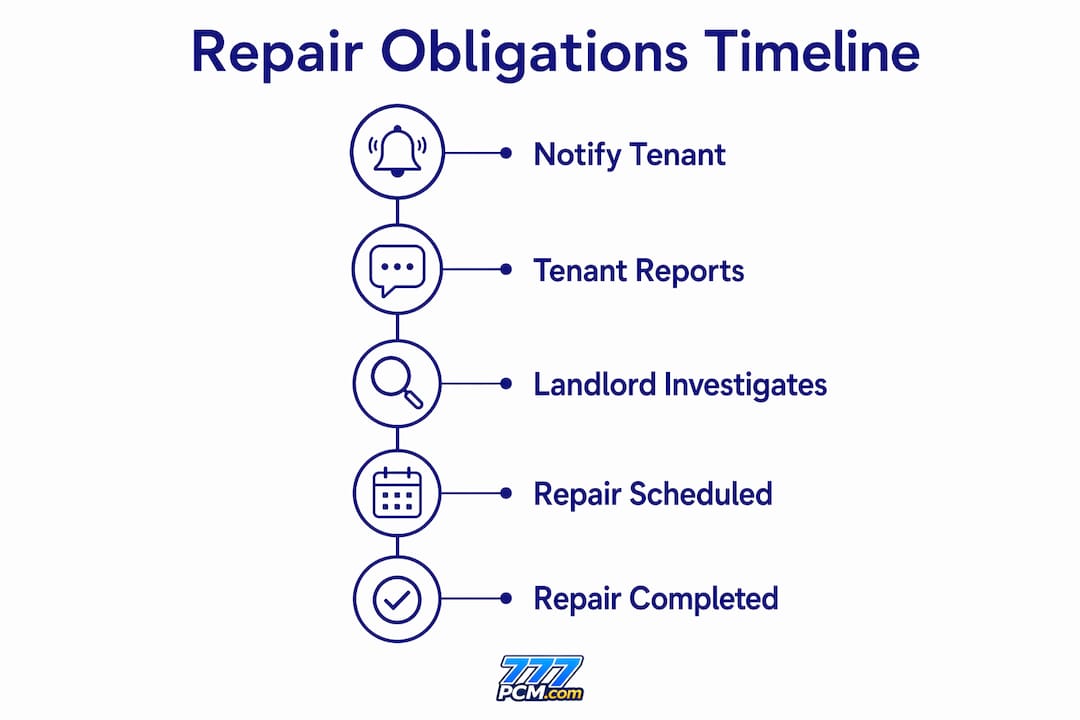
Tenants must notify landlords in writing to trigger the landlord's legal obligation to repair. Until written notice is received, the landlord's duty to act does not formally begin. This is a critical point that many landlords overlook when managing repair requests.
Once notified, the timeframe for completing repairs depends on urgency. The law requires action within a "reasonable time," which varies by the nature of the problem:
- Emergency repairs (boiler failure in winter, burst pipe, loss of electricity): require a response within days, not weeks. Tenants have the right to arrange repairs themselves and deduct the cost from rent if the landlord fails to act promptly.
- Urgent but non-emergency repairs (broken window latch, faulty extractor fan): typically require attention within one to two weeks.
- Minor repairs (small cracks in plasterwork, stiff door handles): may allow a longer window, though delays should still be documented and communicated.
- Damp and mould under Awaab's Law: from may 2026, landlords must investigate damp and mould within 14 days, provide a written report within 7 days of that investigation, and complete remediation within a further 7 days. Failure to comply enables tenant damages claims and enforcement action.
The 14-day investigation requirement under Awaab's Law is the most significant new statutory deadline for residential landlords in years. It removes any ambiguity about what "reasonable time" means for damp and mould specifically.
Pro Tip: Set up a dedicated email address or online portal for repair requests. Written records are automatically created, timestamps are preserved, and you can demonstrate compliance if a dispute reaches a council or court.
Landlords must also allow tenants reasonable access to carry out repairs, but tenants must permit access after 24 hours' written notice. If a tenant refuses access without good reason, the landlord's liability may reduce. Document every access attempt carefully. For guidance on managing urgent situations outside normal hours, the 777pcm resource on out-of-hours repair emergencies offers practical steps.
What are the legal consequences of failing repair obligations?
Non-compliance with landlord repair duties carries escalating consequences, and the 2025 and 2026 legislative changes have made the enforcement landscape considerably tougher.
| Enforcement mechanism | Who triggers it | Potential outcome |
|---|---|---|
| Improvement Notice | Local council | Requires repairs within 28+ days; non-compliance is a criminal offence |
| Prohibition Order | Local council | Prevents use of part or all of the property |
| Emergency Remedial Action | Local council | Council carries out works and recharges the landlord |
| Rent Repayment Order | Tenant or council | Up to two years' rent repaid to tenant post-may 2026 |
| Civil penalty | Local authority | Up to £40,000 under the Housing Act 2004 |
The Housing Health and Safety Rating System (HHSRS) identifies 29 categories of housing hazard. Councils must take enforcement action for Category 1 hazards, which are those posing the most serious risk to health and safety. Ignoring an Improvement Notice is not a civil matter. It is a criminal offence.
The 2026 legal landscape shifts power toward tenants. Landlords who fail to uphold repair standards risk not only fines but also losing the grounds they need to regain possession of their property. The Renters' Rights Act 2025 links possession rights to compliance, meaning a landlord with outstanding enforcement notices may find Section 8 possession claims blocked by the courts.
Tenants are increasingly aware of their rights to escalate repair issues to councils, which can trigger investigations that go well beyond the original repair complaint, including licensing checks and deposit protection audits. A single unresolved repair can open the door to a much wider inspection.
What repairs are tenants responsible for?
Landlord repair duties do not cover everything. Tenants carry their own set of responsibilities, and understanding the boundary prevents unnecessary disputes.
Tenants are generally responsible for:
- Tenant-caused damage: breakages, stains, or structural damage resulting from misuse or negligence
- Internal decoration: repainting walls, replacing wallpaper, and general cosmetic upkeep
- Garden maintenance: mowing lawns, weeding, and keeping outdoor areas tidy (unless the tenancy agreement states otherwise)
- Minor consumables: replacing light bulbs, batteries in smoke alarms, and similar small items
- Tenant-like behaviour: keeping the property reasonably clean and ventilating rooms to reduce condensation
The distinction between a repair and an improvement is also worth understanding. A landlord must restore a property to its previous condition, but is not obliged to upgrade it. Replacing a like-for-like boiler is a repair. Installing underfloor heating where none existed before is an improvement, and that falls outside Section 11 obligations.
Pro Tip: Include a clear "tenant responsibilities" section in your tenancy agreement and walk through it with tenants at the start of the tenancy. Clear expectations at the outset reduce disputes significantly.
Where damage is genuinely caused by a tenant, the landlord can pursue the cost through the deposit or small claims court. However, the landlord must still carry out the structural or installation repair itself. The two obligations run in parallel, not in sequence.
How can landlords manage repair obligations proactively?
Prompt maintenance lowers the risk of expensive structural failures and enforcement action. A reactive approach to repairs is the most common reason landlords find themselves facing council investigations or tribunal hearings.
A practical compliance framework for landlords in 2026 looks like this:
- Schedule regular inspections. Carry out property inspections at least twice a year. Document findings in writing and photograph any areas of concern. Give tenants 24 hours' written notice before each visit.
- Maintain a repair log. Record every repair request, the date received, the action taken, and the date completed. This log is your primary defence in any enforcement or legal dispute.
- Book annual gas safety checks. Gas safety checks must be carried out by a Gas Safe registered engineer every year. The certificate must be provided to tenants within 28 days of the check.
- Commission electrical safety inspections. An Electrical Installation Condition Report (EICR) is required at least every five years. Remedial work identified in the report must be completed within 28 days.
- Respond to damp and mould immediately. Under Awaab's Law, from may 2026, the 14-day investigation clock starts the moment you receive written notification. Build a response workflow before you need it.
- Use qualified tradespeople. Gas work requires Gas Safe registration. Electrical work requires a qualified electrician. Using unqualified contractors does not discharge your legal duty and may invalidate your insurance.
For landlords managing heating systems, the 777pcm guide on heating system maintenance provides a clear overview of what regular servicing should cover. Staying ahead of boiler and heating issues is one of the most effective ways to avoid emergency repair costs and tenant complaints.
Key takeaways
Landlords who understand their repair obligations under Section 11, Awaab's Law, and the Renters' Rights Act 2025 are far better placed to avoid enforcement action, financial penalties, and possession disputes in 2026.
| Point | Details |
|---|---|
| Section 11 is non-negotiable | Structural and installation repair duties apply automatically and cannot be removed by any tenancy clause. |
| Written notice triggers the obligation | Landlords are not legally required to act until they receive written notification of a repair from the tenant. |
| Awaab's Law sets hard deadlines | From may 2026, damp and mould must be investigated within 14 days and remedied within a further 7 days. |
| Penalties are substantial | Civil penalties reach up to £40,000, and Rent Repayment Orders now cover up to two years' rent. |
| Proactive records are your best defence | A detailed repair log, inspection reports, and safety certificates protect landlords in any enforcement or legal dispute. |
The 2026 shift landlords cannot afford to ignore
The legislative changes taking effect in 2026 represent the most significant tightening of landlord repair duties in a generation. I have seen landlords treat repair obligations as a background concern, something to address when a tenant complains loudly enough. That approach is now genuinely dangerous.
Awaab's Law is the change that catches most landlords off guard. The 14-day investigation deadline for damp and mould is not aspirational. It is statutory. A landlord who receives a written complaint about mould on 1 june and has not begun a formal investigation by 15 june is already in breach. The remediation clock then runs from the end of that investigation, not from the original complaint. The timelines stack quickly.
The Renters' Rights Act 2025 adds another layer of risk that many landlords have not yet absorbed. Possession rights are now linked to compliance. A landlord with an outstanding Improvement Notice or a history of unresolved repair complaints may find that the courts block their Section 8 possession claim entirely. Repairs and possession are no longer separate conversations.
The landlords I see managing this well share one habit: they treat their property portfolio like a business with documented processes, not a side income with occasional admin. They have repair logs, scheduled inspections, and relationships with qualified tradespeople who can respond quickly. That preparation is what separates a manageable compliance environment from a crisis.
— Mike
How 777pcm supports landlords with repair compliance
Managing repair obligations across a rental portfolio is demanding, particularly with the 2026 legislative changes adding new timeframes and documentation requirements.

777pcm provides landlords with fast-response maintenance and compliance services designed to meet these legal demands. From CP12 gas safety certificates to plumbing, heating, drainage, and electrical repairs, 777pcm employs in-house Gas Safe engineers, certified electricians, and plumbing specialists who handle the full process. There are no third-party subcontractors, which means faster response times and clear accountability. For landlords who need a reliable partner to stay compliant and protect their portfolio, 777pcm's repair and maintenance services are built precisely for that purpose.
FAQ
What does Section 11 of the Landlord and Tenant Act 1985 cover?
Section 11 requires landlords to maintain the structure, exterior, and installations for water, gas, electricity, and sanitation in good repair. This includes walls, roofs, boilers, pipes, sinks, and radiators throughout the tenancy.
Can a landlord make a tenant responsible for structural repairs?
No. Section 11 duties cannot be contracted out, and any tenancy clause attempting to assign structural or installation repairs to a tenant is void and unenforceable.
What are the Awaab's Law deadlines for damp and mould?
From may 2026, landlords must investigate damp and mould within 14 days of written notification, provide a written report within 7 days of the investigation, and complete remediation within a further 7 days.
What happens if a landlord ignores an Improvement Notice?
Failing to comply with an Improvement Notice issued by a local council is a criminal offence under the Housing Act 2004. Landlords also face civil penalties of up to £40,000.
Are landlords responsible for repairs caused by tenant damage?
Landlords must still carry out structural and installation repairs even when a tenant caused the damage. The landlord may pursue the tenant separately for costs, but cannot delay or refuse the repair itself.