
A Section 11 repair obligation is a statutory covenant implied into every qualifying short residential tenancy in England, binding the landlord to keep the structure, exterior and key installations in repair and proper working order. It comes from Section 11 of the Landlord and Tenant Act 1985 and cannot be removed or transferred to tenants by any clause in the tenancy agreement. If you let a residential property on an assured shorthold or other short-term tenancy, it applies to you automatically.
The core covered items are:
- Structure and exterior — walls, roof, foundations, drains, gutters and external pipes
- Water, gas and electricity supply installations — including basins, sinks, baths and sanitary conveniences
- Sanitation installations — WC, waste pipes and associated fittings
- Space heating and hot water installations — boilers, radiators, immersion heaters and associated controls
Your immediate actions when a repair is reported: confirm the tenancy type qualifies, log the notification with a date and time stamp, arrange access with at least 24 hours' written notice, and instruct a qualified contractor. Every step should leave a paper trail.
Table of Contents
- What does Section 11 actually require you to do?
- Which tenancies does Section 11 cover?
- Who is responsible for shared elements in HMOs and multi-occupied buildings?
- What can you put in the tenancy agreement — and what is void?
- How should you handle repair notifications and what timescales apply?
- Who pays, and how does damp and mould fit in?
- What can tenants do if repairs are not carried out?
- How to plan and deliver repairs to the required standard
- When Section 11 does not apply — where to look instead
- How a professional compliance service helps you meet your Section 11 duties
- Key takeaways
- Why proactive compliance beats reactive repair every time
- 777pcm keeps your Section 11 obligations covered
- Useful primary sources and guidance
What does Section 11 actually require you to do?
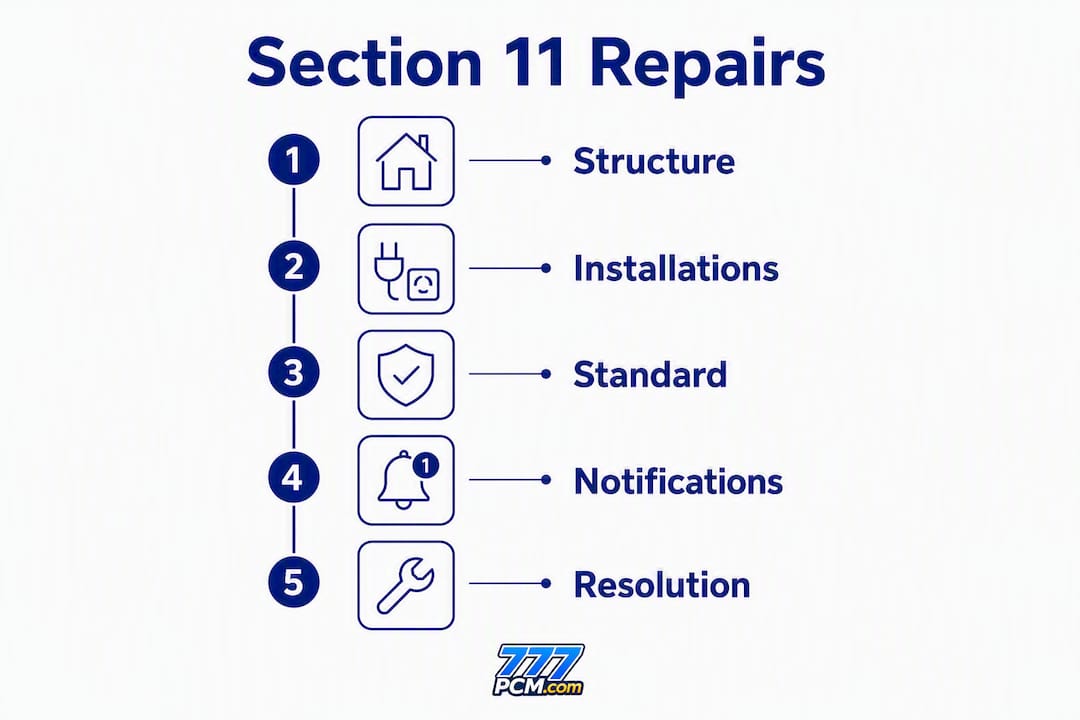
The obligation sits across three statutory strands, each with a distinct scope.
Subsection (1)(a) covers the structure and exterior of the dwelling, including drains, gutters and external pipes. A cracked render allowing water ingress, a failed roof covering, a blocked or broken gutter—all fall here.
Subsection (1)(b) covers installations for the supply of water, gas and electricity, and for sanitation. The statute names basins, sinks, baths and sanitary conveniences explicitly. A burst supply pipe, a failed consumer unit, a cracked WC pan — these are squarely within scope.
Subsection (1)(c) covers installations for space heating and heating water. A boiler breakdown in January is the most obvious example, but the obligation extends to the full heating circuit: radiators, controls, thermostats and immersion heaters.
The legislation itself states the position plainly:
"In a lease to which this section applies there is implied a covenant by the lessor — (a) to keep in repair the structure and exterior of the dwelling-house (including drains, gutters and external pipes), (b) to keep in repair and proper working order the installations in the dwelling-house for the supply of water, gas and electricity and for sanitation (including basins, sinks, baths and sanitary conveniences), (c) to keep in repair and proper working order the installations in the dwelling-house for space heating and heating water."
— Landlord and Tenant Act 1985, s.11
The distinction between "keep in repair" and "proper working order" matters. A boiler that is structurally intact but fails to heat water is in disrepair under subsection (1)(c) even if nothing is visibly broken. Proper working order means the installation does what it is designed to do.
The standard of repair is not "new build" quality. Under s.11(3), the test requires regard to the age, character and prospective life of the dwelling and the locality in which it is situated. A Victorian terrace in a modest area is not expected to meet the same specification as a new-build apartment, but it must be maintained to the standard it would have reached if properly looked after throughout its life. That is the repair standard, not an improvement standard. Replacing a like-for-like leaking gutter section is a repair; replacing the entire guttering system with a premium aluminium profile because it looks better is an improvement, and Section 11 does not require it.
Which tenancies does Section 11 cover?
Section 11 applies to leases of a dwelling-house for a term of less than seven years. In practice, that captures the vast majority of private residential lettings: assured shorthold tenancies (whether fixed-term or periodic), assured tenancies and most social housing tenancies. The Renters' Rights Act 2025 has made procedural changes affecting periodic assured tenancies, but the underlying Section 11 obligations remain in force.
Common exclusions to check:
- Long leases of seven years or more (the tenant typically takes on repair responsibility under the lease terms)
- Licences and lodger arrangements — these are not tenancies and Section 11 does not imply into them
- Tenancies where the tenant has caused the damage themselves (tenant-remediable damage)
- Rebuilding after destruction by fire, storm, flood or other unavoidable disaster
- Items the tenant is entitled to remove (tenant's own fixtures and fittings)
A quick triage checklist for agents and landlords:
- Is the arrangement a tenancy or a licence? If a licence, Section 11 does not apply.
- Is the term less than seven years? If seven years or more, check the lease covenants instead.
- Is the property a dwelling-house? Commercial premises are outside scope.
- Did the tenant cause the damage? If so, liability may rest with the tenant, not the landlord.
For borderline cases, Shelter's guidance on repairs under Section 11 provides a clear practical summary, and the primary legislation at legislation.gov.uk is the definitive reference.
Who is responsible for shared elements in HMOs and multi-occupied buildings?
Section 11(1A) extends the landlord's obligations beyond the individual dwelling when the property forms part of a larger building. Where a repair to the structure or a shared installation is needed to comply with the covenant, and that element is outside the individual dwelling, the obligation still falls on the landlord — provided they have the necessary rights over those parts.
Shared elements that commonly come into scope include:
- Communal staircases, hallways and roof structures
- Shared boilers or communal heating systems
- Shared drainage runs and soil stacks
- Communal electrical installations and meter cupboards
- Lift plant in larger blocks
The practical complication arises when the landlord does not control the relevant part of the building. Under s.11(3A), it is a statutory defence for the landlord to show they used all reasonable endeavours to obtain the rights needed to carry out the repair. That defence only holds if you can prove the endeavours. A single unanswered email to a freeholder is unlikely to satisfy a court.
Pro Tip: Check the head lease, freehold management agreement or estate documentation before a tenancy begins. Identify which parts of the building you control and which you do not. Where you lack rights, document every attempt to obtain them — letters, emails, formal requests — and keep copies in a central file. That paper trail is your statutory defence.
For HMO landlords, the same principle applies across shared kitchens, bathrooms and communal areas. Responsibility follows control, but the obligation to pursue access actively is yours.
What can you put in the tenancy agreement — and what is void?
Section 11(4) is unambiguous: any covenant by the tenant to repair matters covered by subsection (1) is void to the extent it conflicts with the landlord's implied obligation. You cannot draft your way out of Section 11. Clauses that attempt to do so are simply unenforceable.
Void provisions to avoid:
- "The tenant shall be responsible for maintaining the boiler and central heating system."
- "The tenant shall keep the structure and exterior in good repair."
- Any clause that transfers the landlord's s.11(1) duties wholesale to the tenant.
Lawful express terms you can include:
- Additional landlord obligations beyond the statutory minimum (these are valid and enforceable)
- Tenant responsibility for damage caused by the tenant's own misuse or negligence
- Routine upkeep obligations such as keeping gardens tidy, replacing light bulbs or reporting defects promptly
- Tenant obligations to use the property in a tenant-like manner
The line sits between tenant-caused damage (tenant's responsibility) and structural or installation disrepair (landlord's responsibility regardless of cause). A tenant who puts a fist through a wall is liable for that damage. A tenant who reports a cracked wall caused by subsidence is not.
Pro Tip: When drafting tenant upkeep clauses, be specific and narrow. "The tenant shall report any defect in the heating system within 24 hours of becoming aware" is enforceable. "The tenant shall maintain the heating system" is void under s.11(4). Precision protects you; vagueness creates disputes. For a practical guide to drafting residential lease clauses, RentrIQ's lease agreement guide sets out the twelve clauses every landlord should include.
How should you handle repair notifications and what timescales apply?
Landlord liability under Section 11 generally arises once the landlord has knowledge of the defect. Shelter's guidance confirms that notice from the tenant typically starts the repair clock, but awareness by other means — a routine inspection, a report from a managing agent, or a neighbour's complaint — can also create liability. You cannot claim ignorance of a defect you discovered on an inspection and then failed to act on.

The statute sets no fixed timescales, but courts assess whether the landlord acted within a reasonable time given the nature and urgency of the defect. The table below gives practical guidance; these are not statutory deadlines but reflect what courts and local authorities generally consider reasonable.
| Category | Examples | Suggested response time |
|---|---|---|
| Emergency | No heating in winter, gas leak, total loss of water supply, electrical hazard | Same day — within hours |
| Urgent | Partial heating failure, significant leak, broken external door lock | 24 hours |
| Routine | Dripping tap, minor plaster crack, faulty light fitting | 28 days |
Notification handling checklist:
- Log every report immediately with date, time, method of contact and the tenant's description
- Acknowledge receipt in writing (text, email or letter) the same day
- Give at least 24 hours' written notice before entering the property to inspect or carry out works
- Instruct a qualified contractor and confirm the appointment to the tenant
- Put interim safety measures in place where the defect poses an immediate risk
- Retain all communications, invoices and contractor reports
Pro Tip: Use a dedicated repair log — a simple shared spreadsheet or a property management portal works well. The log should record the date of notification, the date of instruction, the date of completion and the contractor's details. That record is your primary defence in a disrepair claim. For practical guidance on scheduling works while tenants remain in the property, see coordinating repairs with tenants in situ.
Who pays, and how does damp and mould fit in?
The landlord bears the cost of repairs falling within Section 11. The tenant bears the cost of damage they have caused through misuse, negligence or failure to behave in a tenant-like manner. Where tenant liability is established, landlords can pursue recovery through the deposit scheme or a civil claim, but the burden of proof rests with the landlord. Photographs taken at check-in and check-out, combined with mid-tenancy inspection reports, are the most reliable evidence.
The standard of repair is contextual. Under s.11(3), the landlord must restore the property to the condition it would have been in if properly maintained throughout, having regard to its age, character and locality. That means a 1930s semi-detached property is judged against the standard of a well-maintained 1930s semi-detached, not a modern equivalent. Landlords are obliged to maintain the existing standard, not upgrade to new.
Damp and mould sit at the intersection of Section 11 and the Homes (Fitness for Human Habitation) Act 2018. Where damp results from a structural defect — a failed damp-proof course, a leaking roof, defective pointing — it is a Section 11 repair issue. Where it causes the property to be unfit for human habitation, the 2018 Act adds a parallel duty. Shelter's fitness for habitation guidance makes clear that persistent damp and mould can trigger both obligations simultaneously.
Cosmetic fixes — painting over mould without addressing the moisture source — satisfy neither obligation and tend to accelerate enforcement action. Root-cause remediation is the only approach that closes both duties.
Not every damp complaint is a Section 11 breach. Courts have held that condensation damp caused by the tenant's lifestyle rather than structural failure, or the presence of asbestos without accompanying fabric disrepair, does not automatically constitute a breach. The cause matters as much as the symptom.
Documents to retain for compliance evidence:
- Pre-tenancy condition report with photographs
- Periodic inspection reports (at least annually)
- Contractor repair orders, invoices and completion notes
- Gas safety certificates (CP12), EICRs and EPCs
- All written communications with the tenant about repairs
- Before-and-after photographs for every significant job
What can tenants do if repairs are not carried out?
A tenant bringing a disrepair claim must establish three things: that the landlord was in breach of the statutory covenant, that the landlord had been put on notice of the defect, and that the landlord failed to carry out the repair within a reasonable time. LawWorks' statutory repairs notes set out this burden clearly. All three elements must be present; notice without breach, or breach without notice, will not succeed.
The escalation path typically runs as follows:
- Tenant reports to landlord — in writing, with a clear description and a reasonable deadline for response
- Written follow-up — if no response, a formal letter before action setting out the defect and the remedy sought
- Local authority complaint — Environmental Health can inspect under the Housing Health and Safety Rating System (HHSRS) and issue improvement notices or prohibition orders
- Civil court claim — the tenant can seek damages for discomfort, inconvenience and any consequential losses, plus an injunction requiring the repair to be carried out
- Rent repayment orders — available in specific circumstances, particularly where the property is unlicensed or where a banning order has been made
| Enforcement route | Likely outcome | Typical timescale |
|---|---|---|
| Local authority / Environmental Health | Improvement notice, prohibition order, potential prosecution | Weeks to months |
| County court disrepair claim | Damages, injunction, costs order | Months to over a year |
| Rent repayment order | Repayment of up to 12 months' rent | Months |
Tenant actions that carry risk:
- Withholding rent without legal advice — this creates rent arrears and risks possession proceedings, even when the disrepair is genuine
- Carrying out repairs and deducting costs from rent without following the correct legal procedure — courts take a dim view of unilateral action without prior notice and a reasonable opportunity for the landlord to act
The most effective landlord response to any escalation is a prompt, documented repair. Responding to a local authority inspection with evidence of a completed repair, a contractor invoice and a follow-up inspection report closes most complaints quickly. Silence, delay or incomplete works are what turn a routine repair into a formal enforcement action.
How to plan and deliver repairs to the required standard
Selecting the right contractor is as important as responding quickly. A repair carried out by an unqualified tradesperson may not satisfy the statutory standard and can create additional liability if it fails or causes harm.
Contractor selection checklist:
- Gas work: Gas Safe registered engineer only — verify the registration number on the Gas Safe Register before instructing
- Electrical work: NICEIC or ECS registered electrician for notifiable work; always obtain an Electrical Installation Condition Report (EICR) where required
- Plumbing: check public liability insurance and ask for references on comparable jobs
- All trades: written quote with a clear scope of works, agreed timescale and a guarantee period
- Roofing and structural: confirm the contractor carries adequate professional indemnity and public liability cover
Certain jobs require formal certification on completion. A boiler service or replacement requires a CP12 gas safety certificate. Notifiable electrical work requires an EICR or a completion certificate from a Part P registered electrician. These certificates are not optional extras; they are part of your compliance record and your defence in any disrepair claim.
Where a permanent repair cannot be completed immediately, temporary measures protect both the tenant and the property. Isolating a faulty electrical circuit safely, providing a temporary electric heater during a boiler failure, or fixing a tarpaulin over a damaged roof section pending a full repair are all reasonable interim steps. For guidance on managing heating failures specifically, fixing heating failure in a rental property covers the practical response in detail.
Documentation to retain for a compliance audit:
- Contractor invoices and completion notes
- Before-and-after photographs for every job
- Copies of all certificates (CP12, EICR, EPC)
- Access request records and tenant acknowledgements
- Any specialist reports (structural surveys, damp surveys, drainage CCTV reports)
When Section 11 does not apply — where to look instead
Not every repair dispute in a residential property involves Section 11. Knowing where the obligation does not sit is as useful as knowing where it does.
Arrangements outside Section 11:
- Licences and lodger arrangements — no tenancy, no implied covenant; responsibility is governed by the licence agreement or common law
- Long leases of seven years or more — repair obligations are set by the lease covenants, not by statute
- Tenant-caused damage — the tenant's liability under the tenancy agreement and common law duty to use the property in a tenant-like manner
- Tenant's own fixtures and fittings — items the tenant installed and is entitled to remove are outside the landlord's Section 11 duty
- Damage caused by unavoidable disaster — fire, storm or flood destruction does not trigger a rebuilding obligation under Section 11
Where to look instead:
- The express covenants in the lease or tenancy agreement
- The head lease or management agreement for leasehold properties
- The landlord's buildings insurance policy for damage caused by insured events
- Local authority powers under the Housing Act 2004 (HHSRS) for fitness and hazard issues not covered by Section 11
- The Homes (Fitness for Human Habitation) Act 2018 for fitness issues that fall outside structural disrepair
For a broader view of landlord obligations beyond Section 11, the landlord repair obligations guide covers the full picture including common law duties and the 2018 Act.
How a professional compliance service helps you meet your Section 11 duties
Managing Section 11 obligations across a portfolio is not simply a matter of calling a plumber when something breaks. The obligation is continuous, the evidence requirements are specific, and the consequences of a gap in the record can be costly. A managed compliance and repairs service addresses the full cycle: report and logging, triage and priority assessment, instruction of in-house trades, remedial works, certification and record upload.
The job types that recur most frequently under Section 11 include boiler failures and heating system faults, communal drainage blockages, electrical faults requiring EICR follow-up, roofing defects causing water ingress, and damp remediation requiring both structural repair and root-cause investigation. Each of these requires a qualified tradesperson, a documented completion record and, in many cases, a formal certificate.
In-house accredited engineers make a material difference here. Gas Safe registered engineers can carry out boiler repairs and issue CP12 certificates in a single visit. Certified electricians can complete remedial works and issue the EICR on the same instruction. That removes the gap between the repair and the certificate, which is exactly the gap that creates evidential problems in disrepair claims.
Pro Tip: Keep a centralised compliance portal with time-stamped photographs, service records and certificates for every property in your portfolio. When a disrepair claim arrives, the ability to produce a complete, dated record of every notification, inspection, repair and certificate is the single most effective defence. A portal that logs access requests alongside job completions closes the evidential loop.
For a practical view of what a responsive repairs service looks like in operation, and how it reduces repeated failures across a portfolio, the linked guide sets out the service model in detail.
Key takeaways
Section 11 of the Landlord and Tenant Act 1985 implies a non-excludable repairing covenant into every qualifying short residential tenancy, requiring landlords to maintain the structure, exterior and key installations in repair and proper working order.
| Point | Details |
|---|---|
| Statutory scope | Section 11 covers structure, exterior, water/gas/electricity/sanitation installations, and space heating — all non-excludable. |
| Notice triggers liability | Landlord liability arises once they have knowledge of the defect; log every tenant notification with date and time. |
| Standard of repair | The test is age, character and locality — maintain the existing standard, not upgrade to new. |
| Damp and mould overlap | Persistent damp may trigger both Section 11 and the Homes (Fitness for Human Habitation) Act 2018; root-cause remediation closes both duties. |
| 777pcm compliance support | 777pcm's in-house Gas Safe engineers, certified electricians and compliance portal handle repairs, certification and record-keeping for landlords and agents. |
Why proactive compliance beats reactive repair every time
There is a pattern that comes up repeatedly in property compliance work: a landlord who has been letting properties for years, who genuinely believes their tenancies are well managed, receives a disrepair claim and discovers that the paper trail simply does not exist. Not because the repairs were not done, but because no one recorded them systematically. The repair happened, the invoice was paid, and then the evidence disappeared into an email thread or a filing cabinet no one can find.
Section 11 is not a complicated statute. Its obligations are clear, its scope is well defined, and the standard it sets is reasonable. What catches landlords out is not the law itself but the operational gap between knowing the obligation and building the systems to demonstrate compliance. A tenant who reports a boiler fault and receives a same-day response, a completed repair within 48 hours and a CP12 certificate uploaded to a portal has no viable disrepair claim. The same tenant, reporting the same fault to a landlord who responds slowly, leaves no written record and uses an unregistered engineer, has a strong one.
The conventional wisdom in this sector tends to focus on the legal text. What actually matters, in practice, is the combination of fast response, qualified trades and documented evidence. Those three things together make Section 11 manageable for any portfolio, regardless of size.
777pcm keeps your Section 11 obligations covered
Staying on top of Section 11 across multiple properties means having the right trades available quickly, the right certificates issued promptly, and the right records stored where you can find them. 777pcm provides exactly that: in-house Gas Safe registered engineers, certified electricians and plumbing specialists who carry out repairs and issue CP12 gas safety certificates, EICRs and EPCs as part of the same instruction.

Every job is managed through a dedicated compliance portal, giving landlords and letting agents a time-stamped record of notifications, access requests, completed works and certificates. Bulk booking is available for portfolio clients, and emergency response is available for urgent Section 11 failures including heating breakdowns and water supply faults. There are no third-party subcontractors in the chain, which means faster scheduling, clearer accountability and no gaps between the repair and the certificate.
To arrange a compliance review or get an emergency job started, visit 777pcm and speak to the team directly.
Useful primary sources and guidance
-
Landlord and Tenant Act 1985, Section 11 — legislation.gov.uk: The primary legislation. Read the full text of the implied covenant, the standard of repair test (s.11(3)) and the reasonable endeavours defence (s.11(3A)) here.
-
Repairs under Section 11 — Shelter England: Practical guidance for landlords and advisers on notice, timescales, the standard of repair and what tenants can do when repairs are not carried out.
-
Fitness for habitation and responsibility for repairs — Shelter England: Explains how Section 11 and the Homes (Fitness for Human Habitation) Act 2018 interact, with specific guidance on damp, mould and fitness issues.
-
Homes (Fitness for Human Habitation) Act 2018 — legislation.gov.uk: The statute that extended implied fitness covenants into residential tenancies; read alongside Section 11 for a complete picture of landlord obligations.
-
Statutory repairs notes — LawWorks: A concise legal note summarising the elements a tenant must prove in a disrepair claim and the limits of Section 11 based on case law.