
The moment a tenant reports a repair, your first move is to acknowledge it in writing, classify its urgency, and propose an agreed access window. That sequence, done within hours, satisfies your duty under section 11 of the Landlord and Tenant Act 1985 and positions you well before any enforcement clock starts ticking.
- Log the report with date, time, and method of contact.
- Classify urgency: emergency (respond within 24 hours), or investigate any potential hazard within 14 days under Awaab's Law. Urgent issues should be responded to within 3 days, and non-urgent matters within 14 days.
- Propose a specific time window and confirm access in writing.
- Schedule an accredited contractor (Gas Safe, NICEIC, or equivalent).
- Record tenant consent or refusal immediately.
Pro Tip: Send your acknowledgement by email or text so you have a time-stamped record from the outset. A WhatsApp message counts, provided you screenshot and save it.
Table of Contents
- How do you coordinate repairs with tenants in situ, step by step?
- What are your legal obligations when arranging in-situ repairs?
- How should you communicate with tenants to get access agreed?
- Which contractor credentials must you check before booking?
- What records should you keep for every in-situ repair?
- What should you do when a tenant refuses access?
- What timescales and costs should you plan for?
- Key takeaways
- Why centralised workflows change repair outcomes
- 777pcm handles in-situ repair coordination for landlords
- Useful sources
How do you coordinate repairs with tenants in situ, step by step?
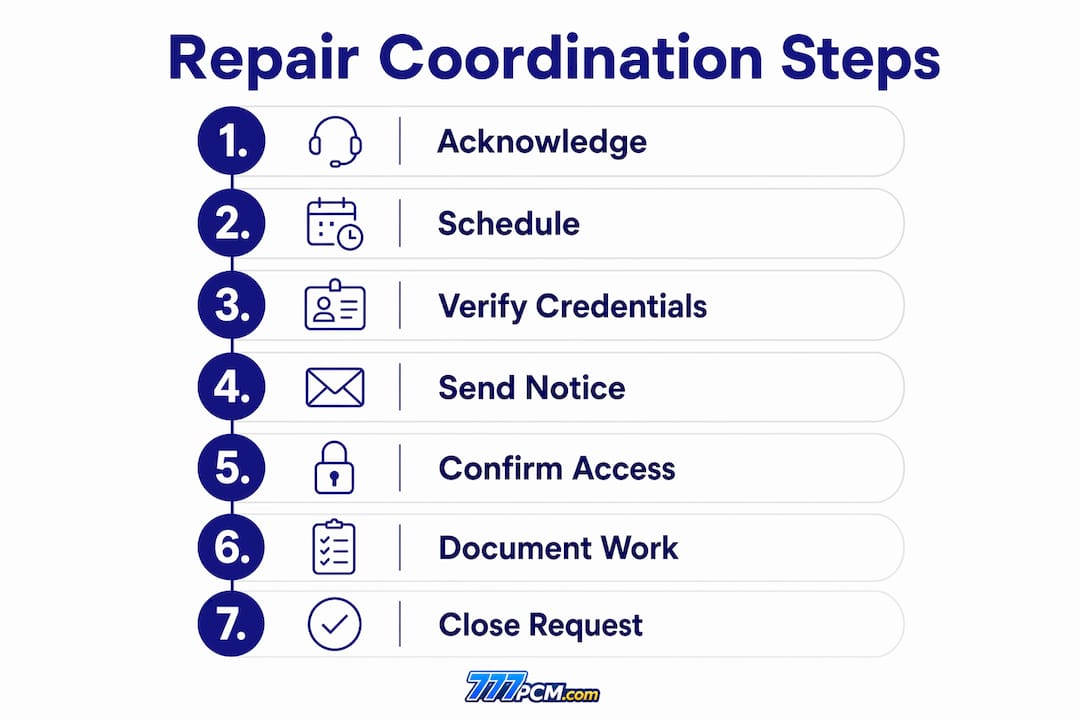
- Acknowledge in writing. Reply to the tenant's report within one hour where possible. State the repair you have noted, the date, and your next action.
- Classify the issue. Emergency (gas leak, total heating failure in winter, structural risk): respond promptly. Urgent (partial heating loss, water ingress): respond within 3 days. Non-urgent (cosmetic, minor): repair within a reasonable period.
- Propose and confirm an access window. GOV.UK guidance requires at least 24 hours' written notice and a reasonable time, generally 8am–6pm on weekdays. Agree a specific slot rather than just giving minimum notice.
- Book an accredited contractor. Confirm Gas Safe registration for gas work, NICEIC or equivalent certification for electrical, and appropriate public liability insurance for all trades.
- Prepare a job sheet and contingency plan. Include hazard notes, permitted working areas, and a fallback if works overrun (alternative accommodation or temporary rent negotiation).
Pro Tip: Offering a two-hour time window rather than a full day dramatically reduces tenant refusals. Tenants are far more willing to stay home for "9am–11am" than for "sometime on Tuesday."

What are your legal obligations when arranging in-situ repairs?
Section 11 of the Landlord and Tenant Act 1985 requires landlords to keep the structure, exterior, and key installations, including boilers, plumbing, electrics, and sanitation, in repair. You cannot contract out of this obligation through a tenancy clause.
Access rules are equally clear. GOV.UK states landlords must give at least 24 hours' written notice and visit at a reasonable time, except in genuine emergencies where immediate entry is justified. Reasonable hours are generally 8am–6pm on weekdays. You cannot demand vacant possession simply to carry out repairs.
Awaab's Law, extended to private rentals recently, adds further obligations. Landlords must promptly investigate reported hazards and begin emergency hazard works without delay. Non-compliance can trigger local authority enforcement, financial penalties, and possible rent repayment orders.
Tenants have a corresponding duty to allow reasonable access. Shelter England confirms that unreasonable refusal can lead to a court injunction, but landlords must never force entry. Document every access attempt and every offer made.
Key legal principle: A landlord who is aware of a defect is treated as being on notice and must act. Shelter's guidance on section 11 repairs makes clear that the duty to act begins from the moment the landlord knows of the problem, not from any formal written demand.
Your landlord repair obligations extend across the whole portfolio, so a consistent process protects you at every property.
How should you communicate with tenants to get access agreed?
Clear, respectful communication prevents most refusals before they start. Treating in-situ repairs as a partnership with tenants, explaining the benefit and providing a named contact, reduces conflict and improves outcomes.
A simple four-stage reminder schedule works well:
- Acknowledgement (Day 0): "We have logged your repair report. A [trade] will attend on [date] between [time window]. Please reply to confirm this suits you."
- 48-hour reminder: "This is a reminder that [contractor name], a Gas Safe/NICEIC-registered engineer, will attend on [date] between [time window]."
- 24-hour reminder: "Your repair appointment is tomorrow between [time window]. The engineer will carry ID and their trade registration card."
- Same-day ETA: "Your engineer is on their way and expects to arrive at approximately [time]."
For major or intrusive works, professionals typically move beyond the statutory 24-hour minimum and offer 30 days' notice or a written agreement, often with compensation, to avoid disputes. Where works cannot be completed with the tenant in occupation, a negotiated written agreement may include temporary rent suspension or an offer of alternative accommodation.
Pro Tip: Always name the contractor and their credential (e.g. "Gas Safe registered engineer, registration number XXXXXXX") in your communications. Tenants are significantly more comfortable granting access when they know exactly who is coming.
Which contractor credentials must you check before booking?
Always use accredited, insured trades for safety-critical work. The credential requirements differ by trade, so check each one specifically.
- Gas work: Engineer must hold a current Gas Safe Register registration. Verify the registration number on the Gas Safe website before booking.
- Electrical work: Use an NICEIC-approved contractor or equivalent. An Electrical Installation Condition Report (EICR) is required every five years for rental properties.
- Public liability insurance: Confirm minimum cover in writing for all trades.
- DBS checks: Required where engineers will have unsupervised access to properties with vulnerable tenants.
- Photo ID: Require contractors to carry and show trade registration cards and photo ID on arrival.
Brief every contractor with a written job sheet covering: the agreed access window, hazard notes, tenant contact details, permitted working areas, H&S measures, and a requirement to log completion with timestamped photographs.
Pro Tip: Favour in-house engineers or direct-account providers over ad-hoc subcontractors. 777pcm employs Gas Safe registered engineers and NICEIC-qualified electricians directly, which removes the credential-verification step and keeps quality consistent across a portfolio.
For structural or masonry repairs, a specialist inspection first saves time. A landlord damp and mould inspection before booking remediation work helps scope the job accurately and protects you under Awaab's Law.
| Credential | Who checks it | Where to verify |
|---|---|---|
| Gas Safe registration | Landlord / manager | gassaferegister.co.uk |
| NICEIC approval | Landlord / manager | niceic.com |
| Public liability insurance | Landlord / manager | Certificate from contractor |
| DBS check | Landlord / manager | Contractor provides certificate |
What records should you keep for every in-situ repair?
A time-stamped central log is your primary defence against tribunal claims, local authority enforcement, and negligence disputes. Centralised digital logging of repair requests, contractor availability, and communication history protects landlords and gives tenants transparency.
Required record fields for every job:
- Date, time, and method of tenant's initial report.
- Landlord acknowledgement timestamp.
- Issue classification and statutory deadline applied.
- Contractor name, trade credential, and booking confirmation.
- Agreed access window and tenant consent or refusal.
- Before-and-after photographs with timestamps.
- Completion confirmation, invoice, and any certificate issued (CP12, EICR, EPC).
A property maintenance workflow portal makes this manageable across a portfolio by centralising all fields in one place.
| Portal field | Purpose |
|---|---|
| Tenant report timestamp | Starts statutory response clock |
| Acknowledgement timestamp | Proves responsiveness |
| Issue classification | Links to correct legal deadline |
| Contractor credential logged | Confirms accredited trade used |
| Access window agreed | Evidence of reasonable notice |
| Completion photos | Confirms works done and condition |
| Certificate stored | Compliance audit trail |
What should you do when a tenant refuses access?
Document every attempt and only escalate after offering reasonable alternatives. That principle keeps you legally protected and preserves the tenancy relationship.
- Stage 1: Repeat the offer with a narrower, confirmed time window. Provide the contractor's name, trade registration number, and photo ID in advance. Offer a small goodwill gesture if appropriate.
- Stage 2: Send a formal written notice setting out the tenant's statutory duty to allow access under the Housing Act 1988, the nature of the repair, and the consequences of unreasonable refusal.
- Stage 3: Propose mediation through a local dispute resolution service.
- Stage 4: Apply for a court injunction where refusal is unreasonable and the repair is essential. Note that eviction or demands for vacant possession are not lawful remedies for access refusal alone.
Legal warning: Never threaten or pressure a tenant into granting access. Rely on documented attempts, written offers of alternatives, and, where necessary, qualified legal advice before pursuing court action. Pressure tactics can constitute harassment under the Protection from Eviction Act 1977.
What timescales and costs should you plan for?
Emergencies require immediate action and may justify entry without notice where there is a genuine risk to life or property. For everything else, UK practice follows a tiered approach.
| Issue type | Investigate / start | Typical completion | Who normally pays |
|---|---|---|---|
| Emergency (gas leak, flooding) | Within 24 hours | Same day or next day | Landlord (section 11) |
| Awaab's Law hazard | Investigate within 14 days | Depends on scope | Landlord |
| Urgent (heating failure, water ingress) | 3 days | 3 days | Landlord (section 11) |
| Non-urgent (cosmetic, minor) | 14 days | 14 days | Landlord or tenant (cause-dependent) |
Tenants pay where damage was caused by them or their guests. Insurers may contribute depending on policy terms, particularly for escape-of-water or storm damage.
For small jobs, working one room at a time minimises disruption. Major works, such as structural damp remediation or full rewires, require a negotiated written agreement covering temporary accommodation or rent suspension. Common plumbing repairs give a useful reference for typical cost ranges on plumbing-related jobs.
Key takeaways
Coordinating in-situ repairs lawfully requires immediate acknowledgement, correct legal classification, a confirmed access window, accredited contractors, and time-stamped evidence at every stage.
| Point | Details |
|---|---|
| Acknowledge within one hour | Log the report with timestamp and confirm receipt to the tenant in writing immediately. |
| Classify and apply the correct deadline | Emergency: 24 hours; Awaab's Law hazard: investigate within 14 days; urgent: 3 days; non-urgent: 14 days. |
| Agree a specific time window | A named two-hour slot reduces refusals and satisfies the 24-hour written notice requirement. |
| Verify contractor credentials | Check Gas Safe, NICEIC, public liability insurance, and DBS before every booking. |
| 777pcm for portfolio management | 777pcm provides in-house Gas Safe and NICEIC engineers, portal logging, CP12 and EICR management, and a single point of contact for all compliance works. |
Why centralised workflows change repair outcomes
The conventional view is that coordinating in-situ repairs is primarily a scheduling problem. It is not. The real risk is evidentiary. Landlords who lose tribunal cases or face enforcement action almost never failed to do the repair; they failed to prove they acted promptly and lawfully. That distinction shapes everything about how a professional operation should be structured.
Using a centralised portal with in-house Gas Safe and NICEIC-qualified engineers removes two of the biggest failure points: credential gaps and communication gaps. When a single account manager handles the job sheet, the contractor briefing, and the completion record, there is no version of events where the engineer "forgot" to photograph the finished work or the tenant claims they never received notice.
Ad-hoc subcontractor models create accountability gaps at every handover. The landlord books a contractor, the contractor attends, but the evidence trail depends entirely on what the contractor chooses to record. An in-house model, like the one 777pcm operates, keeps the audit trail inside one system from first report to final certificate.
For portfolio managers handling dozens of properties, the compounding effect is significant. One missed EICR or one undocumented access refusal can cost more in enforcement and tribunal fees than a year of managed compliance. The maths strongly favours a structured, portal-based approach.
777pcm handles in-situ repair coordination for landlords
Keeping repairs on track while tenants remain in occupation is where most landlords lose time and legal ground. 777pcm provides a managed compliance and maintenance service built specifically for this challenge: in-house Gas Safe registered engineers and NICEIC-qualified electricians, a dedicated property portal that logs every job from first report to completion certificate, and a single account manager who handles scheduling, contractor briefing, and documentation.

Whether you need a CP12 gas safety certificate arranged around an occupied tenancy, an EICR completed with minimal disruption, or a responsive repairs service across a portfolio, 777pcm manages the process end to end. No chasing subcontractors, no credential gaps, no missing paperwork. Get in touch with 777pcm today to arrange a quote or discuss your portfolio's compliance needs.
Useful sources
- Shelter England: problems during repair work — practical guidance on tenant and landlord rights during repairs, including access and quiet enjoyment.
- Shelter England: repairs under section 11 — detailed explanation of the implied repairing covenant and when the duty to act begins.
- GOV.UK: private renting rights and responsibilities — official guidance on notice requirements, reasonable hours, and emergency access.
- Legislation.gov.uk: Landlord and Tenant Act 1985, section 11 — the primary statutory text for landlord repairing obligations.
- Legislation.gov.uk: Housing Act 1988, section 16 — implied term requiring tenants to afford access for repairs.
- Gas Safe Register — verify engineer registration before any gas work.
- NICEIC — find and verify approved electrical contractors.
- SelfLandlord: landlord maintenance responsibilities guide — summary of Awaab's Law timelines, enforcement consequences, and digital logging best practice.
- Hamptons: renovating a rental property with tenants — industry guidance on communication, scheduling, and partnership approaches for in-situ works.
Retain copies of all CP12, EICR, and EPC certificates in your portal or a secure digital folder. Where local authority enforcement is threatened, consult your council's private sector housing team and seek qualified legal advice before responding.
This article provides general information for UK landlords and property managers. It is not legal advice. Confirm current statutory requirements with GOV.UK, Shelter England, or a qualified solicitor for your specific situation.