
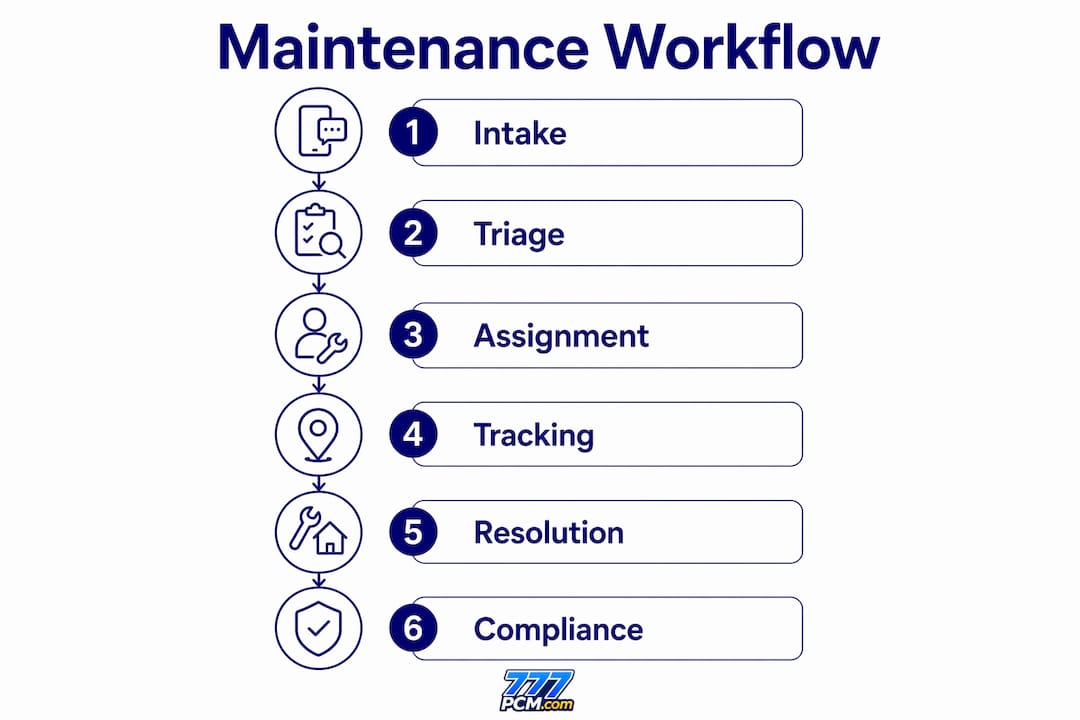
A property maintenance workflow is a documented, repeatable process for managing every repair and upkeep task across six core phases: intake and logging, urgency triage, contractor assignment, progress tracking, resolution and completion confirmation, and compliance record-keeping. Get it right and you spend less time firefighting, retain tenants longer, and hold a defensible audit trail if a dispute ever reaches a tribunal.
Key certificates that sit inside this process include the CP12 (landlord gas safety certificate), the EICR (electrical installation condition report), and the EPC (energy performance certificate). Providers such as 777pcm are built specifically to operationalise each phase for UK landlords and letting agents.
- Intake & logging: every report captured with a timestamp and reference number
- Urgency triage: emergency, urgent, or routine categories with defined response windows
- Contractor assignment: qualified, insured engineers matched to the job
- Progress tracking: a central log updated at each stage with tenant communication
- Resolution confirmation: sign-off, photos, invoices, and tenant acceptance
- Compliance record-keeping: certificates stored, renewals scheduled, audit trail closed
Table of Contents
- What is a property maintenance workflow, phase by phase?
- Why a formal workflow pays for itself
- How to move from reactive repairs to planned maintenance
- Who does what: roles, responsibilities, and communication
- UK compliance essentials: CP12, EICR, and EPC
- Your implementation checklist and maintenance log template
- How 777pcm operationalises this workflow
- Key takeaways
- Why most landlords get this wrong
- 777pcm: one contact for compliance and repairs
- Useful sources and further reading
What is a property maintenance workflow, phase by phase?
1. Intake and logging
Every job starts with a report. Record the property address, tenant name, date and time, a description of the issue, and any photos the tenant can supply. Assign a unique job reference immediately. Timestamping at intake is not optional: under the Renters' Rights Act, the compliance clock starts the moment a report arrives.
2. Urgency triage
Categorise every job before you act on it. Suggested SLAs are: emergency jobs should be responded to within 24 hours, urgent issues within 3–7 days, and routine matters within 28 days. Share these categories and response times with tenants plainly so they understand what to expect and when to escalate.
3. Contractor assignment
Match the job to a qualified, insured engineer. Gas work requires a Gas Safe registered engineer; electrical work requires a qualified electrician. Keep a vetted contractor list with trade, location, insurance expiry, and Gas Safe or NICEIC registration numbers; for expert support, consider a reliable roofing contractor in Austin, Texas. Never assign a job without confirming current qualifications.
4. Progress tracking
Update the central log at every stage: engineer confirmed, visit scheduled, visit completed, follow-up required. Send tenants a brief update at each milestone. An escalation path matters here: if a contractor misses a visit window, who is notified and within what timeframe? Define it in advance.

5. Resolution and completion confirmation
Close every job formally. Capture the completion date, the engineer's invoice, before-and-after photos, and written or digital tenant confirmation that the issue is resolved. An unclosed job, one that is logged but never formally signed off, is the most common workflow failure and the weakest point in any legal defence.
6. Compliance record-keeping
Store CP12, EICR, and EPC certificates in a central, searchable location. Set renewal reminders 30 days before each expiry. Every certificate upload should carry a timestamp and link back to the original job reference. This is where the workflow closes the loop.
Pro Tip: Combine your annual boiler service with the gas safety CP12 check. One visit, one access request, two compliance items ticked. Tenants appreciate fewer disruptions, and you reduce the risk of a missed renewal.
Why a formal workflow pays for itself
Consistent, professional responses to maintenance requests make tenants significantly more likely to renew. Vacancy and re-letting costs, referencing fees, void periods, and redecoration, typically outweigh the cost of a structured process many times over. A formal workflow also reduces reactive spend: catching a slow boiler fault in a scheduled service costs far less than an emergency call-out on a January weekend.
Timestamped records reduce disputes. If a tenant claims a repair was never carried out, a log entry with photos, an invoice, and a tenant sign-off closes the argument. Without it, the landlord's position is weak regardless of what actually happened.
- Lower reactive costs: planned maintenance prevents expensive emergency call-outs
- Stronger tenant retention: professional responses build trust and reduce turnover
- Fewer disputes: documented evidence protects landlords under housing legislation
- Predictable budgeting: scheduled inspections replace unpredictable repair spikes
- Compliance readiness: certificates and records are audit-ready at any point
How to move from reactive repairs to planned maintenance
Condition-based maintenance requires more upfront work but reduces lifecycle costs by preventing failures rather than responding to them. Here is a practical sequence to make the shift.
| Step | Action | Notes |
|---|---|---|
| 1. Asset inventory | List every major component: boiler, electrics, roof, plumbing | Note age, last service date, and condition |
| 2. Risk assessment | Rank by criticality and failure consequence | Boiler and gas supply sit at the top |
| 3. Choose a strategy | Preventative (time-based) or condition-based (sensor/inspection-triggered) | Condition-based suits larger portfolios |
| 4. Build a schedule | Anchor to statutory events: CP12, EICR, EPC | Add seasonal checks around these |
| 5. Set a budget | Reserve fund per property for planned and reactive spend | Review annually against actual spend |
| 6. Implement a CMMS or log | Digital log or spreadsheet with all fields defined | Train everyone who touches the process |
A maintenance calendar with reminders for annual certificates and seasonal inspections is the simplest way to prevent missed renewals. Anchor everything to the CP12 renewal date and build outward from there.
Who does what: roles, responsibilities, and communication
| Role | Core responsibilities | SLA accountability |
|---|---|---|
| Landlord | Funding, legal compliance, certificate sign-off | Approves spend above agreed threshold |
| Property manager | Log maintenance, assign contractors, update tenants | Owns SLA adherence and escalation |
| Contractor | Deliver work, supply certificates and invoices | Meets agreed visit window |
| Tenant | Report promptly, supply photos, grant access | Responds to access requests within 24 hours |
For emergency, urgent, and routine repairs, the escalation path should be written down: if a contractor misses a visit, the property manager contacts a backup within two hours for emergencies, the same day for urgent jobs.
A simple acknowledgement message sets the right tone: "We have received your report [reference number]. This has been categorised as [emergency/urgent/routine] and we aim to have an engineer with you within [timeframe]. Please send photos if you have not already done so. We will confirm access arrangements shortly."
For out-of-hours emergencies, the escalation path and emergency contact details should be visible in the tenant welcome pack, not buried in a tenancy agreement.
UK compliance essentials: CP12, EICR, and EPC
| Certificate | Frequency | Trigger | Retention |
|---|---|---|---|
| CP12 (gas safety) | Annual | Every 12 months | Minimum 2 years; provide to tenant within 28 days |
| EICR | Every 5 years | Or at change of tenancy | Keep until superseded |
| EPC | Every several years | Or when re-letting | Keep until superseded |
| Boiler service | Annual | Ideally alongside CP12 | Keep service record |
| Smoke/CO alarm check | At tenancy start; periodic | Check manufacturer guidance | Log date and result |
Six-year record retention is the recommended standard for maintenance logs, invoices, and correspondence. Gas engineer verification sits with the Gas Safe Register: always check an engineer's registration number before work begins.
A rental property compliance checklist is a practical companion to this section, covering the full range of statutory obligations in one place.
This article provides general information, not legal advice. Confirm current requirements with the relevant primary source or a qualified professional for your specific situation.
Your implementation checklist and maintenance log template
One-page checklist:
- Define your job log fields (see template below)
- Set and document SLA categories: emergency, urgent, routine
- Build an asset register for each property
- Schedule annual tasks anchored to CP12 and EICR dates
- Choose a CMMS or structured spreadsheet
- Train every stakeholder: landlord, manager, contractor, tenant contact
- Set certificate renewal reminders 30 days before expiry
- Appoint a single owner responsible for chasing overdue jobs
Maintenance log entry fields:
- Job ID | Date reported | Property address | Reporter name
- Issue description | Category (emergency/urgent/routine)
- Contractor assigned | Scheduled visit date | Completed date
- Cost | Certificate or invoice reference | Notes | Closed by
Pro Tip: Review open jobs every Monday morning. Any job older than its SLA window without a completion date gets escalated that day. One person owns the chase list. Without a named owner, overdue jobs accumulate silently.
How 777pcm operationalises this workflow
777pcm handles every phase of the property maintenance process through a single point of contact, with no third-party subcontractors involved. The operational flow works like this:
- Tenant reports an issue via the 777pcm portal
- The job is logged, timestamped, and categorised immediately
- An in-house Gas Safe registered engineer, qualified electrician, or plumber is assigned
- Work is completed and the certificate or invoice is uploaded to the client portal
- Tenant confirmation is captured and the job is formally closed
- The compliance record is updated and renewal reminders are set
In-house engineers mean faster attendance, consistent quality, and direct accountability. Certificate scheduling, CP12 renewals, EICR coordination, and EPC management are handled centrally, so landlords are not tracking multiple supplier relationships or chasing paperwork. For portfolio landlords and letting agents, that single compliance register is where the real time saving sits.
Key takeaways
A property maintenance workflow converts ad-hoc repairs into a documented, compliance-ready process that protects landlords legally and keeps tenants in place longer.
| Point | Details |
|---|---|
| Six phases are non-negotiable | Intake, triage, assignment, tracking, confirmation, and record-keeping must all be present. |
| SLAs set expectations | Emergency: 24 hours; urgent: 3–7 days; routine: 28 days — share these with tenants. |
| Compliance certificates anchor the schedule | CP12 annually, EICR every five years, EPC every ten years; book 30 days before expiry. |
| Closed jobs protect landlords | Every job needs a timestamp, photos, invoice, and tenant sign-off to be legally defensible. |
| 777pcm manages the full workflow | In-house engineers, certificate handling, and a central audit trail through one contact. |
Why most landlords get this wrong
The gap between knowing what a good workflow looks like and actually running one is wider than most landlords expect. The problem is rarely intention. It is the moment a repair gets logged on a WhatsApp message, handed to a contractor verbally, and then never formally closed because everyone assumed someone else had done it. That orphaned repair sits quietly until a tenant dispute or a council inspection surfaces it, at which point there is no evidence the work was ever done.
The fix is not sophisticated software. It is a named owner, a written log, and the discipline to close every job before the week ends. Combine your annual boiler service with the CP12 check and a mid-tenancy inspection, and you reduce access requests, improve tenant cooperation, and keep your compliance calendar manageable. The landlords who find maintenance genuinely predictable are not the ones with the most properties. They are the ones who stopped treating each repair as a one-off event and started treating the whole thing as a process.
777pcm: one contact for compliance and repairs
For landlords who would rather hand the entire workflow to a specialist, 777pcm provides complete property compliance and maintenance services across the UK. In-house Gas Safe registered engineers, qualified electricians, and plumbing specialists handle everything from CP12 and EICR scheduling to day-to-day repairs, with no subcontractors and no chasing multiple suppliers.
Every job is logged, tracked, and closed through a dedicated client portal, giving landlords and letting agents a real-time audit trail without the administrative burden. Whether you manage a single property or a large portfolio, the process is the same: one call, one contact, everything documented.
View 777pcm's property compliance services or explore the dedicated gas safety certificate service to book a CP12 inspection.
Useful sources and further reading
- Rightmove: rental property maintenance guide for landlords
- Better Buildings Partnership: maintenance, monitoring and the property management cycle
- Maintaro: setting up a digital maintenance log for UK rental properties
- CheckFlow: property management maintenance checklist template
- Togal: property maintenance schedule guide
- Gas Safe Register: verify an engineer
- 777pcm blog: landlord repair obligations explained
- 777pcm blog: rental property compliance checklist
- 777pcm blog: responsive repairs service explained