
A responsive repairs service is a maintenance system that addresses repair needs in a rental property as they arise, covering both urgent emergencies and routine faults. Known formally as reactive maintenance, it sits at the heart of a landlord's legal duty to keep tenants safe and properties habitable. Under Section 11 of the Landlord and Tenant Act 1985, landlords must maintain the structure, exterior, and essential installations, including plumbing, heating, and electrics, in good repair. The Housing Health and Safety Rating System (HHSRS) and local councils provide the regulatory framework that enforces these obligations. For property owners and tenants alike, understanding what a responsive repairs service covers is the first step to staying safe and legally protected.
What types of repairs are included in a responsive repairs service?
A responsive repairs service covers two broad categories: emergency repairs and routine repairs. Each has distinct response time expectations and triggers different obligations for landlords.
Emergency repairs are those that pose an immediate risk to life or property. Emergency repairs require attendance within 2–4 hours. That window exists because delays in these situations can cause serious harm or significant property damage. Common emergency scenarios include:
- Gas leaks or suspected carbon monoxide exposure
- Severe water leaks or burst pipes affecting the structure
- Total loss of heating in winter months
- Electrical faults creating a fire or shock risk
- Structural failures such as a collapsed ceiling
Routine repairs are less urgent but still require a prompt response. These are typically scheduled within 24–48 hours of the tenant reporting the issue. Examples include a faulty boiler, a broken window latch, a leaking tap, or a damaged door lock. You can read more about rental plumbing issues that commonly fall into this category.
The key distinction between responsive repairs and planned maintenance is timing. Responsive repairs react to a fault that has already occurred. Planned maintenance anticipates faults before they happen, such as an annual boiler service or a scheduled roof inspection. A well-managed property uses both approaches together, not one in isolation.
How does a responsive repairs service work?
The process begins the moment a tenant identifies a fault. Clear, documented reporting is the foundation of an effective repair process.
- Tenant reports the issue. Tenants should report repairs in writing with photographs and a clear description of the problem. Written records protect both parties if a dispute arises later.
- Landlord acknowledges and assesses. The landlord or managing agent reviews the report and determines whether the fault is an emergency or routine repair. This triage step sets the response timeline.
- Contractor or engineer is dispatched. For emergency repairs, attendance must happen within 2–4 hours. For routine faults, the landlord schedules a visit within 24–48 hours.
- Investigation and repair plan. From November 2026, landlords must investigate serious hazards within 10 working days, provide a written repair plan within 3 days of completing the investigation, and complete urgent safety work within 5 days after that investigation.
- Repair is completed and documented. The landlord records the work done, the engineer who completed it, and the date. This documentation supports compliance records.
Key legal fact: Landlords cannot contract out of their repairing obligations under Section 11. Any tenancy clause attempting to shift these duties to the tenant is legally unenforceable.
Since June 2026, local councils can issue fines of up to £7,000 for landlords who ignore Category 1 hazards such as serious damp or mould. That figure reflects the government's intent to treat non-compliance as a financial risk, not just a reputational one. Councils also hold enforcement powers to issue improvement notices and, in serious cases, carry out remedial works themselves and charge the costs directly to the landlord.
Pro Tip: Keep a dedicated repairs log for each property. Record every tenant report, every site visit, and every completed repair with dates. This single habit is your strongest defence against council enforcement action.
Why are responsive repairs services essential?
A responsive maintenance service protects three things simultaneously: tenant safety, property value, and the landlord's legal standing. Neglecting any one of these creates a chain reaction that affects the others.
"A small roof leak left unaddressed for six weeks can become a structural repair costing ten times the original fix. Speed is not just a courtesy. It is a cost-control strategy."
The table below compares the three main maintenance approaches and their practical implications for rental properties.
| Approach | Trigger | Timing | Risk if overused |
|---|---|---|---|
| Responsive repairs | Fault reported by tenant | 2–48 hours depending on severity | Higher emergency costs if no planned work runs alongside |
| Reactive maintenance | Fault causes visible failure | Variable, often delayed | Frequent emergencies, collateral damage, tenant dissatisfaction |
| Planned preventative maintenance | Scheduled inspection calendar | Weeks or months in advance | Misses sudden faults between scheduled visits |
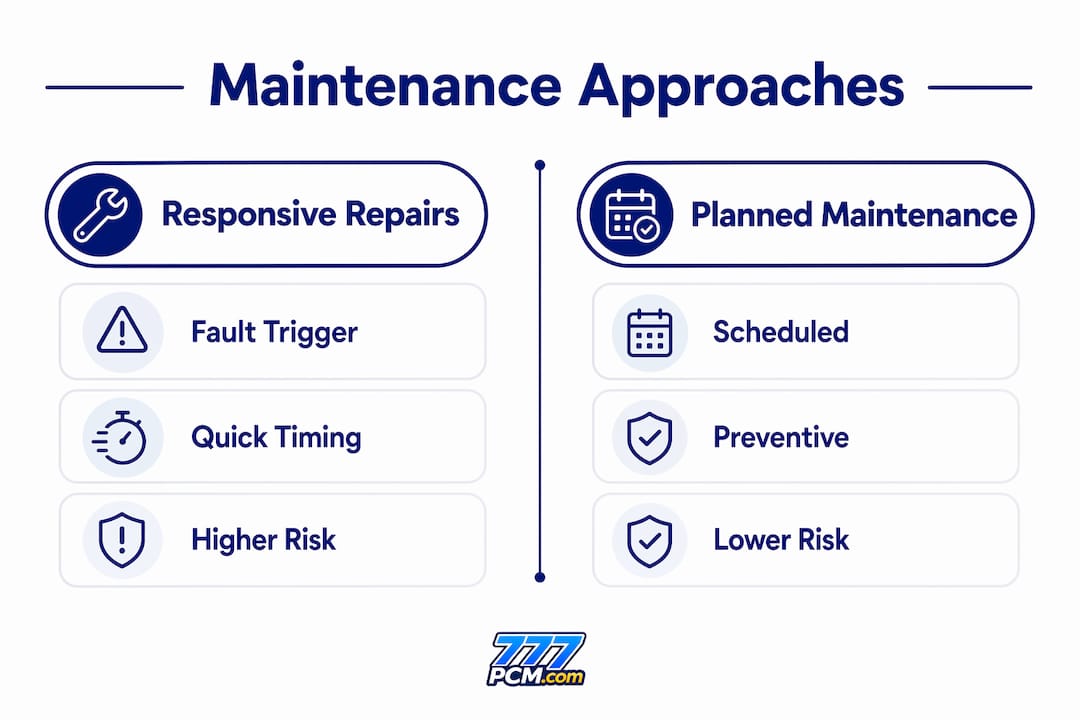
Relying solely on reactive repairs causes more frequent emergencies, higher service fees, and collateral damage to surrounding property fabric. That finding matters because many landlords treat responsive and reactive as interchangeable terms. They are not. Responsive repairs include a structured reporting and response process. Pure reactive maintenance simply waits for things to break completely.
Tenant retention is another measurable benefit. Tenants who receive prompt repairs are far more likely to renew their tenancy. Void periods between tenancies are among the most significant costs a landlord faces. A reliable responsive repairs service reduces that risk directly.
How does responsive repairs differ from other maintenance approaches?
Responsive repairs and planned preventative maintenance serve different purposes, and confusing them leads to gaps in property care.
Planned preventative maintenance is proactive. It follows a fixed schedule regardless of whether a fault has appeared. Examples include annual boiler servicing, electrical installation condition reports (EICRs), and CP12 gas safety checks. These inspections often catch developing faults before they become emergencies.
Responsive repairs fill the gaps between planned visits. A boiler that passes its annual service in March may still develop a fault in october. A responsive repairs service handles that october failure promptly, without waiting for the next scheduled inspection.
The cost difference between the two approaches is significant. Emergency call-outs carry premium labour rates, often two to three times the cost of a scheduled visit. Parts sourced urgently also carry higher prices. Planned maintenance spreads these costs predictably across the year.
- Relying only on responsive repairs increases the frequency of expensive emergency call-outs
- Relying only on planned maintenance leaves sudden faults unaddressed between scheduled visits
- The most cost-effective approach combines both, using planned maintenance to reduce the volume of responsive repair requests
Pro Tip: Review your repair logs quarterly. If the same fault type keeps appearing, it signals a planned maintenance gap rather than bad luck. Address the root cause with a scheduled fix, and your emergency call-out costs will fall.
For out-of-hours emergencies, having a clear protocol in place before a fault occurs is the difference between a resolved issue and a flooded flat at 2AM. Landlords who pre-agree emergency contractor arrangements with their managing agent avoid the most expensive and disruptive scenarios.
Key takeaways
A responsive repairs service is the legal and practical foundation of safe rental property management, combining prompt fault response with clear landlord obligations under the Landlord and Tenant Act 1985 and 2026 regulatory standards.
| Point | Details |
|---|---|
| Legal obligation is fixed | Section 11 of the Landlord and Tenant Act 1985 requires landlords to maintain structure, exterior, and essential installations. |
| Response times are statutory | Emergency repairs require attendance within 2–4 hours; routine repairs within 24–48 hours. |
| Non-compliance carries financial risk | Councils can fine landlords up to £7,000 for unaddressed Category 1 hazards since june 2026. |
| Responsive repairs need planned maintenance alongside | Relying solely on reactive repairs leads to higher long-term costs and more frequent emergencies. |
| Documentation protects both parties | Written repair records and tenant reports are the strongest defence in any compliance dispute. |
A landlord's biggest blind spot in property maintenance
The most common mistake I see landlords make is treating responsive repairs as their entire maintenance strategy. They wait for the phone to ring, send someone out, fix the fault, and consider the job done. That approach works until it doesn't, and when it fails, it fails expensively.
What I have found over years of working in property compliance is that the landlords with the lowest repair costs are not the ones who respond fastest to emergencies. They are the ones who have reduced the number of emergencies in the first place. They run annual gas safety checks, schedule EICRs on time, and service their boilers before winter. Their responsive repairs service handles the genuinely unpredictable faults, not the ones that were always going to happen.
The 2026 regulatory changes have sharpened this issue considerably. The new investigation and repair plan timescales are not difficult to meet if you already have a process in place. They become very difficult if you are managing repairs informally, without records, and without a reliable contractor network. The landlords who will struggle most with the new rules are those who have been treating compliance as an afterthought.
My honest advice: build your responsive repairs process around documentation first. Know who your emergency contacts are, how tenants report faults, and where your records are stored. That structure costs almost nothing to set up and protects you from the scenarios that cost everything.
— Mike
How 777pcm supports landlords with responsive repairs
Property compliance and responsive maintenance are two sides of the same coin, and 777pcm manages both for landlords and letting agents across the residential rental sector.

777pcm's VIP Fast Response service covers urgent plumbing, heating, drainage, and electrical repairs, with in-house Gas Safe registered engineers and certified electricians handling call-outs directly. No third-party subcontractors mean faster attendance, clearer accountability, and consistent quality. For landlords managing multiple properties, 777pcm also handles CP12 gas safety certificates, EICRs, and the full rental compliance checklist that the 2026 regulations demand. If you want a single point of contact for both responsive repairs and planned maintenance, 777pcm is built precisely for that.
FAQ
What is a responsive repairs service in a rental property?
A responsive repairs service is a maintenance system that addresses faults in a rental property as they are reported, covering both emergency and routine repairs. It is the primary mechanism through which landlords meet their legal duty to keep properties safe and habitable.
How quickly must a landlord respond to a repair request?
Emergency repairs require attendance within 2–4 hours. Routine repairs should be addressed within 24–48 hours of the tenant's report, with serious hazards investigated within 10 working days under 2026 regulations.
What happens if a landlord ignores a repair request?
Local councils can issue fines of up to £7,000 for landlords who fail to address Category 1 hazards. Councils also hold powers to carry out remedial works themselves and recover the costs from the landlord.
What is the difference between responsive and planned maintenance?
Responsive repairs address faults after they occur. Planned maintenance follows a fixed schedule to prevent faults from developing. Both approaches are needed for cost-effective, compliant property management.
Can a landlord make a tenant responsible for repairs in the tenancy agreement?
No. Landlords cannot contract out of their repairing obligations under Section 11 of the Landlord and Tenant Act 1985. Any clause attempting to transfer these duties to the tenant is legally unenforceable.