
The moment one tenant hands back the keys and another picks them up is where most landlords slip. Stay compliant between tenancy changeovers by working through one sequence: serve the required written information, confirm the deposit is protected and re-issued with fresh Prescribed Information, check that your CP12, EICR, EPC and alarms are all in date, run right-to-rent checks on the incoming tenant, complete a signed inventory at both ends, record any refunds with a written waiver, and book remedial works before the new tenancy starts.
Miss any one of these and the consequences aren't hypothetical. An unprotected deposit can cost you up to three times its value in compensation, an expired gas certificate is a criminal offence, and an unserved Renters' Rights Act Information Sheet can undermine your position later if you ever need to rely on possession grounds.
- Provide the required written statement of terms before the tenancy begins.
- Confirm deposit protection and reissue Prescribed Information where the tenancy changes.
- Verify CP12, EICR, EPC, and smoke/CO alarms are current.
- Run right-to-rent checks on every new adult occupant.
- Complete signed, dated inventories at check-out and check-in.
- Document refunds with a signed waiver from any outgoing tenant.
- Schedule remedial works and cleaning ahead of the new move-in date.
Bodies like the Tenancy Deposit Scheme and gov.uk publish the procedural detail behind each of these steps, and 777pcm can handle the certification and remedial side of the list end-to-end if you'd rather not chase engineers yourself.
Key Takeaways
Staying compliant between tenancy changeover depends on treating deposit protection, safety certification, and written tenant information as one linked sequence, not separate afterthoughts.
| Point | Details |
|---|---|
| Deposit protection is time bound | Protect deposits and serve Prescribed Information within 30 days to avoid compensation claims of up to three times the deposit. |
| Joint-tenancy changes need formality | End and regrant, or follow your scheme's official changeover procedure, never an informal cash refund between tenants. |
| Safety certificates gate everything | CP12, EICR, EPC and alarm checks must be current before a new tenant moves in. |
| 2026 deadlines are fixed | Serve written statements for new APTs from 1 May 2026 and the Information Sheet to existing tenancies by 31 May 2026. |
| Outsourcing reduces coordination risk | 777pcm manages certification and remedial works in-house, cutting the scheduling gaps that cause void periods. |
Table of Contents
- Handling deposit changeovers and joint-tenancy leave events
- Documents and certificates to have ready before move-in
- Inventories and inspections: the evidence that protects you
- Serving written statements and the Information Sheet
- Right-to-rent checks and record retention at changeover
- Cleaning, repairs and remedial works at changeover
- Practical timeline and costs for a compliant changeover
- How 777pcm handles compliance at changeover
- Why most changeover checklists miss the point
- Get changeover compliance handled without the juggling
- Sources
Handling deposit changeovers and joint-tenancy leave events
Deposits cause more changeover disputes than anything else, particularly in shared houses where one tenant leaves and another arrives mid contract. You have two compliant routes, and picking the wrong one is how landlords end up personally liable for money that was never properly protected.
The clean option is to end the existing tenancy and grant a new one to the remaining and incoming tenants together. The alternative is a formal changeover within your deposit scheme, which custodial schemes generally support directly, while insured schemes usually require you to end protection on the old deposit and re-protect the new one. TDS guidance on joint tenancy disputes is blunt about this: informal cash refunds between tenants, arranged without the landlord's involvement, are the single biggest cause of adjudication problems when the tenancy eventually ends.
- Confirm the change in writing with all parties, remaining and outgoing.
- Calculate the outgoing tenant's proportional share of the deposit.
- Get a signed waiver or release form from the outgoing tenant before releasing any funds.
- Update the deposit registration and issue fresh Prescribed Information to the new tenant group.
- Re-protect within the statutory window if the scheme requires ending and restarting protection.
TDS's own change-of-sharers guidance sets out this sequence step by step, including how to apportion refunds fairly between sharers.
Pro Tip: Keep a dated paper trail for every deposit conversation, even a two-line email confirming who agreed to what. Adjudicators lean heavily on written evidence when a dispute reaches them months later.
Documents and certificates to have ready before move-in
A new tenant moving in without valid safety paperwork exposes you to civil penalties and weakens your legal footing if you ever need possession later. Before handing over keys, confirm:
- CP12 gas safety certificate, valid for 12 months, with a copy given to the tenant at the start of the tenancy.
- EICR, valid for five years, confirming the electrical installation is safe.
- EPC, where applicable, showing the property's energy rating.
- Smoke alarms on every storey and carbon monoxide alarms in any room with a fixed combustion appliance.
Deposit protection itself carries a strict clock: once you've taken a deposit, gov.uk requires you to protect it and serve Prescribed Information within 30 days. Miss that window and you can be ordered to pay the tenant between one and three times the deposit amount, on top of losing the ability to serve certain possession notices. Build a tenant-facing compliance pack, gas certificate, electrical report, EPC, and deposit paperwork, and keep certified copies on file for at least six years in case of an audit or dispute. A rental property compliance checklist is worth working through room by room before any new tenancy starts.
Inventories and inspections: the evidence that protects you
Inventories aren't a legal requirement, but skipping one is one of the fastest ways to lose a deposit dispute. A comprehensive inventory covers every room, fixture and item of furniture, backed by dated, time-stamped photographs and signed by the tenant at check-in.
- Record the condition of walls, carpets, appliances, and any existing damage before keys are handed over.
- Get the tenant's signature on the inventory, not just your own notes.
- At check-out, compare against the original document line by line, distinguishing fair wear and tear from genuine damage.
- Keep every inventory, photograph and inspection report on file for at least the length of any potential claim, typically six years.
Without a signed move-in inventory, deposit disputes commonly go in the tenant's favour simply because there's nothing to prove the property's original condition. Structured check-in and check-out inspections turn a subjective argument into a documented fact.
Serving written statements and the Information Sheet
From 1 May 2026, every new private tenancy in England is an Assured Periodic Tenancy, fixed terms are no longer permitted, and landlords must provide a written statement of terms before the tenancy starts. Separately, the Renters' Rights Act Information Sheet must be served to certain existing tenancies by 31 May 2026, a deadline that applies regardless of when the original tenancy began.
- Give the written statement of terms before the tenant moves in, not after.
- Check whether your existing tenancies fall within the group required to receive the Information Sheet, and serve it before the deadline.
- Keep a signed receipt or a dated email with the PDF attached as proof of delivery.
- Don't reuse legacy AST paperwork; it's no longer fit for an APT-compliant tenancy.
The statutory schedule underpinning these duties gives the Secretary of State power to prescribe the exact format, so check for updated templates rather than relying on last year's version. Failing to serve the Information Sheet on time can undermine your ability to rely on certain grounds for possession later, so treat the deadline as fixed, not advisory. A landlord legal duties guide is a useful reference if you manage multiple tenancies with different start dates.
Right-to-rent checks and record retention at changeover
Every incoming adult occupant needs a right-to-rent check before they move in, either through the Home Office's online checking service or a manual document check for those without digital status. Passports, biometric residence permits and share codes are the most common acceptable documents.
- Take dated, certified copies of every document checked, not just a note that the check happened.
- Use the Home Office online service wherever the tenant has digital immigration status; it's faster and creates its own audit trail.
- Retain records for the duration of the tenancy plus one year afterwards.
- Letting agents should keep a standard checklist and audit log so checks aren't missed under time pressure, since civil penalties for non-compliance run into thousands of pounds per illegal occupier.
Cleaning, repairs and remedial works at changeover
Outgoing tenants are generally responsible for leaving the property in a reasonably clean condition, consistent with the inventory's original standard, while landlords carry the legal duty for structural repairs, safety issues and anything covered by the Landlord and Tenant Act.
- Triage every issue found at check-out into safety-critical, functional, and cosmetic categories.
- Instruct contractors for safety-critical work immediately, since gas, electrical and structural faults can't wait for a convenient slot.
- Get written estimates before authorising any deduction from the deposit.
- Photograph completed work and keep invoices alongside the inventory as evidence for any deduction you make.
Distinguishing tenant responsibility from landlord duty early avoids arguments later; a tenant safety responsibility checklist helps set that line clearly before disputes start.
Practical timeline and costs for a compliant changeover
A CP12 gas safety visit typically takes under an hour once an engineer is on site, but booking lead times run from same-day to a week depending on demand. EICRs take longer, often two to three hours for a typical flat, and EPCs a similar window. Build in a few days' buffer either side of a changeover date rather than assuming certificates will land exactly when you need them.
- Gas safety checks: usually booked within a week; same-day emergency slots often available at a premium.
- EICRs: typically require several days' notice, longer for larger or older properties.
- Minor remedial works and deep cleaning: budget several days between check-out and the next move-in.
- Always sequence statutory safety work first; leave cosmetic touch-ups for after keys change hands if the delay is genuinely minor and safe.
Rushing certification to save a day of void period is the false economy that leads to fines. A short, planned buffer costs far less than a botched changeover.
How 777pcm handles compliance at changeover
Coordinating a Gas Safe engineer, an electrician for the EICR, an EPC assessor and a repairs contractor across one changeover window is where most landlords lose days to scheduling conflicts. 777pcm runs all of it in-house, Gas Safe registered engineers, certified electricians and plumbing specialists, through one portal, so CP12, EICR, EPC and remedial works are booked, tracked and certified without juggling separate subcontractors.
- CP12, EICR and EPC management with in-house engineers, not subcontracted third parties.
- Remedial works, plumbing, heating, and general repairs scheduled through a single account manager.
- Portfolio-level portal access for tracking certificate expiry across multiple properties.
Before appointing any compliance provider, ask who actually carries out the work, how quickly they can turn round an expired certificate, and whether paperwork lands in one place or several. A switching guide for compliance providers sets out the right onboarding questions if you're weighing up a change.
Pro Tip: Ask any prospective provider how many trades they employ directly versus subcontract. Direct employment usually means faster booking and one point of accountability when something goes wrong.

Why most changeover checklists miss the point
Most landlord guidance treats changeover compliance as a paperwork exercise: tick the certificate, file the form, move on. That misses what actually causes disputes and penalties, which is timing, not documentation. A landlord who has every certificate but serves it a week late is in a worse position than one who chased a contractor for an extra day to get the sequence right.
The 2026 reforms make this sharper, not softer. Fixed terms are gone, the Information Sheet deadline is fixed, and there's no informal workaround for joint-tenancy deposit changes anymore. The temptation is to treat these as separate admin tasks handled by different people, the letting agent does the paperwork, the landlord chases the gas engineer, nobody owns the whole sequence.
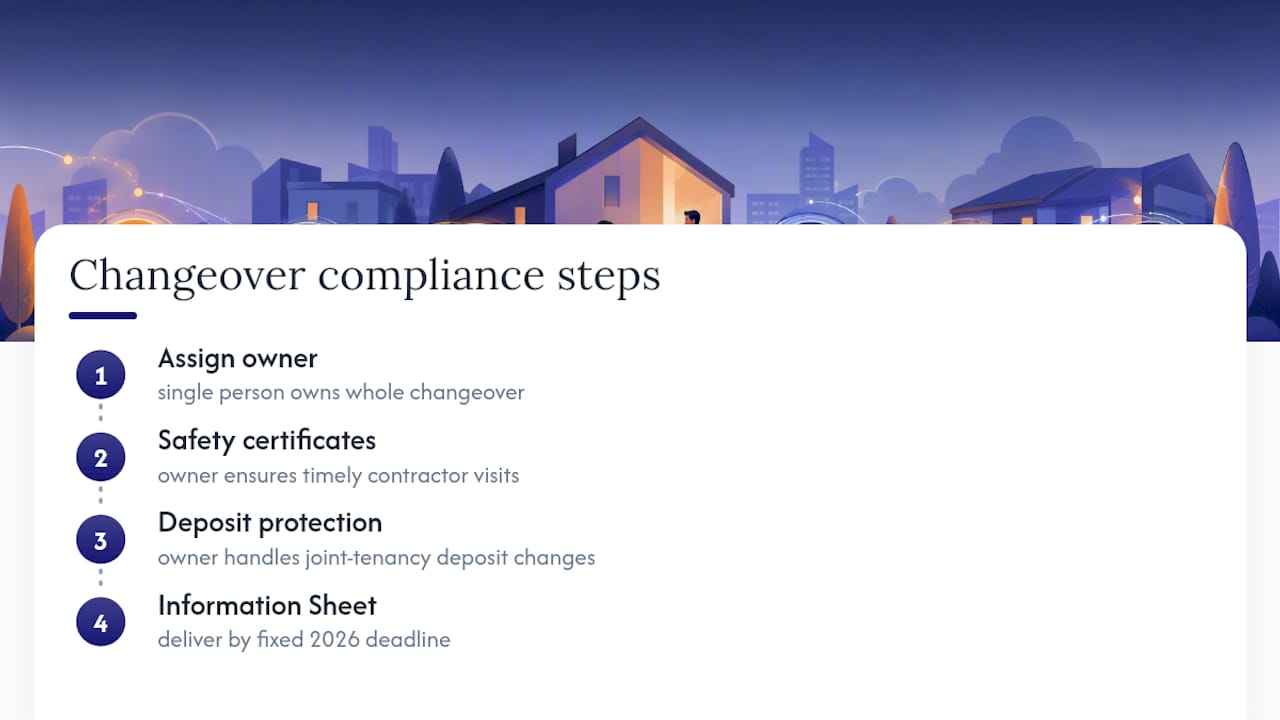
That's the gap worth closing first. Before worrying about which template to use, decide who owns the changeover from end to end, and make sure that person has visibility over every deadline, not just the ones in their part of the job.
Get changeover compliance handled without the juggling
777pcm exists for exactly the gap described above: one provider, in-house Gas Safe engineers, certified electricians and plumbing specialists, handling CP12, EICR, EPC and remedial works so nothing falls through the cracks between one tenant leaving and the next arriving.

Rather than booking three separate contractors and hoping their diaries align before your changeover date, you get one point of contact who schedules the whole job and delivers certification and repairs together. That matters most at changeover, when every extra day of coordination is a day added to your void period. If you manage a single property or a full portfolio, 777pcm's property compliance and maintenance service covers certification and remedial works under one account. For an immediate need, book a CP12 gas safety certificate and get your next changeover moving today.