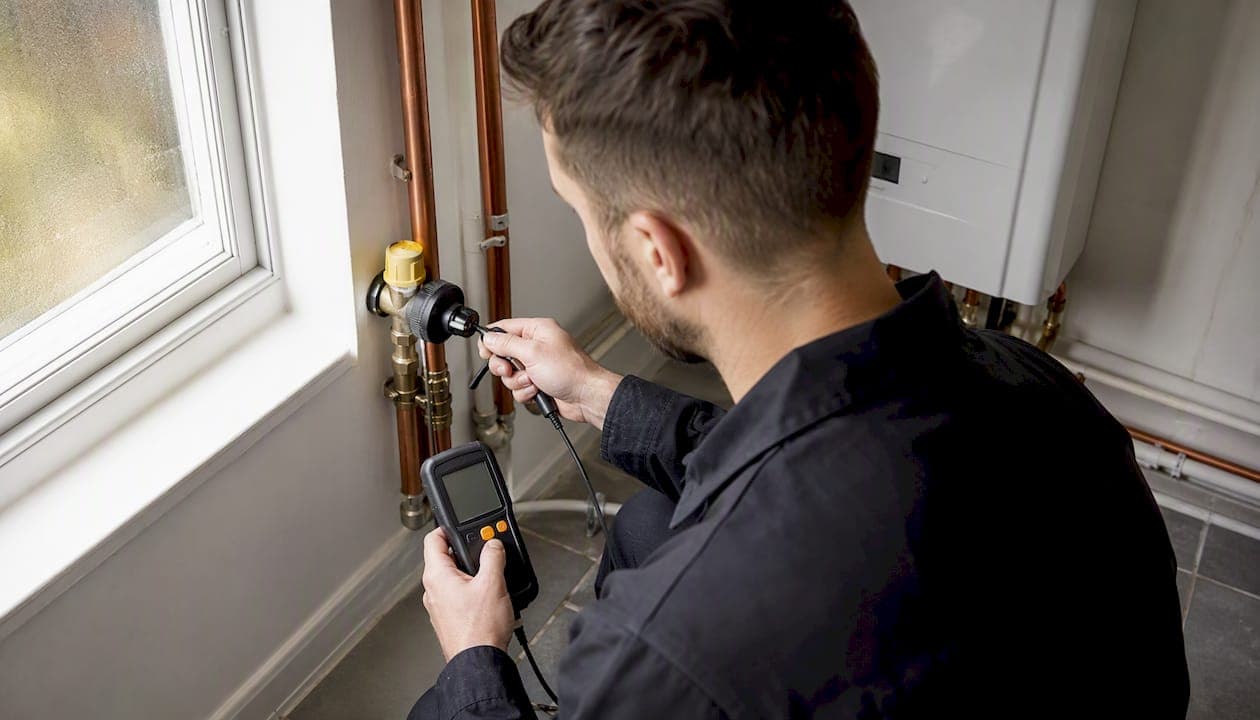
Switching your property compliance provider is safe and entirely routine, provided you secure continuous coverage for all statutory checks, obtain a verified handover pack from the outgoing provider, and appoint your new provider before the current contract ends. The critical actions are straightforward: confirm the next due dates for your gas safety certificate (CP12), Electrical Installation Condition Report (EICR), Energy Performance Certificate (EPC), and any HMO or selective licences; request the outgoing provider's full evidence pack; and schedule overlapping inspections where certificates are close to expiry.
Your first seven days after deciding to switch should cover:
- Gas safety (CP12): Confirm the current certificate is valid and note the renewal date. A Gas Safe registered engineer must carry out the annual check.
- Electrical safety (EICR): Verify the report is within its five-year period (or three years for HMOs) and that a copy is held on file.
- EPC validity and MEES status: Check the band and expiry date. Any property at band F or G cannot legally be let without a registered exemption under the Minimum Energy Efficiency Standard.
- Smoke and CO alarm records: Confirm working alarms are documented at the start of each tenancy.
- Local licensing: Verify HMO or selective licence status and check whether a transfer or new application is needed.
- Statutory tenant information: From 1 May 2026, landlords must provide tenants with written key terms for their tenancy; failure to do so can result in fines of up to £7,000.
Pro Tip: Before you serve notice on your current provider, pull every certificate from their portal or request hard copies. Providers occasionally archive records in proprietary systems that become inaccessible once a contract ends.
Key takeaways
Switching your property compliance provider carries no legal risk if you secure continuous certificate coverage, obtain a verified handover pack, and appoint your new provider before the current contract ends.
| Point | Details |
|---|---|
| Appoint before you terminate | Confirm the new provider is in place before serving notice on the outgoing one to avoid any coverage gap. |
| Verify gas and electrical certificates | Check CP12 and EICR validity against the Gas Safe and NICEIC registers independently, not just from the provider's records. |
| Arrange overlapping inspections | Schedule the new provider's first round of checks before existing certificates expire, particularly for properties due within 90 days. |
| Collect and timestamp your evidence pack | Use a consistent file naming convention and store timestamped copies of every certificate independently of the provider's portal. |
| 777pcm as your end-to-end partner | 777pcm manages CP12, EICR, and EPC certificates with in-house engineers and a landlord portal, covering the full handover and ongoing compliance cycle. |
This article is general information, not a substitute for advice from a qualified lawyer. Consult a qualified legal professional about your own circumstances before acting on anything here.
Table of Contents
- How to switch compliance providers: a timed checklist
- What documents and certificates must you collect?
- What to do on handover day
- How do you choose a reliable new compliance provider?
- What do switching costs and timelines look like?
- What are the legal risks of a poor handover?
- Why an end-to-end compliance partner reduces your risk
- A practical perspective on portfolio handovers
- 777pcm handles your compliance switch from day one
- Sources
How to switch compliance providers: a timed checklist
A structured timeline prevents the two most common handover failures: a lapsed certificate nobody noticed and a data transfer that never completed. The 90-day approach below, adapted from established property management practice, gives you a clear sequence of who does what and when.
Pre-decision (four or more weeks before switch)
- Audit all existing compliance certificates, noting expiry dates and any outstanding remedial actions.
- Review the current contract for notice periods, data-return obligations, and any exit fees.
- Collect contractor contact lists, asset registers, and access arrangements.
- Check insurance policies to confirm no compliance-related cover gaps arise during transition.
Two to four weeks before the switch
- Appoint the new provider formally and agree a start date that overlaps with the current contract by at least one week.
- Instruct urgent remedial works if any certificate is within 60 days of expiry.
- Confirm the new provider's portal setup and data-import process.
Handover week
- Collect the full evidence pack from the outgoing provider (certificates, inspection logs, tenant records, contractor agreements).
- Confirm physical and digital access arrangements for all properties.
- Notify tenants of the new compliance contact in writing. Where the Renters' Rights Act information sheet applies, serve it by 31 May 2026 for existing tenancies.
- Transfer or securely export portal data, passwords, and CAFM records.
Days 1–30: stabilise
- Verify certificate authenticity against Gas Safe and NICEIC registers.
- Re-run any borderline checks where records are incomplete or near expiry.
- Update your compliance tracker and agree a reporting cadence with the new provider.
Days 31–90: embed
- Conduct a full audit of planned preventative maintenance (PPM) schedules.
- Review contractor performance against agreed SLAs.
- Obtain a written sign-off report from the new provider confirming all properties are compliant.
| Task | Responsible | Target date |
|---|---|---|
| Audit certificates and contracts | Landlord / outgoing provider | Week minus 4 |
| Appoint new provider | Landlord | Week minus 2 |
| Instruct urgent remedial works | New provider | Week minus 2 |
| Collect full evidence pack | Outgoing provider | Handover week |
| Notify tenants, serve statutory documents | Landlord / new provider | Handover week |
| Verify certificates against registers | New provider | Days 1–7 |
| Full compliance tracker updated | New provider | Days 1–30 |
| PPM schedule audit | New provider | Days 31–90 |
| Written sign-off report | New provider | Day 90 |
Pro Tip: Ask the outgoing provider to confirm in writing that all data has been returned and that they hold no further copies of tenant personal data. This satisfies your GDPR obligations as data controller.
What documents and certificates must you collect?
This is where most handovers go wrong. Landlords assume the outgoing provider will volunteer everything; they rarely do without a formal request. Below is every legally required item, what the law says, what to request, and what to keep in your evidence pack.
Gas safety (CP12)
What the law requires: An annual gas safety check by a Gas Safe registered engineer, with a copy of the certificate given to existing tenants within 28 days and to new tenants before they move in.
Request from outgoing provider: The most recent CP12, the engineer's Gas Safe registration number, and any remedial action records.

Evidence pack: Store the certificate with the date of issue, engineer ID, and property address. Keep records for at least two years.
Electrical safety (EICR and PAT)
What the law requires: An EICR every five years for most private rented properties (three years for HMOs), carried out by a qualified electrician. A copy must be given to tenants and to the local authority on request within 28 days.
Request from outgoing provider: The current EICR, any C1 or C2 remedial action records, and PAT test logs where portable appliances are provided.
Evidence pack: Retain the EICR with the inspector's qualifications noted (NICEIC or equivalent), the date, and any follow-up works completed.
EPC and MEES
What the law requires: A valid EPC (ten-year validity) with a minimum band E to let legally. The MEES guidance sets out exemptions and enforcement routes for properties that cannot reach band E.
Request from outgoing provider: The current EPC certificate number and band. Check it on the EPC register independently.
Immediate action if below band E: Register an exemption or commission improvement works before re-letting. Budget and lead times for this are covered in the costs section below.
Fire safety
What the law requires: Working smoke alarms on every storey and a CO alarm in any room with a solid fuel appliance. Larger HMOs require a fire risk assessment.
Request from outgoing provider: Alarm test records, fire risk assessment (where applicable), and any remedial action logs.
Evidence pack: Photograph alarm locations and retain test records with dates.
HMO and selective licensing
What the law requires: A mandatory HMO licence for properties with five or more occupants from two or more households. Many councils also operate selective licensing schemes.
Request from outgoing provider: Current licence number, expiry date, and any conditions attached.
Action on switch: Check with the local authority whether the licence transfers automatically or requires a new application. Some councils require notification of a change in managing agent.
Right to Rent, deposit protection and prescribed information
What the law requires: Right to Rent checks must be documented and retained. Deposits must be protected in a government-approved scheme within 30 days, with prescribed information served on the tenant.
Request from outgoing provider: Copies of Right to Rent check records, deposit protection certificates, and prescribed information documents for each tenancy.
Evidence pack: Retain these for the duration of the tenancy and for at least six years after it ends.
Statutory tenant information: How to Rent and Renters' Rights Act
The UKSI 2026/324 sets out the precise written terms landlords must provide for assured tenancies, including landlord and tenant names, property address, rent, deposit details, notice periods, and statutory obligations. For tenancies created on or after 1 May 2026, this written statement is mandatory at the outset. For existing tenancies, the Renters' Rights Act information sheet must be served by 31 May 2026.
Key compliance point: The written tenancy information requirement is not optional. Fines of up to £7,000 apply for non-compliance, and councils now have strengthened powers to investigate and pursue rent repayment orders under the Renters' Rights Act 2026.
What to do on handover day
Handover day is an operational event, not a formality. Treat it as a structured mobilisation and you will avoid the gaps that create liability.
- Collect all physical and digital certificates from the outgoing provider. Confirm receipt in writing, listing each document by property address and certificate type.
- Receive the asset register covering all properties: appliances, boilers, electrical panels, alarm systems, and any specialist equipment.
- Obtain contractor contracts and warranties for any ongoing works or service agreements.
- Collect keys and access lists for all properties, including communal areas and meter cupboards.
- Transfer portal and CAFM access. If the outgoing provider uses a proprietary system, arrange a secure data export in a portable format (CSV or PDF). Confirm deletion of your data from their systems in writing.
- Notify tenants. Send a written notification to each tenant confirming the new compliance contact, the date of change, and any upcoming inspection dates. Include the new emergency contact number.
- Complete GDPR steps. As data controller, confirm the outgoing provider has returned or destroyed all tenant personal data and that the new provider has signed a data processing agreement.
File naming and folder structure for your evidence pack
A consistent naming convention makes audit responses straightforward. A practical folder structure:
/[Property Address]/Gas Safety/CP12_[YYYY-MM-DD]_[EngineerID].pdf/[Property Address]/Electrical/EICR_[YYYY-MM-DD]_[InspectorRef].pdf/[Property Address]/EPC/EPC_[YYYY-MM-DD]_[CertificateNumber].pdf/[Property Address]/Fire Safety/AlarmTest_[YYYY-MM-DD].pdf/[Property Address]/Tenancy/DepositProtection_[TenantSurname]_[YYYY-MM-DD].pdf
Timestamp every file on receipt. Where documents arrive by email, forward the email to a dedicated compliance inbox so the received date is preserved automatically.
Tenant notification: a short template
How do you choose a reliable new compliance provider?
The provider you appoint carries significant legal weight. A weak handover commitment or absent in-house capability can leave you exposed even when you believe you are covered. Here is a practical due diligence checklist.
Credentials and registrations to verify
- Gas Safe registration: Ask for the company's Gas Safe registration number and verify it on the Gas Safe Register. Individual engineers must also be registered.
- Electrical qualifications: Look for NICEIC registration or equivalent for electricians carrying out EICRs.
- Public liability and professional indemnity insurance: Request certificates of insurance, not just verbal confirmation.
- Company credentials: Check Companies House registration, trading history, and any relevant trade body memberships.
Questions to ask before you appoint
- Do you use in-house engineers or subcontractors for gas and electrical work?
- What is your typical response time for urgent remedial works after a failed inspection?
- Do you provide a landlord portal with timestamped certificate storage and scheduling?
- How do you handle the handover pack from the outgoing provider?
- What is your process if a certificate expires during the transition period?
- Can you provide references from landlords with portfolios of a similar size?
- What are your cancellation terms and data-return obligations at contract end?
Contract clauses to insist on
- A formal handover obligation requiring the provider to deliver a complete evidence pack within five working days of contract end.
- Data transfer and deletion provisions compliant with UK GDPR.
- An overlap period of at least seven days where the provider will honour existing inspection bookings.
- Defined remedy timescales: C1 electrical faults within 24 hours, C2 faults within 28 days, gas safety failures immediately.
- SLAs for certificate delivery after inspection (typically within 24–48 hours).
- A minimum notice period for contract termination (typically 30–90 days).
Red flags to watch for
- No in-house engineers: reliance entirely on subcontractors reduces accountability and slows remedial response.
- Missing proof of Gas Safe or NICEIC registration.
- Vague or absent handover commitments in the contract.
- No portal or audit trail for certificate storage.
- Reluctance to provide references or insurance certificates.
Providers that operate with in-house engineers and a dedicated landlord portal give you a single point of accountability and a timestamped evidence trail that holds up in tribunal or council enforcement proceedings.
Pro Tip: Run a small test before committing: ask the prospective provider to describe their process for handling a failed EICR on a tenanted property. A confident, specific answer (C1 isolation within 24 hours, written notification to tenant, remedial quote within 48 hours) tells you far more than a brochure.
What do switching costs and timelines look like?
Budgeting for a provider switch requires accounting for both the standard certificate costs and the possibility of remedial works identified during the transition audit. Regional variation is real, particularly between London and the rest of England, so treat the ranges below as a guide rather than a fixed price.
- CP12 (gas safety certificate): Typically £60–£120 per property for a standard annual check. Emergency or out-of-hours bookings carry a premium.
- EICR: Typically £100–£300 depending on property size and number of circuits. Larger HMOs sit at the upper end.
- EPC: Typically £60–£120. Properties requiring improvement works before re-letting will incur additional costs for insulation, heating upgrades, or other measures.
- Remedial works: Costs vary widely. A C2 electrical fault might require £150–£500 of remedial work; a boiler replacement can run to £2,000–£3,500.
For portfolio landlords, bulk booking with a single provider typically reduces per-unit certificate costs and avoids the premium pricing that comes with urgent, last-minute bookings. A planned overlap of inspections, where the new provider carries out the next round of checks before the outgoing provider's certificates expire, also removes the risk of a gap period entirely.
| Certificate type | Typical cost range | Typical lead time | Notes |
|---|---|---|---|
| CP12 (gas safety) | £60–£120 | 1–5 working days | Annual; Gas Safe engineer required |
| EICR (electrical) | £100–£300 | 3 working days | 5-year cycle; 3 years for HMOs |
| EPC | £60–£120 | 2–5 working days | Ten-year validity; MEES minimum band E |
| Remedial works (minor) | £150–£500 | 1–7 working days | Varies by fault type and trade |
| Remedial works (major) | £500–£3,500+ | 1–6 weeks | Boiler replacement, rewiring, insulation |
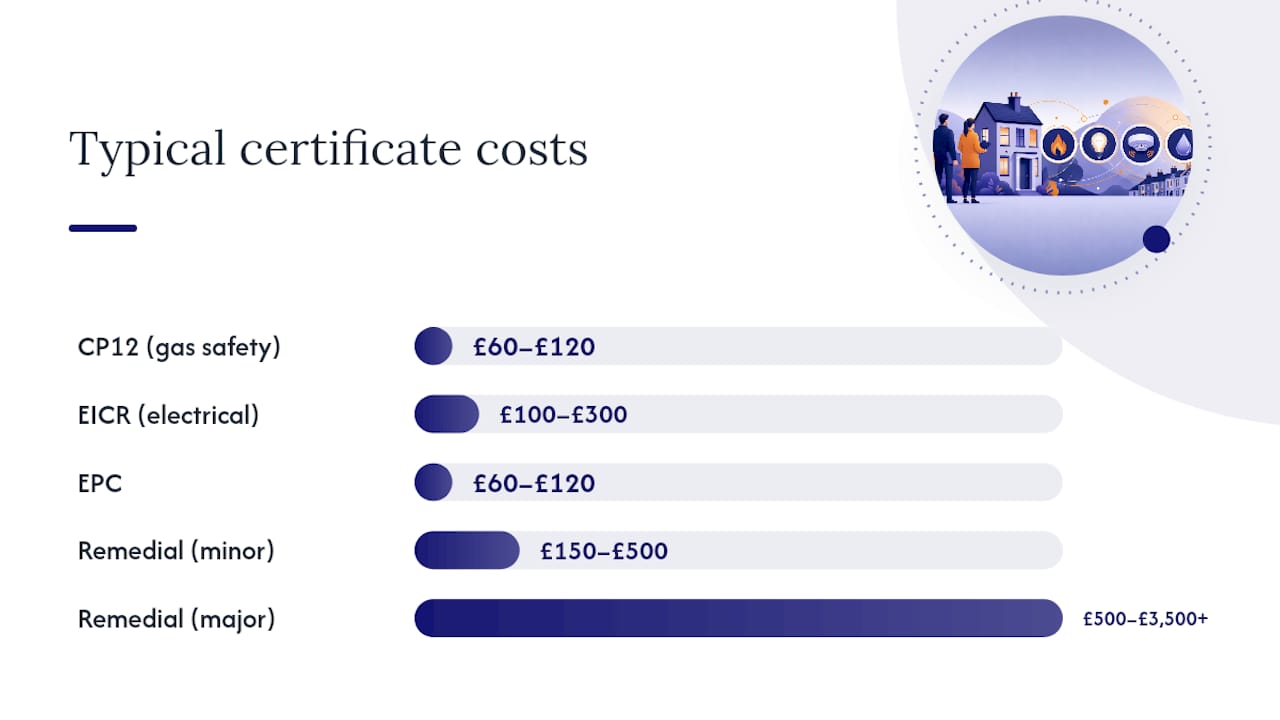
Regional variation means London landlords typically pay towards the upper end of these ranges. Always request a written quote before authorising remedial works, and confirm the engineer's qualifications before the inspection takes place.
What are the legal risks of a poor handover?
The dutyholder for statutory safety obligations is always the landlord, not the compliance provider. If a provider holds your records in a proprietary system and becomes unresponsive, you remain liable for any lapsed certificates. This is not a theoretical risk: facilities management transitions without structured handover documentation regularly produce compliance gaps that owners discover only when a council inspection or tenant complaint forces the issue.
The core legal principle: Statutory safety obligations cannot be delegated away. A landlord who relies on a provider's assurance that "everything is in order" without holding independent copies of certificates has no defence if a certificate has lapsed or a check was never carried out.
Primary risks during a provider switch
- Lapsed gas safety certificate: A criminal offence under the Gas Safety (Installation and Use) Regulations 1998. Penalties include unlimited fines and up to two years' imprisonment.
- Missing or expired EICR: Local authorities can issue remedial notices and fines. Landlords cannot serve a valid Section 8 notice if the EICR has not been provided to the tenant.
- Invalid EPC or MEES breach: Letting a property below band E without a registered exemption can result in a fine of up to £30,000 under the MEES regulations.
- Deposit protection failures: A landlord who cannot prove timely protection and service of prescribed information faces a penalty of one to three times the deposit amount and cannot serve a Section 21 notice (now abolished under the Renters' Rights Act, but deposit failures still affect possession proceedings).
- Failure to provide statutory tenancy information: Under the Renters' Rights Act, which came into force on 1 May 2026, landlords must follow new rent-increase and possession procedures. Failure to provide the required written tenancy information can result in fines of up to £7,000 per tenancy.
Common handover mistakes
- Failing to request an asset register, leaving the new provider without a complete picture of what requires compliance management.
- Incomplete asbestos or fire records for older properties, creating liability for the incoming provider and the landlord.
- Undocumented inspection histories, making it impossible to prove a check was carried out.
- Broken data transfer procedures, leaving tenant personal data in the outgoing provider's system without a deletion confirmation.
Mitigation checklist
- Conduct an immediate audit of all certificates before serving notice on the outgoing provider.
- Arrange overlapping inspections for any certificate due within 90 days of the switch date.
- Use a third-party verification step for high-risk items: check Gas Safe and NICEIC registers independently rather than relying on the provider's own confirmation.
- Obtain a signed handover sign-off document with timestamps from both the outgoing and incoming providers.
Why an end-to-end compliance partner reduces your risk
A single supplier that manages certificates, remedial works, and evidence storage removes the coordination burden that creates gaps. The service workflow for a genuine end-to-end partner looks like this: an initial audit of all properties, scheduled inspections with in-house engineers, immediate remedial quoting and works where a check identifies a failure, certificate issuance, and automatic storage in a landlord portal with timestamped records.
The practical benefits of this model are significant:
- Single point of contact for all compliance queries, inspections, and remedial works.
- Timestamped evidence packs stored in a portal accessible to the landlord, letting agent, and any authorised third party.
- Faster remedial response because in-house engineers can attend the same day in many cases, rather than waiting for a subcontractor to become available.
- Simplified audit trails that hold up in tribunal, council enforcement proceedings, or insurance claims.
- Reduced compliance gaps because the same team that identifies a fault carries out the remedial work and issues the certificate.
What to look for in a provider: In-house Gas Safe registered engineers, NICEIC-qualified electricians, a landlord portal with timestamped certificate storage, and a written handover procedure that commits to delivering a complete evidence pack within five working days of contract end. These are not premium features; they are the baseline for a provider that takes compliance seriously.
777pcm operates exactly this model: in-house engineers across gas, electrical, and plumbing trades, CP12, EICR, and EPC management, and a dedicated landlord compliance portal that gives landlords and letting agents a real-time view of certificate status across their portfolio. For landlords managing multiple properties, the bulk-booking capability and emergency response function mean that a failed inspection rarely becomes a compliance gap.
A practical perspective on portfolio handovers
The most underestimated risk in a provider switch is not the paperwork. It is the assumption that the outgoing provider will be cooperative. In practice, some providers are slow to return data, reluctant to confirm deletion of tenant records, or simply unresponsive once notice has been served. The landlords who navigate this cleanly are the ones who started collecting their own copies of every certificate from day one, rather than relying on the provider's portal as the sole record.
Three habits that consistently save time and reduce risk in portfolio handovers:
- Adopt a consistent file naming rule from the start of any new provider relationship. The format
/[Address]/[CertType]_[YYYY-MM-DD]_[Ref].pdftakes seconds to apply and makes an audit response a matter of minutes rather than hours. - Insist on 24–48 hour certificate delivery after every inspection, in writing. Providers who cannot commit to this timeline are telling you something about their operational capacity.
- Stage contractor changes rather than switching everything at once. Move gas safety to the new provider first, confirm the process works, then transfer electrical and EPC management. This limits the blast radius if something goes wrong.
The overlap period is the single most valuable protection available during a switch. A structured first 90 days gives you time to verify records, re-run borderline checks, and build confidence in the new provider before you are fully dependent on them. Landlords who skip the overlap to save a few days of dual-provider cost almost always spend more resolving the gaps it creates.
777pcm handles your compliance switch from day one
Switching providers is straightforward when you have a team that manages the handover process alongside you. 777pcm offers a complete handover audit, rapid in-house inspections, and portal onboarding for landlords and letting agents who want the transition handled professionally.

Services available from day one of your switch:
- Full compliance audit across your portfolio (CP12, EICR, EPC, fire safety, licensing)
- In-house Gas Safe and NICEIC-qualified engineers for immediate inspections and remedial works
- Timestamped certificate storage and scheduling through a dedicated landlord portal
- Tenant communications support and statutory document preparation
- Emergency response for urgent gas or electrical failures
To get started, contact 777pcm with your property list and the next due dates for your key certificates. The team will confirm a handover timeline and prioritise any properties with certificates due within 60 days. Visit 777pcm or book a CP12 gas safety certificate to begin.