
In England from 1 May 2026, every lawful letting and every possession claim rests on one thing: documentary proof. The Renters' Rights Act abolished Section 21 for assured tenancies, which means landlords can no longer serve a no-fault notice and walk away. Instead, you must demonstrate compliance at every stage — from the moment a tenant signs to the day you apply to court. The non-negotiables are a current CP12 gas safety certificate, a valid EICR, an EPC, working smoke and carbon monoxide alarms, the Renters' Rights Act Information Sheet (or a written statement of terms), a protected deposit with prescribed information served, Right to Rent checks, and a documented repair log that satisfies Awaab's Law. Miss any one of these and you risk fines, a failed possession claim, or a rent repayment order.
Quick evidence checklist for a possession hearing:
- Up-to-date safety certificates (CP12, EICR, EPC)
- Timestamped communication log and repair invoices
- Proof of deposit protection and prescribed information served
Deadline alert: The Information Sheet must have been given to existing tenants with written agreements by 31 May 2026. Section 21 is gone — possession now requires Section 8 with full documentary evidence.
Table of Contents
- Your 2026 landlord compliance checklist at a glance
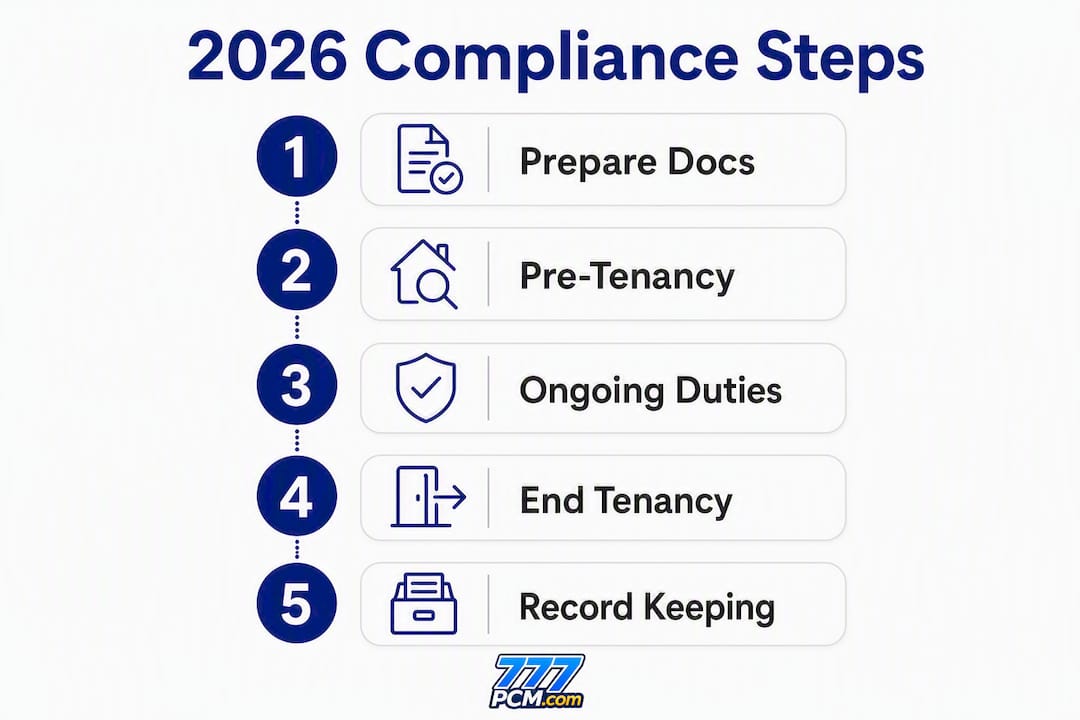
- 1. Pre-tenancy legal requirements: what you must do before day one
- 2. Ongoing responsibilities during a tenancy
- 3. End-of-tenancy duties and possession under the Renters' Rights Act
- 4. Record-keeping, certificate timelines and cost estimates
- 5. Common compliance mistakes in 2026 and how to fix them
- 6. How to run a one-day portfolio audit
- 7. Why outsource compliance and what 777pcm does for landlords
- Key takeaways
- The compliance burden has shifted — here is what that means in practice
- 777pcm: your single point of contact for 2026 compliance
- Useful sources and official guidance
Your 2026 landlord compliance checklist at a glance
Use this as your printable quick-reference. Tick each item, note the date completed, and store the evidence centrally.
Do immediately (if not already done):
- Provide the Renters' Rights Act Information Sheet to all tenants with written agreements (deadline: by the end of May 2026; fine up to £7,000 for non-provision)
- Confirm deposit is protected in an approved scheme (DPS, TDS, or MyDeposits) and prescribed information has been served
- Check all safety certificates are current and remedial work is logged
Certificate renewal cycles:
- CP12 gas safety: every 12 months
- EICR electrical: every 5 years (C1/C2 findings remediated within 28 days or the electrician's shorter stated period)
- EPC: every 10 years (must be shown before viewing)
- Smoke and CO alarm checks: at the start of each tenancy
Ongoing tasks:
- Log all repair requests with timestamps and outcomes
- Respond to damp and mould reports within 24 hours under Awaab's Law
- Prepare for PRS Database registration (expected later in 2026)
Documents to store centrally (PDF or signed hard copy):
- Signed tenancy agreement or written statement of terms
- Information Sheet (with proof of delivery)
- All safety certificates
- Deposit protection certificate and prescribed information
- Right to Rent check records
- Repair logs, photographs, and contractor invoices
1. Pre-tenancy legal requirements: what you must do before day one
Getting the paperwork right before a tenancy starts is no longer just good practice — it is a precondition for lawful possession. The MHCLG landlord checklist makes clear that failure to provide the Information Sheet or required written statement can invalidate possession actions and attract penalties up to £7,000 for non-provision.

| Task | When to complete | Documentary proof to retain | Enforcement risk if missing |
|---|---|---|---|
| Provide EPC | Before or at viewing | Signed acknowledgement or email record | Fine; cannot let without valid EPC |
| Right to Rent check | Before tenancy start | Copy of documents checked, date recorded | Civil penalty |
| Provide Information Sheet | At tenancy start (or by 31 May 2026 for existing tenancies) | Proof of delivery (email attachment, signed receipt) | Fine up to £7,000 for non-provision; weakened possession claim |
| Written statement of terms | At or before tenancy start (verbal tenancies) | Signed copy retained | Possession risk |
| Protect deposit | Within 30 days of receipt | Deposit protection certificate | Penalty; cannot serve Section 8 on deposit grounds |
| Serve prescribed information | Within 30 days of deposit receipt | Signed prescribed information form | Penalty; possession risk |
| Provide CP12 | Before tenancy start | Copy given to tenant; landlord retains copy | Fine; possession risk |
| Provide EICR | Before tenancy start | Copy given to tenant | Fine up to £30,000 |
The Information Sheet versus written statement distinction matters. Landlords with existing written agreements must provide the prescribed Information Sheet; wholly verbal tenancies require a written record of specified terms instead. Both must be delivered by 31 May 2026 for pre-existing tenancies, and at tenancy start for new ones created after 1 May 2026.
Pro Tip: Send the Information Sheet as a PDF attachment to an email — not a link to the PDF. Gov.uk guidance is explicit: a link does not satisfy the legal requirement. Keep the sent email in your records folder.
2. Ongoing responsibilities during a tenancy
Once a tenancy is running, compliance shifts from paperwork to active management. Statutory duties do not pause between certificate renewals.
Safety certificate cycles to track:
- CP12: renew annually; give a copy to the tenant within 28 days of the inspection (or before they move in for new tenancies). See the full CP12 guide for tenant notification requirements.
- EICR: every five years. Where the report identifies a C1 or C2 finding, remediation must be completed within 28 days or the shorter period the electrician specifies. Documenting completion within that window is the operative deadline for avoiding fines.
- EPC: every ten years; show to prospective tenants before viewing.
- Smoke alarms: test at the start of each tenancy; carbon monoxide alarms required in any room with a fixed combustion appliance.
Awaab's Law response obligations:
Awaab's Law requires landlords to investigate reports of damp and mould within 24 hours where the hazard poses a risk to health. Remediation must follow within specified short timeframes. This is not aspirational guidance — it carries enforcement teeth. Every report must be logged with a timestamp, every inspection recorded, and every remedial action evidenced with contractor sign-off and photographs.
Repair logging template (minimum fields):
- Date and time of tenant report (method: email, text, portal message)
- Nature of defect and location in property
- Date of inspection and inspector's name
- Remedial action taken and contractor details
- Date of completion and photographic evidence
- Tenant confirmation of resolution (where possible)
Pro Tip: A central compliance portal that auto-timestamps incoming repair requests removes the single biggest gap in most landlords' evidence files. If a tenant reports a leak by text and you reply by phone, the text exists — the phone call does not. Keep all communications in writing.
3. End-of-tenancy duties and possession under the Renters' Rights Act
Section 21 no longer applies for assured tenancies from 1 May 2026. Every possession claim now runs through Section 8, which means the landlord must prove a statutory ground and serve the correct notice with the correct notice period.
Evidence a court will expect at a Section 8 hearing:
- Current safety certificates (CP12, EICR, EPC) — expired certificates undermine credibility
- Full repair and communication log with timestamps
- Rent statements showing arrears (minimum three months' arrears for mandatory ground)
- Deposit protection certificate and proof prescribed information was served
- Proof the Information Sheet was delivered
- PRS Database registration proof (once mandatory registration is live)
Common Section 8 grounds and notice periods:
- Rent arrears (Ground 8, mandatory): Tenant owes at least three months' rent. Notice period: four weeks. Court must grant possession if arrears persist at hearing.
- Anti-social behaviour (Ground 14): Notice period shortened; landlord can apply to court immediately. Requires documented evidence of behaviour (police reports, neighbour statements, written warnings).
- Landlord or family moving in (Ground 1): Four months' notice. Landlord must genuinely intend to occupy; court scrutinises this ground carefully.
- Property required for sale (Ground 1A): Four months' notice. Evidence of genuine intention to sell required.
Deposit process flow:
- Protect within 30 days of receipt in DPS, TDS, or MyDeposits
- Serve prescribed information within 30 days
- At end of tenancy: agree deductions in writing; dispute unresolved deductions through the scheme's adjudication service within the scheme's stated timeframe
- Retain check-out report, photographs, and inventory as tribunal evidence
Professional end-of-tenancy cleaning standards matter here too. A thorough end-of-tenancy clean that meets building-code expectations reduces deposit disputes and supports a clean check-out record.
Pro Tip: For rent-arrears claims, send a formal letter before action by recorded post and email before serving the Section 8 notice. Courts look favourably on landlords who demonstrate they attempted resolution first.
4. Record-keeping, certificate timelines and cost estimates
A court or local authority enforcement officer will ask for documents in a specific format. Scanned PDFs, digital certificates issued by Gas Safe registered engineers or certified electricians, and signed contractor invoices are all acceptable. Handwritten notes without corroboration are not.
| Document / Certificate | Legal frequency | Retain copies for | Acceptable format |
|---|---|---|---|
| CP12 gas safety | Annual | Minimum 2 years | Gas Safe digital certificate or PDF |
| EICR | Every 5 years | Duration of tenancy + 2 years | Electrician's signed report (PDF) |
| EPC | Every 10 years | Duration of tenancy | Government register or PDF |
| Smoke / CO alarm check | Each tenancy start | Duration of tenancy | Written log, dated and signed |
| Deposit protection | Within 30 days | Duration + 6 years | Scheme certificate + prescribed information |
| Right to Rent | Before tenancy | Duration + 2 years | Copies of documents checked, dated |
| Repair records | Ongoing | Duration + 6 years | Timestamped log, photos, invoices |
| Information Sheet | At tenancy start / by 31 May 2026 | Duration + 6 years | Email attachment proof or signed receipt |
Reminder cadence for certificate renewals:
- Set a 3-month reminder ahead of CP12 expiry to book the Gas Safe engineer
- Set a 6-week reminder for EICR expiry to allow time for remedial work if C1/C2 findings arise
- Set a 2-week reminder as a hard deadline if the earlier reminders were missed
Tracking renewal dates centrally across a portfolio prevents the most common enforcement failures. A missed CP12 renewal on one property in a portfolio of ten is easy to overlook without a system.
Approximate cost ranges (single property, England):
- CP12: typically £60–£120 depending on appliance count and location
- EICR: typically £150–£300 depending on property size and circuit count
- EPC: typically £60–£120
- EICR C2 remedial works: varies significantly by finding; budget separately
Portfolio landlords often achieve lower per-property rates through bulk booking. Local authorities and courts accept scanned documents provided they are legible and carry the engineer's registration number.
Pro Tip: Store all certificates in a single cloud folder named by property address and certificate type. When a possession claim arises, you need to produce documents within days — not spend a week searching email threads.
5. Common compliance mistakes in 2026 and how to fix them
Industry observers report that the most frequent errors stem from using outdated tenancy templates that no longer meet statutory requirements after 1 May 2026. The Renters' Rights Act changed the legal landscape substantially, and templates written for an AST world do not translate cleanly.
Frequent errors and quick fixes:
- Outdated tenancy templates: Audit every template against the post-1 May 2026 requirements. Remove fixed-term clauses that no longer have automatic legal effect and add the correct periodic tenancy language.
- Missing or late Information Sheet: If you have not yet served it, do so immediately with proof of delivery. Late service does not erase the obligation — it just adds a period of exposure.
- Poor EICR remedial evidence: If a C1 or C2 finding was remediated but not documented, obtain a retrospective sign-off from the electrician and log it with the date. Going forward, photograph every remedial job before and after.
- Deposit protected in wrong scheme or prescribed information not served: Check the scheme's records now. If prescribed information was never served, take legal advice — this is a serious gap that affects both penalty exposure and possession rights.
- No Awaab's Law response log: If a tenant has reported damp or mould and you have no written record of your response, create one now and begin the investigation process immediately.
Red flags during an enforcement visit:
- Certificates not available on request
- No landlord contact details displayed or provided
- Property advertised without an asking rent (now illegal)
- Evidence of bidding wars or above-asking-rent acceptance
48-hour action plan if you suspect non-compliance:
- Pull all certificates and check expiry dates
- Confirm deposit protection status with the scheme directly
- Check your records for the Information Sheet delivery proof
- Review your repair log for any open Awaab's Law-relevant reports
- Book any overdue inspections immediately
Local authorities can impose significant fines for non-provision for a first breach and substantial fines for repeat offences. Those figures make a same-day audit worth every minute.
6. How to run a one-day portfolio audit
A structured audit run property by property takes a full day for a portfolio of up to ten properties. The output is a prioritised remediation plan, not just a list of gaps.
Step-by-step audit procedure:
- Create a property register: List every property with its current tenant name, tenancy start date, and certificate expiry dates (CP12, EICR, EPC).
- Check certificate status: For each property, confirm the certificate is current, was given to the tenant, and is stored in the correct format.
- Review tenancy documentation: Confirm the Information Sheet was served with proof of delivery; check the tenancy agreement or written statement is post-1 May 2026 compliant.
- Audit deposit records: Confirm protection within 30 days and prescribed information served; check the scheme's portal directly.
- Review repair logs: Identify any open repair requests, particularly damp or mould reports. Flag any where the 24-hour investigation window may have been missed.
- Check Right to Rent records: Confirm documents were checked before tenancy start and copies retained.
- Assess PRS Database readiness: Gather the data you will need for registration (property addresses, tenancy details, landlord contact information) ahead of the mandatory registration phase later in 2026.
Prioritise by enforcement risk:
- Immediate (within 48 hours): Missing CP12, unprotected deposit, no Information Sheet proof, open Awaab's Law reports
- 30-day: Overdue EICR, C1/C2 findings not yet remediated, outdated tenancy templates
- 90-day: EPC approaching expiry, PRS Database preparation, reminder system setup
Pro Tip: Convert the audit output into a procurement brief: list each property, the work needed, and the certificate type. A compliance provider can then schedule all outstanding inspections in a single booking run, which is faster and often cheaper than booking property by property.
7. Why outsource compliance and what 777pcm does for landlords
The Renters' Rights Act converts previously discretionary admin into preconditions for possession. Every step must be proved, not just asserted. For landlords managing more than two or three properties, that level of documentation is genuinely difficult to maintain without a system.
777pcm operates as a single point of contact for the full compliance cycle. In-house Gas Safe registered engineers handle CP12 inspections and gas remedials; certified electricians carry out EICRs and remediate C1/C2 findings; EPC assessors, plumbers, drainage specialists, and general maintenance teams are all employed directly. No subcontractors means no handoff delays and no gaps in the evidence chain.
Services that map directly to the 2026 checklist:
- Scheduled CP12 annual inspections with same-day digital certificates
- EICR inspections and C1/C2 remedial works within the 28-day window
- EPC assessments with government-register submission
- Emergency repair response with timestamped job records
- Portfolio compliance portal for certificate tracking and renewal reminders
- Bulk booking for multi-property landlords and letting agents
How 777pcm closes a high-risk gap: A landlord with an overdue CP12 and an EICR showing a C2 finding contacts 777pcm. A Gas Safe engineer attends within 24 hours for the gas inspection; the C2 electrical finding is remediated by a certified in-house electrician within the 28-day window. Both certificates are issued digitally, uploaded to the compliance portal, and the landlord receives a court-ready evidence pack — certificate, engineer's report, and timestamped job record — before the possession hearing date.
Pro Tip: Ask any compliance provider whether they use in-house engineers or subcontractors. Subcontracted work creates gaps in the evidence chain — the job record may not carry the right registration numbers or timestamps. 777pcm's in-house model eliminates that risk.
Key takeaways
Post-1 May 2026, every possession claim in England requires documentary proof of compliance at every stage of the tenancy, with no Section 21 safety net.
| Point | Details |
|---|---|
| Information Sheet deadline | Existing tenants with written agreements must have received it by 31 May 2026; significant fine for non-provision. |
| Certificate cycles | CP12 annually, EICR every 5 years (C1/C2 remediated within 28 days), EPC every 10 years. |
| Possession evidence | Courts require safety certificates, communication logs, repair invoices, and deposit protection proof under Section 8. |
| Enforcement penalties | Fines reach up to £7,000 for a first breach and up to £40,000 for repeat offences under the Renters' Rights Act. |
| 777pcm compliance service | 777pcm provides CP12, EICR, EPC, remedial works, and a compliance portal as a single-provider solution for landlords. |
The compliance burden has shifted — here is what that means in practice
The Renters' Rights Act is often discussed as though it simply swapped Section 21 for Section 8. The practical reality is more significant than that. What the Act actually did was transfer the burden of proof onto the landlord for every stage of the tenancy. Previously, a landlord who had been sloppy with paperwork could still recover possession through a no-fault notice. That exit route is gone.
What this means for busy landlords is that compliance can no longer be treated as a periodic task — something you sort out when a certificate is about to expire or when a tenant complains. It has to be a continuous, documented process. The landlords who will struggle most in the next 12 months are not the ones who are deliberately cutting corners; they are the ones who have been managing properties informally, relying on good relationships with tenants and a rough sense of when things need renewing. That approach does not survive a Section 8 hearing.
The practical priority is clear: fix the documentary gaps first (Information Sheet, deposit prescribed information, certificate delivery proof), then build a system that keeps those gaps from reopening. A compliance portal, whether self-managed or outsourced to a provider like 777pcm, is not a luxury for portfolio landlords — it is the infrastructure that makes possession claims defensible.
777pcm: your single point of contact for 2026 compliance
Keeping a rental portfolio compliant in 2026 means managing annual CP12 inspections, five-year EICRs, EPC renewals, Awaab's Law response logs, and a paper trail that holds up in court. 777pcm handles all of it through one account, with in-house Gas Safe engineers, certified electricians, and maintenance specialists who attend, certify, and remediate without subcontracting the work out.

For letting agents and portfolio landlords, 777pcm's bulk booking model means every property in a portfolio can be scheduled, inspected, and certified in a single coordinated run. Certificates are issued digitally, stored in the compliance portal, and available for download the moment you need them. Emergency repairs are logged with timestamps from the first call, giving you the Awaab's Law evidence trail automatically.
Book a CP12 inspection or portfolio audit with 777pcm, or visit 777pcm.com to discuss a compliance package for your properties.
Useful sources and official guidance
The sources below are the primary references for the obligations covered in this guide. Bookmark them — they are updated as the Renters' Rights Act implementation progresses.
- Renters' Rights Act: an overview for landlords (GOV.UK): The official summary of all changes from 1 May 2026, covering possession, rent increases, pets, and tenant rights.
- Repossessing your privately rented property after 1 May 2026 (GOV.UK): Step-by-step guidance on Section 8 grounds, notice periods, and court procedures.
- The Renters' Rights Act Information Sheet 2026 (GOV.UK): The official PDF landlords must provide; includes delivery requirements and the 31 May 2026 deadline.
- Enforcement measures for landlords: Renters' Rights Act 2025 (GOV.UK): Details on local authority powers, fine levels (significant fine for non-provision and £40,000), and rent repayment orders.
- MHCLG landlord checklist (housinghub.campaign.gov.uk): The government's own printable checklist for landlords, covering pre-tenancy and ongoing obligations.
- NRLA (National Residential Landlords Association): Practical guidance, template documents, and training for landlords navigating the Renters' Rights Act.
- Deposit Protection Service (DPS): One of the three government-approved deposit protection schemes; use to protect deposits and manage disputes.
- The Dispute Service (TDS): Government-approved scheme for deposit protection and adjudication.
- MyDeposits: Third government-approved deposit protection scheme; useful for landlords who prefer custodial or insured options.
- Rental property compliance checklist: 2026 guide (777pcm blog): Deeper reading on statutory requirements and how to implement them across a portfolio.
- Types of landlord safety certificates: 2026 guide (777pcm blog): Detailed breakdown of CP12, EICR, and EPC requirements, frequencies, and remedial obligations.
This article is general information for landlords and letting agents in England. It is not legal advice. Confirm current requirements with GOV.UK or a qualified legal professional for your specific situation.