
Tenant safety rights are defined as the legal entitlements that protect renters from living in properties with serious health and safety hazards. These rights are grounded in specific legislation, including Section 11 of the Landlord and Tenant Act 1985, the Housing Act 2004, and the Renters' Rights Act 2025. The Housing Health and Safety Rating System (HHSRS) is the formal framework councils use to assess and enforce those rights. Understanding tenant safety laws is not optional knowledge. It is the foundation of every renter's ability to hold a landlord accountable and live safely.
What are tenant safety rights explained under housing law?
Tenant safety rights are the legal protections that require landlords to maintain properties free from hazards that could harm health or safety. The HHSRS framework lists 21 specific hazard categories and gives local councils a legal duty to act when serious risks are identified. This system sits alongside Section 11 of the Landlord and Tenant Act 1985, which requires landlords to keep the structure, installations, and utilities of a property in good repair. Together, these laws mean your right to a safe home is not a courtesy. It is enforceable.
The Renters' Rights Act 2025 strengthened these protections further. It abolished Section 21 no-fault evictions and introduced new Ombudsman powers to resolve disputes between tenants and landlords. Rights of tenants explained under this updated framework now include greater security of tenure and clearer routes to remedy when landlords fall short.
What health and safety hazards do tenants have protection against?
The HHSRS simplifies hazard assessment into 21 categories, making enforcement clearer and faster for councils and tenants alike. Hazards are split into two tiers. Category 1 hazards are the most serious and trigger a legal duty for councils to act. Category 2 hazards are less severe but councils still have powers to intervene.
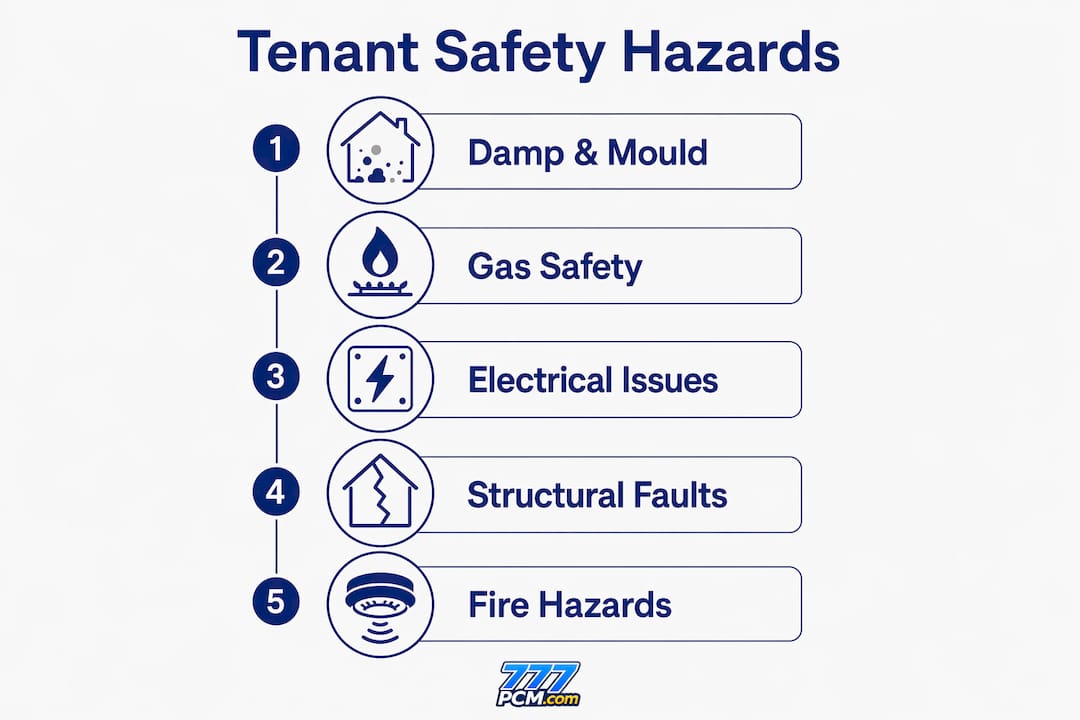
The table below summarises the main hazard categories tenants are protected against:
| Hazard category | Examples |
|---|---|
| Damp and mould | Severe condensation, black mould growth, water ingress |
| Excess cold | Inadequate heating, poor insulation in winter months |
| Fire | Faulty electrics, missing smoke alarms, blocked escape routes |
| Falls | Unsafe staircases, broken flooring, poor lighting |
| Carbon monoxide | Faulty boilers, gas appliances without proper ventilation |
| Structural collapse | Subsidence, crumbling ceilings, unsafe walls |
Category 1 hazards carry the most weight. When a council inspector identifies one, the local authority has a legal duty to take enforcement action. That action can range from issuing an improvement notice to carrying out emergency remedial works at the landlord's expense. Tenants do not need to wait for a landlord to agree before a council can step in.
What are landlords legally required to do to keep tenants safe?
Section 11 obligations cover repairs to the structure of the property, including roofs, walls, windows, and floors, as well as installations for heating, hot water, gas, and electricity. Landlords must keep these in working order throughout the tenancy. This is not a one-off obligation at the start of a let. It is a continuing duty.
Beyond general repairs, landlords must hold and provide specific safety documentation:
- Gas Safety Certificate (CP12): Required annually. A Gas Safe registered engineer must inspect all gas appliances and installations. Tenants must receive a copy within 28 days of each check. You can read more about gas safety compliance and why it matters.
- Electrical Installation Condition Report (EICR): Required every five years. A certified electrician must inspect the fixed wiring and report on its condition.
- Smoke alarms: Required on every floor of the property. Carbon monoxide alarms are required in any room with a solid fuel appliance. Smoke alarm requirements for rental properties are clearly set out in law.
- Energy Performance Certificate (EPC): Must be provided to tenants before they move in.
Failing to provide mandatory documents like a Gas Safety Certificate, EICR, EPC, or deposit information blocks most landlord possession claims in England. This means a landlord who has not served these documents cannot legally evict you through the courts. That is a significant protection that many tenants do not realise they hold.
Awaab's Law, originally introduced for social housing, sets mandatory timescales for investigating and addressing hazards like damp and mould. Emergency hazards must be investigated within 24 hours. The principles of this law are now influencing expectations across the private rented sector.

Pro Tip: Always request copies of your Gas Safety Certificate and EICR before or at the start of your tenancy. If your landlord cannot produce them, report this to your local council immediately.
How can tenants assert their safety rights?
Asserting your rights starts with a clear, written record. Verbal reports are often disputed and carry little evidential weight if a dispute reaches a council inspector or court. Written complaints with photographs and timestamps are far harder to dismiss.
Follow these steps when a hazard appears in your home:
- Document the hazard immediately. Take dated photographs or video. Note when the problem started and how it affects your daily life.
- Notify your landlord in writing. Use email or a messaging platform that creates a record. State the hazard clearly and request a repair within a reasonable timeframe.
- Follow up in writing if there is no response. Send a second notice after 14 days if the landlord has not acknowledged or acted on your report.
- Contact your local council. If the landlord fails to act, request a housing inspection. Councils have a legal duty to inspect when Category 1 hazards are reported.
- Escalate to the Private Rented Sector Ombudsman. The Renters' Rights Act 2025 established this body to resolve disputes without going to court. It is free to use for tenants.
Local councils can issue fines of up to £7,000 to landlords for serious Category 1 hazards. That financial pressure is a powerful incentive for landlords to act. Councils can also carry out emergency remedial action immediately in serious cases and recover the cost directly from the landlord.
Tenants who report hazards are also protected from retaliatory eviction. If a landlord attempts to evict you shortly after you have made a formal complaint, this is treated as retaliatory and courts will not grant possession. Understanding tenant safety laws means knowing that reporting a problem cannot legally be used against you.
Pro Tip: Keep a dedicated folder, physical or digital, for all tenancy documents, repair requests, and council correspondence. This record is your strongest asset if a dispute escalates.
What does the Renters' Rights Act mean for tenant safety in 2026?
The Renters' Rights Act 2025 introduced the most significant shift in tenant protections in a generation. Its core changes directly affect tenant safety obligations and the balance of power between renters and landlords.
Key changes under the Act include:
- Abolition of Section 21 no-fault evictions. Landlords can no longer evict tenants without a valid legal reason. This removes the threat that previously discouraged tenants from reporting hazards.
- Monthly tenancy rollovers. Fixed-term tenancies are replaced with rolling periodic tenancies, giving tenants greater flexibility and security.
- Rent increase limits. Landlords can only raise rent once per year and must follow a formal process. Tenants can challenge increases through a tribunal.
- Private Rented Sector Ombudsman. All landlords must register with this body. Tenants can bring complaints about repairs and safety without going to court.
"The Renters' Rights Act now protects millions of renters by removing the fear of eviction for those who speak up about unsafe conditions. Tenants should treat safety as a legal right, not a favour they are asking for."
The £7,000 fine powers available to councils reinforce this shift. Landlords who ignore hazards now face real financial consequences, not just the possibility of a court order years down the line. The combination of stronger tenure security and faster enforcement creates a fundamentally different environment for tenants asserting their rights in 2026.
Common mistakes that weaken your position as a tenant
Many tenants unintentionally undermine their own rights through avoidable errors. Knowing what not to do is as valuable as knowing what to do.
- Relying on verbal reports. A phone call to a landlord is not a formal repair request. Always follow up any conversation with a written message.
- Failing to keep evidence. Photographs taken weeks after a hazard appears are far less persuasive than those taken on the day. Document problems as soon as they arise.
- Not knowing your landlord's documentation obligations. If your landlord has not provided a Gas Safety Certificate, EICR, or EPC, missing documentation can prevent them from legally regaining possession of the property.
- Waiting too long to escalate. If a landlord has not responded within a reasonable period, typically 14 days for non-emergency issues, contact your local council. Do not wait months hoping the problem resolves itself.
- Ignoring Legionella risk. Gas and electrical safety require formal certificates, but Legionella risk assessments do not. Tenants should still request written evidence that a risk assessment has been carried out, particularly in older properties with complex water systems.
Pro Tip: If your landlord manages the property through a letting agent, send all written repair requests to both the agent and the landlord directly. This prevents either party from claiming they were unaware of the issue.
Key takeaways
Tenant safety rights are legally enforceable entitlements backed by the HHSRS, the Landlord and Tenant Act 1985, and the Renters' Rights Act 2025, giving tenants clear routes to remedy when landlords fail to act.
| Point | Details |
|---|---|
| Know your legal foundation | Section 11 of the Landlord and Tenant Act 1985 and the HHSRS define your core safety rights. |
| Demand mandatory certificates | Gas Safety (CP12) and EICR documents are legally required; missing ones block landlord possession claims. |
| Report hazards in writing | Written complaints with photo evidence are far stronger than verbal reports in any enforcement action. |
| Use council enforcement | Councils can fine landlords up to £7,000 and carry out emergency works for Category 1 hazards. |
| The Renters' Rights Act protects you | Section 21 abolition means reporting hazards can no longer be used as grounds to evict you. |
What I have learned about tenant safety rights enforcement in 2026
The single biggest shift I have observed in recent years is not the legislation itself. It is the change in confidence among tenants. For a long time, many renters treated safety complaints as a negotiation rather than a right. They worried that pushing too hard would cost them their home. The abolition of Section 21 removes that threat in a meaningful way.
The councils I have seen act most effectively are those that treat the HHSRS not as a bureaucratic checklist but as a genuine enforcement tool. The new £7,000 fine powers give them real leverage. Landlords who previously ignored improvement notices now respond far more quickly when a financial penalty is on the table.
My honest advice to any tenant reading this is straightforward. Document everything from day one. Do not wait for a problem to become serious before you report it in writing. The law is on your side in 2026 in a way it simply was not five years ago. Use it.
— Mike
How 777pcm supports safe, compliant rental properties
Landlord compliance is the practical side of tenant safety rights. When landlords hold current Gas Safety Certificates, valid EICRs, and a reliable maintenance record, tenants benefit directly.

777pcm manages the full compliance cycle for landlords and letting agents, from CP12 gas safety certificates to electrical inspections and urgent repairs. The company's in-house Gas Safe registered engineers and certified electricians handle everything without third-party subcontractors, which means faster turnaround and clear accountability. For tenants, a landlord using 777pcm's property maintenance services is a landlord with fewer excuses for delay. If you are a renter experiencing maintenance issues, sharing this resource with your landlord or letting agent is a practical first step toward a safer home.
FAQ
What are tenant safety rights?
Tenant safety rights are the legal entitlements that protect renters from living in properties with serious health and safety hazards. They are defined by the Landlord and Tenant Act 1985, the Housing Act 2004, and the HHSRS framework.
Can a landlord evict me for reporting a safety hazard?
No. The Renters' Rights Act 2025 abolished Section 21 no-fault evictions, meaning a landlord cannot legally evict you simply because you reported a hazard or complained about repairs.
What happens if my landlord ignores a repair request?
You can report the hazard to your local council, which has a legal duty to inspect and can issue fines of up to £7,000 for Category 1 hazards. Councils can also carry out emergency works and recover the cost from the landlord.
What documents must my landlord provide?
Landlords must provide a Gas Safety Certificate (CP12) annually, an EICR every five years, an EPC before you move in, and deposit protection information. Failure to provide these blocks most possession claims in court.
How do I report a hazard effectively?
Report the hazard in writing with dated photographs and send it directly to your landlord or letting agent. If there is no response within a reasonable period, escalate to your local council or the Private Rented Sector Ombudsman.