
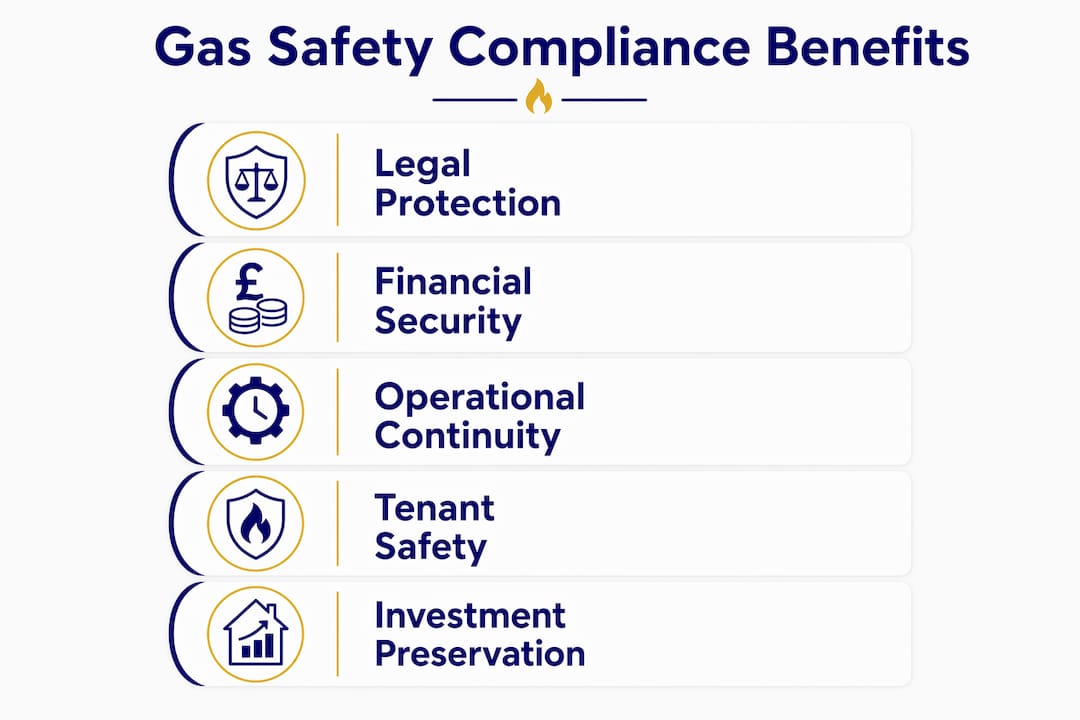
Gas safety compliance is the legal and operational framework that protects landlords from criminal liability, financial loss, and the collapse of their rental income. Governed by the Gas Safety (Installation and Use) Regulations 1998, it requires landlords to maintain annual checks on all gas appliances and flues, issue CP12 certificates to tenants, and use only Gas Safe Register engineers. Understanding why gas safety compliance protects investment is not simply a matter of following rules. It is a matter of preserving the financial viability of your property portfolio against risks that can be swift, severe, and irreversible.
What are the key legal obligations for landlords under gas safety regulations?
Landlords in England, Scotland, and Wales operate under Regulation 36 of the Gas Safety (Installation and Use) Regulations 1998. This regulation defines the minimum duties that every residential landlord must fulfil. Falling short of any one of them creates immediate legal exposure.
The core obligations are:
- Annual gas safety checks: Every gas appliance and flue must be inspected no more than 12 months apart by a Gas Safe Register engineer.
- Issuing the CP12 certificate: Existing tenants must receive their safety records within 28 days of the check. New tenants must receive them before they move in.
- Record retention: Landlords must keep gas safety records for a minimum of two years.
- Engineer verification: Only engineers listed on the Gas Safe Register may carry out legally valid inspections. Using an unregistered engineer renders the certificate worthless.
- Defect documentation: Any faults identified during a check must be recorded in full, including remedial actions taken.
Pro Tip: Always request the engineer's Gas Safe Register ID card before any work begins. You can verify credentials directly on the Gas Safe Register website at no cost.
The importance of gas safety standards extends beyond the certificate itself. Compliance requires evidence of timely inspections, correct engineer registration, and documented tenant notification. A certificate alone, without proof of delivery to the tenant, is not sufficient in a dispute or enforcement scenario.
How does gas safety compliance reduce financial and legal risks?
Non-compliance with gas safety regulations is a criminal offence under the Health and Safety at Work Act 1974. The financial risks of non-compliance are not limited to administrative fines. They extend to criminal prosecution, unlimited financial penalties, and custodial sentences.
The legal consequences escalate quickly:
- Unlimited fines: Magistrates' courts can impose unlimited fines for gas safety breaches, with no statutory cap.
- Custodial sentences: Manslaughter charges carry sentences of 6–15 years where a gas failure causes death.
- Imprisonment for dangerous work: HSE enforcement records confirm that dangerous gas work results in jail time. In one case, a man received a 12-month custodial sentence after illegal gas work put a 90-year-old homeowner at serious risk.
- Insurance voidance: Most landlord insurance policies require full compliance. A missing or expired CP12 certificate can cause insurers to refuse claims entirely, leaving landlords personally liable for damages and injury costs.
- Tenant dispute liability: Incomplete records expose landlords to civil claims. Courts focus on original gas safety records, engineer registration details, and proof of timely delivery to tenants.
The insurance dimension is one that many landlords underestimate. A single refused claim following a gas incident, where no valid certificate exists, can produce a financial loss that dwarfs years of rental income. Investment protection through compliance is not a theoretical benefit. It is a direct shield against costs that can exceed the value of the property itself.
Pro Tip: Store digital copies of every CP12 certificate alongside proof of delivery to each tenant. A timestamped email or a signed receipt creates an evidence trail that holds up in court.
How does gas safety compliance protect cash flow and operational continuity?
Gas safety compliance has a direct and often overlooked effect on a landlord's ability to manage tenancies and recover possession of their property. The connection between a CP12 certificate and cash flow is concrete and legally binding.
| Compliance status | Operational impact |
|---|---|
| Valid CP12 issued on time | Section 21 notice can be served; possession process proceeds normally |
| Expired or missing CP12 | Section 21 notice is invalid; landlord cannot begin possession proceedings |
| Certificate issued late to tenant | Potential challenge to notice validity; risk of delayed possession |
| No record of tenant delivery | Certificate may be deemed unserved; enforcement and legal costs increase |
The Section 21 restriction is one of the most financially damaging consequences of non-compliance. A landlord who cannot serve a valid Section 21 notice faces extended void periods, continued arrears accumulation, and increased legal costs. These are direct hits to rental yield and portfolio performance.
Scheduling plays a critical role in avoiding these situations. Landlords can schedule checks 30 to 60 days early without resetting the 12-month compliance cycle. This two-month window is a practical tool for portfolio landlords managing multiple properties. It absorbs access issues, engineer availability gaps, and tenant scheduling conflicts before they cause a certificate to lapse.
Pro Tip: For portfolios of five or more properties, map every certificate expiry date into a single calendar. Flag renewals 10 weeks in advance to give yourself the full two-month early-check window plus time to resolve access problems.
Standardised processes across multiple properties are not a luxury. Portfolio landlords need consistent scheduling and escalation procedures to prevent missed inspections and document errors from cascading across the portfolio. One lapsed certificate in a portfolio of ten properties can trigger a chain of operational disruptions that takes months to resolve.
What are the best practices for managing gas safety compliance as an investment protection strategy?
Treating gas safety compliance as an evidence-driven system, rather than an annual formality, is the single most effective shift a landlord can make. Compliance functions as a system that integrates scheduling, documentation, and tenant communication into a repeatable process.
The following practices define that system in practical terms:
- Verify engineer credentials before every visit: Check the Gas Safe Register directly. Do not rely on a business card or a previous relationship. Registration status can change.
- Record defects in full: Every fault identified during a check must be documented with the remedial action taken. Incomplete records lose disputes. Completeness and traceability are the two qualities that determine whether documentation protects you or fails you.
- Notify tenants promptly and keep proof: Issue the CP12 certificate within 28 days for existing tenants and before occupation for new tenants. Keep a delivery record for every instance.
- Use the early-check window deliberately: Schedule renewals 30 to 60 days before expiry. This prevents last-minute failures caused by engineer unavailability or tenant access issues.
- Centralise your compliance records: Whether you use a spreadsheet, a property management platform, or a compliance service, all records must be accessible, dated, and traceable.
The defensibility of compliance depends on evidence. Courts and enforcement bodies do not accept good intentions. They examine original records, engineer registration numbers, and delivery timestamps. Landlords who treat documentation as an afterthought consistently lose disputes that they could have won with proper record-keeping.
Common landlord mistakes include using unregistered engineers and failing to provide timely safety records. Both errors are avoidable with a structured process. Both errors undermine investment protection in ways that no amount of retrospective effort can fix once enforcement begins.
Key takeaways
Gas safety compliance protects property investment by eliminating criminal liability, preserving insurance cover, and maintaining the legal right to serve possession notices.
| Point | Details |
|---|---|
| Annual checks are mandatory | Gas appliances and flues must be inspected every 12 months by a Gas Safe Register engineer. |
| CP12 delivery is legally required | Existing tenants must receive records within 28 days; new tenants must receive them before moving in. |
| Non-compliance voids insurance | Missing certificates can cause insurers to refuse claims, creating direct personal financial liability. |
| Section 21 depends on compliance | A landlord without a valid CP12 cannot serve a Section 21 notice, blocking possession and extending arrears. |
| Documentation is the real defence | Complete, traceable records of inspections, defects, and tenant delivery determine outcomes in disputes. |
Gas safety compliance: what I have seen landlords get wrong
Landlords consistently underestimate how gas safety compliance functions as a legal defence mechanism. I have seen portfolios where every property had a certificate on file, yet the landlord still lost a dispute because they could not prove the certificate had been delivered to the tenant on time. The certificate existed. The evidence of delivery did not. That distinction cost them the case.
The most damaging pattern I observe is treating the annual check as the finish line. It is not. The check is the starting point. What follows, including issuing the CP12, documenting any defects, recording remedial work, and keeping proof of tenant notification, is where investment protection is actually built or lost. Landlords who understand this treat compliance as a process with multiple checkpoints, not a single event.
Scheduling is the other area where I see consistent failures. Landlords with large portfolios often allow certificates to expire because they have no system for tracking renewal dates. The two-month early-check window exists precisely to prevent this. Using it deliberately, across every property in a portfolio, is the difference between a well-managed investment and one that is perpetually one lapsed certificate away from a Section 21 problem.
My honest view is that landlords who invest in professional compliance management, whether through a dedicated service or a rigorous internal system, consistently outperform those who treat compliance as an occasional task. The financial risks of non-compliance are too severe and too immediate to manage casually.
— Mike
Professional gas safety support for landlords
Keeping a portfolio compliant requires more than good intentions. It requires reliable engineers, fast scheduling, and documentation that holds up under scrutiny.

777pcm provides CP12 gas safety certificates through in-house Gas Safe registered engineers, with no third-party subcontractors involved. That means faster turnaround, direct accountability, and records that are complete from the first visit. For landlords who need rapid response, the 777pcm fast response service covers inspections, certification, and remedial works under one roof. Whether you manage one property or a large portfolio, having a single provider handle scheduling, access coordination, and documentation removes the gaps where compliance failures tend to occur.
FAQ
What is a CP12 certificate and why do landlords need one?
A CP12 is the gas safety record issued after an annual inspection of gas appliances and flues by a Gas Safe Register engineer. Landlords are legally required to hold a current CP12 for each tenanted property and to provide it to tenants within the deadlines set by Regulation 36.
Can a landlord be imprisoned for gas safety non-compliance?
Yes. Non-compliance is a criminal offence under the Health and Safety at Work Act 1974. Where a gas failure causes death, manslaughter charges can result in custodial sentences of 6–15 years.
Does a missing gas safety certificate affect a Section 21 notice?
A landlord who has not provided a valid gas safety record to the tenant cannot serve a legally valid Section 21 possession notice in England, which blocks the possession process and prolongs tenancy disputes.
How early can a landlord schedule a gas safety check?
Landlords can schedule checks up to 60 days before the current certificate expires without resetting the 12-month compliance cycle. This window helps avoid last-minute failures caused by access issues or engineer availability.
What records must a landlord keep after a gas safety check?
Landlords must retain gas safety records for at least two years. Records must include the engineer's Gas Safe Register number, details of any defects found, remedial actions taken, and proof that the certificate was delivered to the tenant within the required deadline.