
A landlord portal is a secure, role-based control panel that a letting agent configures for each landlord client, giving them direct visibility into their property's tenancy records, maintenance jobs, compliance certificates, and financial statements without needing to chase the agent by phone or email.
- The bottom line: a well-built portal gives landlords and agents compliance confidence, an audit-ready record for council inspections, tribunal hearings, or court proceedings, and automated tracking of CP12 gas safety certificates, EICRs, and EPCs. Critically, it enforces the 14-day damp and mould investigation timers now expected under Awaab's Law, with timestamped logs that prove action was taken.
Table of Contents
- What does a landlord portal actually do?
- Why do UK landlords and letting agents need a portal?
- What compliance features must a UK landlord portal include?
- Portal vs CRM vs landlord app: what is the difference?
- How do you evaluate a letting agent's portal?
- Getting started: how landlords use a portal day to day
- What should landlords and letting agents do next?
- Mobile access and app availability for landlord portals
- Key takeaways
- The compliance gap most portals quietly ignore
- How 777pcm supports landlords with compliance and portal access
- Further reading and authoritative sources
What does a landlord portal actually do?
The core of any letting agent's portal is a maintenance ticketing system. When a tenant reports a repair, the portal logs it with a timestamp, assigns it to an engineer, records photos, tracks the estimated cost, and updates the job status in real time. The landlord sees all of this without a single phone call.
Beyond maintenance, landlord portal features typically include automated expiry alerts for safety certificates, a document library, rent ledger visibility, digital approval workflows, and a full message thread between agent, contractor, and landlord. Each action is logged with a date and time, creating the audit trail that matters when a council or tribunal asks for evidence.
| Feature | Problem it solves | Portal automation example |
|---|---|---|
| Maintenance ticketing | Missed or delayed repairs | Timestamped log, engineer assigned, status updated automatically |
| Certificate storage | Lost or expired documents | Expiry alerts sent 60 days before renewal date |
| Audit trail | Proving compliance to councils | Every action recorded with date, time, and user |
| Rent ledger | Landlord uncertainty about income | Live statement updated on payment receipt |
| Digital approvals | Slow sign-off on quotes | One-click approval with a logged response time |
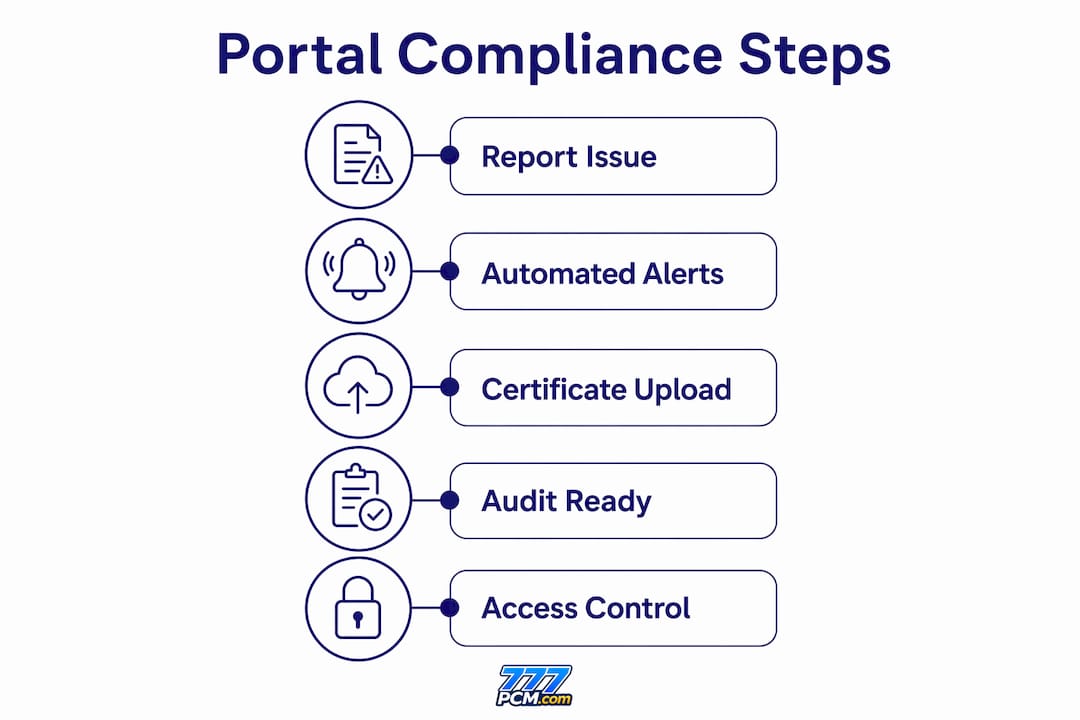
Agents often configure which records a landlord can see, so portal access levels vary by agency. A landlord expecting full transparency should confirm what the agent shares by default before signing a management agreement.
Why do UK landlords and letting agents need a portal?
Portals are a key retention factor for letting agents. They convert a manual, phone-dependent relationship into a visible, paperless partnership where landlords can see operational progress at any time. That shift builds trust in a way that monthly email updates simply cannot replicate.
For agents, the efficiency argument is equally strong. Property management automation can reduce admin time by 60–80% in some cases, freeing staff from routine certificate chasing and rent reconciliation so they can focus on judgement work: handling disputes, advising on investment decisions, managing complex references. A connected portal that links lettings, tenancy handling, compliance, and maintenance into one environment reduces fragmented admin and duplicate data entry across teams.
Stat to note: automation platforms report cutting per-tenancy admin from 8–12 hours of negotiator time down to a fraction of that, with payback periods measured in weeks rather than years.
What compliance features must a UK landlord portal include?
This is where portals earn their place. Awaab's Law, which came into force for social housing and is shaping expectations across the private rented sector, requires landlords to investigate damp and mould hazards within 14 days of a report. A portal must enforce that timer automatically, log the investigation outcome with a timestamp, and escalate if no action is recorded within the window.
The compliance capabilities a portal must provide include:
- Automated 14-day damp and mould investigation timers with escalation alerts
- Timestamped maintenance logs that are court and tribunal ready
- CP12 gas safety certificate tracking with expiry alerts
- EICR electrical safety certificate storage and renewal reminders
- EPC tracking and visibility for landlords and prospective tenants
- One-click evidence pack generation for council or tribunal requests
The highest-value portals produce audit-ready evidence packs instantly, saving hours when a council or tribunal requests proof of compliance. That capability alone justifies the investment.
| Certificate / issue | Why it matters | Portal automation |
|---|---|---|
| CP12 (gas safety) | Annual legal requirement | Expiry alert + renewal booking prompt |
| EICR (electrical) | 5-year cycle, mandatory | Automated reminder, certificate stored |
| EPC | Required at tenancy start | Tracked, visible to landlord and tenant |
| Damp / mould report | Awaab's Law 14-day timer | Auto-timer starts on report, escalation if overdue |
| Maintenance job | Proof of reasonable action | Timestamped log, engineer notes, photos |

Integration matters here too. A portal that sits outside the agency's client accounting system creates compliance blind spots. Integrated systems handle accurate client money handling, ring-fenced funds under Money Laundering Regulations, and live listing feeds without duplicate data entry. Fragmented records are a liability when a tribunal asks for a complete history.
Portal vs CRM vs landlord app: what is the difference?
These three categories are frequently confused, and choosing the wrong one is a common and costly mistake.
A single-landlord app suits a self-managing landlord with a small portfolio. It handles rent tracking, basic maintenance logging, and document storage, but it lacks client money accounting, listing feed integration, and the multi-landlord management tools an agency needs.
A letting-agent CRM or operating system manages the full agency workflow: leads, viewings, tenancy progression, client accounting, and compliance. The landlord portal is typically a module within this system, not a separate product.
An integrated portal tied to agency CRM is the gold standard. The landlord sees a role-based view of their properties while the agent manages everything from the same underlying data. Role-based access gives each stakeholder the right view without disconnecting them from the workflow.
"An effective landlord portal is an integrated module of an agency's CRM rather than a standalone tool — this reduces duplicate entry and strengthens compliance controls." — Softomate Solutions
Pro Tip: Before signing with any agent, ask whether their portal is a native module of their CRM or a third-party add-on. A bolt-on portal often means data lives in two places, which creates gaps in the audit trail precisely when you need it most. For a broader view of CRM and portal integration options, the comparison guides on the 777pcm blog are a useful starting point.
How do you evaluate a letting agent's portal?
Ask these questions before signing a management agreement:
- Do you surface CP12 and EICR expiry dates directly to me in the portal?
- Can you produce an audit-ready evidence pack within 24 hours of a council or tribunal request?
- Are all maintenance records timestamped and attributed to a named engineer or contractor?
- Does the portal enforce the 14-day Awaab's Law damp and mould investigation timer?
- Is the portal a module of your CRM, or a separate system?
- Are client funds ring-fenced and visible in the portal's financial statements?
Must-have capabilities checklist:
- Timed maintenance triage with escalation alerts
- Immutable audit logs with timestamps
- Certificate tracking for CP12, EICR, and EPC
- Secure, role-based access configured per landlord
- SLA commitments and response-time visibility
- Integration with client accounting and ring-fenced funds
A portal that cannot answer questions 1–3 above is likely a marketing front-end rather than a genuine compliance tool. The difference shows up when a council inspector arrives or a tenant raises a formal complaint.
Getting started: how landlords use a portal day to day
Onboarding typically follows these steps:
- The agent sends an invitation email with a secure login link.
- The landlord sets up their account, confirms their role and permissions with the agent, and links their properties.
- The agent configures which documents and records are visible, including the first compliance pack.
- The landlord reviews open maintenance jobs, certificate expiry dates, and the current rent ledger.
- From that point, everyday tasks include approving maintenance quotes, downloading certificates, checking job status updates, and reviewing monthly statements.
Pro Tip: Set up two notification channels in the portal (email and SMS or app push) and configure a weekly digest rather than instant alerts for every update. This keeps you informed without notification fatigue, and means you will not miss a genuine compliance alert buried in routine updates.
What should landlords and letting agents do next?
Prefer an integrated portal that provides audit-ready compliance evidence, timestamped maintenance triage, and clear SLA commitments from the agent. A portal that cannot produce a one-click evidence pack or enforce Awaab's Law timers is not fit for purpose in the current regulatory environment.
- Ask for a demo focused specifically on compliance workflows, not just the dashboard overview.
- Request a sample audit pack for a completed maintenance job before committing.
- Confirm the portal integrates with the agency's CRM and client accounting to avoid compliance blind spots.
- Check that tenant safety obligations and certificate renewals are tracked automatically, not manually.
Pro Tip: Use the rental property compliance checklist as a benchmark when reviewing what an agent's portal actually surfaces. If the portal cannot show you everything on that list, ask why.
Mobile access and app availability for landlord portals
Most modern portals offer a mobile-optimised web interface, and a growing number provide dedicated iOS and Android apps. For landlords managing properties across multiple locations, mobile access means approving a maintenance quote, checking a certificate expiry, or reviewing a job photo without sitting at a desk.
The practical test is whether the mobile experience mirrors the desktop one. Some portals restrict certain functions on mobile, such as document downloads or audit pack generation, which limits their usefulness in the field. When evaluating a portal, ask the agent to demonstrate the mobile view specifically, and confirm that compliance alerts and maintenance approvals work fully on a smartphone. For emergency repair situations, mobile access to job status and engineer contact details can make a material difference to response times.
Key takeaways
A landlord portal for letting agents is only as valuable as the compliance data it surfaces and the audit trail it maintains. Time-stamped records and one-click evidence packs are what protect landlords and agents when councils, tribunals, or courts ask for proof.
| Point | Details |
|---|---|
| What a portal is | A secure, agent-configured control panel giving landlords visibility into maintenance, compliance, and finances. |
| Must-have compliance features | Awaab's Law 14-day timers, CP12/EICR/EPC tracking, and timestamped audit logs are non-negotiable. |
| Integration requirement | The portal must be a CRM module, not a standalone app, to avoid compliance gaps and duplicate data. |
| What to ask agents | Demand a demo of compliance workflows and a sample audit pack before signing a management agreement. |
| 777pcm's approach | 777pcm provides in-house engineers, certificate delivery, and a compliance portal giving landlords audit-ready evidence. |
The compliance gap most portals quietly ignore
Most portal marketing focuses on dashboards and tenant communication. What it underplays is the evidentiary function: the moment a council inspector arrives or a tenant raises a formal complaint, the portal's audit trail is the only thing standing between a landlord and a penalty notice.
The 14-day Awaab's Law timer is a good example of where many portals fall short. Displaying a report date is not the same as enforcing an investigation deadline with an escalation workflow. Agents who rely on manual reminders will miss the window under pressure. The portals that genuinely protect landlords are the ones built around compliance logic, not just communication convenience.
There is also a subtler point about integration. A portal that sits outside the agency's accounting system means the financial record and the compliance record live in different places. When a tribunal requests a complete history of a tenancy, including rent payments, maintenance actions, and certificate status, a fragmented system cannot produce it cleanly. That gap is where disputes become expensive.
The right question to ask any agent is not "do you have a portal?" but "can you show me a completed audit pack right now?" The answer tells you everything about whether the portal is a genuine compliance tool or a polished front end.
How 777pcm supports landlords with compliance and portal access
777pcm delivers end-to-end property compliance for landlords and letting agents across the UK, with in-house Gas Safe registered engineers, certified electricians, and plumbing specialists handling every job directly. No subcontractors, no handoff delays, and no gaps in the audit trail.
Where 777pcm differs from a standard maintenance contractor is the compliance infrastructure behind every job. CP12 gas safety certificates, EICRs, and EPCs are tracked, delivered, and stored with the documentation landlords need for council inspections and tribunal hearings. Bulk bookings, emergency response, and CP12 gas safety certificates are available for portfolio clients who need consistent, fast turnaround across multiple properties.
For landlords who want a single point of contact for compliance certificates, remedial works, and maintenance, 777pcm's portal gives direct visibility into job status, certificate expiry, and engineer assignment without chasing anyone. Get in touch via 777pcm.com to discuss your portfolio's compliance requirements and request a walkthrough of the portal.
Further reading and authoritative sources
- Proplix — landlord portal overview: supports claims on portal retention, trust, and paperless workflows.
- Softomate Solutions — property management software for UK landlords: integration requirements, CRM vs standalone app guidance, and compliance gaps.
- Latch — AI property management guide: admin time savings and automation evidence.
- RIS Compliance — portal compliance features: Awaab's Law timers, timestamped audit trails, and certificate tracking.
- Maintaro — portal feature set: one-click audit packs and compliance confidence evidence.
- Expert Agent learning centre — portal configuration: access levels and agent-configured landlord visibility.
- 777pcm — rental property compliance checklist: practical UK compliance benchmark for landlords and agents.
- Fire safety terms for property managers: broader safety obligations and documentation context.