
A landlord compliance certificate pack is defined as a curated collection of mandatory legal and safety documents that prove a rental property meets current UK statutory obligations. The pack typically includes a Gas Safety Record (CP12), an Electrical Installation Condition Report (EICR), an Energy Performance Certificate (EPC), and the current 'How to Rent' guide. Under 2026 UK housing regulations, civil penalties reach up to £30,000 or criminal prosecution for non-compliance. Understanding what is a landlord compliance certificate pack is no longer optional for landlords and property managers. It is the foundation of legally sound property management.
What is a landlord compliance certificate pack?
A landlord compliance certificate pack is an inspection-ready evidence bundle that links each mandatory safety certificate to proof of tenant receipt, forming a critical legal defence against possession challenges. The industry term for this collection is a "compliance pack" or "landlord documentation pack," and both terms are used interchangeably across the sector. Think of it as a property's legal passport: without it, a landlord cannot demonstrate that the home is safe, legally let, or properly managed.
The pack serves two purposes simultaneously. First, it satisfies the compliance requirements for landlords set by legislation such as the Gas Safety (Installation and Use) Regulations 1998, the Housing and Planning Act 2016, and the Renters' Rights Act 2025. Second, it protects landlords during disputes, inspections, or possession proceedings by providing a timestamped, verifiable record of every document served.

Merely holding the certificates is not enough. The burden of proof lies with the landlord to show that the tenant actually received each document. Courts regularly reject standard emails or postal delivery as adequate evidence. A properly assembled compliance pack addresses this gap from the outset.
What documents make up a landlord compliance certificate pack?
The core documents in a compliance pack are defined by statute, and each carries its own renewal cycle and delivery requirement.
- Gas Safety Record (CP12): Issued by a Gas Safe registered engineer, this certificate confirms that all gas appliances, pipework, and flues are safe. It must be renewed annually and given to tenants within 28 days of each inspection or before a new tenant moves in.
- Electrical Installation Condition Report (EICR): This report assesses the condition of all fixed electrical wiring and installations. It is valid for five years or until the start of a new tenancy, whichever comes first. Landlords must provide a copy to tenants before or at the start of the tenancy. The EICR certificate benefits for landlords extend well beyond legal compliance, reducing the risk of electrical fires and insurance disputes.
- Energy Performance Certificate (EPC): The EPC rates a property's energy efficiency on a scale of A to G. Rental properties must achieve a minimum rating of E to be legally let. The certificate is valid for ten years but must be updated if significant works alter the property's energy profile.
- 'How to Rent' Guide: This government-published booklet must be the most current version at the point of issue. Serving an outdated version is treated the same as not serving it at all.
- Renters' Rights Act (RRA) Information Sheet: Following the Renters' Rights Act 2025, landlords must provide this new information sheet to all existing tenants by 31 May 2026. Failure to do so triggers civil penalties and can block possession claims.
- Tenancy agreement and deposit prescribed information: These are not safety certificates, but they form part of the full landlord documentation checklist. Deposit protection prescribed information must be served within 30 days of receipt.
- HMO licence (where applicable): Properties let to five or more people forming two or more households require a mandatory House in Multiple Occupation licence. A copy should sit within the compliance pack for that property.
Pro Tip: Always obtain a signed or e-signed acknowledgement from the tenant confirming receipt of each document. A signature is far stronger evidence in court than a delivery receipt or a sent email.
Why does compliance communication matter legally and practically?
Compliance has shifted from a peripheral task to a core landlord responsibility essential for legal security under current possession claim laws. This is not a subtle shift. Missing a single document from the compliance pack can invalidate a Section 8 possession notice, leaving a landlord unable to regain their property through the courts until the deficiency is corrected.
The financial consequences of non-compliance are severe.
- Civil penalties for missing or invalid certificates reach up to £30,000 per offence.
- Non-registration on the new Private Rented Sector Database triggers fines starting at £7,000 and rising to £40,000.
- Criminal prosecution remains a real risk for persistent or serious breaches, particularly around gas safety.
- A failed possession claim due to missing compliance documents can cost landlords months of lost rent and legal fees.
"Evidence of receipt by the tenant is critical. Tracked or e-signed documents provide stronger court-ready proof than simple emails or posting, reducing legal risk significantly. Landlords who rely on standard email delivery often find their compliance pack rejected during legal proceedings."
Common mistakes that lead to compliance failures include serving an outdated version of the 'How to Rent' guide, failing to re-serve the EICR at the start of a new tenancy, and not retaining proof that the tenant received each document. The importance of compliance certificates lies not just in having them, but in being able to prove they were properly communicated.
How often must compliance certificates be renewed?
Each certificate in the pack operates on its own renewal cycle, and missing a single deadline can render the entire pack non-compliant.
- Gas Safety Record (CP12): Renew annually. Serve to the tenant within 28 days of the inspection date, or before a new tenant moves in. A full overview of landlord safety certificate renewal timelines helps landlords plan ahead across their portfolio.
- EICR: Renew every five years or at the start of each new tenancy. If remedial works are required, a satisfactory report must be obtained before the tenancy begins.
- EPC: Valid for ten years. Update if major energy-related works are carried out, such as a new boiler installation or significant insulation upgrades.
- 'How to Rent' Guide: Re-serve whenever a new version is published by the government, even mid-tenancy if a statutory periodic tenancy arises.
- RRA Information Sheet: Serve to all existing tenants by 31 may 2026. For new tenancies commencing after the Act's commencement date, serve at the start of the tenancy.
The certificate renewal timeline for a portfolio landlord can quickly become complex. A property with a high tenant turnover may require an EICR more frequently than the five-year statutory minimum. Synchronising renewal dates across multiple properties prevents what compliance professionals call "compliance drift," where one or two certificates quietly expire unnoticed.
Pro Tip: Set calendar reminders 60 days before each certificate expiry date. This gives enough time to book a Gas Safe engineer or electrician without rushing, and avoids the risk of a gap in compliance.
How to organise and manage a compliance pack effectively
A well-organised compliance pack is one that can be produced at short notice, whether for a council inspection, a court hearing, or a new letting agent taking over management.
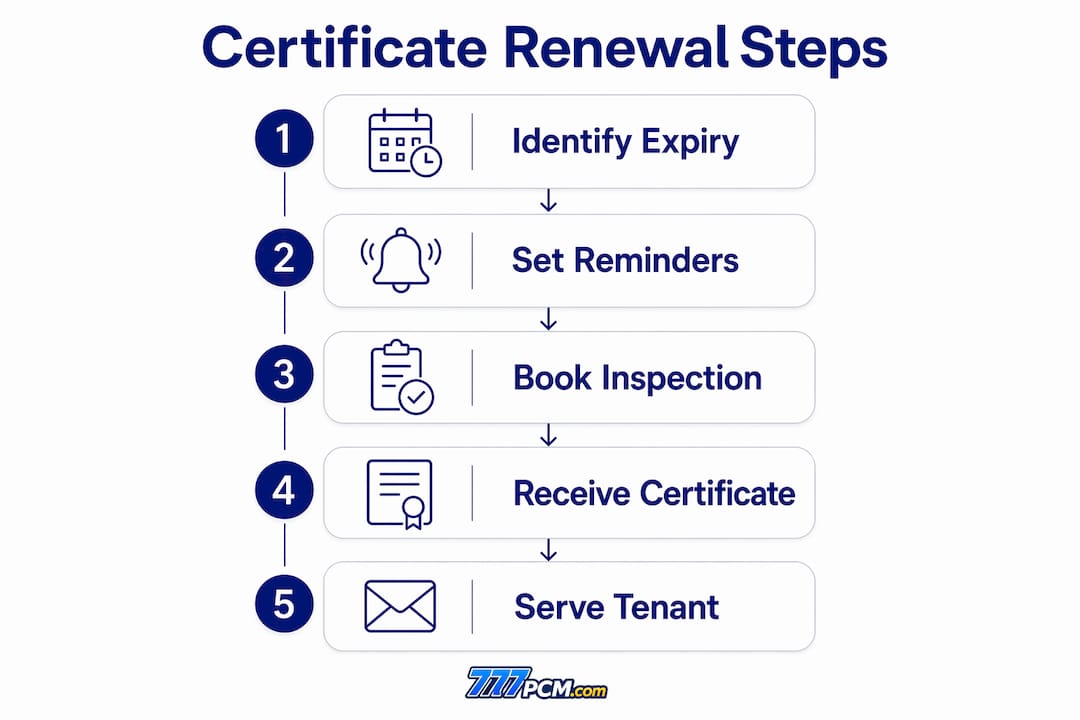
The most effective approach combines digital storage with a clear audit trail. Physical folders work for a single property, but they become unmanageable across a portfolio. Digital systems allow landlords to link each certificate directly to the relevant property and tenancy record, with expiry dates visible at a glance.
Key elements of a well-managed compliance pack:
- Central compliance register: A spreadsheet or property management platform that lists every property, every certificate, its expiry date, and the date it was served to the tenant.
- Timestamped receipt proofs: Tracked delivery or e-signatures create the strongest audit trail. These records should be stored alongside the certificate itself.
- Version control for statutory documents: Keep a record of which version of the 'How to Rent' guide was served and when. Government updates to this document are easy to miss.
- Compliance defence pack: A subfolder for each tenancy containing every document served, the date of service, and the proof of receipt. This is the folder you produce if a possession claim is challenged.
| Document | Renewal frequency | Proof of service required |
|---|---|---|
| Gas Safety Record (CP12) | Annual | Yes, within 28 days or before move-in |
| EICR | Every 5 years or new tenancy | Yes, before or at tenancy start |
| EPC | Every 10 years | Yes, before tenancy start |
| 'How to Rent' Guide | Each new version | Yes, at tenancy start or update |
| RRA Information Sheet | Once (existing tenants by 31 May 2026) | Yes, with acknowledgement |
Portfolio landlords face compliance drift as a major risk. A central register that tracks document expiry by property and tenancy relationship is the single most effective tool for avoiding it.
Key takeaways
A landlord compliance certificate pack is a legally binding evidence bundle, and its value lies entirely in the proof of tenant receipt attached to each document.
| Point | Details |
|---|---|
| Core documents are mandatory | CP12, EICR, EPC, and the 'How to Rent' guide are required by statute for every residential tenancy. |
| Proof of receipt is non-negotiable | Courts require evidence that tenants received each document; e-signatures and tracked delivery are the strongest proof. |
| Penalties for non-compliance are severe | Civil penalties reach £30,000 per offence; non-registration on the PRS Database can attract fines up to £40,000. |
| Renewal cycles vary by certificate | Gas safety records renew annually; EICRs every five years; EPCs every ten years. Track each separately. |
| RRA Information Sheet deadline is fixed | Existing tenants must receive the Renters' Rights Act Information Sheet by 31 may 2026 to avoid penalties. |
Compliance packs are your first line of defence, not your last
I have seen landlords with genuinely safe, well-maintained properties lose possession cases because a certificate was served by standard email with no read receipt. The property was safe. The paperwork existed. But the proof of communication was missing, and that gap was enough for the court to reject the Section 8 notice.
The legislation has not suddenly become hostile to landlords. What has changed is the standard of evidence required. The Renters' Rights Act 2025 and the incoming Private Rented Sector Database have raised the bar considerably. Landlords who treat compliance as a box-ticking exercise will find themselves exposed. Those who treat it as a live, managed process will find it protects them at every turn.
My honest view is that the compliance pack is not bureaucracy. It is the closest thing a landlord has to an insurance policy against a possession dispute. The landlords I have seen manage this well share one habit: they never separate the certificate from the proof of service. The two travel together, stored in the same digital folder, from the moment the document is issued.
The 2026 regulatory environment rewards preparation. Landlords who build a compliance culture into their property management process, rather than scrambling before each inspection, will find the workload manageable and the legal risk minimal.
— Mike
How 777pcm supports landlord compliance certificate management
Keeping a compliance pack current across multiple properties takes consistent effort and reliable engineers.

777pcm provides in-house Gas Safe registered engineers and certified electricians who handle CP12 gas safety certificates, EICRs, and EPCs directly, without subcontracting. Every certificate is issued promptly, with clear communication through a dedicated portal so landlords always know where their compliance stands. For landlords in Berkshire, CP12 gas safety certificates in Newbury are available with fast response times that fit around tenant schedules. 777pcm manages the full process from booking to certification, helping landlords avoid the penalties that come from expired or missing documents.
FAQ
What is a landlord compliance certificate pack?
A landlord compliance certificate pack is a collection of mandatory legal and safety documents, including the CP12, EICR, EPC, and 'How to Rent' guide, that prove a rental property meets current UK statutory requirements. It must include proof that each document was served to the tenant.
What documents must a landlord provide to a tenant?
Landlords must provide a valid Gas Safety Record (CP12), EICR, EPC rated A–E, the current 'How to Rent' guide, and, from 2026, the Renters' Rights Act Information Sheet. Deposit prescribed information must also be served within 30 days of receiving the deposit.
How often does a Gas Safety Certificate need renewing?
The Gas Safety Certificate (CP12) must be renewed every year and served to the tenant within 28 days of the inspection, or before a new tenant moves in.
What happens if a landlord does not have a compliance pack?
Missing compliance documents can block a Section 8 possession claim and attract civil penalties up to £30,000. Non-registration on the Private Rented Sector Database carries additional fines of up to £40,000.
Is email sufficient proof that a tenant received compliance documents?
Courts frequently reject standard email as adequate proof of service. Tracked delivery or e-signed acknowledgements provide a stronger audit trail and are the recommended method for demonstrating tenant receipt.