UK private landlords must meet a defined set of statutory duties covering gas safety, electrical safety, smoke and carbon monoxide alarms, deposit protection, right-to-rent checks, repairs, energy performance, and licensing — the consequences of falling short range from civil penalties to criminal prosecution. The Gov page summarises these obligations clearly, and they apply from the moment a property is marketed, not just once a tenancy begins.
The core duties every landlord must meet are:
- Gas safety (CP12): annual check by a Gas Safe registered engineer, record supplied to tenants within 28 days (or before move-in for new tenants)
- Electrical safety (EICR): inspection at least every 5 years, remedial work completed within 28 days where required
- Energy Performance Certificate (EPC): valid EPC (minimum E rating) before marketing
- Smoke and carbon monoxide alarms: working smoke alarm on every floor, CO alarm in any room with a solid fuel appliance (and now gas appliances in England)
- Deposit protection: protected in a government-approved scheme within 30 days, prescribed information served on the tenant
- Right-to-rent checks: verify every adult occupant's right to reside in the UK before tenancy starts
- Repairs: statutory duty under Section 11 of the Landlord and Tenant Act 1985 to keep structure, exterior, and installations in repair
- Fitness for human habitation: property must meet the standard set by the Homes (Fitness for Human Habitation) Act 2018
- Licensing: HMO licence (and selective licence where applicable) obtained before letting
- Record-keeping: certificates, inspection reports, and remedial confirmations retained and produced on request
If you are behind on compliance, the single most urgent action is to check whether your gas safety record and EICR are current, and to confirm that working smoke and CO alarms are in place. Everything else can be addressed in sequence, but those three carry the highest immediate risk.
Pro Tip: Keep a single compliance folder per property — physical or digital — containing the current CP12, EICR, EPC, deposit protection certificate, and alarm test log. If a local authority inspector calls, you can respond within minutes rather than hours.
Key takeaways
UK landlords face statutory duties at every stage of a tenancy — from pre-let certificates to end-of-tenancy deposit returns — and documented proof of compliance is as important as the compliance itself.
| Point | Details |
|---|---|
| Gas safety is annual and ongoing | CP12 required every year; serve to tenants within 28 days; ongoing appliance maintenance is a separate duty. |
| EICR every 5 years, remedial within 28 days | An unsatisfactory EICR requires written remedial confirmation — the report alone is not compliance. |
| Renters' Rights Act changes from 1 May 2026 | Section 21 abolished; Information Sheet required; rent increases via Form 4A with two months' notice. |
| Records are your legal defence | Retain CP12s until two further checks; EICRs until next inspection; deposit certificates for 6 years post-tenancy. |
| 777pcm manages the full compliance cycle | In-house Gas Safe and qualified electricians, portal scheduling, and remedial confirmations within statutory timeframes. |
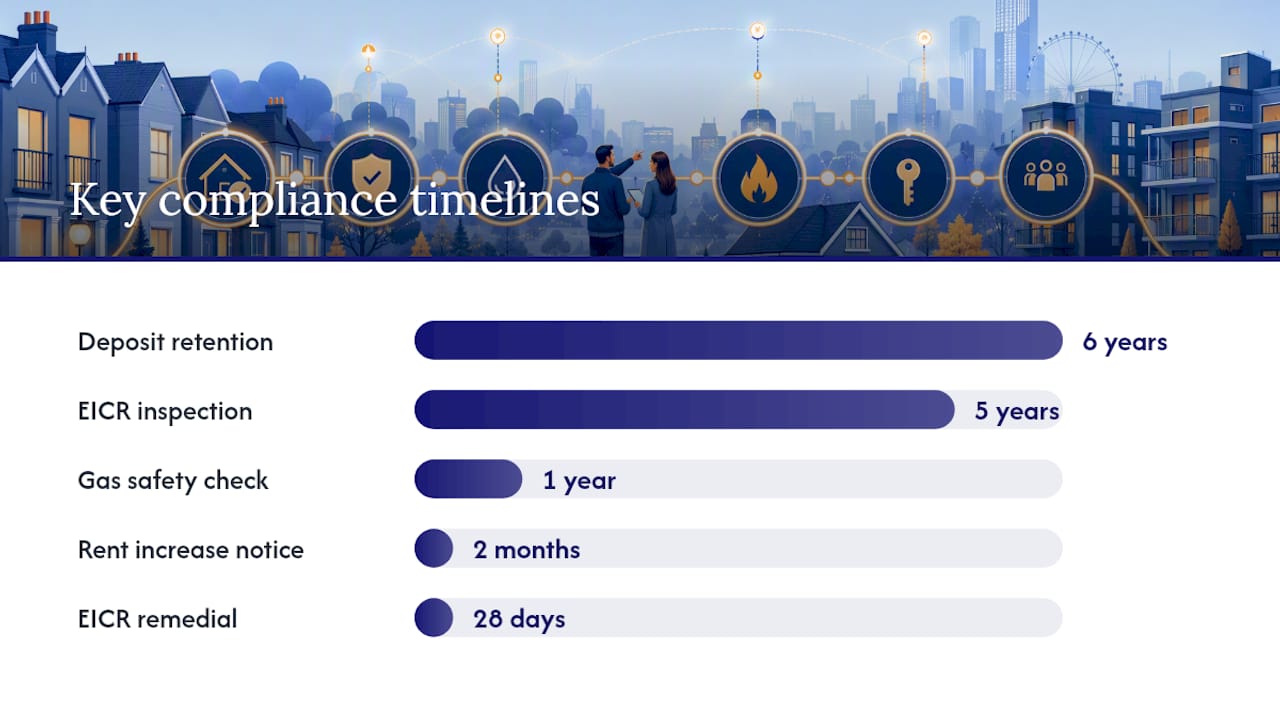
Table of Contents
- What must you do before a tenancy starts?
- What are your ongoing duties during a tenancy?
- Which certificates must you keep, and who gets copies?
- How do you lawfully gain access to your property?
- How do you lawfully end a tenancy in 2026?
- What enforcement powers do local authorities and the HSE have?
- Your compliance checklist and the mistakes that cost landlords most
- The compliance gap most landlords do not see until it is too late
- How 777pcm helps landlords stay compliant without the administrative burden
- Sources
What must you do before a tenancy starts?
Getting the paperwork right before a tenant moves in is not just good practice — several of these steps are legal prerequisites to letting the property at all.
Certificates and documents to have in hand before marketing or occupation:
- Valid EPC (minimum band E for most residential lets; band D from 2028 under proposed changes)
- Gas safety record (CP12) dated within the last 12 months, or arranged before the new tenant moves in
- EICR dated within a valid period and showing a satisfactory result
- Deposit protection certificate and prescribed information (served within 30 days of receiving the deposit)
- Renters' Rights Act Information Sheet — required from 1 May 2026 for assured tenancies
- How to Rent guide (current version at the time of tenancy start)
- Landlord's name and address (or agent's details) in writing
Pro Tip: Download the current How to Rent guide directly from GOV.UK on the day the tenancy starts — the version changes periodically, and serving an out-of-date copy can invalidate a later section 21 notice (where still applicable).
Right-to-rent checks
Every adult who will occupy the property as their main home must have their right to reside in the UK verified before the tenancy begins. Acceptable documents include a UK or Irish passport, a share code from the Home Office online service, or a biometric residence permit. Keep a dated copy of the document checked, alongside a note of who carried out the check and when. For tenant screening and ID verification, a structured process reduces the risk of missing an occupant or accepting an expired document.
Failure to carry out right-to-rent checks can result in a civil penalty of up to £20,000 per occupant for a first breach, rising to £60,000 for a repeat breach.
Tenancy type and why it matters
The type of tenancy you grant determines your notice rights and eviction routes. Most private lets in England are assured periodic tenancies, which from 1 May 2026 are subject to the Renters' Rights Act changes including the removal of section 21 notices. Regulated tenancies (pre-1989 lets) carry different rent and security rules. Excluded licences — typically lodger arrangements where the landlord shares living space — sit outside the Housing Act 1988 and carry fewer statutory protections for the occupant, but also fewer procedural requirements for the landlord. Understanding which category applies to your arrangement before signing anything is worth the time.
Licensing: do you need one?
Mandatory HMO licensing applies to any property occupied by five or more people from two or more households sharing facilities. Additional and selective licensing schemes operate at local authority level and vary by area. Check your local council's website or the GOV.UK renting out a property page to confirm whether your property falls within a licensing zone. Letting without a required licence is a criminal offence and can trigger a rent repayment order covering up to 12 months' rent.
What are your ongoing duties during a tenancy?
Once a tenancy is running, the legal obligations do not pause. Statutory repair duties, safety checks, and maintenance cadence all continue throughout the tenancy, and the evidence you gather during this period is often what determines enforcement outcomes later.
Repairs under Section 11
Section 11 of the Landlord and Tenant Act 1985 requires landlords to keep in repair the structure and exterior of the property (including drains, gutters, and external pipes), and the installations for the supply of water, gas, electricity, sanitation, space heating, and water heating. The duty is triggered once the landlord has notice of a defect — either from the tenant or by direct observation. Tenants have a corresponding duty to use the property in a tenant-like manner and to report defects promptly. A useful breakdown of tenant and landlord responsibilities helps clarify the boundary between what you must fix and what falls to the occupant.
Response times are not rigidly defined in statute for most repairs, but courts and local authorities apply a reasonableness test. Emergency repairs (no heating in winter, a burst pipe, a gas leak) require same-day or next-day action. Routine repairs should be addressed within a reasonable period — typically 28 days for non-urgent items, sooner where health or safety is at risk.
Gas safety
The Gas Safety (Installation and Use) Regulations 1998 require landlords to have all gas appliances, fittings, and flues checked annually by a Gas Safe registered engineer. The resulting gas safety record (commonly called a CP12) must be given to existing tenants within 28 days of the check, and to new tenants before they move in. Records must be retained until two further annual checks have been completed.

Crucially, the annual check is not a substitute for ongoing maintenance. The HSE is explicit that landlords must keep gas appliances in a safe condition throughout the year — not simply arrange the annual inspection and consider the duty discharged. Boiler servicing, flue inspections, and prompt repair of reported faults all form part of that ongoing obligation. For practical scheduling guidance, the NRLA gas safety resource covers CP12 management and the Building Regulations crossover on installation work.
Electrical safety
Electrical installations must be inspected and tested at least every five years by a qualified person, with the results recorded in an Electrical Installation Condition Report (EICR). The standard applied is British Standard 7671 (18th Edition). Where the EICR identifies remedial or investigative work, that work must be completed within 28 days — or within the shorter period the report specifies — and written confirmation of completion must be supplied to both the tenant and the local authority on request.
An EICR alone does not constitute compliance. The Electrical Safety Standards in the Private Rented Sector (England) Regulations 2020 require the written confirmation of remedial completion as a separate document. Missing that step is one of the most common compliance failures in portfolio management. Guidance on managing EICR remedial works within the 28-day window sets out a practical process for documenting completion correctly.
Smoke alarms, CO alarms, and fire safety
Working smoke alarms are required on every storey of the property. A carbon monoxide alarm is required in any room containing a solid fuel appliance, and from October 2022 in England, also in rooms containing a gas boiler or gas fire. Alarms must be tested at the start of each tenancy and kept in working order. In shared accommodation and HMOs, fire door requirements and fire risk assessments apply additionally.
Furniture and furnishings supplied with the property must comply with the Furniture and Furnishings (Fire Safety) Regulations 1988, which require that upholstered items carry a permanent label confirming they meet the fire resistance standard.
Pro Tip: Photograph alarm test results at the start of each tenancy and store them with the tenancy file. If a tenant later claims alarms were not working, dated photographic evidence is a straightforward defence.
Legionella risk assessment
Landlords have a duty under the Health and Safety at Work etc. Act 1974 and the Control of Substances Hazardous to Health Regulations 2002 to assess the risk of Legionella bacteria in the water system. For most domestic lets, the risk is low and a simple written assessment by the landlord is sufficient — but it must be done, documented, and reviewed when circumstances change (for example, after a long void period).
Which certificates must you keep, and who gets copies?
Record-keeping is where many landlords lose enforcement cases they should have won. Having carried out the work is not enough; you must be able to prove it, to the right people, within the right timeframe.
The types of landlord safety certificates guide covers the differences between annual checks and periodic inspections in more detail, including what each document must contain to be legally valid.
On data protection: right-to-rent identity documents contain sensitive personal data. Store copies securely — encrypted digital storage or a locked physical file — and retain them only for as long as legally required (typically two years after the tenancy ends). Do not share them with third parties without a lawful basis under UK GDPR.
How do you lawfully gain access to your property?
Landlords have a right of access for repairs and inspections, but it is not unconditional. The standard requirement is at least 24 hours' written notice, and visits must take place at a reasonable time. Entering without notice — except in a genuine emergency such as a gas leak — constitutes a breach of the tenant's right to quiet enjoyment and can amount to harassment.
What to do when a tenant refuses access:
- Send a written request (email or letter) stating the reason for the visit, the proposed date and time, and the statutory basis for the inspection
- Offer alternative dates if the first is refused
- Document every communication, including dates, times, and the tenant's response
- If access continues to be refused for a safety-critical inspection (gas check, EICR), write formally to the tenant explaining the legal obligation and the risk of non-compliance
- Keep copies of all correspondence as evidence that you took "all reasonable steps"
The "all reasonable steps" test matters because HSE guidance and Shelter both acknowledge that a landlord who can demonstrate documented, repeated attempts to arrange a gas safety check is in a materially better position than one who cannot. If access is persistently refused, the next step is typically a formal letter before action, followed by an application to the county court for an injunction requiring access.
Pro Tip: Use a written access log for every property visit — date, time, purpose, who attended, and outcome. This takes two minutes per visit and can be decisive evidence if enforcement action follows.
On tenant data: any personal information gathered during the tenancy (identity documents, maintenance correspondence, financial records) must be handled in accordance with UK GDPR. Tenants have the right to request access to their personal data, and you must respond within one calendar month.
How do you lawfully end a tenancy in 2026?
The Renters' Rights Act has changed the eviction landscape significantly. From 1 May 2026, section 21 "no-fault" possession notices are abolished for assured tenancies in England. Landlords must now rely on the grounds set out in Schedule 2 of the Housing Act 1988 (section 8 grounds) to recover possession.
Key section 8 grounds landlords use most often:
- Ground 8: at least two months' rent arrears at both the notice date and the hearing date (mandatory ground — the court must grant possession if proved)
- Ground 10: some rent arrears at the notice date (discretionary)
- Ground 11: persistent delay in paying rent (discretionary)
- Ground 12: breach of tenancy agreement (discretionary)
- Ground 14: nuisance or antisocial behaviour (discretionary)
- Ground 1: landlord wishes to occupy as principal home (mandatory, subject to conditions)
Notice periods vary by ground. For Ground 8, the minimum notice period is four weeks. Serving a section 8 notice requires the correct prescribed form (Form 3), and the notice must specify the ground(s) relied upon and the date after which possession proceedings may be issued.
The Renters' Rights Act Information Sheet must be served on tenants at the start of new assured tenancies from 1 May 2026. Rent increases for periodic assured tenancies must now follow the statutory process using Form 4A, with a minimum two months' notice.
Deposits at tenancy end: the landlord must return the deposit (or the undisputed portion) within 10 days of agreeing the deductions with the tenant. Where there is a dispute, the deposit scheme's alternative dispute resolution (ADR) service handles the claim. Deductions must be evidenced — an inventory, dated photographs, and repair invoices are the standard evidence set.
What enforcement powers do local authorities and the HSE have?
Enforcement is not theoretical. Local housing authorities and the HSE have real powers, and they use them.
Local authority enforcement tools:
- Remedial notices: served under the Electrical Safety Standards Regulations 2020 where an EICR shows unsatisfactory results and the landlord has not completed remedial work within the required period
- Arranging remedial action: if a landlord fails to comply with a remedial notice, the local authority can arrange the work itself and recover the cost from the landlord
- Financial penalties: up to £40,000 for electrical safety breaches under the 2020 Regulations; up to £30,000 for HMO licensing offences; civil penalties for right-to-rent failures
- Improvement notices and prohibition orders: under the Housing Act 2004, where a property presents a Category 1 or Category 2 hazard under the Housing Health and Safety Rating System (HHSRS)
Gas safety breaches carry criminal sanctions. Failing to arrange an annual gas safety check, or failing to provide the gas safety record to tenants, is a criminal offence under the Gas Safety (Installation and Use) Regulations 1998 and can result in prosecution, an unlimited fine, or imprisonment.
Tenant remedies: tenants can bring county court claims for damages where a landlord has failed to carry out repairs. They can seek injunctions requiring access or specific works. Where a landlord has been convicted of a relevant offence or received a civil penalty, tenants can apply for a rent repayment order (RRO) covering up to 12 months' rent. The evidence landlords are most commonly asked to produce in these proceedings is the compliance record: CP12, EICR, remedial confirmations, and maintenance correspondence.
Demonstrating that you took "all reasonable steps" — documented attempts to arrange access, written tenant notifications, prompt remedial action — can affect both the decision to prosecute and the penalty imposed.
Your compliance checklist and the mistakes that cost landlords most
Step-by-step compliance checklist
Before tenancy:
- Obtain valid EPC (minimum band E)
- Arrange gas safety check (CP12) if due
- Confirm EICR is within 5-year validity and satisfactory
- Test smoke and CO alarms; photograph results
- Protect deposit and serve prescribed information within 30 days
- Carry out right-to-rent checks on all adult occupants; copy and date documents
- Serve Renters' Rights Act Information Sheet (from 1 May 2026)
- Serve current How to Rent guide
- Confirm licensing status with local authority
During tenancy: 10. Renew gas safety check annually; serve CP12 to tenant within 28 days 11. Schedule EICR before the 5-year expiry; complete remedial works within 28 days 12. Respond to repair reports in writing; document actions taken 13. Review Legionella risk assessment after void periods 14. Test alarms at each tenancy renewal or change of occupant
End of tenancy: 15. Carry out checkout inspection with dated photographs 16. Return deposit (or undisputed portion) within 10 days of agreeing deductions 17. Retain all compliance records for the required periods
The mistakes that most often trigger enforcement
- Treating the annual gas check as the only gas obligation. Ongoing maintenance of appliances is a separate, year-round duty.
- Missing the 28-day EICR remedial deadline. An unsatisfactory EICR with no follow-up remedial confirmation is a live enforcement risk.
- Not serving the Renters' Rights Act Information Sheet for new tenancies from 1 May 2026.
- Poor record-keeping. Carrying out the work but having no evidence of it is functionally the same as not having done it.
- Assuming a local licensing exemption applies without checking the current local authority scheme.
Pro Tip: The gas-safety anniversary flexibility allows checks to be carried out between 10 and 12 months after the previous check while retaining the original anniversary date. For a portfolio, this means you can batch inspections across a two-month window without losing compliance dates — but keep the original anniversary date on record to demonstrate the schedule is within the permitted range. Guidance on managing gas safety across large portfolios covers this in detail.
The compliance gap most landlords do not see until it is too late
The most common enforcement trigger is not ignorance of the law — it is the gap between knowing a duty exists and having documented proof that it was met. Landlords who arrange gas checks, EICR inspections, and remedial works but keep no organised record of them are in a surprisingly fragile position. A local authority request for records, or a tenant's county court claim, can arrive years after the work was done, and verbal assurances count for nothing.
What actually reduces enforcement risk is not just compliance — it is auditable compliance. Centralised scheduling, in-house engineers whose Gas Safe registration and electrician qualifications are on file, and documented remedial confirmations issued within statutory timeframes together create a record that is difficult to challenge. The landlords who face the most difficulty in enforcement proceedings are typically those who used multiple ad hoc contractors, kept records inconsistently, and cannot produce a coherent timeline of inspections and remedial actions.
The practical implication is straightforward: treat your compliance records as a legal asset, not an administrative afterthought. A single compliance folder per property, updated after every inspection and remedial job, is the simplest and most effective risk-reduction tool available. For portfolio managers, centralising that process across all properties — with a consistent supplier, consistent documentation, and a shared scheduling system — compounds the benefit considerably.
How 777pcm helps landlords stay compliant without the administrative burden
Keeping on top of CP12 gas checks, EICR inspections, EPC renewals, and remedial works across even a small portfolio takes real coordination. 777pcm provides end-to-end compliance management for landlords, letting agents, and property managers across the UK — handling the scheduling, the inspections, the remedial works, and the documentation through a single point of contact.

In-house Gas Safe registered engineers and qualified electricians carry out CP12 and EICR work directly, with no subcontractors involved. Remedial confirmations are issued within statutory timeframes, and all certificates are stored and accessible through 777pcm's compliance portal. Emergency response is available for urgent repairs, and bulk booking options make portfolio-wide scheduling straightforward.
If you need a CP12 gas safety certificate or want to discuss managing your full compliance programme, visit 777pcm to get started.
Sources
The following sources provide primary guidance on the legal obligations covered in this article: