
Local authority enforcement is the process by which councils use statutory powers under the Housing Act 2004 to compel landlords to bring properties up to required standards. The typical sequence runs from informal contact through to formal notices, financial penalties, and, where necessary, prosecution. Understanding where you sit in that sequence, and what you can do to change your position, is what this guide is for.
The immediate outcomes landlords most commonly face:
- Improvement notice — a formal requirement to carry out specified works within a set timescale
- Prohibition order — restricts or prohibits use of all or part of a property
- Civil financial penalty — up to £30,000 per offence as an alternative to prosecution
- Management order — the council takes over management of the property
- Prosecution — criminal proceedings, usually reserved for serious or repeated failures
What to do first if a council contacts you:
- Respond promptly and in writing, even if you dispute the findings
- Gather evidence of any works already completed or planned (invoices, photographs, contractor quotes)
- Start remedial work or prepare a realistic schedule of works
- Seek legal or specialist advice before the compliance deadline passes
Most councils prefer remediation over punishment and will give a landlord who engages constructively the opportunity to carry out required works before formal notices are served.
Table of Contents
- How local authority enforcement works: the legal framework
- What enforcement powers can a council actually use?
- How an enforcement case typically progresses
- What happens during an inspection and what are your rights?
- How councils decide which landlords to target
- How to avoid enforcement action: a practical checklist
- How to appeal and what happens if you do not
- Key takeaways
- A compliance manager's perspective
- How 777pcm helps landlords stay ahead of enforcement
- Useful sources and further reading
How local authority enforcement works: the legal framework
The primary statute is the Housing Act 2004, which gives councils a legal duty to keep housing conditions in their area under review and to take enforcement action where hazards are identified. For Category 1 hazards (the most serious), the duty to act is mandatory. For Category 2 hazards, councils have a discretionary power to act.
The Housing Health and Safety Rating System (HHSRS)
The tool councils use to assess those hazards is the Housing Health and Safety Rating System. HHSRS is not a fixed checklist. It is a risk-based assessment that weighs the likelihood of harm against the likely severity of that harm for the actual occupants of the property. The same physical defect can produce a different outcome depending on who lives there: damp and mould in a property occupied by a young child or an elderly person with a respiratory condition will score higher than the identical defect in a property occupied by healthy adults.
HHSRS covers a range of hazard categories, ranging from excess cold and damp to falls on stairs, electrical hazards, and fire. Officers score each hazard and the result determines whether it is Category 1 (action required) or Category 2 (action discretionary).
Other legislation landlords need to know
The Housing and Planning Act 2016 introduced civil financial penalties and banning orders as additional tools. The Renters' Rights Act 2025 places a general duty on every local housing authority to enforce landlord legislation in its area. From 1 May 2026, councils may apply updated enforcement powers for conduct occurring on or after that date, so landlords should check their local authority's current enforcement policy to understand which framework applies to their situation. The Rogue Landlord Enforcement guidance consolidates the practical routes to enforcement and stresses evidence collection, proportionality, and the Regulators' Code principles that councils must follow.
What enforcement powers can a council actually use?
Councils have a wide toolkit. The table below maps each power to its usual trigger and the likely consequence for the landlord.
| Enforcement power | Usual trigger | Likely consequence for landlord |
|---|---|---|
| Improvement notice | Category 1 or 2 hazard identified; landlord given opportunity to act | Legal obligation to complete specified works within the notice period (minimum 28 days) |
| Prohibition order | Serious hazard making property or part of it unsafe to occupy | Property or rooms cannot be used; loss of rental income until remediated |
| Emergency prohibition order | Imminent danger to occupants | Immediate restriction on occupation; no notice period required |
| Emergency remedial action (works in default) | Imminent danger; landlord unavailable or refuses to act | Council carries out works and recovers full costs from landlord |
| Civil financial penalty | Specified housing offence (e.g. unlicensed HMO, failure to comply with improvement notice) | Up to £30,000 per offence |
| Prosecution | Serious, repeated, or deliberate offences | Criminal record, unlimited fine, or custodial sentence |
| Banning order | Serious offence or pattern of non-compliance | Prohibition from letting or managing properties in England |
| Rent repayment order (RRO) | Unlicensed property, breach of banning order, or certain other offences | Repayment of up to 12 months' rent to tenants or local authority |
| Interim/Final management order (IMO/FMO) | Property at risk of becoming seriously defective; landlord not managing adequately | Council takes over management; landlord loses control of property |
| Licence revocation | Serious breach of licence conditions or repeated enforcement action | Loss of HMO or selective licence; property cannot lawfully be let |
| Compulsory purchase order (CPO) | Severe long-term disrepair; property a danger to the wider area | Compulsory acquisition by the council |
Civil penalties are now widely favoured over prosecution because they are quicker and more proportionate. The GOV.UK headline enforcement report found that civil penalties were considered effective by many authorities, and that mandatory and selective licensing helped improve standards across their areas. Banning orders are increasing but prosecutions remain relatively few, partly because of the resource demands they place on councils.
Where there is imminent danger, such as a gas leak, severe fire risk, or structural collapse, officers can carry out emergency remedial action immediately and recover the full cost as "works in default." That bill lands with the landlord regardless of whether they were aware of the problem.
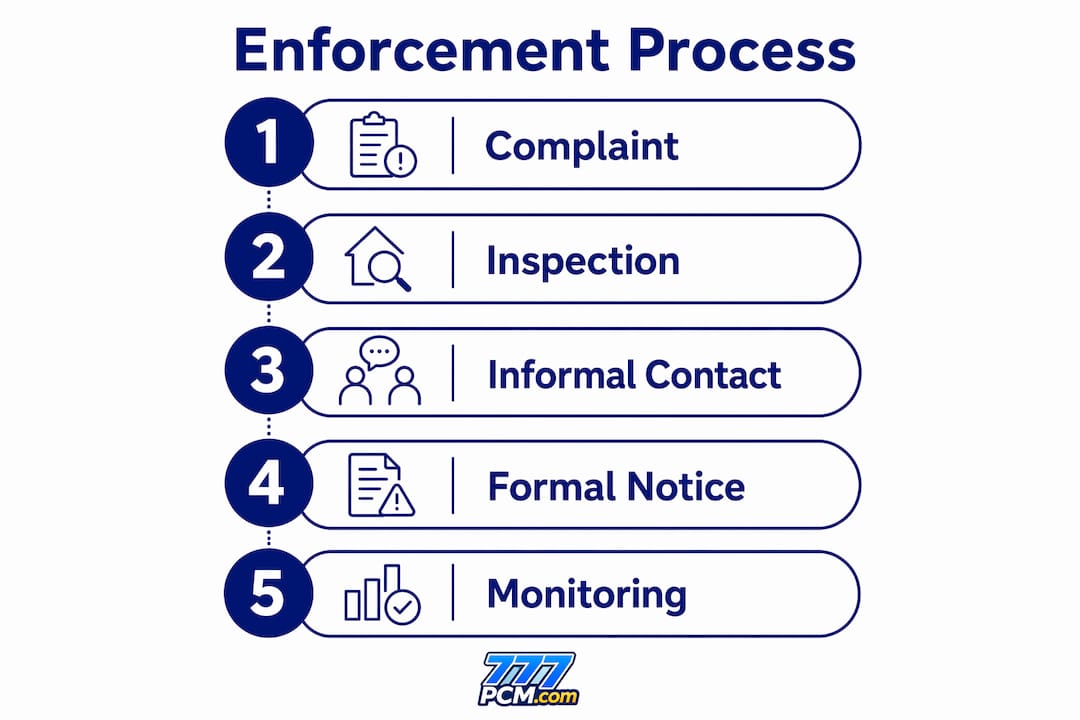
How an enforcement case typically progresses
The enforcement process is rarely a sudden event. It usually follows a recognisable sequence, and landlords who understand that sequence can intervene at the right moment.
Stage 1: Complaint or intelligence trigger
Most cases begin with a tenant complaint, a referral from another council team, or a flag from a licensing or data system. The council logs the issue and triages it against other open cases and available resources.
Stage 2: Inspection and HHSRS assessment
An authorised officer visits the property and conducts an HHSRS assessment. They score hazards, photograph defects, and record their findings. The inspection report forms the evidential basis for any subsequent action.

Stage 3: Informal contact or hazard awareness notice
Where the hazard is not immediately dangerous, most councils will make informal contact first, giving the landlord a chance to address the issue voluntarily. A hazard awareness notice may be issued to put the concern on record without triggering formal obligations.
Stage 4: Formal notice with compliance period
If informal steps fail, a formal improvement notice or prohibition order is served. Improvement notices must give a minimum of 28 days for compliance. The landlord is legally obliged to carry out the specified works within that period.
Stage 5: Monitoring and escalation
The council monitors compliance. If works are completed satisfactorily, the case closes. If not, the authority escalates: civil penalty, prosecution, management order, or works in default, depending on the severity and the landlord's history.
Typical timescales vary considerably. A straightforward case from complaint to notice might take four to eight weeks. Escalation to a civil penalty or prosecution can take months, particularly if representations are made. Imminent danger cases can move to emergency action within hours.
Pro Tip: The moment you receive any written contact from a council housing officer, treat it as the start of a formal process. Reply in writing, confirm what works you have already done or plan to do, and set a realistic completion date. Officers note engagement, and it genuinely influences how quickly a case escalates.
What happens during an inspection and what are your rights?
Notice requirements
Under section 239 of the Housing Act 2004, councils must normally give 24 hours' written notice before entering a property for a survey or inspection. That notice requirement falls away where officers suspect an offence has been committed or where there is imminent danger to occupants.
What authorised officers can do
- Take photographs, measurements, and samples
- Bring other persons (specialists, contractors, other officers) into the property
- Use equipment such as moisture meters, thermal imaging cameras, and gas detection devices
- Inspect all parts of the property, including communal areas in HMOs
What landlords must not do
- Obstruct an authorised officer from entering or carrying out their inspection. Obstruction is itself an offence under the Housing Act 2004 and will almost certainly worsen the council's response and increase the likelihood of prosecution.
- Intimidate or pressurise tenants before or after an inspection. Councils are alert to retaliatory behaviour, and the Homes (Fitness for Human Habitation) Act 2018 provides additional protections for tenants who raise complaints.
- Remove or conceal evidence of defects. Officers are experienced at identifying recent cosmetic work that masks underlying problems, and concealment can convert a civil matter into a criminal one.
- Serve a section 21 notice on a tenant within six months of an improvement notice or emergency remedial action notice being served. Doing so is unlawful under the Deregulation Act 2015.
A landlord's best position during an inspection is cooperative and well-prepared. Have your safety certificates ready, know the history of repairs at the property, and be honest about anything that needs attention.
How councils decide which landlords to target
Councils do not have the resources to inspect every private rented property. They allocate their enforcement capacity to the highest-risk cases, and the way they identify those cases has become considerably more sophisticated.
Common intelligence sources councils use:
- Tenant complaints (the single most common trigger)
- Licensing returns from mandatory HMO licensing and selective licensing schemes
- Council tax and electoral roll data to identify overcrowding or undisclosed occupants
- EPC, gas safety, and electrical certificate records (or the absence of them)
- Anti-social behaviour reports and environmental health referrals
- Companies House data and land registry records to identify landlord structures
- Cross-team data sharing between housing, environmental health, and benefits teams
Participation in mandatory HMO or selective licensing is both a compliance requirement and a critical intelligence source for councils. Unlicensed properties are automatically treated as higher risk and are more likely to be inspected. Landlords who operate outside licensing schemes are not avoiding scrutiny; they are attracting it.
Data-led enforcement is growing. Councils increasingly use complaint clustering (multiple complaints from the same street or postcode), cross-referencing of licensing databases with certificate records, and intelligence from other agencies to build profiles of repeat poor performers. A landlord with a clean compliance record, up-to-date certificates, and no complaint history is genuinely less likely to be inspected than one with gaps in any of those areas.
Well-resourced councils with strategic commitment to enforcement use these powers more proactively. Capacity constraints in some authorities mean that resource-intensive options such as prosecutions or banning orders are used less frequently, but that position is changing as data tools improve and the Renters' Rights Act 2025 places a clearer statutory duty on all local housing authorities to enforce.
Pest infestations are one area where environmental health and housing enforcement teams frequently overlap. A landlord's pest control obligations can become an enforcement trigger when infestations are linked to structural defects or inadequate maintenance, so keeping on top of this is part of a broader compliance picture.
How to avoid enforcement action: a practical checklist
Proactive compliance is not just good practice; it is the most effective defence against enforcement. A landlord who can demonstrate a consistent, documented approach to safety and maintenance is in a fundamentally different position to one who cannot.
Mandatory certificates and checks
- CP12 gas safety certificate — annual inspection by a Gas Safe registered engineer; provide a copy to tenants within 28 days of the check
- Electrical Installation Condition Report (EICR) — required every five years for all private rented properties in England; remedial works must be completed within 28 days of the report
- Energy Performance Certificate (EPC) — minimum E rating currently required; check current minimum standards as these are subject to change
- Smoke alarms — at least one on every storey; test at the start of each tenancy
- Carbon monoxide alarms — required in any room with a fixed combustion appliance (including gas boilers); check at the start of each tenancy
- Legionella risk assessment — a documented risk assessment is required; full legionella compliance involves flushing infrequently used outlets and maintaining water temperatures
- Fire risk assessment — mandatory for HMOs; strongly advisable for all rented properties; see the fire risk assessment guide for what this involves
Record-keeping best practice
Good records are your primary defence at appeal. Keep:
- Dates and outcomes of all safety checks, with certificate copies
- Access logs showing when you or contractors visited the property
- Contractor invoices and completion certificates for all remedial works
- Written communications with tenants about repairs and their responses
- Photographs taken at inspections and after works are completed
A clear paper trail showing prompt action in response to tenant reports can be the difference between a case that closes at the informal stage and one that escalates to a formal notice.
Pro Tip: Set calendar reminders for every certificate renewal date, not just the expiry date. Booking a Gas Safe engineer or electrician six weeks before expiry gives you time to reschedule if access is difficult, and means you are never in the position of having a lapsed certificate when an officer asks to see it.
Practical maintenance approach
- Carry out regular property inspections at appropriate intervals and document the outcome
- Respond to tenant repair reports in writing and within a reasonable timeframe
- Prioritise safety-critical repairs (heating, hot water, structural issues, electrical faults) above cosmetic ones
- Use a rental property compliance checklist to audit your portfolio systematically
- Where a repair cannot be completed immediately, communicate the timeline to the tenant in writing and keep that record
How to appeal and what happens if you do not
Appealing an improvement notice or prohibition order
A landlord who receives an improvement notice or prohibition order has the right to appeal to the First-tier Tribunal (Property Chamber). The appeal must be lodged within 28 days of the notice being served. Filing an appeal does not automatically suspend the notice, so taking legal advice promptly is important. For civil financial penalties, the same 28-day window applies from the date of the final notice, and the final notice is suspended while the appeal is determined.
The grounds for appeal typically include: the hazard does not exist or has been remedied; the notice is not the most appropriate enforcement action; or the works required are excessive or unreasonable.
Consequences of non-compliance beyond the immediate fine
The financial penalty is often the least of a landlord's long-term concerns. Non-compliance can trigger:
- Licence revocation — loss of an HMO or selective licence, making the property unlawful to let
- Banning orders — a prohibition from letting or managing any residential property in England, recorded on the national database
- Inclusion on the rogue landlord database — accessible to other local authorities; two or more civil penalties within a 12-month period can result in inclusion
- Rent repayment orders — tenants or the local authority can apply to the First-tier Tribunal for repayment of up to 12 months' rent
- Management orders — the council takes over management of the property, with the landlord losing control of rental income and decisions
- Compulsory purchase — in the most serious long-term cases, the council can acquire the property compulsorily
When to seek specialist legal advice:
- On receipt of any formal notice, before the compliance deadline
- If you intend to appeal any enforcement decision
- If you are facing prosecution or a banning order application
- If a rent repayment order application has been made against you
Organisations such as the National Residential Landlords Association (NRLA) and the Residential Landlords Association provide member advice services. Shelter publishes guidance for tenants that also helps landlords understand what tenants are being advised to do, which is useful context when managing a complaint. For landlord repair obligations and the legal timescales attached to them, the GOV.UK guidance is the primary reference.
Key takeaways
Local authority enforcement follows a graduated path from informal contact to formal notices and penalties, and landlords who engage early and document their compliance consistently are far better placed to avoid escalation.
| Point | Details |
|---|---|
| Respond promptly to council contact | Written engagement at the informal stage is the single most effective way to prevent escalation to formal notices. |
| Keep all certificates current | CP12, EICR, EPC, smoke and CO alarms must be up to date; a lapsed certificate is an immediate enforcement trigger. |
| Document everything | Dated records of inspections, repairs, and tenant communications are your primary defence at the First-tier Tribunal. |
| Understand the HHSRS | Risk is assessed against your actual occupants, not a fixed standard; vulnerable tenants mean higher hazard scores for the same defect. |
| 777pcm handles compliance end to end | 777pcm schedules mandatory checks, manages remedial works, and maintains the documentation trail that protects landlords at every stage of enforcement. |
A compliance manager's perspective
The gap between landlords who sail through enforcement contact and those who find themselves facing a prohibition order is rarely about the physical condition of the property alone. It is almost always about how they respond in the first 48 hours.
Officers are trained to distinguish between a landlord who is genuinely managing their portfolio and one who is scrambling. When you receive that first letter or phone call, the instinct to be defensive is understandable, but it is the wrong move. The landlords who come out best are the ones who call back the same day, confirm what they already know about the issue, and arrive at the inspection with a folder of certificates and a schedule of works already drafted. That behaviour signals to an officer that this is a manageable case, not a rogue landlord situation.
One thing that surprises many landlords is how much weight officers give to tenant communication records. A WhatsApp message from a tenant reporting a leak, followed by a contractor invoice three days later, is more persuasive than any verbal assurance. Officers have seen every excuse; they respond to evidence.
The other non-obvious point is about scheduling. Access failures, where a landlord cannot get into a property to carry out works because of tenant availability, are one of the most common reasons compliance deadlines are missed. Building access coordination into your process from the start, rather than treating it as an afterthought, prevents a straightforward repair from becoming a formal enforcement matter.
How 777pcm helps landlords stay ahead of enforcement
Keeping a rental portfolio compliant is not complicated in principle, but the administrative load of tracking certificate renewal dates, coordinating access, managing remedial works, and maintaining a clean paper trail across multiple properties is where things go wrong. That is precisely the problem 777pcm is built to solve.

777pcm provides a complete compliance and maintenance service for landlords and property managers across the UK, handling CP12 gas safety certificates, EICRs, EPCs, and the full range of remedial works through in-house Gas Safe engineers, certified electricians, and trade specialists. There are no third-party subcontractors, which means faster turnaround, clearer accountability, and a single point of contact for everything from a boiler repair to a full electrical remediation. Every job is documented through a dedicated portal, so your compliance records are always current and accessible if a council officer asks to see them.
If you want to reduce your enforcement risk and take the administrative pressure off your portfolio, get in touch with 777pcm for a compliance review or to arrange an urgent safety check.
Useful sources and further reading
The sources below are the primary references for landlords who want to read the legislation and local guidance in full.
- Housing Act 2004 — the primary statute governing council inspection powers, improvement notices, prohibition orders, emergency remedial action, and management orders. Start here for the legal basis of any enforcement action.
- Draft HHSRS Enforcement Guidance (GOV.UK) — explains how officers apply the Housing Health and Safety Rating System in practice; essential for understanding how hazard scores are calculated and what triggers Category 1 action.
- Civil Penalties under the Housing and Planning Act 2016 (GOV.UK) — statutory guidance on how civil financial penalties are calculated, issued, and appealed; includes the process for notice of intent and final notice.
- Rogue Landlord Enforcement Guidance (GOV.UK) — practitioner handbook consolidating enforcement powers, evidence standards, and proportionality principles; useful for understanding how officers make decisions.
- Local Authority Enforcement in the Private Rented Sector: Headline Report (GOV.UK) — DLUHC-published research on how councils use enforcement powers in practice; covers civil penalties, licensing, banning orders, and data-led enforcement trends.
- Renters' Rights Act 2025 (legislation.gov.uk) — sets the general duty on local housing authorities to enforce landlord legislation; relevant for understanding the post-May 2026 enforcement framework.
- Guide for Local Authorities: Homes (Fitness for Human Habitation) Act 2018 (GOV.UK) — explains how the 2018 Act interacts with existing council enforcement powers and tenant rights to seek redress directly.
- Middlesbrough Council Private Sector Housing Enforcement Guide — a representative example of a local authority enforcement policy; useful for understanding how the graduated approach is applied in practice at council level.
- Newham Council: Enforcement Options for Landlords — lists the full range of enforcement tools available to councils and notes the application of the Renters' Rights Act from 1 May 2026.
This article is general information for landlords in England and does not constitute legal advice. For your specific situation, consult the relevant primary legislation or a qualified legal professional.