
Legionella compliance in rental properties works through four connected duties: assess the risk, put controls in place, monitor those controls regularly, and review everything when circumstances change. Under the Health and Safety at Work etc. Act 1974 and the Control of Substances Hazardous to Health Regulations 2002 (COSHH), every landlord in the UK is a duty holder with a legal obligation to manage Legionella risk in their water systems. The HSE's Approved Code of Practice ACOP L8 and technical guidance HSG274 set out exactly how that obligation should be met in practice.
For most residential lets, the core compliance elements are straightforward:
- Carry out a written Legionella risk assessment of the property's water system
- Implement proportionate control measures, primarily temperature management
- Flush infrequently used outlets and clean showerheads on a regular schedule
- Keep records of all monitoring, inspections, and remedial actions
- Review the assessment after significant changes to the system or tenancy
Pro Tip: The HSE is clear that compliance should be proportionate. A standard mains-fed property with a combi boiler and daily use of all outlets is typically low risk. A short, honest written assessment is all that is needed — not an expensive laboratory report.
Table of Contents
- What are landlords' legal duties for Legionella compliance?
- How do you carry out a Legionella risk assessment for a rental property?
- What ongoing management keeps Legionella risk under control?
- How 777pcm supports landlords with Legionella compliance
- 777pcm makes Legionella compliance straightforward for landlords
- Key takeaways
What are landlords' legal duties for Legionella compliance?
The legal framework sits across three pieces of legislation. The Health and Safety at Work etc. Act 1974 creates the overarching duty to protect people from risks arising from premises. COSHH 2002 specifically addresses biological agents, including Legionella bacteria. ACOP L8 translates both into practical requirements for duty holders, which includes landlords of residential accommodation.
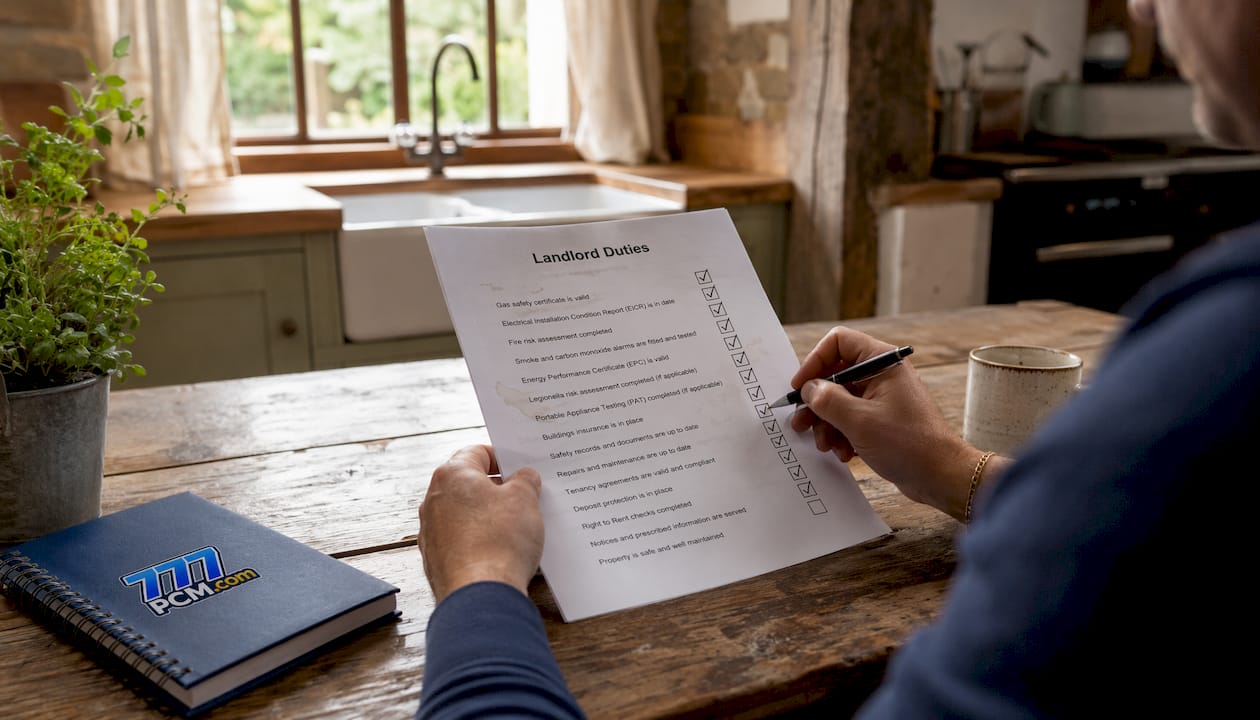
Crucially, the duty holder cannot delegate ultimate liability. You can appoint a managing agent, a contractor, or a specialist firm to carry out assessments and implement controls, but the legal responsibility remains yours. Written delegation is good practice, but it does not transfer accountability.
| Legal duty | What it requires |
|---|---|
| Risk assessment | Identify hazards in the water system and evaluate who may be exposed |
| Written control scheme | Document measures to prevent or control Legionella growth |
| Monitoring and maintenance | Regularly check that controls remain effective |
| Record keeping | Retain monitoring logs for at least five years; other records for two years |
| Competent person | Appoint someone with sufficient knowledge to manage the control scheme |
In blocks of flats or HMOs, responsibility is often split. Freeholders or management companies typically hold duty for communal water systems and storage tanks, while individual landlords remain responsible for the pipework and outlets serving their own letting. Knowing exactly where your boundary sits matters, particularly in larger buildings with shared cold water tanks.
Failing to comply can result in enforcement action by the HSE, improvement notices, and, in serious cases, prosecution. Civil liability for a tenant who contracts Legionnaires' disease is also a real exposure. A dated, well-maintained written assessment is one of the strongest defences available, even where the actual risk in a property was low.
Compliance note: There is no requirement to obtain a formal Legionella certificate. The HSE confirms that compliance depends on risk assessment and active temperature control, not laboratory testing.
How do you carry out a Legionella risk assessment for a rental property?
A Legionella risk assessment is a written examination of the property's water system, designed to identify where bacteria could grow and what controls are in place to prevent it. The HSE's INDG458 guidance sets out what a thorough assessment should cover.
Step-by-step process:
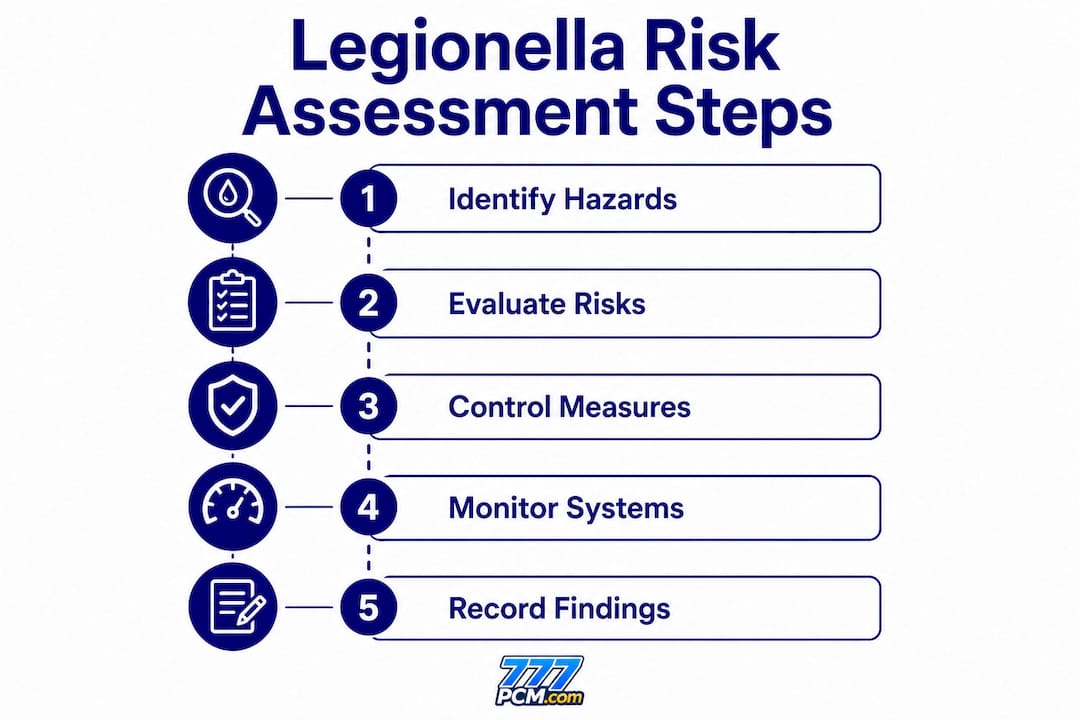
- Map the water system. Record whether the property is mains-fed or tank-fed, where hot water is generated, and the location of all outlets including showers, taps, and outside taps.
- Identify hazards. Look for conditions that favour Legionella growth: water temperatures between 20°C and 45°C, stagnation in dead legs or little-used pipework, scale or sediment in tanks, and spray-producing outlets such as showers.
- Evaluate the risk level. A family home with daily use of all outlets and a modern combi boiler is typically low risk. A void property, a building with a cold water storage tank, or a property with vulnerable occupants sits higher on the scale.
- Record control measures. Document what you are doing to manage identified risks, including temperature settings, flushing schedules, and showerhead maintenance.
- Set a review date. Note when the assessment will next be reviewed and under what circumstances it should be revisited sooner.
There is no fixed statutory interval for renewing a Legionella risk assessment, but best practice is to review it at least every 24 months or sooner after significant system or tenancy changes.
Who carries out the assessment matters. Landlords can self-assess if they are competent and understand their water system. For larger or more complex properties — HMOs, buildings with communal storage tanks, or any premises where the landlord is uncertain — a qualified external assessor is the sensible choice.
Pro Tip: Integrate your Legionella risk check with other routine property inspections. Reviewing water system conditions at the same time as a general inspection saves time and keeps your compliance records aligned.
What ongoing management keeps Legionella risk under control?
Legionella risk management is an ongoing process, not a one-off exercise. Once the assessment is complete and controls are in place, the real work is maintaining them consistently over time.
Temperature control is the primary strategy. Hot water should be stored at 60°C and cold water kept below 20°C. The danger zone for Legionella growth sits between 20°C and 45°C, so keeping systems outside that range is the single most effective control available.
Routine management actions:
- Check hot water cylinder temperatures periodically and confirm the system is reaching 60°C at storage
- Monitor cold water temperatures at sentinel draw-off points, particularly in tank-fed systems
- Flush little-used outlets, including showers and taps in spare rooms or void properties, weekly for several minutes
- Clean and descale showerheads and hoses periodically
- Inspect and maintain any cold water storage tanks, checking lids are fitted and insulation is intact
- Log all monitoring results, inspection dates, and any remedial actions taken
- Carry out a documented flush and temperature check before tenants reoccupy a property after a void period
Tenants play a role too. A short plain-English note included with tenancy paperwork, explaining how to run taps after returning from a holiday and how to report heating or hot water problems, is usually sufficient. Keeping communication simple and practical means tenants are more likely to act on it.
For landlords managing larger portfolios, a consistent maintenance schedule across all properties prevents gaps. Replacement kitchen and bathroom fittings that eliminate dead legs or hard-to-clean areas also reduce long-term risk; resources covering landlord property maintenance can help identify practical improvements during refurbishments.
How 777pcm supports landlords with Legionella compliance
777pcm provides end-to-end property compliance and maintenance services for landlords, letting agents, and property managers across the UK. Legionella compliance sits alongside gas safety, electrical certification, and general maintenance within a single managed service, so nothing falls through the gaps between different contractors.
The 777pcm team includes in-house qualified engineers and trade specialists who carry out risk assessments, implement control measures, and maintain the monitoring records that demonstrate ongoing compliance. Because 777pcm does not subcontract, scheduling, access coordination, and documentation all flow through one point of contact.
What landlords gain from working with 777pcm:
- Risk assessments carried out by qualified in-house engineers familiar with residential water systems
- Written control schemes and monitoring logs maintained on your behalf
- Temperature checks, flushing regimes, and showerhead cleaning built into a scheduled maintenance programme
- Integration with gas safety checks, EICRs, and other mandatory certificates through a single compliance portal
- Fast response when defects are identified, with remedial works carried out by the same team
- Clear audit trail of all compliance activity, ready to present to the HSE or a prospective tenant
For landlords managing multiple properties, 777pcm's portfolio approach means every property is tracked against its own compliance schedule, with reminders and reports generated automatically. The rental property compliance checklist on the 777pcm blog gives a useful overview of how Legionella fits within the broader compliance picture.
777pcm makes Legionella compliance straightforward for landlords
Legionella compliance does not need to be complicated, but it does need to be consistent. 777pcm handles the full cycle — from initial risk assessment through to ongoing monitoring and documentation — so landlords and property managers can focus on running their portfolios rather than chasing paperwork.

Unlike using a mix of separate contractors, 777pcm's in-house team manages every stage under one roof. Risk assessments, temperature monitoring, showerhead maintenance, and compliance records are all coordinated through a dedicated account management system, with no handoffs between third parties. For landlords who want a reliable, accountable compliance partner rather than a stack of individual service providers, 777pcm is a practical fit.
Get in touch with 777pcm today to arrange a Legionella risk assessment or discuss a full compliance programme for your rental portfolio.
Key takeaways
Legionella compliance for UK rental properties requires landlords to assess, control, monitor, and document water system risks as an ongoing legal duty under COSHH and ACOP L8.
| Point | Details |
|---|---|
| Legal duty is non-transferable | Landlords remain accountable even when agents or contractors are appointed to manage compliance. |
| Assessment frequency | Best practice is to review at least every 24 months or sooner after system changes, void periods, or new tenants. |
| Temperature is the primary control | Hot water stored at 60°C and cold water kept below 20°C prevents Legionella growth in most systems. |
| Records are your evidence | Monitoring logs must be retained for at least five years; other compliance records for at least two years. |
| 777pcm covers the full cycle | 777pcm provides in-house risk assessments, monitoring, and documentation for landlords across the UK. |