A fire risk assessment for rental properties is a structured, documented evaluation that identifies fire hazards, evaluates risks to occupants, reviews existing safety measures, and produces a prioritised action plan to reduce risk to a level as low as reasonably practicable. Under Article 9(1) of the Regulatory Reform (Fire Safety) Order 2005, every landlord responsible for non-domestic premises or the common parts of residential buildings must carry one out. It is not a tick-box exercise. A properly conducted assessment is the foundation on which every other fire precaution in your property is built.
A fire risk assessment covers:
- Hazard identification — sources of ignition, fuel, and oxygen that could start or spread a fire
- Risk evaluation — who is at risk and how likely harm is if a fire occurs
- Existing precautions — adequacy of alarms, escape routes, fire doors, and emergency arrangements
- Action planning — a prioritised list of improvements with clear timescales
- Record keeping — full written documentation of findings and the assessor's identity
Table of Contents
- What are your legal obligations as a landlord for fire safety?
- How to carry out a fire risk assessment for a rental property
- What fire safety measures must landlords provide?
- What extra rules apply to Houses in Multiple Occupation?
- Tenant responsibilities and practical ways to reduce fire risk
- How does a fire risk assessment differ from other safety checks?
- What causes most fires in rental properties?
- How often should you review a fire risk assessment?
- What to do after the fire risk assessment
- 777pcm keeps your property compliant without the complexity
- Key takeaways
What are your legal obligations as a landlord for fire safety?
The Regulatory Reform (Fire Safety) Order 2005 places the duty to carry out a "suitable and sufficient" fire risk assessment squarely on the Responsible Person, which in a rental context means you as the landlord or property manager. The Building Safety Act 2022 strengthened those duties further, and since October 2023 landlords must record their assessment in full, not merely its significant findings.
Landlords cannot delegate legal responsibility for fire safety. Even if you hire a third-party assessor who makes errors, the duty to ensure a suitable and sufficient assessment remains yours. The Home Office is explicit on this point.
Key statutory obligations include:
- Conducting and recording a full fire risk assessment for all premises within scope
- Sharing the assessor's name and organisation with residents of multi-residential buildings
- Reviewing the assessment regularly and whenever significant changes occur
- Appointing only competent assessors with relevant training and experience for your property type
- Providing residents with information on identified risks, escape arrangements, and fire safety measures
Failure to comply carries serious enforcement consequences, from improvement notices through to prosecution. The London Fire Brigade is clear that carrying out a fire risk assessment is both a legal duty and a practical safeguard for everyone in the building.
How to carry out a fire risk assessment for a rental property
Professional assessors follow the nine-step PAS 79-1:2020 methodology, which structures the process from initial information gathering through to a reviewed action plan. Whether you commission a specialist or conduct the assessment yourself on a simple property, the same logical sequence applies.
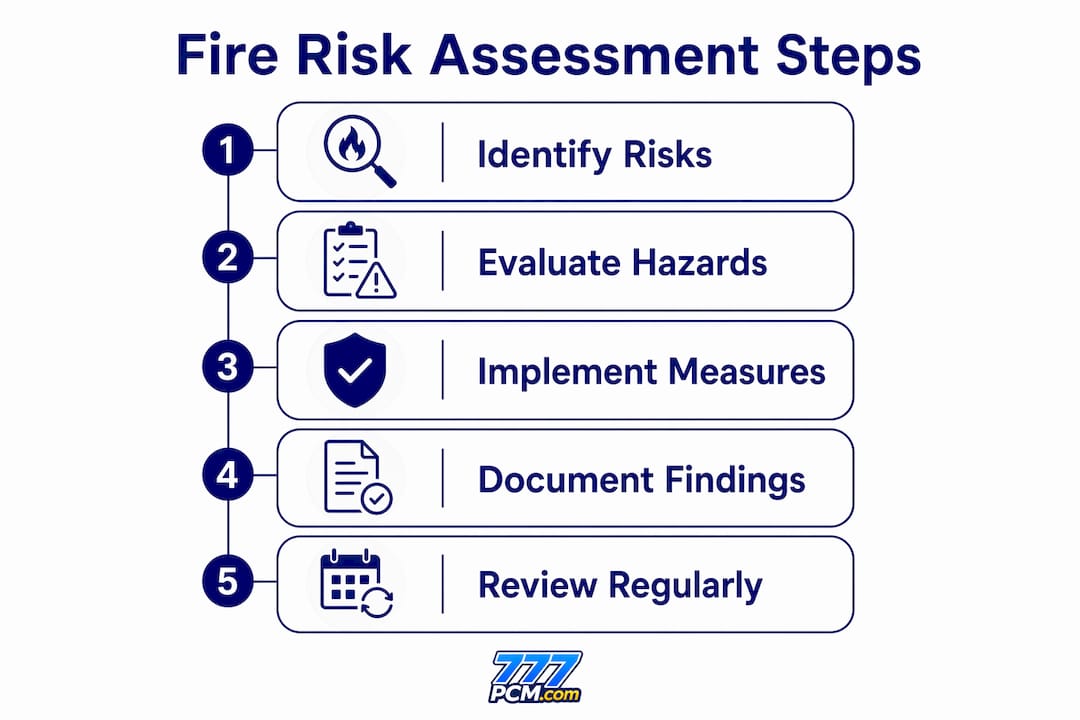
- Gather building information — floor plans, construction type, occupancy details, and any previous assessments
- Identify fire hazards — ignition sources (faulty electrics, cooking equipment), fuel loads (stored materials, furnishings), and oxygen sources
- Identify people at risk — tenants, visitors, contractors, and anyone in the immediate vicinity
- Evaluate existing precautions — alarm systems, escape routes, fire doors, emergency lighting, and signage
- Evaluate the risk level — combine likelihood of fire with potential consequences to determine overall risk
- Identify additional measures needed — gaps between current precautions and what is required
- Record findings — document everything, including the assessor's name and organisation
- Produce a prioritised action plan — assign timescales and responsibilities for each remedial measure
- Review and update — revisit the assessment at regular intervals or after any significant change
Who can carry out the assessment? Landlords may legally conduct their own assessments if they are competent to do so. For a straightforward single-let property with simple layout and low occupancy, a knowledgeable landlord can manage this. For anything more complex, including blocks of flats, older buildings, or properties with unusual construction, a qualified specialist is the only realistic way to meet the "suitable and sufficient" standard. You can find guidance on locating a competent assessor through the GOV.UK fire safety guidance pages.

What fire safety measures must landlords provide?
Beyond the assessment itself, landlords have specific obligations to install and maintain physical safety features. The GOV.UK private renting guidance sets out the core requirements clearly.
- Smoke alarms on every storey of the property
- Carbon monoxide alarms in any room containing a solid fuel burning appliance
- Clear escape routes accessible to tenants at all times, free from obstructions
- Fire-safe furnishings — all furniture and soft furnishings supplied by the landlord must meet fire resistance standards under the Furniture and Furnishings (Fire Safety) Regulations 1988
- Fire doors where required, fitted with functioning self-closing devices and intumescent strips
- Fire extinguishers and fire alarms in large HMOs
The Fire Safety Act 2021 clarified that flat entrance doors and external walls, including balconies, fall within the scope of the fire risk assessment. Regular checks on self-closing devices are now a specific requirement under the Fire Safety (England) Regulations 2022. For detailed guidance on alarm placement and specification, the smoke alarm requirements for rental properties are worth reviewing alongside the legislative text.
What extra rules apply to Houses in Multiple Occupation?
HMOs face more stringent fire safety requirements than standard single-let properties, reflecting the higher occupancy density and shared living arrangements. The RICS fire safety guidance for landlords confirms that HMOs require additional features as a baseline.
- Fire doors on all habitable rooms, not just communal corridors
- Interconnected fire alarm systems so an alarm in one room triggers all detectors throughout the property
- Tailored evacuation plans accounting for the number of occupants and layout
- Assessment of communal areas as a distinct part of the fire risk assessment, separate from individual rooms
- Mandatory fire extinguishers and fire blankets in shared kitchens
- Clear signage on escape routes and assembly points
The Responsible Person for an HMO must share fire safety information with all residents, not merely post a notice. This includes the risks identified, the measures in place, and the identity of the assessor. For a broader view of the landlord safety certificates that sit alongside fire safety obligations in an HMO, it is worth mapping all compliance requirements together.
Tenant responsibilities and practical ways to reduce fire risk
Tenants carry their own duties under fire safety law. They must follow the fire safety instructions provided, avoid blocking escape routes, report faults with alarms or fire doors promptly, and refrain from actions that create unnecessary fire hazards, such as overloading sockets or using prohibited appliances.
Landlords can actively support a safer environment by:
- Communicating fire safety measures clearly at the start of each tenancy and in writing
- Conducting regular property inspections to check that escape routes remain clear and alarms are functioning
- Acting promptly on reported defects — a faulty smoke alarm or damaged fire door left unrepaired is both a safety risk and a compliance failure
- Providing a tenant safety checklist so occupants understand their specific responsibilities
- Keeping records of all inspections and remedial works as evidence of active risk management
Good communication between landlord and tenant is one of the most underrated elements of fire safety. A tenant who understands why the fire door must stay closed, or why the hallway cannot store bicycles, is far more likely to comply than one who has never been told.
How does a fire risk assessment differ from other safety checks?
A fire risk assessment is not the same as a CP12 gas safety certificate or an Electrical Installation Condition Report (EICR). The RICS guidance is unambiguous: gas and electrical certificates do not substitute for a fire risk assessment, and treating them as equivalent is one of the most common compliance errors landlords make.
- A CP12 confirms that gas appliances and pipework are safe. It says nothing about fire spread, escape routes, or alarm adequacy.
- An EICR assesses the condition of fixed electrical installations. It does not evaluate fire hazard management across the whole building.
- A fire risk assessment takes a whole-building view, covering structural elements, occupant behaviour, emergency planning, and the interaction between all fire precautions.
Common landlord pitfalls include failing to update the assessment after refurbishments, overlooking flat entrance doors and external walls, and assuming a basic checklist satisfies the "suitable and sufficient" standard. It does not. The Home Office guidance is explicit that a suitable and sufficient assessment must be a thoughtful, documented analysis with a clear safety management plan behind it.
Pro Tip: When selecting an assessor, check that they hold a recognised qualification relevant to your property type. Competence for a low-rise single-let is not the same as competence for a high-rise block of flats. Always record the assessor's name and organisation in your documentation.
What causes most fires in rental properties?
Understanding the most common ignition sources helps landlords target their assessments and preventive measures more effectively. Cooking equipment is consistently the leading cause of accidental dwelling fires in England, followed by electrical faults, including faulty wiring, overloaded sockets, and defective appliances. Smoking materials, candles, and portable heaters account for a further share of incidents.
Rental properties carry particular risk factors. High tenant turnover means occupants may be unfamiliar with the property layout and escape routes. Shared kitchens in HMOs concentrate cooking risk. Older properties often have ageing electrical installations that predate modern safety standards. A well-conducted fire hazard evaluation of a rental property will map these specific risks rather than applying a generic template.
How often should you review a fire risk assessment?
The Regulatory Reform (Fire Safety) Order 2005 requires landlords to review their assessment regularly to keep it up to date. There is no fixed statutory interval for most residential properties, but the widely accepted professional standard is an annual review as a minimum.
A review is also required whenever:
- The property undergoes structural alterations or refurbishment
- There is a change in occupancy type or number of residents
- A fire or near-miss incident occurs
- New fire safety legislation comes into force
- The assessor or Responsible Person changes
For complex properties or those with a history of fire safety issues, more frequent reviews are advisable. Treating the assessment as a living document rather than a one-off exercise is what separates genuine compliance from paper compliance.
What to do after the fire risk assessment
Completing the assessment is the starting point, not the finish line. Once the assessment is done, landlords should work through the action plan systematically, prioritising any items rated as high risk. Remedial works should be completed within the timescales set in the plan, and every action taken should be recorded with a date and description.
Keep the full written assessment, the action plan, and records of completed works in a place that is readily accessible to enforcement authorities. Since October 2023, the record must include the assessor's name and, where applicable, their organisation. Share the relevant fire safety information with residents, including the risks identified and the measures in place to manage them. When a new tenancy begins or a new Responsible Person takes over, pass the documentation on so continuity of compliance is maintained. A rental property compliance checklist can help you track all outstanding actions alongside your other statutory obligations.
777pcm keeps your property compliant without the complexity
Property compliance covers a lot of ground: gas certificates, electrical reports, EPCs, and fire safety obligations all running on different timescales. 777pcm handles the full picture for landlords and property managers across the UK, with in-house engineers and trade specialists managing every certificate, inspection, and remedial job through a single point of contact.

No subcontractors, no chasing multiple trades, no gaps in your compliance records. 777pcm coordinates scheduling, access, certification, and follow-up works directly, so your portfolio stays legal and your tenants stay safe. Whether you manage one property or a large portfolio, the process is the same: clear communication, qualified engineers, and documentation you can rely on at inspection.
Get your compliance sorted with 777pcm's property services and stop managing compliance from a spreadsheet.
Key takeaways
UK landlords must treat a fire risk assessment as a legally mandated, fully documented analysis covering the whole building, reviewed regularly, and backed by a clear action plan to reduce fire risk as low as reasonably practicable.
| Point | Details |
|---|---|
| Legal duty under the Fire Safety Order | Article 9(1) of the Regulatory Reform (Fire Safety) Order 2005 requires a "suitable and sufficient" assessment for all premises in scope. |
| Full recording now mandatory | Since October 2023, landlords must record the complete assessment and the assessor's name, not just significant findings. |
| Assessments cover the whole building | Flat entrance doors, external walls, and balconies are all within scope under the Fire Safety Act 2021. |
| HMOs face stricter requirements | HMOs require interconnected alarms, fire doors on all habitable rooms, and tailored evacuation plans as a baseline. |
| 777pcm manages compliance end to end | 777pcm coordinates certificates, inspections, and remedial works for landlords across the UK through in-house engineers. |