
Property companies typically commission six core decorating services: interior painting, wallpapering and feature walls, woodwork and joinery finishing, specialist coatings, exterior painting, and end-of-tenancy touch-ups. For a void turnover between tenancies, interior painting and touch-up decorating does most of the work. For long-term upgrades that boost rental value, wallpapering, staging, and specialist finishes earn their cost back. For communal blocks and managed buildings, exterior painting and shared-area decorating need careful access planning and committee sign-off.
- Void turnover: interior painting, touch-up and void-repair decorating
- Long-term upgrades: wallpapering, feature walls, specialist finishes, staging
- Communal or managed blocks: exterior painting, shared-area decorating with agent coordination
777pcm coordinates decorating alongside compliance checks and remedial trades, so a repaint doesn't mean a separate visit for the plasterer, electrician, or gas engineer.
Key Takeaways
Decorating quality in rental properties depends on surface preparation and contractor vetting far more than on paint brand or colour choice.
| Point | Details |
|---|---|
| Match service to purpose | Use interior painting and touch-ups for void turnover, staging and specialist finishes for long-term value uplift. |
| Preparation decides longevity | Insist on named filling, sanding, and priming steps in every quote before comparing prices. |
| Vet credentials, not just cost | Check PDA membership, TrustMark registration, and minimum £1 million public liability insurance. |
| Structure payments in stages | Expect a modest deposit, a progress payment, and a final balance on completion. |
| Coordinate trades to cut voids | 777pcm delivers decorating alongside compliance and remedial works through one in-house team, reducing repeat site visits. |
Table of Contents
- Types of decorating services for rental properties explained
- What a professional decorating job includes: process and quality signals
- How to vet and choose decorators for a rental portfolio
- Scheduling decorating around occupied and multi-occupancy properties
- Typical costs and timelines for decorating projects
- Communal and managed-block decorating: access and permissions
- Specialist decorating services worth knowing about for rentals
- Decorating services tailored to flats, houses, and commercial units
- Environmentally friendly and low-VOC decorating options
- Handling décor style and tenant preferences in rental properties
- A practitioner's view on decorating and compliance together
- How 777pcm brings decorating and compliance under one roof
- Frequently asked questions
- Sources
Types of decorating services for rental properties explained
Every rental property eventually needs the same handful of decorating jobs. What changes is the specification, and getting that right is what separates a job that lasts three years from one that needs redoing after eight months.
- Interior painting. Walls, ceilings, and woodwork typically get two coats of emulsion on walls and ceilings, with a mist coat first on bare or freshly plastered surfaces. Trade-grade paints in mid-sheen or matt finishes tend to hold up better against scuffs than budget retail tins, which matters when a property turns over tenants every twelve to eighteen months.
- Wallpapering and feature walls. A single feature wall behind a bed or in a hallway can lift a listing photo considerably, but full-room wallpaper is a harder sell in a rental. It's harder to patch after tenant damage and slower to strip between lets, so most letting agents restrict it to one wall in living areas or hallways.
- Specialist finishes. Textured coatings, limewash effects, and Venetian plaster look striking in show flats, but they cost more to apply and are difficult to spot-repair. For a rental you're likely to relet within two years, standard emulsion usually beats a specialist finish on cost per year of use.
- Woodwork and joinery painting. Skirting boards, doors, and window frames need a different paint system (usually satinwood or eggshell) and often need sanding back to bare wood if previous coats have chipped. Exterior woodwork, including fascias and soffits, needs access equipment and weather-appropriate scheduling.
- Exterior painting. Render, brickwork, and cladding painting depends heavily on access. A ground-floor terrace is a different job to a three-storey block needing scaffolding or a tower system, and this is where quotes vary most.
- Staging and end-of-tenancy works. Staging dresses a property for viewings with furniture, soft furnishings, and finishing touches, while end-of-tenancy decorating repairs scuffs, fills holes, and refreshes high-wear areas before the next let. Professionally staged rentals can achieve faster lets or stronger rents, though the effect varies by local demand and property type.
Pro Tip: Ask your decorator to specify the exact paint system by name and sheen level in the quote, not just "two coats of paint." Vague specifications are how you end up with a matt finish that shows every fingerprint in a busy HMO kitchen.
What a professional decorating job includes: process and quality signals
A decorating quote tells you far more than its total figure. What it says about preparation tells you whether the job will still look good in year two.
The decisive checkpoint on any repaint is surface preparation: inspection, filling of cracks and nail holes, sanding back flaking areas, and priming bare patches before any topcoat goes on. Skip this and paint fails early, especially over old distemper or damp-affected plaster.
- Detailed inspection of walls, ceilings, and woodwork before quoting
- Filling, sanding, and spot-priming of damaged or bare areas
- A stated number of coats, including a mist coat on new plaster
- Named paint brand and product line, not just "trade paint"
- Flagging of remedial issues (damp, cracked plaster, rotten joinery) that need another trade first
- Access equipment specified where ceilings, stairwells, or exteriors need it
A reputable decorator names surface-preparation steps, coat counts, and paint brands in the quote itself; a quote that skips straight to a price per room without mentioning prep is worth questioning. If a decorator spots damp staining or movement cracks during inspection, that's a signal to bring in a plumbing or building specialist before paint goes anywhere near the wall, otherwise you're paying to redo it within months.
On payment, the standard industry structure is a modest deposit, a progress payment, and a final balance released once you're satisfied with the finish. Anything asking for full payment upfront is a departure from that norm worth querying.
How to vet and choose decorators for a rental portfolio
Price is the easiest thing to compare and the least useful. Process and credentials tell you far more about whether a job will hold up.
Start with membership and insurance. Painting and Decorating Association membership, TrustMark registration, and public liability insurance of at least £1 million are the three checks worth making before anything else, alongside NVQ or City & Guilds qualifications and evidence of manufacturer training on the paint systems they're using.
- PDA membership and TrustMark registration
- Public liability insurance, minimum £1 million, with proof on request
- NVQ, City & Guilds, or manufacturer-accredited training
- Photographed examples of previous work in similar managed or rented properties
For flats and HMOs specifically, experience matters more than it might seem. Contractors used to working in leasehold blocks understand access arrangements and can write quotes structured for committee approval, which saves weeks of back-and-forth with a managing agent.
- Ask for the full written quote, including prep, materials, and coat counts
- Confirm access and equipment needs upfront, not on the day
- Agree staged payments in writing: deposit, progress, final retention
- Set a snagging period and warranty terms before work starts
- Confirm dispute resolution steps in case the finish falls short
Pro Tip: If a decorator won't show you their public liability certificate before you've asked twice, treat that as the red flag it is. A legitimate tradesperson has this document ready and expects the question.
Refusal to detail preparation, demands for full upfront payment, and reluctance to show insurance documents are the three clearest warning signs across the whole vetting process.
Scheduling decorating around occupied and multi-occupancy properties
Getting a decorator into an occupied property or a shared block takes more planning than an empty flat between tenancies.
- Give tenants reasonable written notice of the visit, confirming dates, expected duration, and which rooms are affected
- Coordinate directly with the managing agent or residents' committee for any communal area work, since contractors experienced in these settings write quotes structured for approval rather than causing delays
- Sequence decorating after inspections and remedial trades but before final cleaning, so paint touch-ups don't get undone by a plumber's access hole
- Insist on dust sheets, extraction where sanding is involved, and daily clear-up, particularly in occupied bedrooms or kitchens
Coordinating trades in this order avoids the common trap of repainting a wall only to have it opened up again for a plumbing or electrical fix a fortnight later.
Typical costs and timelines for decorating projects
Costs vary by region and by how much preparation the property needs, so treat any figure as a shape rather than a fixed price. A single bedroom typically takes a day or two; a full two-bedroom flat repaint usually runs three to five working days depending on how many rooms need ceiling work as well as walls.
- Exterior projects take longer and depend heavily on weather and drying time between coats
- Scaffolding or tower access adds both cost and lead time, since it needs booking separately from the decorating slot
- Remedial work discovered mid-job (damp, cracked plaster) extends both cost and schedule
- Contractor-supplied trade paint is often better value than client-supplied retail paint, since trade formulations are designed for durability and coverage in fewer coats
Neglected interior presentation contributes to longer void periods and weaker rental income, which is worth weighing against the temptation to delay a repaint to save a few days of void time.
Communal and managed-block decorating: access and permissions
Decorating a stairwell, lobby, or shared landing is a different job to a single flat, mostly because of who needs to say yes before work starts.
Managing agents and residents' committees usually require sight of the contractor's insurance, a proposed schedule, and sometimes a method statement before communal work is approved. This isn't bureaucracy for its own sake. Shared spaces affect every resident's daily access to their home, so a fire escape blocked by paint tins for a week generates complaints fast.
The practical fix is choosing decorators who've done this before. Firms used to managed blocks structure their quotes with committee sign-off in mind, naming exact dates, working hours, and access routes rather than a vague "two weeks, flexible." That level of detail is usually what gets a proposal approved on the first pass rather than kicked back for clarification.
Timing also matters more in communal settings. Lifts, bin stores, and entry doors often need protective covering, and any scaffolding erected for exterior work needs separate sign-off from the freeholder or agent, sometimes with a party wall consideration if it touches a neighbouring building. Building this lead time into your project plan from the outset avoids a scramble later, and it pairs naturally with wider maintenance scheduling across a block, since decorating, gutter clearance, and communal lighting checks often need the same access window.
Specialist decorating services worth knowing about for rentals
Standard emulsion and gloss cover most jobs, but some rental properties need something more targeted.
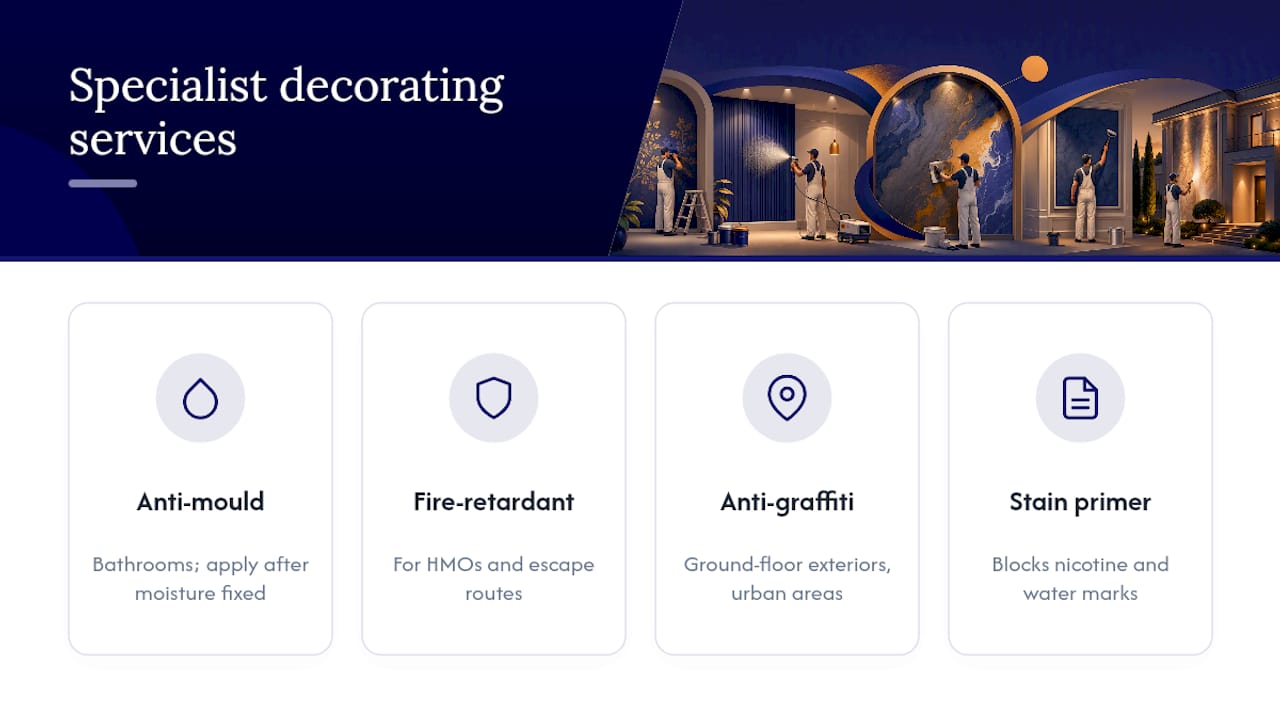
Anti-mould treatments matter most in bathrooms, poorly ventilated bedrooms, and any property with a history of condensation. These are usually anti-fungicidal paints applied after the underlying moisture issue has been addressed, not before, since painting over an active damp problem just delays the visible symptom rather than solving it. If a decorator suggests anti-mould paint as a fix without asking about ventilation or a moisture source, that's worth questioning.
Fire retardant coatings come up more often in HMOs and communal areas, where fire safety obligations are stricter than in a single-occupancy let. These coatings are usually specified for escape routes, communal stairwells, and sometimes timber cladding on exteriors, and they need to be applied to the correct standard rather than treated as a like-for-like swap for standard paint.
Other specialist options worth knowing about include anti-graffiti coatings for ground-floor exteriors in urban areas, and stain-blocking primers for properties with historic nicotine staining or water marks that would otherwise bleed through fresh paint. None of these are needed on every job, but flagging them at the quote stage, rather than discovering the need mid-project, keeps costs and timelines predictable.
Decorating services tailored to flats, houses, and commercial units
The property type changes what "decorating" actually involves more than most landlords expect.
Flats, particularly upper floors in managed blocks, come with access constraints that houses don't. Lifts have weight and size limits for materials, communal corridors need protecting, and any external work depends on scaffolding permissions from the freeholder. Interior work inside the flat itself is usually straightforward, but getting materials and equipment there safely takes more planning.
Houses give decorators more direct access, but exterior work on a semi-detached or terraced property often needs coordination with a neighbour if scaffolding or ladders cross a boundary line. Gardens and driveways typically make material storage and skip placement easier than in a block.
Commercial units, including retail premises or office space within a mixed-use building, usually need decorating scheduled around trading hours or between tenancies, with different fire safety and signage considerations than residential work. A commercial repaint might also need sign-off from a superior landlord if the unit sits within a larger managed estate, similar to the committee approval process for residential blocks.
Environmentally friendly and low-VOC decorating options
Low-VOC and water-based paints have moved from a niche request to a mainstream option most trade suppliers stock as standard.
Volatile organic compounds are the solvents that give traditional paint its strong smell and off-gas for days after application. Low-VOC formulations reduce this significantly, which matters most in occupied properties where tenants remain in situ during the work, or in bedrooms and children's rooms where extended ventilation isn't always practical.
Water-based versions of gloss and satinwood for woodwork have also improved considerably in recent years, closing much of the durability gap that used to make solvent-based paint the default choice for high-wear surfaces like skirting and door frames. For landlords weighing this up, the main trade-off is usually cost rather than performance, since low-VOC and eco-formulated ranges tend to sit slightly above standard trade paint on price per litre.
Ask your decorator directly whether they stock low-VOC ranges as standard or only on request, since this affects both the quote and how quickly you can re-let the property after work finishes.
Handling décor style and tenant preferences in rental properties
Décor choice in a rental is a balancing act between personal taste and what actually rents well.
Neutral colour schemes, off-whites, light greys, and muted tones, remain the default for a reason: they photograph well for listings, suit a broader range of furniture and tenant taste, and are easiest to touch up between lets without a full repaint. Bold colour choices can work in a single feature wall or a property targeting a specific tenant demographic, but committing a whole flat to a strong colour narrows your pool of prospective tenants.
Some landlords now offer tenants limited input on colour choice within a set palette, particularly for longer tenancies where retention matters more than rapid turnover. This isn't standard practice everywhere, but it can support the kind of tenant satisfaction that reduces the void periods and re-letting costs that come with more frequent changeovers.
Where a property is aimed at professional sharers or a family let, durability tends to matter more than styling flourishes, favouring washable finishes over statement wallpaper. Where it's aimed at a higher-end single-let market, staging and a slightly more considered palette can support the rent premium that comes with presentation.
A practitioner's view on decorating and compliance together
Surface preparation and an experienced team matter more than paint choice. Coordinating decorating with EICR and CP12 checks cuts repeat site visits, and a managed provider takes the scheduling burden off your desk entirely.
How 777pcm brings decorating and compliance under one roof
Repainting a flat and rewiring a socket shouldn't need two separate contractors, two separate site visits, and two separate invoices, yet that's how most landlords end up managing it. 777pcm runs decorating alongside plumbing, electrical, and compliance work through the same in-house team, so a decorator who spots a damp patch or a loose fitting can flag it to a qualified engineer on the same visit rather than leaving you to chase a second contractor.

That matters most once your portfolio grows past a handful of properties, or if you've dealt with the same access headaches on a managed block more than once. Booking gas safety checks, EICRs, and decorating separately across different trades multiplies the admin and the number of times a tenant needs to grant access. A single provider handling certification and remedial works together removes that duplication. If you manage a portfolio where repeat access issues or certification deadlines are becoming a scheduling problem, get a quote through 777pcm and see how decorating fits alongside your existing compliance and maintenance plan.
Frequently asked questions
What are the main types of decorating services property companies offer? The core services are interior painting, wallpapering and feature walls, woodwork and joinery painting, specialist finishes, exterior painting, and end-of-tenancy or void-repair decorating. Most landlords commission interior painting most frequently, since it applies to almost every turnover.
How much should I budget for decorating a rental flat? Costs vary by region, property size, and how much preparation is needed, so ask for an itemised quote rather than relying on a per-room average. A quote naming coat counts, paint brand, and prep steps gives a far more reliable basis for comparison than a bare total figure.
Do I need a specialist decorator for a managed block or HMO? Not strictly, but contractors experienced in leasehold blocks and multi-occupancy properties understand access permissions and committee approval processes, which usually saves time and avoids disputes over communal access.
Is low-VOC paint worth the extra cost for a rental property? It's worth it in occupied properties or rooms with limited ventilation, since it reduces the odour and off-gassing period after application. The performance gap against standard trade paint has narrowed considerably in recent years.
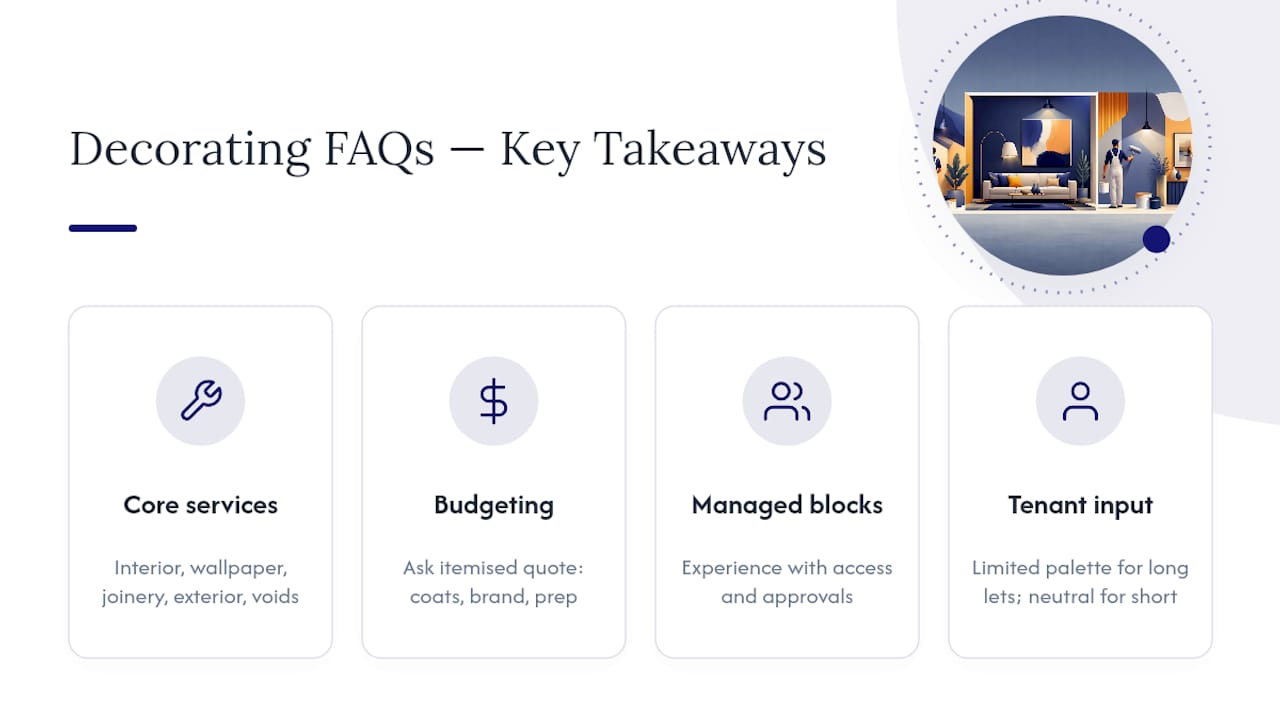
Should tenants have input on decorating choices? Some landlords allow limited colour choice within a set palette for longer tenancies, which can support retention. For shorter lets or high-turnover properties, neutral, durable finishes chosen by the landlord typically serve the property better.