
When an electrical fault is reported in a rental property, the property manager's job is to triage the hazard, deploy a tenant communication checklist across four timing windows, and book a qualified electrician registered with NICEIC or NAPIT to diagnose and carry out remedial work in line with BS 7671 (IET Wiring Regulations). Under the Electrical Safety Standards in the Private Rented Sector (England) Regulations 2020, remedial work must be completed within 28 days of the EICR identifying it, with written confirmation supplied to both the tenant and the local council within 28 days of completion. 777pcm offers a fully managed route covering triage, in-house certified electricians, EICR and remedial certificate management, and portal-based records.
Immediate action checklist:
- Isolate the affected circuit or consumer unit if there is an immediate danger; evacuate if there is a burning smell or sparking
- Log the incident with timestamp, photos, and tenant statement
- Contact a NICEIC or NAPIT-registered electrician for diagnosis
- Activate the tenant communication checklist (Hour 1 → Hour 4 → 24h → 48–72h)
- Collect the remedial certificate (EIC or MEIWC) and update property records once work is complete
Table of Contents
- How do you manage electrical remedial works clients step by step?
- What should you say to tenants, and when?
- What certificates and records does UK law require?
- How do you reduce tenant disruption and control costs?
- How do you vet and work with electricians in the UK?
- How do you use remedial data to prevent future electrical problems?
- In-house management or a managed compliance provider: which fits your portfolio?
- Key takeaways
- What good looks like, and where most managers fall short
- How 777pcm handles electrical remedial works for property professionals
- Useful sources for UK electrical compliance
How do you manage electrical remedial works clients step by step?
Property managers act as the linchpin between tenants and contractors. Scheduling, access, and communication sit firmly with the manager; technical diagnostics and execution belong to the licensed electrician.
- Intake and triage. Classify severity on first contact: emergency (sparking, burning smell, complete power loss), urgent (partial outage affecting essential services), or standard (single faulty socket, flickering light). For emergencies, advise the tenant to isolate the circuit and call 999 if there is fire or risk to life.
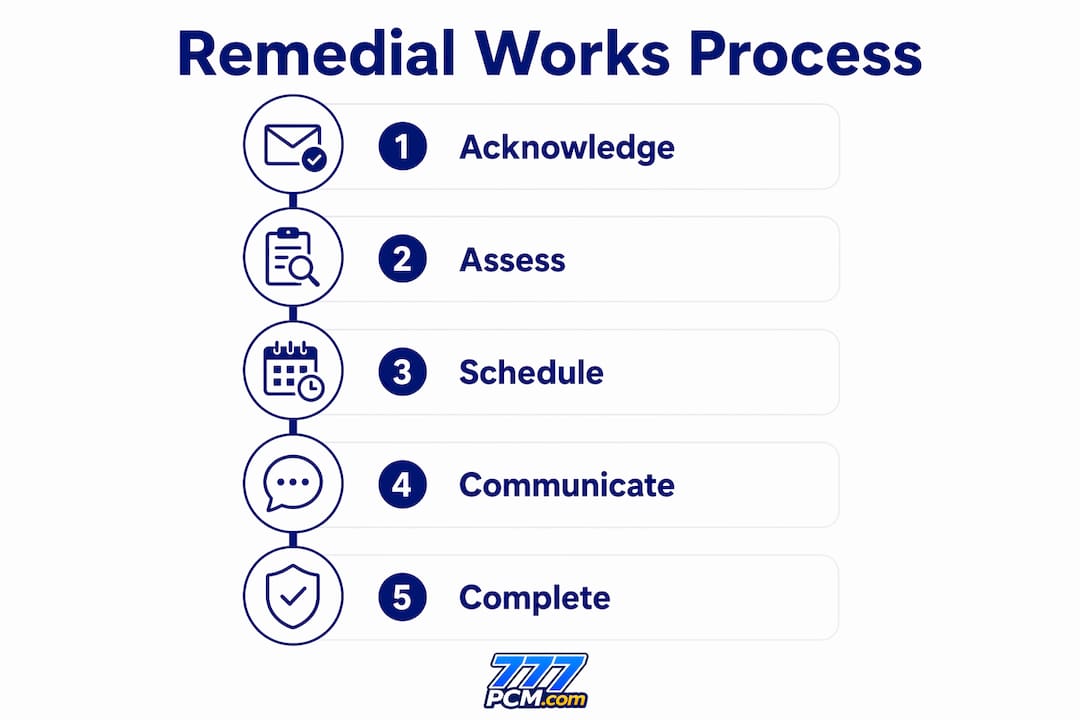
- Hour 1 actions. Acknowledge the report in writing, confirm the safety steps taken, and open a job record with timestamp and photos.
- Dispatch. For emergencies, deploy a pre-qualified electrician under a written SLA targeting a 2-hour response for critical hazards such as sparking outlets or burning smells. For urgent and standard jobs, schedule within the windows below.
- Approval. Confirm spend authority with the landlord or portfolio owner before committing to works above the agreed threshold.
- Documentation. Capture timestamps, photos, initial assessment notes, owner approval, vendor invoices, and the remedial certificate at every stage.
- Sign-off and close. Receive the EIC or MEIWC, update the asset register, notify tenant and owner, and file all records against the property unit.
| Stage | Timing | Owner | Action |
|---|---|---|---|
| Acknowledge | Hour 1 | Property manager | Confirm receipt, issue safety advice |
| Initial assessment | Hour 4 | Electrician + manager | Classify fault, confirm next steps |
| Repair ETA | 24h | Property manager | Share timeline and access windows with tenant |
| Confirmed schedule | 48–72h | Property manager | Confirm contractor arrival or completion |
Pro Tip: Pre-qualify at least one electrician under a written emergency SLA before a fault occurs. A verbal promise of fast response is not a reliable emergency resource.
What should you say to tenants, and when?
Clear, timely communication is the single most effective way to reduce follow-up calls and access failures. Realistic timelines maintain tenant trust far better than vague "as soon as possible" messaging.
- Hour 1: Acknowledge the report by SMS or phone. Confirm the safety steps the tenant should take and give a named point of contact.
- Hour 4: Send an update by email or SMS confirming the initial assessment, the severity classification, and the next action.
- 24h: Share the repair timeline, the planned access window, and any outage period. Request access confirmation.
- 48–72h: Confirm the contractor's arrival time or, for completed works, send a completion notice with the certificate reference.
Channel guidance: SMS for immediate acknowledgements; email for formal access notices and completion confirmations; phone for vulnerable tenants or complex situations. Every message should state the purpose, the expected outage window, access requirements, safety instructions, and who to call if circumstances change.
Pro Tip: Give tenants a concrete outage window (e.g. 8am–5pm on Wednesday) rather than a vague day. Specific windows reduce follow-up calls and improve access rates.
What certificates and records does UK law require?
The Electrical Safety Standards Regulations 2020 set the statutory framework. Landlords must hold a valid EICR, carry out any remedial work identified within 28 days, and supply written confirmation to tenants and the local council within 28 days of completion. Acceptable confirmation includes a satisfactory EICR, an Electrical Installation Certificate (EIC), or a Minor Electrical Installation Works Certificate (MEIWC).
Records to capture and store for every remedial job:
- Initial EICR with all observations and codes
- Photos of the fault before and after remediation
- Remedial electrician certificate (EIC or MEIWC)
- Owner approval record and spend authorisation
- Vendor invoice and permit documentation where applicable
- Tenant and council notification records with dates
All electrical work must be carried out by a qualified person. Using a NICEIC or NAPIT-registered electrician provides the verification trail insurers and local councils expect. Property managers must arrange and record remedial work but must not carry out technical electrical tasks themselves.
Closing a remedial job: checklist
- Receive signed technician sign-off and remedial certificate
- Upload certificate and photos to the property record
- Update the asset register with the work completed and next inspection date
- Notify the owner and tenant in writing with the certificate reference
How do you reduce tenant disruption and control costs?
Scheduling and transparency are the two levers that matter most. For planned works, give tenants at least 48 hours' written notice with a concrete outage window. Phase multi-unit programmes by floor or riser stack to avoid whole-building outages, and group inspections to reduce repeated access requests.
On costs, permit fees can materially affect budgets: pulling a permit for panel work can trigger additional code-compliance requirements such as GFCI outlets, smoke detectors, or grounding updates that were not in the original scope. Build a contingency of at least 15–20% into any panel or rewiring budget.
Preventive maintenance programmes can reduce emergency calls by 30–50% when incident data feeds capital planning.
Feeding remedial-job data into your capital plan is where the real savings accumulate. A recurring fault on a specific circuit type across multiple units is a signal to replace components portfolio-wide rather than repair them one by one.
Pro Tip: Set approval thresholds in writing before the season starts. A clear spend limit (e.g. up to £500 without owner sign-off) removes delays on routine repairs and keeps emergency response fast.
How do you vet and work with electricians in the UK?
Reputation alone is not sufficient. Experienced managers require vendors to show documented emergency response protocols and SLAs as part of vetting.
Vetting checklist:
- NICEIC or NAPIT registration (verify on the scheme's public register)
- Current Certificate of Insurance (COI) for public liability and employers' liability
- Written emergency protocols with defined response times
- Evidence of BS 7671 compliance and recent inspection experience in occupied buildings
- References from other property managers, not just homeowners
Questions to ask before appointing:
- What is your guaranteed response time for a sparking outlet at 2am?
- How do you handle permit applications for panel work?
- Who is the single point of contact for a multi-unit programme?
- Can you provide a sample remedial certificate (EIC or MEIWC)?
Red flags: no written emergency protocols; refusal to provide a COI; reluctance to issue remedial certification; unwillingness to pull permits when required.
For day-to-day working, confirm scope in writing before each visit, agree access windows with the tenant, and require weekly status updates for any programme spanning multiple units. The role of certified electricians in a rental portfolio is most effective when the manager controls scheduling and communication, leaving technical decisions entirely to the trade.

Pro Tip: Ask for a sample of a completed EIC or MEIWC before appointing. A contractor unfamiliar with the correct certificate format is a compliance risk.
How do you use remedial data to prevent future electrical problems?
Every remedial job is a data point. Capturing the right fields turns a reactive repair log into a preventive maintenance asset.
| Field | What to record |
|---|---|
| Property and unit | Full address and unit reference |
| Date and time | Fault reported and works completed |
| Issue type | Fault category (circuit, consumer unit, wiring, etc.) |
| EICR reference | Report number and inspection date |
| Remedial action | Work carried out and certificate issued |
| Cost | Labour, materials, permit fees |
| Vendor | Contractor name and registration number |
| Follow-up actions | Next inspection date or capital works flag |
Once you have three or more incidents of the same fault type across a portfolio, apply a Five Whys root-cause analysis to identify whether a component, installation era, or contractor is the common factor. Link findings to capital budgets and preventive maintenance schedules. A good preventive maintenance programme requires an asset inventory, a maintenance schedule, clear task ownership, and consistent documentation.
Pro Tip: Tag each job record by fault category in your property management system. Filtering by tag reveals recurring failure points that individual job reviews miss.
In-house management or a managed compliance provider: which fits your portfolio?
The right operating model depends on portfolio size, incident frequency, and internal resource.
In-house management suits smaller portfolios with a reliable preferred electrician, low incident frequency, and a manager who can absorb triage calls out of hours. The main advantages are direct control and no management markup. The risks are gaps in 24/7 cover, inconsistent documentation, and slower certification turnaround.
Managed compliance providers suit larger portfolios, high-turnover lettings, or managers who need guaranteed SLAs and centralised certificate records. A managed provider handles triage, dispatch, tenant communications, and certification in one workflow, with portal-based records accessible to owners and agents.
A hybrid approach works well for many managers: handle routine inspections and minor repairs in-house, and outsource emergency triage and certification management to a trusted partner. This keeps costs predictable while removing the 2am phone call from the manager's personal risk.
| Factor | In-house | Managed provider |
|---|---|---|
| 24/7 triage cover | Depends on manager availability | Included |
| Certification management | Manager's responsibility | Handled centrally |
| SLA guarantees | Informal | Written and contractual |
| Cost structure | Per-call trade costs | Fixed or portfolio fee |
| Audit trail | Manual | Portal-based, always accessible |
777pcm's model uses in-house certified electricians, dedicated account management, and a client portal so that every certificate, photo, and approval sits in one place, accessible whenever an owner, insurer, or local council asks for it.
Pro Tip: Whatever model you choose, get the emergency response SLA in writing. A contractor who verbally promises fast response but has no documented protocol is not a reliable emergency resource.
Key takeaways
Effective management of electrical remedial works requires a clear role split, a four-window communication timeline, and a complete documentation trail from EICR to remedial certificate.
| Point | Details |
|---|---|
| Remedial work deadline | UK law requires completion within 28 days of an EICR identifying the need, with written confirmation to tenant and council. |
| Tenant communication | Acknowledge at Hour 1, update at Hour 4, share timeline at 24h, confirm schedule at 48–72h. |
| Electrician credentials | Always verify NICEIC or NAPIT registration and require a written emergency SLA before appointing. |
| Preventive maintenance | Feeding incident data into capital planning can reduce emergency calls by 30–50% over time. |
| 777pcm managed service | 777pcm provides in-house certified electricians, EICR and certificate management, and portal-based records for landlords and letting agents across the UK. |
What good looks like, and where most managers fall short
The most common failure mode is not the electrical fault itself. It is the gap between the fault being reported and a coherent process taking over. Poor documentation, vague tenant communications, and the absence of written emergency SLAs are the three patterns that turn a manageable repair into a compliance liability.
What good looks like in practice is straightforward: a job record opens the moment a fault is reported, a qualified electrician is dispatched under a written SLA, the tenant receives a concrete update at each timing window, and the remedial certificate is filed against the property record before the job is closed. When that sequence runs consistently, owners rarely escalate, insurers rarely challenge, and local councils rarely intervene.
The audit trail is the underrated asset. A complete record of the initial EICR, photos, remedial certification, and tenant notifications is what protects a landlord during a sale, a refinance, or a dispute. Managers who treat documentation as an afterthought discover its value at exactly the wrong moment.
How 777pcm handles electrical remedial works for property professionals

777pcm removes the coordination burden that makes electrical remedial works stressful for property managers and letting agents. Rather than chasing separate contractors for triage, certification, and records, you get a single point of contact backed by in-house certified electricians who carry out the work, issue the correct certificates, and update your portal records in one workflow. Every EICR, EIC, and MEIWC is stored centrally, so when an owner, insurer, or local council asks for documentation, it is ready immediately.
The service covers 24/7 triage, remedial electrical works, EICR certificate management, and tenant communications across residential portfolios throughout the UK. No subcontractors, no chasing paperwork, no compliance gaps. To arrange a consultation or get a quote for your portfolio, visit 777pcm.com.
Useful sources for UK electrical compliance
- GOV.UK Electrical Safety Standards Guidance: verify the 28-day remedial deadline, acceptable certificate formats, and local council enforcement powers at gov.uk/government/publications/electrical-safety-standards-in-the-private-and-social-rented-sectors-guidance
- The Electrical Safety Standards in the Private Rented Sector (England) Regulations 2020: read the full statutory text at legislation.gov.uk/uksi/2020/312/contents/made; check Part 3 (remedial action) and Part 4 (urgent remedial action) specifically
- NICEIC: verify contractor registration and find approved electricians at niceic.com; check registration before every appointment
- NAPIT: alternative approved scheme; verify registration at napit.org.uk
- IET Wiring Regulations (BS 7671): the technical standard all UK electrical installation work must meet; available via the IET at theiet.org
- Electrical certification guide for property firms: practical explanation of EICR and remedial certificates at blog.777pcm.com
- Tenant safety responsibility checklist: a structured safety checklist for landlords at blog.777pcm.com
Store links to each of these sources in your property compliance file and include them in the onboarding pack for any new contractor or letting agent joining your portfolio management team.