
Electrical certification is the formal process by which qualified engineers inspect, test, and document the safety of fixed electrical installations in rental properties. The role of electrical certification property firms extends well beyond issuing a piece of paper. These firms verify that your property meets the standards set by the Electrical Safety Standards in the Private Rented Sector (England) Regulations 2020, protecting tenants, satisfying insurers, and shielding you from penalties that can reach £30,000 per breach. Recognised certifying bodies such as NICEIC, NAPIT, and ELECSA define who is qualified to carry out this work legally.
What legal obligations do landlords have for electrical certification?
The Electrical Safety Standards in the Private Rented Sector (England) Regulations 2020 require landlords to have fixed electrical installations inspected every five years by a qualified person. That inspection must result in a written report, which you must provide to existing tenants within 28 days and to local authorities within 7 days of a request. New tenants must receive the report before they move in.
The financial consequences of ignoring these rules are serious. Penalties for non-compliance can reach £30,000 per breach. That figure is per property, per breach, which means a portfolio landlord who lets multiple certificates lapse simultaneously faces compounding exposure.

The regulatory picture is also changing for larger operators. From 2026/27, social housing landlords managing more than 1,000 homes must publish electrical safety check performance data. This transparency requirement signals a broader direction of travel: regulators expect landlords to treat electrical safety as an ongoing, documented commitment rather than a one-off tick-box exercise.
Key obligations at a glance:
- Inspect fixed electrical installations every five years
- Provide the report to tenants within 28 days of the inspection
- Supply the report to the local authority within 7 days if requested
- Carry out any remedial work specified in the report within 28 days
- Retain copies of all reports for at least two inspection cycles
How do electrical certification firms conduct inspections?
The primary document produced by an electrical certification firm is the Electrical Installation Condition Report, universally known as an EICR. This report records the condition of all fixed wiring, consumer units, earthing arrangements, and protective devices within a property. The inspecting electrician assigns each observed defect a code: C1 for immediate danger, C2 for potentially dangerous, C3 for improvement recommended, and FI for further investigation required.
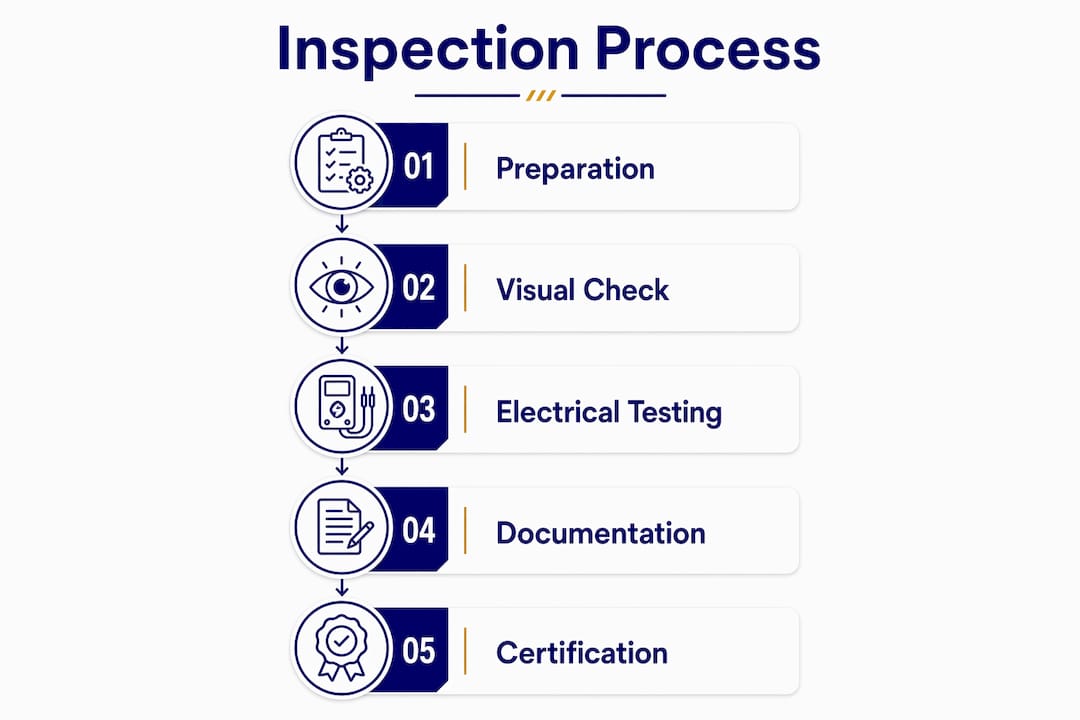
The inspection process follows a structured sequence:
- Visual inspection of all accessible electrical components, including sockets, switches, light fittings, and the consumer unit
- Dead testing of circuits with the power off, checking insulation resistance and continuity of protective conductors
- Live testing to verify the correct operation of residual current devices (RCDs) and overcurrent protection
- Documentation of all findings against the schedule of circuits, producing the EICR with coded observations
One distinction that trips up many landlords is the scope of an EICR. An EICR covers only fixed electrical installations; it does not replace Portable Appliance Testing (PAT) for tenant appliances or fire alarm certifications. In houses in multiple occupation (HMOs), separate mandatory certification streams exist for each of these areas. Treating an EICR as a catch-all document is a common and costly misunderstanding.
Pro Tip: Ask your certification firm to provide a schedule of circuits alongside the EICR. This document maps every circuit in the property and becomes invaluable when planning renovations or investigating faults later.
Electricians conducting legally valid inspections must be registered with a recognised scheme such as NICEIC, NAPIT, or ELECSA. Using an unregistered person does not satisfy the legal requirement, regardless of how thorough the inspection appears.
Why does electrical certification matter for liability and insurance?
Electrical certification is the first line of defence against fire and electrocution risks in rental properties. Faulty wiring is one of the leading causes of domestic fires in the UK, and a current, satisfactory EICR demonstrates that you have taken reasonable steps to prevent harm. Without that evidence, your position in any legal dispute becomes very difficult to defend.
Insurers have made their position clear. Insurance providers require a current EICR for coverage to remain valid, and the absence of one can lead to outright claim rejection. This means a landlord whose property suffers an electrical fire without a valid certificate may find their insurer refusing to pay out, leaving them personally liable for repair costs, tenant compensation, and legal fees.
"Without a current EICR, insurers frequently reject claims relating to electrical hazards, exposing landlords to direct financial loss." — Elsys Electrical
The impact on property value and lender confidence is equally real. Mortgage lenders increasingly request evidence of electrical compliance during refinancing or portfolio reviews. Prospective tenants, particularly in competitive rental markets, treat a valid EICR as a signal of a well-managed property. The benefits of certified electrical systems therefore extend beyond legal compliance into commercial advantage.
Consider also the liability position in multi-let commercial buildings. Landlords typically retain responsibility for communal electrical areas, while tenants hold responsibility for their own demised premises. Lease terms shape this distribution, but the landlord's exposure in communal areas is absolute. A lapsed certificate in a shared corridor or plant room creates direct liability.
Independent firms vs installer-led certification: which should you choose?
Not all electrical certification is equal. The distinction between installer-led certification and independent third-party testing is one that many property owners overlook, often to their detriment.
| Provider Type | Independence | Conflict of Interest Risk | Typical Use Case |
|---|---|---|---|
| Installing electrician self-certifying | Low | High: certifies own work | New installations only |
| General electrical contractor | Medium | Moderate: commercial relationship | Routine inspections |
| Independent testing firm (NETA-accredited or equivalent) | High | Low: no prior installation relationship | Portfolio compliance, dispute resolution |
Independent third-party testing firms provide structurally unbiased electrical system assessments. This independence protects data integrity over commercial interest. When an electrician certifies their own installation, the incentive to overlook minor defects is present, even unconsciously. An independent firm has no such incentive.
Third-party certified testing avoids the conflicts of interest inherent in installer-led certification. For landlords managing multiple properties or facing a council audit, this distinction can determine whether a certificate stands up to scrutiny.
Pro Tip: When selecting a certification provider, ask whether the firm has carried out any previous installation or remedial work on the property. If they have, consider commissioning a separate independent firm for the EICR to remove any question of bias.
Working with estate agents who already have established relationships with accredited certification firms can also simplify the process considerably, particularly for landlords new to managing rental portfolios.
How can property owners maintain compliance between inspections?
Maintaining electrical safety compliance is not a five-year event. It is an ongoing responsibility that sits between formal inspections and requires active management.
The most common reason landlords fail council audits is not a missing certificate. It is missing documentation linking remedial work to certification findings. If your EICR identifies a C2 defect and you commission a repair, you must retain written evidence connecting that repair to the specific defect. Without this compliance trail, the repair may as well not have happened in the eyes of an auditor.
An electrical certificate is also a snapshot in time. Changes in property layout or usage require fresh inspections to confirm ongoing safety. Converting a loft, subdividing a flat, or adding a new circuit all trigger the need for re-inspection before the five-year cycle is due. Landlords who assume their certificate remains valid through significant alterations are taking a risk that property modifications can nullify previous safety reports entirely.
Practical steps to stay compliant between inspections:
- Keep a property compliance folder containing every EICR, remedial invoice, and sign-off letter
- Record the date and nature of any electrical work carried out, even minor repairs
- Notify your certification firm before undertaking any structural or electrical modifications
- Coordinate access with tenants well in advance of inspection dates to avoid delays
- Set calendar reminders 12 months before each certificate expiry to allow time for scheduling
Understanding how often electrical testing must occur and what triggers retesting is the foundation of a sound compliance strategy. The five-year rule is a maximum interval, not a guaranteed safe period.
Key takeaways
Electrical certification is a legal requirement, a financial safeguard, and a direct measure of tenant safety that no landlord or property investor can afford to treat as optional.
| Point | Details |
|---|---|
| Legal inspection cycle | Fixed electrical installations must be inspected every five years by a NICEIC, NAPIT, or ELECSA-registered electrician. |
| Penalty exposure | Non-compliance with the 2020 Regulations can result in fines of up to £30,000 per breach. |
| Insurance validity | Insurers can reject claims relating to electrical hazards if a current, satisfactory EICR is not in place. |
| EICR scope | An EICR covers fixed installations only; PAT testing and fire alarm certification are separate, additional requirements. |
| Documentation trail | Linking remedial work to EICR findings in writing is the single most important step for surviving a council audit. |
Why landlords underestimate electrical certification at their peril
I have worked with property owners across a wide range of portfolio sizes, and the same misconception appears repeatedly. Landlords treat the EICR as a formality, something to obtain and file away. They do not read it. They do not act on C3 recommendations. They assume the certificate covers everything electrical in the building, including appliances and alarms.
That assumption is wrong, and it is expensive when it unravels. The landlords I have seen face the sharpest consequences are not those who ignored certification entirely. They are the ones who obtained a certificate from an unregistered electrician, or who commissioned a firm with a prior installation relationship and accepted a clean report without question. The certificate looked valid. It was not.
The industry is also shifting. Insurers are tightening their requirements, and the 2026/27 social housing transparency rules signal that regulators are moving toward continuous monitoring rather than periodic snapshots. Private landlords who adopt that mindset now, treating compliance as a living process rather than a five-year event, will be far better positioned as scrutiny increases.
My practical advice: choose an independent certification firm with no prior connection to your property, build a documented compliance trail from day one, and treat every EICR finding as a prompt for action rather than a report to archive.
— Mike
How 777pcm keeps your properties electrically compliant

777pcm provides end-to-end electrical certification and compliance services for landlords, letting agents, and property investors across the UK. The company's in-house certified electricians, all registered with recognised schemes, handle everything from scheduling and tenant access coordination to EICR completion and remedial works. There are no third-party subcontractors, which means consistent quality and clear accountability at every stage. If your EICR identifies defects, 777pcm manages the remedial work and produces the documentation trail that protects you during council audits and insurance claims. To book an inspection or discuss your portfolio's compliance needs, visit 777pcm's compliance services today.
FAQ
What is an EICR and why do landlords need one?
An Electrical Installation Condition Report (EICR) is a formal document produced by a qualified electrician after inspecting a property's fixed wiring and electrical systems. Landlords in England are legally required to obtain one every five years under the Electrical Safety Standards in the Private Rented Sector (England) Regulations 2020.
How much can a landlord be fined for not having a valid certificate?
Penalties for failing to comply with electrical certification requirements can reach £30,000 per breach. Local authorities have the power to issue these fines and can also carry out remedial works themselves and recover the costs from the landlord.
Does an EICR cover portable appliances and fire alarms?
No. An EICR covers fixed electrical installations only. PAT testing for portable appliances and fire alarm certification are separate requirements, both of which are mandatory in HMOs and other multi-occupancy properties.
When does a property need a new electrical inspection before five years?
A property requires a fresh inspection whenever significant changes are made to the electrical installation or the layout of the building. Converting a loft, subdividing a flat, or adding new circuits all trigger the need for re-inspection, regardless of when the last EICR was issued.
Who is qualified to carry out a legally valid electrical inspection?
Only electricians registered with a recognised scheme such as NICEIC, NAPIT, or ELECSA are qualified to conduct inspections that satisfy the legal requirement. Reports produced by unregistered individuals do not meet the standard set by the 2020 Regulations.