
A property maintenance schedule is a planned calendar of statutory safety checks, routine preventive maintenance and remedial works, organised so landlords, letting agents and property managers can keep rental properties legally compliant and safe. At its core, the schedule answers three questions: what needs doing, when, and who is responsible. For UK rental portfolios, that means tracking three non-negotiable certificates alongside a broader programme of preventive tasks.
The schedule's standard elements include:
- Certificate records: CP12 (Landlord Gas Safety Certificate), EICR (Electrical Installation Condition Report) and EPC (Energy Performance Certificate) with issue and expiry dates
- Inspection calendar: mapped due dates for each statutory check and recommended preventive task
- Owner assignment: named responsible person or contractor for each task
- Evidence log: file references for certificates, invoices and written confirmations
- Remedial window: deadline tracker for any required follow-up works
For landlords managing more than a handful of properties, a service like 777pcm can hold all of this in a single compliance portal, with in-house engineers covering gas, electrical and general maintenance across the portfolio.
Key takeaways
A property maintenance schedule is the single most practical tool for keeping rental properties legally compliant, with CP12, EICR and EPC cycles forming its non-negotiable core.
| Point | Details |
|---|---|
| Three core certificates | CP12 annually, EICR every 5 years; each has distinct renewal cycles and penalty exposure. |
| 28-day remedial rule | EICR remedial works must be completed within 28 days; supply written confirmation to tenants and local authority. |
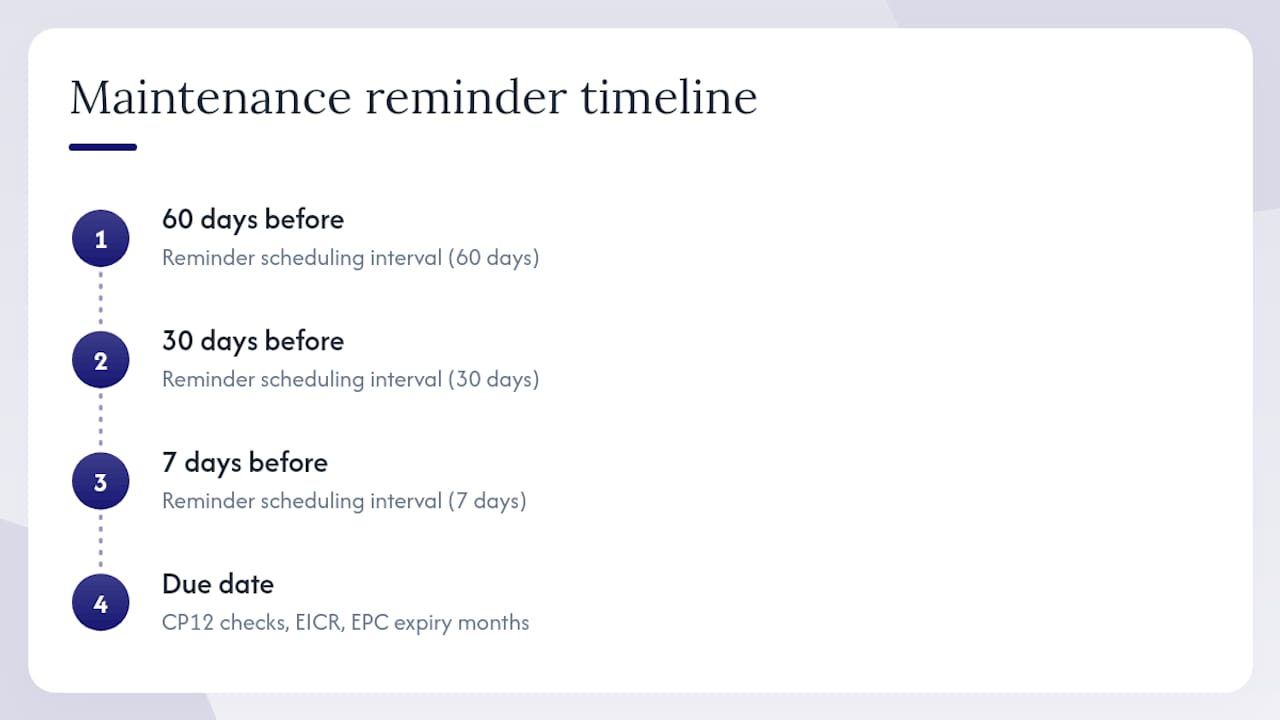
| Staged reminders | Set alerts at 60, 30 and 7 days before each certificate expiry to avoid lapses and scheduling gaps. |
| Centralise evidence | Store all certificates, invoices and remedial confirmations in one digital folder per property, timestamped at upload. |
| 777pcm managed service | 777pcm provides in-house CP12, EICR and EPC bookings plus remedial works and portal-based compliance records for portfolios. |
Table of Contents
- What does a property maintenance schedule contain?
- What are the statutory checks and how often are they required?
- How do you build a property maintenance schedule step by step?
- What records do you need to keep and how do you supply them?
- How do you prioritise hazards and manage remedial works?
- Sample 12-month maintenance calendar and checklist
- How do you manage maintenance schedules across a portfolio?
- The compliance gap most landlords underestimate
- 777pcm handles your compliance schedule end to end
- Sources
What does a property maintenance schedule contain?
A well-structured schedule is more than a list of dates. Each entry needs enough information to be auditable if a local authority or tenant requests evidence.
Essential fields for every task record:
- Property ID and full address
- Tenancy start and end dates (to trigger pre-tenancy checks)
- Certificate or task type (e.g. CP12, EICR, boiler service)
- Last inspection date and next due date
- Responsible person and contractor name
- Evidence file reference or document link
- Remediation deadline where applicable
Categorise tasks into four types: statutory checks, preventive maintenance, seasonal tasks and remedial actions. That distinction matters practically because statutory checks carry legal deadlines and penalty exposure, whereas preventive tasks are risk-managed by the landlord. Remedial actions are triggered by inspection outcomes, such as a C1 or C2 code on an EICR, and carry their own 28-day completion window.
Pro Tip: Set three advance reminders at 60, 30 and 7 days before each certificate expiry. LettingsLedger's certificate guide recommends this staged approach to avoid scheduling bottlenecks and give time for rebooking if an engineer cancels. Log all certificates in a single source-of-truth document rather than across separate email threads.
What are the statutory checks and how often are they required?
UK rental law sets minimum frequencies for several checks. Missing them is not an administrative oversight; it can be a criminal offence or attract substantial civil penalties.
Statutory minimums:
- CP12 gas safety check: required regularly, by a Gas Safe registered engineer; the record must be given to existing tenants promptly and to new tenants before they move in
- EICR: inspected and tested at intervals not exceeding five years, or sooner if the report specifies an earlier date; carried out by a qualified electrician following BS 7671 standards
- EPC: generally valid for a lengthy period; properties must meet Minimum Energy Efficiency Standards (MEES) requirements before being let
- Smoke alarms: fitted on every storey with living accommodation; carbon monoxide alarms required in rooms with fixed solid fuel burning appliances as legally mandated
- Legionella assessment: reviewed periodically or at least every couple of years, or sooner where circumstances change, per NRLA guidance
Remedial deadlines: Under the Electrical Safety Standards Regulations 2020, any remedial or investigative work identified in an EICR must be completed within 28 days (or the shorter period the report specifies). The report must be supplied to tenants within 28 days of inspection and to a local housing authority within 7 days of request.
Recommended preventive checks beyond the statutory floor include an annual boiler service, seasonal drainage and HVAC checks, and smoke/CO alarm tests at every change of tenancy. A comprehensive rental compliance checklist can help map these alongside the statutory items.
How do you build a property maintenance schedule step by step?
Building a schedule from scratch is straightforward when you follow a consistent method. The same process works for a single flat or a portfolio of fifty properties.
- Gather baseline documents. Collect the current CP12, EICR, EPC, Legionella assessment and tenancy agreements for each property. Note the issue date and expiry date of every certificate.
- Map statutory due dates into a master calendar. Use certificate issue dates and legal renewal cycles to calculate next-due dates. For EICR, the Electrical Safety Standards Regulations 2020 confirm the interval is no more than five years unless the report requires an earlier date.
- Risk-rate each task and set frequency. Gas and electrical checks are high-risk and non-negotiable. Legionella assessments and boiler services are medium-risk preventive tasks. Seasonal drainage checks are lower-risk but reduce costly reactive callouts.
- Assign owners and contractors. Name a responsible person for each task. Record contractor details, Gas Safe registration numbers for gas work, and any access or notice requirements for tenanted properties.
- Set reminders and escalation rules. Programme alerts at 60, 30 and 7 days before each due date. Define what happens if a task is missed: who escalates, what the fallback contractor is, and when a tenant or local authority notification is triggered.
- Review quarterly. Tenancy changes, new remedial works and mid-cycle repairs all affect the schedule. A quarterly review captures these and keeps the calendar accurate.
For practical guidance on structuring the handoffs between steps, the property maintenance workflow guide covers how to organise recordkeeping and contractor coordination in detail.
What records do you need to keep and how do you supply them?
Good record-keeping is the difference between a compliant landlord and one who cannot prove compliance when challenged.
Records to retain:
- CP12 certificates (keep for at least two years; supply to tenants within 28 days of inspection or before move-in)
- EICR reports and written confirmation of any remedial works completed
- EPC certificates
- Legionella risk assessments and review notes
- Boiler service invoices
- Smoke and CO alarm test records
- Written confirmation of EICR remedials, supplied to both tenant and local authority
Supply timelines: Since April 2021, all private rental properties in England must hold a valid EICR. Landlords must give tenants a copy within 28 days of inspection and supply it to a local housing authority within 7 days of request. The same 28-day window applies to written confirmation of completed remedial works.
Pro Tip: Centralise all certificates and invoices in a single digital folder per property, timestamped at upload. A single export from that folder then proves your compliance history without hunting through email chains. Social landlords should also retain ISIT (in-service inspection and testing) records for any electrical equipment they supply, keeping them until the next check supersedes them.
How do you prioritise hazards and manage remedial works?
Not every inspection finding carries the same urgency. EICR outcomes use a four-code system that tells you exactly how fast to act.
- C1 (Danger present): immediate action required; the property should not be let until the hazard is resolved
- C2 (Potentially dangerous): urgent remedial work required within the 28-day window
- C3 (Improvement recommended): no mandatory deadline, but worth scheduling to reduce future risk
- FI (Further investigation): investigation must be completed within the 28-day period before a final assessment can be made
For gas work, only a Gas Safe registered engineer may carry out repairs or testing. For electrical remedials, the contractor must be competent under BS 7671. Using unqualified tradespeople invalidates the certificate and may void insurance.
Where a landlord fails to act within the required period, local authorities have powers to arrange remedial work themselves and to impose financial penalties. Keeping a clear audit trail of when you received the report, when you instructed a contractor and when work was confirmed complete is the most practical protection against enforcement action.

Pro Tip: When coordinating repairs with tenants in situ, give written notice of the visit and confirm the contractor's arrival time. The landlord repairs coordination guide covers the notice requirements and practical steps for minimising disruption.
Sample 12-month maintenance calendar and checklist
The table below maps common tasks across a calendar year. Adjust the months to match your actual certificate anniversary dates.
Export this table as a CSV and import it into your portfolio tool or spreadsheet. 777pcm can supply templated imports for portfolio onboarding, pre-mapped to certificate cycles and remediation triggers.
How do you manage maintenance schedules across a portfolio?
A single property can be tracked in a shared spreadsheet with calendar reminders. A portfolio of ten or more properties needs something more structured, particularly when tenancy turnovers are frequent and remedial works overlap.
Workflow pattern for portfolio management:
- Central master calendar with one row per property per task
- Automated reminders at 60/30/7 days before each due date
- Local job allocation to named contractors with confirmation receipts
- Evidence upload to a digital folder immediately after each visit
- Quarterly compliance review to capture new works, tenancy changes and upcoming renewals
When in-house capacity is limited or remedial work is frequent, a managed service removes the scheduling burden entirely. The EchoPM maintenance request guide covers practical workflows for handling requests and recordkeeping at scale, which is useful context for landlords weighing up in-house versus outsourced management.
For portfolios with short tenancy turnovers or a high volume of statutory checks due in the same window, guaranteed engineer availability becomes the deciding factor. That is where a provider with in-house Gas Safe engineers and qualified electricians, rather than subcontracted trades, offers a material advantage.
The compliance gap most landlords underestimate
Most landlords know the certificate names. Fewer have a system that catches the gap between a certificate expiring and the replacement being booked. That gap is where enforcement risk lives.
The 28-day remedial window for EICR findings sounds generous until you factor in contractor availability, tenant access coordination and the time needed to obtain written confirmation of completed works. In practice, a C2 finding on a Friday afternoon can consume most of that window before a qualified electrician is even on site.
The same logic applies to CP12. An annual check sounds simple, but a portfolio of twenty properties means twenty separate booking windows, twenty tenant access arrangements and twenty certificates to file and distribute. A missed reminder on one property is a criminal liability, not an administrative inconvenience.
The fix is not complicated. A single master calendar, staged reminders and a contractor relationship you can rely on at short notice covers most of the risk. What makes the difference at portfolio scale is having those contractors in-house rather than sourced reactively.
777pcm handles your compliance schedule end to end
Keeping a rental portfolio compliant means managing CP12 renewals, EICR cycles, EPC validity and remedial deadlines simultaneously, often across properties with different anniversary dates and tenancy patterns. 777pcm takes that coordination off your plate entirely.

With in-house Gas Safe registered engineers and qualified electricians, 777pcm books and completes CP12, EICR and EPC certificates directly, without subcontracting. Remedial works identified in an inspection are handled by the same team, with written confirmation supplied to you and your tenants within the required timelines. Every certificate and job record is stored in a dedicated compliance portal, so a single export proves your full compliance history on request.
For landlords and letting agents ready to bring their portfolio up to date, book your CP12 or EICR with 777pcm or visit 777pcm to discuss portfolio onboarding.
Sources
The sources below back the statutory claims in this article. For definitive legal wording, use the legislation.gov.uk link; for practical landlord checklists, the NRLA and sector guides are the most accessible starting point.
- Gov
- The Electrical Safety Standards in the Private Rented Sector and Social Rented Sector (England) Regulations 2020
- Landlord compliance: a safety checklist for landlords | NRLA
- Certificate expiry deadlines: Landlord reference guide 2026 | LettingsLedger
- What Certificates Do Landlords Need? (2026 Guide) | ComplianceOS
This article is general information, not a substitute for advice from a qualified lawyer. Consult a qualified legal professional about your own circumstances before acting on anything here.