For UK property investors, the most reliable approach is a portfolio-ready, end-to-end compliance provider that employs in-house Gas Safe registered engineers and NICEIC or NAPIT-accredited electricians, issues CP12s, EICRs, and EPCs on a managed schedule, and stores every certificate in a single digital portal. That combination removes the coordination risk of juggling multiple contractors and keeps your portfolio compliant without gaps.
Your immediate next step: book a portfolio compliance audit or a CP12/EICR bundle through a provider's compliance portal before any certificate expires.
Key trust signals to confirm before you book:
- Gas Safe Register number on the engineer's ID card, verifiable online
- NICEIC or NAPIT registration for all electrical work
- CP12 (landlord gas safety certificate) issued annually
- EICR (Electrical Installation Condition Report) at least every five years
- EPC supplied for all lettings
Pro Tip: Ask any prospective provider to show you a sample CP12 and EICR before you commit. The formatting and detail level tells you a great deal about their process quality.
Key takeaways
UK landlords face statutory deadlines for CP12, EICR, EPC, and alarm compliance, and the most reliable way to meet them across a portfolio is through a single end-to-end provider with in-house engineers and a centralised compliance portal.
Table of Contents
- What safety certificates do UK landlords legally need?
- How do you choose a property safety certificate service?
- What do safety inspections cost and how long do they take?
- Why does an end-to-end provider suit investors with multiple properties?
- How does 777pcm handle compliance for landlord portfolios?
- 777pcm makes portfolio compliance straightforward
- Sources
What safety certificates do UK landlords legally need?
Understanding your obligations is the foundation of any investor's compliance plan. The law is specific, and the penalties for missing deadlines are real.
| Certificate | Frequency | Key obligation |
|---|---|---|
| CP12 (gas safety) | Annual | Gas Safe engineer; tenant copy within 28 days; records kept 2 years |
| EICR | Every 5 years | Qualified electrician; remedial works within 28 days |
| EPC | Required before marketing a property to let | There is no fixed renewal interval for EPCs in England; an EPC is valid for up to ten years, unless a new one is required due to significant changes or regulations. |
| Smoke/CO alarms | Check at tenancy start | Repair or replace when reported faulty |
Gas safety (CP12). Landlords must arrange an annual gas safety check by a Gas Safe registered engineer, keep the record for two years, and give each tenant a copy within 28 days. New tenants must receive their copy before they move in. Communal appliances in HMOs and blocks are included in this duty, which catches many portfolio investors off guard.

Electrical safety (EICR). The Electrical Safety Standards in the Private Rented Sector (England) Regulations 2020 require an inspection at least every five years by a qualified person. Any remedial work identified must be completed within 28 days, or sooner if the report specifies. Copies go to tenants and to the local council on request. Guidance updated in 2025 extended these duties into the social rented sector, so mixed portfolios now face a wider compliance perimeter.
Smoke and carbon monoxide alarms. The Smoke and Carbon Monoxide Alarm (England) Regulations 2015 require a smoke alarm on every storey and a CO alarm in any room containing a fixed combustion appliance. Alarms must be checked on the first day of each new tenancy and repaired or replaced promptly when a tenant reports a fault. A full breakdown of alarm requirements is covered in our smoke alarm requirements guide.
EPC and HHSRS. GOV.UK confirms that landlords must supply an EPC for all lettings and keep properties free from hazards assessed under the Housing Health and Safety Rating System (HHSRS). Councils can issue improvement notices, carry out remedial work themselves and recover the cost from the landlord. The HHSRS covers 29 hazard categories, making it a broad enforcement tool that goes well beyond certificates alone.
How do you choose a property safety certificate service?
Choosing the right provider for investor safety certification is not just about price. At portfolio scale, the wrong supplier creates compliance gaps that compound quickly.
Core checklist for vetting suppliers
- Confirm Gas Safe registration numbers before any engineer visits a property.
- Verify electrical contractors hold NICEIC, NAPIT, or equivalent accreditation and carry appropriate public liability and professional indemnity insurance.
- Establish whether the provider uses in-house engineers or subcontractors. In-house teams offer faster mobilisation and clearer accountability.
- Check geographic coverage against your portfolio map, not just the provider's headline claim.
- Ask for a sample turnaround time: how long from booking to CP12 issue, and from EICR completion to written remediation confirmation?
- Confirm how certificates are stored and whether you can export records for council requests or due diligence.
Questions worth asking directly:
- What is your SLA for emergency attendance?
- How are remedial works quoted and authorised after an EICR?
- Do you offer bulk-booking discounts and a single invoice for multiple properties?
- How do you send automated reminders for expiring certificates?
The Electrical Safety Roundtable guidance is clear: electricians carrying out EICRs should be registered with a recognised scheme such as NICEIC or NAPIT, hold the right qualifications, and carry appropriate insurance. Asking for evidence of all three is not excessive; it is due diligence.
Red flags to walk away from:
- Refusal to provide Gas Safe or NICEIC/NAPIT registration numbers
- Vague or verbal-only remedial estimates with no written confirmation
- No evidence of public liability or professional indemnity cover
- No digital portal for certificate storage or record export
Pro Tip: Cross-reference any Gas Safe registration number on the Gas Safe Register website before the engineer arrives. It takes under a minute and confirms the engineer is licensed for the specific appliance type in your property.
What do safety inspections cost and how long do they take?
Budgeting for property safety compliance means planning for both inspection fees and potential remedial costs. Neither is fixed, but both are manageable with the right information.
Factors that shape cost:
- Property size and number of gas appliances (more appliances, higher CP12 fee)
- Age and condition of wiring (older wiring often triggers EICR remedial work)
- HMO vs single dwelling (HMOs require more circuits tested and more alarm points checked)
- Location and engineer availability in your area
Typical timescales:
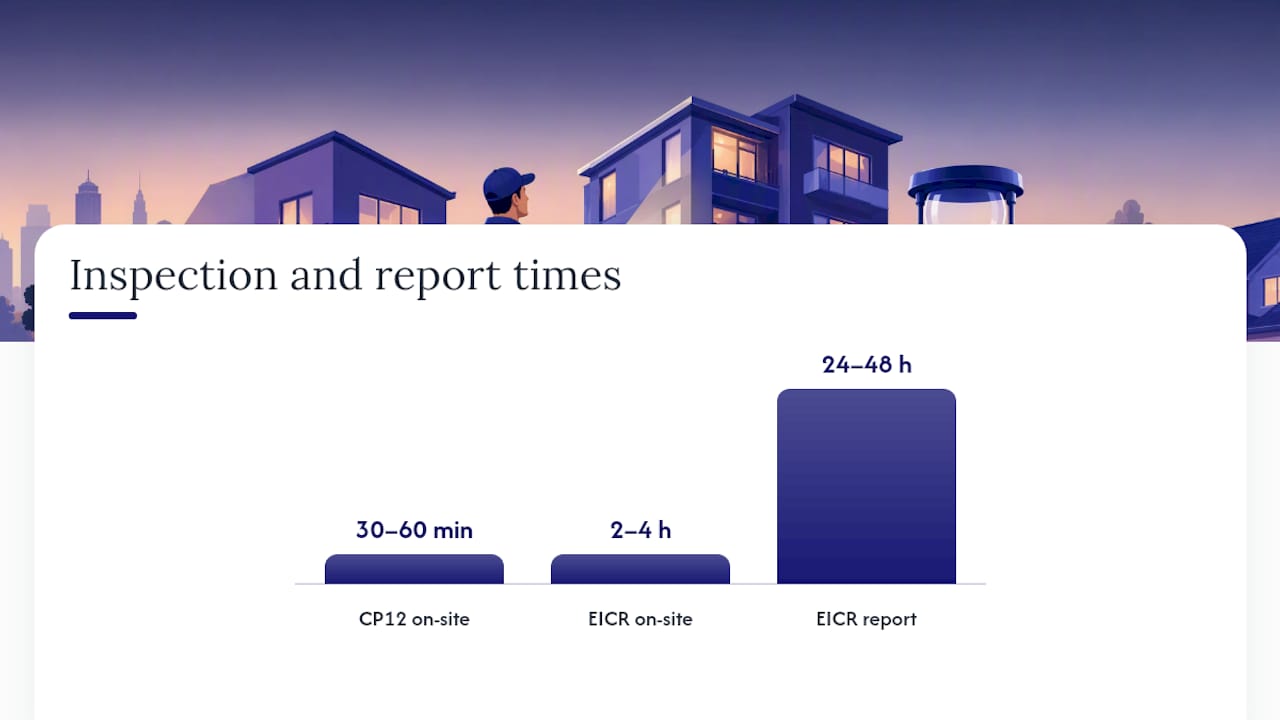
- A single-property CP12 inspection usually takes 30–60 minutes on site; the certificate is often issued the same day.
- An EICR for a standard two-bedroom flat typically takes 2–4 hours; formal reports follow within 24–48 hours from most providers.
- Remedial work timescales vary by severity. Minor remedials are often completed within a few days; significant rewiring can take longer and should be scoped before you commit to a timeline.
HSE guidance recommends obtaining quotes from at least three Gas Safe registered engineers before booking. Gas Safe Register does not control engineers' charges, so prices genuinely vary. For bulk portfolios, a single provider offering block pricing will usually undercut the sum of three separate contractors. Our guide on organising gas safety checks for tenants walks through the scheduling process step by step.
Pro Tip: Schedule CP12 and EICR inspections for the same visit where possible. A provider with in-house gas and electrical engineers can combine both in a single access window, cutting tenant disruption and your coordination time.
Why does an end-to-end provider suit investors with multiple properties?
Managing safety certificates across a portfolio is less like administration and more like logistics. The more properties you hold, the more a fragmented approach costs you in time, missed renewals, and enforcement exposure.
A single provider with in-house engineers across trades gives you one contract, standardised reporting, and a centralised record system. That matters when a council requests an EICR copy at short notice or when a new tenant needs their CP12 before move-in day. Centralised rental lifecycle management reduces missed renewals and cuts the risk of enforcement action.
Bulk scheduling also changes the economics of remedial work. When a provider can route in-house engineers across several nearby properties in a single mobilisation, lead times for remedial work drop and cost per job often falls with them. Verified provider networks that publish their registration numbers and insurance details as part of their pitch reduce procurement risk further, because you are not relying on self-reported credentials alone.
How property safety affects rental demand is another dimension investors often underestimate. Visible, up-to-date certificates support tenant confidence and reduce void periods, which feeds directly into yield.
How does 777pcm handle compliance for landlord portfolios?
An end-to-end property compliance and maintenance service is available for landlords, letting agents, and property managers across the UK. The service covers CP12 landlord gas safety certificates, EICRs, and EPCs, all carried out by in-house Gas Safe registered engineers and NICEIC/NAPIT-accredited electricians. No subcontractors means one point of accountability from scheduling through to written certificate delivery.
What the service includes:
- CP12, EICR, and EPC provision with same-day or next-day certificate issue where possible
- Bulk booking for portfolios, with a single invoice and dedicated account management
- Emergency response for urgent compliance issues or remedial works
- In-house repair and remedial capacity across plumbing, heating, drainage, electrical, roofing, and general maintenance
- A compliance portal for certificate storage, expiry reminders, and record export
Trust signals are built into the model: Gas Safe registration is verifiable on every engineer's ID card, electrical work is carried out by NICEIC or NAPIT-registered electricians, and written remediation confirmation is provided for every job. The landlord compliance checklist on the 777pcm blog maps every certificate type to its statutory deadline, useful for cross-referencing your own portfolio schedule.
Pro Tip: Use 777pcm's compliance portal to set automated renewal reminders 60 days before each CP12 and EICR expiry. That window gives you time to schedule, complete any remedial work, and issue tenant copies before the deadline.
What experienced investors know about compliance that most landlords learn too late
Compliance certificates are often treated as a cost to minimise. That framing is understandable but tends to produce the worst outcomes: last-minute bookings, missed remedial deadlines, and council enforcement notices that cost far more than the inspection would have.
The investors who manage compliance well treat certificate renewal windows the same way they treat rent review dates: as fixed points in the cash-flow calendar, planned months in advance. When a CP12 or EICR falls due, the budget is already allocated and the engineer is already booked.
In-house engineering teams make a specific difference here. When an EICR identifies a C2 observation, an in-house provider can mobilise an electrician within days rather than weeks. That speed is the difference between meeting the 28-day remedial deadline comfortably and scrambling to find a contractor at short notice. Council enforcement under HHSRS tends to follow landlords who are visibly reactive, not those who can demonstrate a proactive compliance record.
777pcm makes portfolio compliance straightforward
For landlords managing more than a handful of properties, the real cost of compliance is not the certificate fee. It is the time spent coordinating multiple contractors, chasing records, and responding to council requests. 777pcm removes that overhead entirely.

With in-house Gas Safe engineers and NICEIC-accredited electricians, this service handles CP12s, EICRs, and EPCs under one roof, alongside any remedial works that follow. Bulk booking, a dedicated account manager, and a compliance portal for certificate storage mean your portfolio stays on schedule without you managing the diary. Regional coverage includes local CP12 and compliance services for landlords outside major cities.
To arrange a portfolio compliance audit or book a CP12/EICR bundle, visit 777pcm and speak to the team directly.
Sources
The following primary sources underpin the legal duties covered in this article. Use them to verify current rules and find guidance for specific queries.
- Gas safety - landlords and letting agents - HSE
- Gov
- The Smoke and Carbon Monoxide Alarm (England) Regulations 2015
- How to Find a Competent Qualified Person for Landlord Electrical Safety Checks - Electrical Safety Roundtable
To verify engineer credentials directly: check Gas Safe registration at Gassaferegister and request NICEIC or NAPIT registration certificates from any electrician before work begins. Our rental property compliance checklist covers every certificate type with deadlines in one place.
This article is general information, not a substitute for advice from a qualified lawyer. Consult a qualified legal professional about your own circumstances before acting on anything here.