
Organising a gas safety check for tenants is a legal obligation under the Gas Safety (Installation and Use) Regulations 1998, which requires landlords to arrange an annual inspection by a Gas Safe registered engineer. The formal output of this inspection is the CP12 certificate, also known as the Landlord Gas Safety Record. Failure to comply is not a paperwork oversight. The Health and Safety Executive (HSE) enforces this regime strictly, and penalties range from unlimited fines to custodial sentences of 6–15 years for serious breaches causing injury or death. Every landlord and property manager needs a clear, repeatable process for getting this right.
What are the prerequisites before organising a gas safety check?
Preparation before booking the inspection saves time and prevents compliance gaps. Start by identifying every gas appliance, fitting, and flue in the property. This includes boilers, gas hobs, fires, and any pipework that connects them. A property with unrecorded appliances is a property with unrecorded risk.
The engineer you appoint must be Gas Safe registered. This is not optional. You can verify any engineer's registration on the Gas Safe Register website by entering their licence number. Never rely on a verbal assurance or a company logo alone.
One of the most useful but underused rules in the Regulations is the early booking window. Checks can be booked up to 2 months early without resetting the expiry date. Think of it like an MOT: renewing early does not shorten the next cycle. This means a landlord whose certificate expires in october can book in august and still receive a certificate valid until the following october.
- Compile a full list of gas appliances and their locations before contacting an engineer
- Verify the engineer's Gas Safe registration number before confirming the booking
- Check your current CP12 expiry date and calculate the earliest booking date (2 months prior)
- Confirm the property address, access arrangements, and any known appliance faults in advance
Pro Tip: Set a calendar reminder 60 days before your CP12 expiry date. Booking at the 30–60 day mark gives you enough time to reschedule if the first appointment falls through, without losing the early renewal window.
How do you schedule the inspection and arrange property access?
Scheduling the inspection is straightforward. Arranging access is where many landlords encounter friction. The law requires you to give tenants at least 24 hours' written notice before the visit. In practice, giving far more notice produces better outcomes.
Follow this process to keep access arrangements on track:
- Send written notice at least 7 days in advance. Email is the preferred method because it creates a timestamped record. State the date, time window, and the reason for the visit.
- Offer two or three alternative time slots. Tenants with shift work or childcare commitments may not be available during standard working hours. Flexibility reduces refusals.
- Confirm the appointment 24–48 hours before the visit. A brief reminder message reduces no-shows and gives the tenant a final chance to flag any access issues.
- Document every communication attempt. If a tenant refuses access or does not respond, your written records become your legal evidence. Retaining evidence of all communication attempts is the single most important step if you later need to pursue legal access.
- Make at least two further attempts with alternative dates before escalating. Courts expect landlords to demonstrate genuine, repeated effort before granting injunctive relief.
- Seek legal advice if access is persistently refused. A solicitor can advise on applying to court for an injunction. This is a last resort, but it is the correct one.
Pro Tip: Keep a simple spreadsheet or compliance log for each property. Record the date of every notice sent, every response received, and every appointment outcome. This takes five minutes per property and can be decisive if a dispute reaches court.
For landlords managing multiple properties, the annual gas safety check process benefits enormously from a consistent scheduling system applied across the whole portfolio.

What happens during the inspection and how do you read the results?
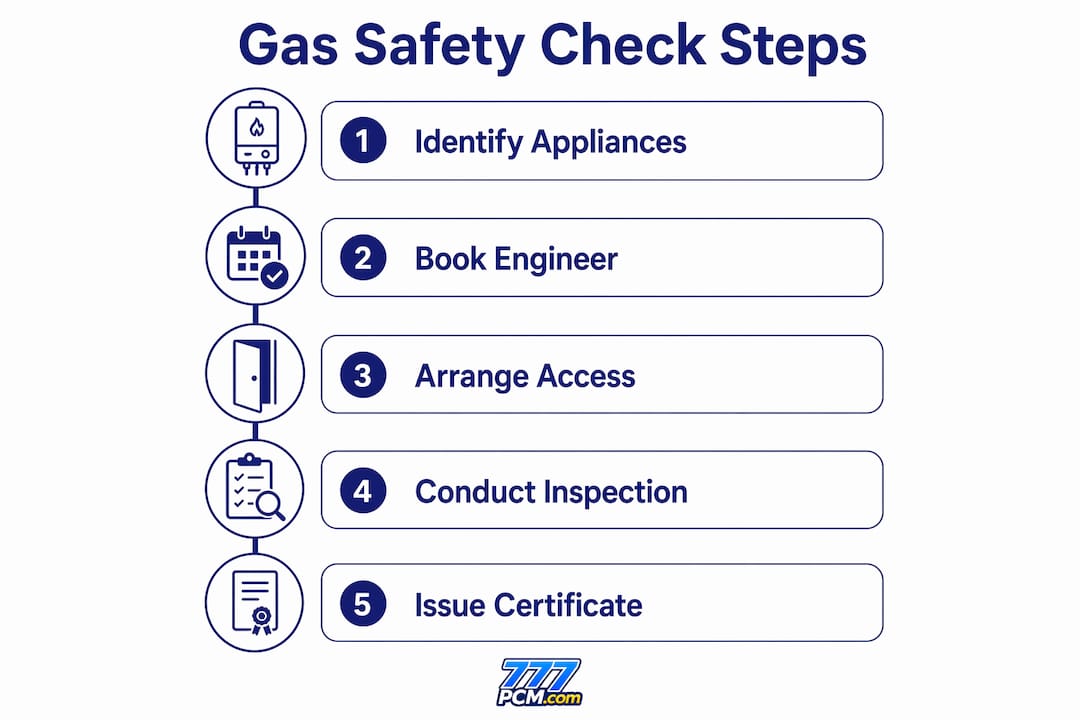
A Gas Safe engineer follows a structured process during the visit. They check each appliance for safe operation, test for gas tightness, inspect flues and ventilation, and verify that safety devices function correctly. The inspection typically takes 30–60 minutes per property, depending on the number of appliances.
The engineer records findings against three classifications:
- Immediately Dangerous (ID): The appliance poses an immediate risk. The engineer must disconnect it before leaving. Appliances rated Immediately Dangerous must not be used until a qualified engineer clears them after repair.
- At Risk (AR): The appliance is not safe to use. It may not be disconnected on the day, but the landlord must arrange urgent repairs.
- Requires Attention (NCS): The appliance is not to current standards but is not immediately dangerous. Remedial work is still required.
The CP12 certificate documents the engineer's findings, the appliances inspected, the date of inspection, and the engineer's Gas Safe registration number. Records must be retained for at least two years. Landlords managing larger portfolios should treat the CP12 as a legal document, not a filing afterthought. For a full breakdown of what the certificate contains, the types of landlord safety certificates guide covers each component in detail.
| Classification | Meaning | Required action |
|---|---|---|
| Immediately Dangerous (ID) | Poses immediate risk to life | Disconnect on the day; repair before use |
| At Risk (AR) | Unsafe but not immediately dangerous | Arrange urgent repairs promptly |
| Requires Attention (NCS) | Below current standards | Schedule remedial work |
| Pass | Appliance is safe and compliant | Issue CP12 and retain records |
Post-inspection responsibilities: communicating with tenants and managing repairs
The inspection is not the end of the process. Landlords must provide tenants with the CP12 within 28 days of the inspection date. For new tenancies, the record must be provided before the tenant moves in. This is a hard deadline, not a guideline.
- Deliver the CP12 by email with a read receipt or delivery confirmation. This creates proof of delivery, which matters if a dispute arises later.
- For existing tenants, a copy must reach them within 28 days of the inspection. Do not wait until the next rent review or routine contact.
- Prohibit use of condemned appliances immediately. If the engineer has classified an appliance as Immediately Dangerous or At Risk, the tenant must be told in writing not to use it.
- Arrange repairs through a Gas Safe registered engineer. The obligation to repair does not transfer to the tenant under any circumstances.
- Retest after repairs and update your records. A repair without a follow-up inspection leaves the compliance cycle incomplete.
Pro Tip: When emailing the CP12, include a brief covering note explaining what the document is and what the tenant should do if they have concerns. Tenants who understand the certificate are less likely to ignore it, and more likely to report issues promptly.
Staying on top of post-inspection follow-up is also where gas safety compliance protects your investment. Landlord insurance policies frequently require valid gas safety records. An insurer can refuse a claim if the certificate has lapsed, leaving the landlord personally liable for damages.
What are the most common mistakes landlords make with gas safety checks?
The most common cause of non-compliance is late scheduling. Landlords who book at the last minute risk engineer unavailability, missed deadlines, and losing the early renewal window entirely. Experts recommend booking 30–60 days before expiry as standard practice.
- Letting the certificate lapse before a new tenancy starts bars the landlord from serving a valid Section 21 possession notice. This is a direct legal consequence, not a theoretical risk.
- Failing to keep records for two years leaves landlords unable to demonstrate compliance if challenged by the HSE or a tenant.
- Appointing unregistered engineers to save money creates criminal liability. Only Gas Safe registered engineers are legally permitted to carry out these inspections.
- Poor communication records make it impossible to defend against access refusal claims. Every notice, every response, and every appointment must be logged.
"Gas safety is the most strictly enforced landlord compliance regime in the UK. The CP12 certificate is not just compliance paperwork. It is vital legal evidence protecting landlords from liability and disputes."
Digital compliance logs help landlords avoid late bookings and give a central portfolio overview. For landlords managing several properties, the gas safety oversights in large portfolios guide identifies the specific patterns that lead to missed deadlines at scale.
Key takeaways
Landlords must organise annual gas safety checks by a Gas Safe registered engineer, provide tenants with the CP12 within 28 days, and retain records for at least two years to remain legally compliant.
| Point | Details |
|---|---|
| Annual legal obligation | Gas safety checks must be arranged every 12 months under the Gas Safety (Installation and Use) Regulations 1998. |
| Book 30–60 days early | Use the MOT-style early booking window to avoid last-minute cancellations and maintain continuous compliance. |
| Written notice to tenants | Provide at least 24 hours' written notice before the visit and document every communication attempt. |
| CP12 delivery deadline | Provide tenants with the gas safety record within 28 days of inspection, or before a new tenancy begins. |
| Act on defects immediately | Appliances rated Immediately Dangerous or At Risk must not be used until repaired and re-inspected. |
Gas safety compliance: what I've learned from managing it at scale
Over years of working with landlords and property managers, the pattern I see most often is not wilful neglect. It is drift. A landlord with one property keeps a tight grip on their CP12 renewal. A landlord with ten properties starts to rely on memory. By fifteen properties, something slips.
The MOT analogy is genuinely useful here. Nobody lets their car tax lapse because they forgot. They set a reminder. Gas safety deserves exactly the same treatment, and the consequences of forgetting are far more serious than a fixed penalty notice.
What I have also seen is the difference a good engineer relationship makes. Landlords who use the same Gas Safe registered engineer year after year build a working knowledge of each property. The engineer already knows the boiler model, the quirks of the flue, and the history of any previous faults. That continuity catches problems earlier.
The CP12 certificate is often treated as the finish line. It is not. It is the start of the next 12-month cycle. Landlords who treat it that way, booking the next inspection before the current one is even filed, never face the stress of a lapsed certificate. That mindset shift, from reactive to planned, is the single most practical change any landlord can make.
— Mike
How 777pcm helps landlords stay gas safe and compliant
Gas safety compliance does not have to be a source of stress. 777pcm provides CP12 gas safety certificates carried out by in-house Gas Safe registered engineers, with no third-party subcontractors involved. Every step from scheduling and access coordination to certification and record delivery is managed directly.

For landlords managing a portfolio, 777pcm's account management tools give a clear overview of upcoming renewals, outstanding certificates, and completed inspections. Remedial works following any identified faults are handled by the same team, keeping the compliance cycle closed. Visit 777pcm.com to book a gas safety inspection or discuss portfolio compliance support with the team.
FAQ
What is a CP12 certificate?
A CP12, or Landlord Gas Safety Record, is the official document issued after a Gas Safe registered engineer completes an annual gas safety inspection. It records the appliances checked, the findings, and the engineer's registration details.
How often do landlords need a gas safety check?
Landlords must arrange a gas safety inspection every 12 months. Checks can be booked up to 2 months early without changing the certificate's expiry date.
What happens if a tenant refuses access for the inspection?
Landlords must provide written notice of at least 24 hours and make multiple attempts with alternative dates. If access is persistently refused, landlords should seek legal advice and retain all communication records as evidence.
When must the CP12 be given to tenants?
Landlords must provide the CP12 to existing tenants within 28 days of the inspection. New tenants must receive a copy before they move in.
Can a landlord be prosecuted for not having a gas safety certificate?
Yes. Failure to maintain valid gas safety records and provide them to tenants can result in unlimited fines or custodial sentences of up to 15 years for serious breaches causing injury or death.