
A boiler that is over 12 years old and showing two or more serious faults is the clearest sign a landlord needs to act on boiler replacement. Under the Landlord and Tenant Act 1985 and the Fitness for Human Habitation Act 2018, landlords carry a legal duty to keep heating systems in safe working order. Failing to replace a failing boiler is not just a maintenance oversight. It creates direct liability. Modern A-rated condensing boilers pay back installation costs in 6–10 years through fuel savings, making replacement a sound financial decision as well as a legal one.
1. What are the critical signs your boiler needs replacing?
Knowing the warning signs of boiler failure separates landlords who act early from those who face emergency call-outs and tenant complaints. The signs below are the most reliable indicators that repair is no longer the right answer.
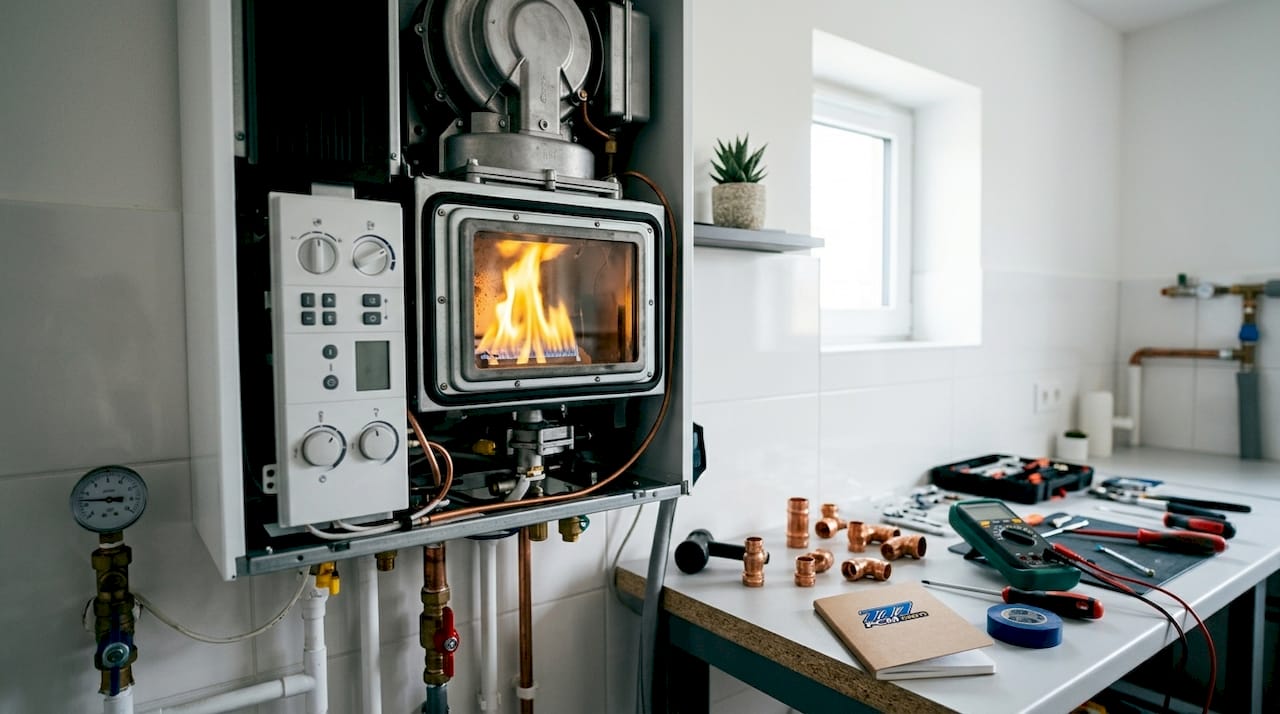
Yellow or orange flame
A healthy boiler flame burns blue. A yellow or orange flame signals incomplete combustion and a potential carbon monoxide leak. Stop using the boiler immediately and call a Gas Safe registered engineer. This is not a repair situation. It is a safety emergency.
Persistent banging, kettling, or unusual noises
Kettling is a rumbling sound caused by limescale or sludge restricting water flow through the heat exchanger. Occasional noise is normal. Persistent banging or kettling after a service indicates internal damage that repair alone rarely resolves.
Frequent pressure loss
A boiler that loses pressure repeatedly points to a leak in the system, a failing pressure relief valve, or a degraded expansion vessel. Topping up the pressure once is routine. Doing it every few weeks is a boiler replacement sign that landlords should not ignore.
Recurring fault codes after repairs
Modern boilers display fault codes when something goes wrong. A code that reappears after a qualified engineer has addressed it signals a deeper mechanical failure. At that point, the cost of further repairs often exceeds the value of the work.
Slow heating of radiators or hot water
Cold spots on radiators or a long wait for hot water can indicate sludge buildup, a failing pump, or a degraded heat exchanger. If a power flush does not resolve the issue, the boiler itself is likely the problem.
Visible water leaks from the boiler body
Water pooling beneath the boiler or staining around the casing is a sign of internal corrosion or a failing seal. Leaks accelerate damage to surrounding pipework and property fabric. A leaking boiler body rarely justifies the cost of repair on an older unit.
Rising fuel bills despite consistent usage
A boiler losing efficiency burns more gas to produce the same heat. If your tenant's energy bills are climbing without a change in usage patterns, the boiler is working harder than it should. This is one of the most overlooked boiler replacement signs among landlords managing multiple properties.
Repair costs approaching replacement value
The industry benchmark is straightforward. If a single repair quote exceeds one third of the cost of a new boiler, replacement is the better investment. Spending £600 to fix a boiler worth £1,800 installed makes no financial sense, particularly when the unit is already past its prime.
Age over 12–15 years with multiple symptoms
Boilers older than 12 years showing multiple symptoms should be replaced rather than repaired. Age alone is not sufficient reason to replace, but age combined with two or more of the signs above is a clear trigger. Smart landlords treat this as a firm rule, not a guideline.
Pro Tip: Keep a simple log of every boiler fault, repair, and service visit. When you review it alongside the boiler's age, the replacement decision becomes obvious rather than subjective.
2. How to assess boiler condition beyond visible signs
Visible faults are only part of the picture. Landlords who monitor boiler condition proactively avoid the worst outcomes.
- Schedule annual servicing. An annual boiler service by a Gas Safe registered engineer catches deterioration before it becomes a breakdown. The best time to schedule this service is during a void period between tenancies, when access is straightforward and testing can be thorough.
- Monitor for sludge. Repeated sludge buildup despite power flushing indicates that the heat exchanger or pipework has degraded beyond the point where flushing helps. This is a strong signal that full replacement is necessary.
- Track fuel consumption. Ask tenants to share meter readings quarterly, or install a smart meter. A steady rise in gas consumption without a change in household size or behaviour points to declining boiler efficiency.
- Apply the two-symptom rule. The two-symptom rule is a practical benchmark: replace any boiler over 12 years old that shows at least two serious symptoms such as pressure loss, rising bills, or recurring faults. Repairing beyond this point is a sunk cost.
- Increase monitoring after year 8. Smart landlords treat boilers as lifecycle assets. Monitoring more closely after year 8 and budgeting for replacement by years 12–15 prevents emergency replacements at the worst possible time.
- Use Gas Safe engineers only. Any inspection, repair, or replacement on a gas appliance must be carried out by a Gas Safe registered engineer. This is a legal requirement, not a preference. The annual gas safety check is the minimum standard.
Pro Tip: Time major heating upgrades during void periods. Scheduling during vacancies avoids the disruption of working around tenants and allows full system testing before the next tenancy begins.
3. Understanding boiler replacement options for landlords in 2026
Landlords replacing a boiler in 2026 have several options, each with different costs, efficiency ratings, and installation requirements.
Gas boilers remain legal in UK rental properties as of mid-2026. Landlords can replace a broken unit with a new A-rated condensing model without regulatory barriers. The proposed gas boiler ban has been delayed, so there is no legal obligation to switch to a heat pump at this stage.
Typical replacement costs for a combi boiler range from £1,800 to £3,500. System boilers cost approximately £2,500 to £4,500. Air source heat pumps sit between £8,000 and £14,000 before grants. The Boiler Upgrade Scheme currently offers £7,500 grants for air source heat pumps, though properties must meet specific criteria to qualify.
| Replacement type | Typical cost (before grants) | Efficiency rating | Installation complexity |
|---|---|---|---|
| Combi boiler (A-rated) | £1,800–£3,500 | Up to 94% | Low to moderate |
| System boiler (A-rated) | £2,500–£4,500 | Up to 94% | Moderate |
| Air source heat pump | £8,000–£14,000 | 300%+ (COP) | High |
A new A-rated condensing boiler also improves a property's Energy Performance Certificate rating. A better EPC score strengthens the property's rental appeal and positions it ahead of incoming minimum energy efficiency standards. Landlords managing boiler servicing across portfolios should factor replacement cycles into their annual budget planning rather than treating each unit as an isolated cost.
4. What are the landlord's legal responsibilities when replacing a boiler?
Legal compliance is not optional when it comes to heating in rental properties. The obligations are clear and the consequences of ignoring them are serious.
- Landlord and Tenant Act 1985 requires landlords to keep installations for the supply of heating and hot water in repair and proper working order throughout the tenancy.
- Fitness for Human Habitation Act 2018 extends this duty, requiring that properties remain fit to live in. A broken or dangerous boiler can render a property legally uninhabitable.
- Delayed replacement creates liability. Failure to replace a failing boiler can lead to tenant compensation claims. Courts have found in favour of tenants where landlords delayed action on known heating failures.
- Alternative heating must be provided. If a boiler is taken out of service for replacement, landlords must provide an alternative heating source for the duration. Portable electric heaters are the standard interim solution.
- CP12 certificates are mandatory. Every gas appliance in a rental property requires an annual CP12 gas safety certificate. A new boiler installation triggers a fresh certificate requirement.
- Carbon monoxide detectors are required by law. Any room containing a gas appliance must have a working carbon monoxide detector. Landlords should review the carbon monoxide detector rules that apply to their properties.
- Record keeping matters. Keep copies of all service records, repair invoices, and certificates. These records are your evidence of compliance if a tenant raises a complaint or a dispute reaches court.
Key takeaways
A landlord's boiler needs replacing when it is over 12 years old, shows two or more serious symptoms, and repair costs approach the price of a new installation.
| Point | Details |
|---|---|
| Age and symptoms trigger replacement | Replace boilers over 12 years old showing two or more faults such as pressure loss or rising bills. |
| Yellow flame is a safety emergency | A yellow or orange flame signals carbon monoxide risk; stop use and call a Gas Safe engineer immediately. |
| Gas boilers remain legal in 2026 | Landlords can replace broken units with new A-rated condensing models without switching to heat pumps. |
| Legal duty is clear and enforceable | Delayed replacement under the Fitness for Human Habitation Act 2018 can result in tenant compensation claims. |
| Void periods are the best time to replace | Scheduling replacements between tenancies avoids disruption and allows full system testing. |
Why I think landlords underestimate the cost of waiting
Most landlords I speak with frame boiler replacement as a cost to avoid. They patch, repair, and hope. What they rarely account for is the compounding cost of that approach.
A boiler that has been limping along for two years has likely cost more in call-out fees, parts, and tenant goodwill than a replacement would have. Add the risk of a mid-winter failure, the legal obligation to provide alternative heating, and the potential for a compensation claim, and the maths shifts decisively. Waiting is not saving money. It is deferring a larger bill.
The two-symptom rule exists precisely because landlords need a clear, defensible threshold. When a boiler is over 12 years old and showing two serious faults, the decision is already made. The only question is whether you act before or after an emergency forces your hand. Proactive replacement, ideally timed during a void period, protects your tenants, your property, and your legal position. That is not a cost. That is asset management.
— Mike
How 777pcm supports landlords with boiler replacement
Landlords who need fast, professional boiler replacement without the coordination headache will find 777pcm built for exactly that purpose.

777pcm employs in-house Gas Safe registered engineers who handle the full replacement process, from initial assessment through to certification. There are no third-party subcontractors and no gaps in accountability. The service covers CP12 gas safety certificates, carbon monoxide compliance checks, and ongoing landlord heating maintenance across single properties and large portfolios alike. Whether you manage one flat or fifty, 777pcm provides the speed, documentation, and compliance support that landlords need to stay on the right side of the law.
FAQ
How old does a boiler need to be before replacing it?
Replace a boiler that is over 12 years old and showing two or more serious symptoms such as pressure loss, recurring faults, or rising fuel bills. Age alone is not the trigger; the combination of age and symptoms is.
Is a yellow boiler flame dangerous?
A yellow or orange flame signals incomplete combustion and a potential carbon monoxide leak. Stop using the boiler immediately and call a Gas Safe registered engineer before restarting it.
Can a landlord still install a gas boiler in 2026?
Gas boilers remain legal in UK rental properties in 2026. Landlords can replace broken units with new A-rated condensing models. The proposed ban on new gas boilers has been delayed and does not currently apply to replacement installations in rental properties.
What happens if a landlord delays boiler replacement?
Delayed replacement can result in tenant compensation claims under the Fitness for Human Habitation Act 2018. Landlords must also provide alternative heating if the boiler is out of service during replacement.
How much does a boiler replacement cost for a landlord?
A combi boiler replacement typically costs between £1,800 and £3,500. System boilers range from £2,500 to £4,500. Air source heat pumps cost £8,000 to £14,000 before any applicable grants such as the Boiler Upgrade Scheme.