
A boiler service schedule is a structured maintenance plan that coordinates mandatory safety checks, routine inspections, and compliance tasks across every heating asset in a property portfolio. For landlords and property managers, understanding how boiler servicing schedules work across portfolios is the difference between proactive compliance and costly reactive repairs. Preventive maintenance programmes reduce energy consumption by 10–20% and can extend boiler lifespan by up to 15 years compared to reactive approaches. That is not a marginal gain. It is the financial case for treating your servicing schedule as a management tool, not an afterthought.
How do boiler servicing schedules work across portfolios?
A boiler service schedule, known in the industry as a planned preventive maintenance (PPM) programme, defines when each boiler in a portfolio receives a service, what tasks are completed, and who holds the compliance record. For a single property, this is straightforward. Across ten, twenty, or fifty properties, it becomes a logistical operation requiring clear systems and consistent execution.
The core of any effective boiler maintenance plan is the annual service. Standard domestic boiler servicing lasts 30–120 minutes and covers combustion analysis, safety valve checks, and gas tightness testing. Each of those tasks serves a distinct purpose: combustion analysis confirms the boiler is burning fuel efficiently, gas tightness testing identifies leaks before they become dangerous, and safety valve checks confirm pressure relief mechanisms are functioning correctly.

Portfolio managers often make the mistake of treating servicing as a tenant obligation rather than an asset obligation. The schedule belongs to the boiler, not the tenancy. When a tenant moves out and a new one moves in, the boiler's service history and next due date must carry over without interruption.
What are the core components of effective boiler maintenance plans?
Every well-structured boiler service schedule includes a defined set of recurring tasks. These tasks fall into three categories: mandatory annual checks, periodic safety inspections, and condition-based monitoring.
Mandatory annual tasks include:
- Combustion analysis and flue gas testing
- Gas tightness and pressure testing
- Safety valve and thermostat checks
- Heat exchanger inspection for corrosion or scaling
- Burner cleaning and ignition electrode inspection
- Visual inspection of pipework and fittings
Periodic tasks (typically every 2–5 years depending on boiler age and manufacturer guidance) include:
- Full strip-down and internal cleaning
- Pump and motorised valve replacement
- Expansion vessel recharge or replacement
- Magnetic filter cleaning and inhibitor top-up
Condition-based monitoring applies to older boilers or those in high-demand properties. This means tracking error codes, flue temperatures, and pressure drops between services to catch deterioration early.
The timing of these tasks matters as much as the tasks themselves. Calendar-based scheduling works well for domestic properties with consistent year-round use. For seasonal or variable-use properties, operating hours-based scheduling prevents both over-servicing and critical neglect. A holiday let used for six months of the year does not need the same calendar rhythm as a year-round family home.
Pro Tip: Schedule annual boiler services during the summer months. Booking in summer avoids the winter rush, secures Gas Safe engineer availability, and allows time for any repairs before the heating season begins.
How do servicing schedules vary by portfolio type and boiler age?
Not every boiler in a portfolio follows the same schedule. Variation is driven by boiler model, fuel type, age, and how intensively the property is used. A condensing combi boiler in a two-bedroom flat has different servicing needs from a floor-standing commercial boiler in a block of flats or a school.
The table below shows how key variables affect servicing frequency and scope.
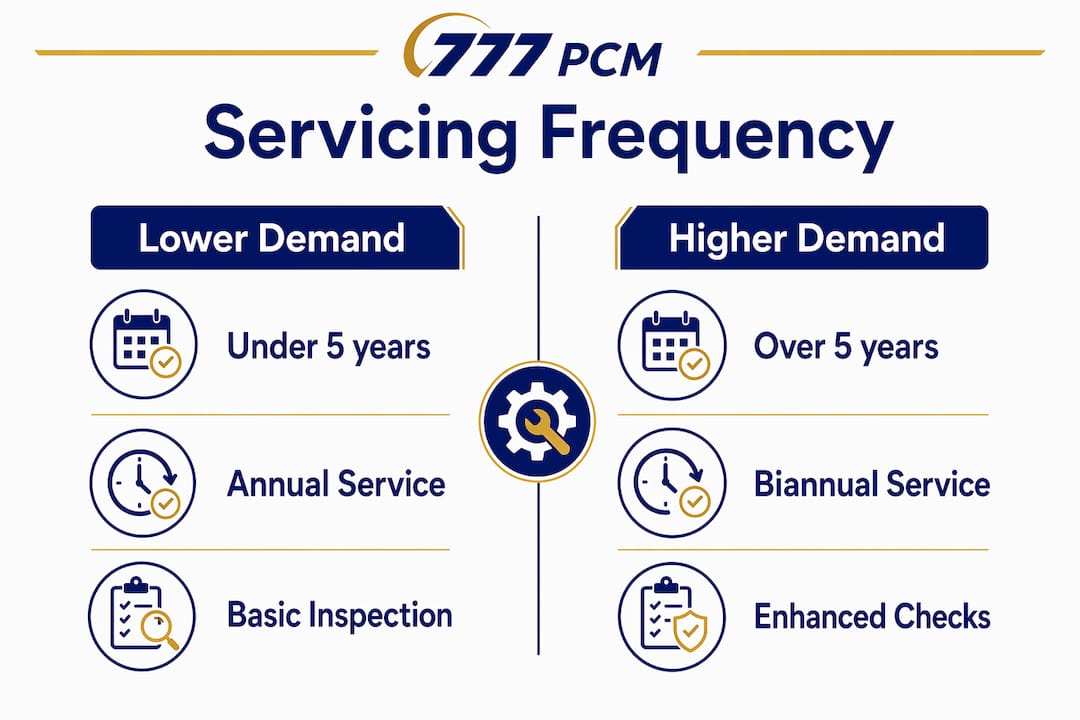
| Variable | Lower-demand scenario | Higher-demand scenario |
|---|---|---|
| Boiler age | Under 5 years: annual service | Over 10 years: annual service plus condition monitoring |
| Usage pattern | Year-round domestic use: calendar-based | Seasonal or commercial use: operating hours-based |
| Fuel type | Natural gas: annual Gas Safe inspection | LPG or oil: annual plus fuel-specific checks |
| Property type | Single-occupancy flat: standard annual service | HMO or commercial block: more frequent inspections |
| Additional assets | Combi boiler only | Unvented cylinder, gas meter, and multiple zones |
Portfolios that include Houses in Multiple Occupation (HMOs) or commercial properties face the most complex scheduling demands. These properties often have multiple heating zones, unvented hot water cylinders, and higher occupancy rates that accelerate wear. Integrating unvented cylinder inspections and gas meter checks into the same service visit reduces engineer call-outs and keeps compliance records consolidated.
Pro Tip: When managing a mixed portfolio, group properties by boiler type and age into service tiers. Tier one covers boilers under five years old on standard annual visits. Tier two covers older or higher-demand assets on enhanced schedules. This structure makes contract pricing and engineer allocation far more predictable.
What role does technology play in managing service schedules?
Technology is the backbone of any portfolio-wide boiler service schedule overview. Without it, landlords and property managers rely on spreadsheets, paper records, and memory. All three fail under the pressure of a growing portfolio.
Asset-level scheduling software changes this entirely. Platforms like Commusoft and Oxmaint allow engineers and managers to schedule maintenance at the asset level, using the boiler's serial number as the anchor point. This means service history, certificates, and next due dates follow the boiler regardless of tenant changes or ownership transfers. The practical benefit is significant: no service falls through the gap during a void period or tenancy changeover.
Automation within these platforms handles recurring visit scheduling, engineer reminders, and certificate issuance. Invoicing for planned maintenance contracts can run on monthly direct debit cycles, creating predictable revenue for service providers and predictable costs for landlords. Consolidated maintenance contracts for 10 properties at £30–£50 per month generate £3,600–£6,000 in annual recurring revenue while maintaining full statutory compliance. That figure illustrates why structured contracts benefit both sides of the arrangement.
Fragmented record-keeping is the leading cause of portfolio compliance failures. Unified systems that store service records, CP12 gas safety certificates, and engineer reports in one place are not optional for serious portfolio managers. They are the foundation of audit readiness.
The four non-negotiable features of any portfolio scheduling system are:
- Asset-level records tied to boiler serial numbers, not tenant names
- Automated reminders for upcoming and overdue services
- Digital certificate storage with expiry date tracking
- Integration with invoicing and direct debit management
"The shift from tenant-level to asset-level scheduling is the single most impactful change a portfolio manager can make to their compliance process. When the record follows the boiler, nothing gets lost in a tenancy changeover."
How can landlords improve compliance and reduce costs through scheduling?
The most effective boiler maintenance plans share three characteristics: they are consolidated, they are timed well, and they prioritise the highest-return tasks first.
Consolidation means grouping all properties under a single maintenance contract rather than managing separate agreements for each address. This reduces administrative overhead, gives the service provider enough volume to offer competitive pricing, and creates a single point of accountability for compliance records. For estate agents managing multiple properties, consolidated contracts also simplify client reporting.
Timing is a practical lever that most landlords underuse. Scheduling annual services in june, july, or august means engineers are available, prices are often lower, and any faults identified can be repaired before october when demand peaks. A boiler that fails in january costs more to fix and causes far more tenant disruption than one repaired in august.
Prioritising combustion analysis delivers the clearest financial return. Tuning combustion to a 2–4% O2 target recovers 10–15% of fuel waste across a portfolio. On a portfolio of twenty properties, that saving compounds meaningfully over a heating season.
Additional practices that strengthen compliance and control costs include:
- Maintaining a live asset register with boiler make, model, age, and last service date for every property
- Using CP12 gas safety certificates as the compliance anchor for each annual service cycle
- Setting 60-day advance reminders for upcoming service dates to allow access coordination
- Reviewing service reports after each visit to identify recurring faults that signal a boiler nearing end of life
Pro Tip: Build a boiler replacement reserve into your portfolio budget for any unit over 12 years old. Planned replacement is always cheaper than emergency breakdown, and it gives you control over timing and specification.
Key takeaways
Effective boiler servicing schedules are asset-level maintenance plans that protect compliance, reduce energy costs, and prevent expensive breakdowns across a property portfolio.
| Point | Details |
|---|---|
| Annual service is mandatory | Every boiler needs a Gas Safe inspection annually covering combustion, gas tightness, and safety valves. |
| Schedule by asset, not tenant | Tie service records to the boiler serial number so history survives tenancy changes. |
| Summer timing reduces costs | Booking services in summer secures engineer availability and allows repairs before peak demand. |
| Combustion analysis pays back | Tuning to 2–4% O2 recovers 10–15% fuel waste, cutting portfolio energy costs directly. |
| Unified records prevent failures | Fragmented record-keeping is the leading cause of compliance failures at audit. |
Why asset-level thinking changes everything for portfolio managers
I have worked with landlords who manage two properties and landlords who manage two hundred. The gap in compliance outcomes between them rarely comes down to budget. It comes down to whether they think about boilers as assets or as tenant amenities.
When you treat a boiler as a tenant amenity, the service gets booked when the tenant complains or when the letting agent sends a reminder. The record lives in an email thread. The certificate gets printed and filed in a drawer. When the tenant leaves, that history disappears. The next landlord or manager starts from scratch.
When you treat a boiler as an asset, it has a serial number, a service history, a next due date, and a replacement forecast. The record follows the boiler. The compliance is automatic. I have seen this shift alone reduce a portfolio manager's compliance-related call-outs by a significant margin, simply because nothing falls through the gap.
The technology to do this properly exists and is accessible. Platforms like Commusoft make asset-level scheduling straightforward even for smaller portfolios. The barrier is not cost or complexity. It is the habit of thinking about the boiler rather than the tenancy. Once that habit forms, everything else follows naturally.
— Mike
How 777pcm supports portfolio boiler compliance
Managing boiler servicing schedules across a growing portfolio takes more than good intentions. It takes Gas Safe registered engineers, reliable scheduling, and certificates that arrive on time.

777pcm provides portfolio compliance and maintenance services for landlords and property managers, covering CP12 gas safety certificates, boiler servicing, and remedial works through in-house engineers with no third-party subcontractors. Every service is tracked through a dedicated portal, giving you a live view of compliance status across all your properties. For landlords who need gas safety certification alongside planned maintenance, 777pcm handles both under one contract. Contact 777pcm to discuss a maintenance plan built around your portfolio.
FAQ
What is a boiler service plan for landlords?
A boiler service plan is a maintenance contract that schedules annual Gas Safe inspections, safety checks, and compliance certificate issuance for rental properties. It replaces ad hoc booking with a structured, recurring programme tied to each boiler in the portfolio.
How often should a boiler be serviced in a rental property?
Every boiler in a rental property requires a Gas Safe inspection at least once per year. Properties with older boilers or higher occupancy, such as HMOs, may benefit from more frequent condition monitoring between annual services.
What does a standard boiler service include?
A standard boiler service lasts 30–120 minutes and includes combustion analysis, gas tightness testing, safety valve checks, heat exchanger inspection, and burner cleaning.
Why does combustion analysis matter for portfolio managers?
Combustion analysis tuned to 2–4% O2 recovers 10–15% of fuel waste per boiler. Across a portfolio of multiple properties, that saving has a direct and measurable impact on energy costs.
What is the best way to manage boiler records across multiple properties?
Scheduling maintenance at the asset level using the boiler's serial number, rather than the tenant's name, ensures service history and certificates remain intact through tenancy changes and void periods.