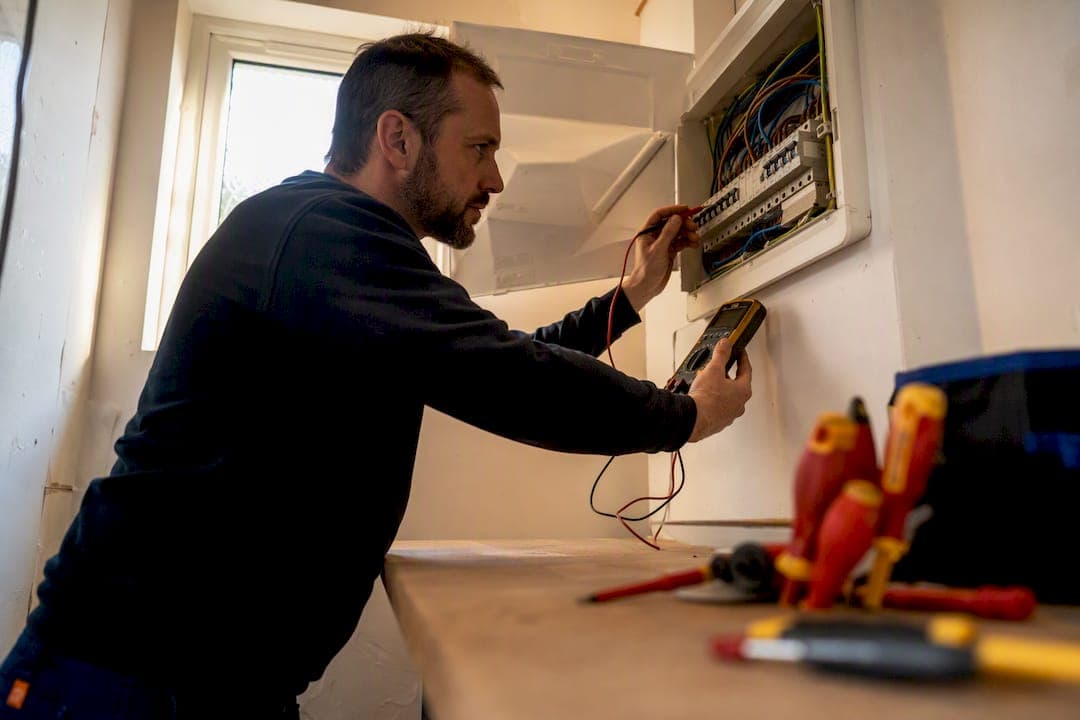
An EICR (Electrical Installation Condition Report) is the mandatory formal inspection for rented homes, and it must be carried out by a qualified person at least every five years. If you're a landlord reading this because a report is overdue or a tenant has raised a concern, that's the first thing to check: the date on your last EICR and whether it flagged any C1, C2 or FI observations.
Beyond that legal minimum, several supplementary checks help you stay ahead of problems rather than reacting to them:
- Routine visual and operational checks — informal, non‑intrusive looks at sockets, switches and visible wiring, usually annual
- PAT (portable appliance testing) — covers plug‑in items, not fixed wiring
- Pre‑tenancy checks — a practical once‑over between tenancies to catch damage or tampering
- Urgent remedial inspections — triggered by a fault, a tenant report, or a previous C1/C2 finding
Once you have an EICR, three statutory duties follow: supply the report to your tenant within 28 days, retain a copy until the next inspection falls due, and complete any C1, C2 or FI remedial work within the timescale the report specifies.
Key Takeaways
An EICR every five years is the mandatory legal baseline for rented homes, but documented remedial action and routine checks in between are what actually keep landlords compliant.
| Point | Details |
|---|---|
| EICR is mandatory | Rented properties need an EICR at least every five years from a qualified, registered electrician. |
| Know your codes | C1 and C2 require urgent remedial work; FI needs further investigation; C3 is advisory only. |
| Meet the deadlines | Supply the report to tenants within 28 days and complete C1/C2/FI remedial work within 28 days. |
| Document everything | Keep EICRs, minor works certificates and EICs together until the next inspection is due. |
| Consider a managed service | 777pcm runs EICRs, remedial works and certification through in‑house electricians with portal access for landlords. |
Table of Contents
- Types of residential property electrical safety inspections and when to use them
- What an EICR actually tests and how to read the codes
- What the law actually requires, and by when
- Turning a bad report into a compliant one
- How to verify a genuinely qualified electrician
- Keeping the paper trail tenants and councils can actually rely on
- How 777pcm handles inspections and remedial work for landlords
- What the rules get right, and where landlords still trip up
- Get inspections, remedial works and certificates handled by one team
- Sources
Types of residential property electrical safety inspections and when to use them
Not every electrical check does the same job, and confusing them is one of the more expensive mistakes a landlord can make. Here's how the main residential property electrical safety types break down, from the legally mandatory to the sensibly precautionary.
-
The EICR (periodic inspection and testing). This is the one the law names. It tests fixed wiring, the consumer unit, circuit protection, earthing and bonding, and it's required at intervals not exceeding five years for rented homes (owner‑occupied properties are only recommended to test every ten). It will uncover things like deteriorated insulation, undersized cabling for modern loads, or a consumer unit that predates current protection standards.
-
Routine visual and operational checks. These sit between EICRs and cost almost nothing to do properly. A landlord, agent, or the tenant themselves checks for scorch marks around sockets, loose fittings, exposed wires, or a trip switch that won't reset. Industry checklists recommend doing this annually, and it's not a legal substitute for the EICR, just a way of catching obvious deterioration between formal tests.
-
PAT, or in‑service appliance testing. This covers portable items, kettles, lamps, microwaves, anything with a plug, rather than the building's fixed wiring. It's not a legal requirement for most residential tenancies the way an EICR is, but landlords who supply furnished properties often run it anyway, since a faulty appliance is just as dangerous as faulty wiring.
-
Pre‑tenancy checks. Between tenants is the ideal window for a practical inspection, because access is easiest and any damage caused by a previous occupant (a DIY light fitting, an overloaded extension lead left wired into a socket) is still visible before new furniture goes in.
-
Urgent remedial inspections. These happen outside the schedule entirely, triggered by a tripping breaker, a burning smell, or a tenant report. They're narrower in scope than a full EICR, usually focused on diagnosing one specific fault.
One limitation applies across all of these: inspectors generally cannot assess wiring concealed behind walls, under floors, or inside sealed conduit unless specifically agreed in advance. A report will state this as a limitation, and it's why an EICR that comes back clean isn't a guarantee against every possible hidden fault, just a professional judgement based on what's reasonably accessible.
What an EICR actually tests and how to read the codes
An EICR examines the parts of the electrical installation that don't move house with the tenant: the consumer unit and its protective devices, every circuit, earthing and bonding connections, RCDs, and the fixed wiring running to sockets, switches and light fittings. The report follows BS 7671 (the IET Wiring Regulations), the technical standard every registered electrician tests against, and it will state which parts of the installation were inaccessible or excluded from testing.
The report structure has two layers. The overall assessment gives a single verdict, satisfactory or unsatisfactory, but the real detail sits in the observation schedule, where each individual issue found is assigned a code:
- C1 (danger present): Immediate risk to life. Requires urgent action, sometimes before the electrician even leaves the property.
- C2 (potentially dangerous): Not an immediate emergency, but urgent remedial work is required to remove the risk.
- C3 (improvement recommended): Advisory only. It doesn't affect the overall pass/fail outcome, but it's worth fixing.
- FI (further investigation required): Something looked wrong but couldn't be diagnosed without more invasive testing.
These four codes carry different weight, and Gov is explicit that only C1, C2 and FI make a report "unsatisfactory" overall. A property with three C3 observations and nothing worse technically passes, whereas a single C2 does not.
Pro Tip: An FI code is often mistaken for a formality. It usually means the electrician spotted something that looked off, an inconsistent reading, a sign of a hidden fault, but couldn't diagnose it without further, more invasive testing. Treat it as seriously as a C2 until a qualified person has ruled the risk out.
What the law actually requires, and by when
The regulatory baseline for rented homes is set out in the Electrical Safety Standards in the Private and Social Rented Sector Regulations 2020, updated through 2025, and it's worth knowing the deadlines rather than just the headline five‑year figure.
- Inspection frequency: At least every five years, carried out by a person who is qualified and competent to do so.
- Report supply: A copy of the EICR must go to the tenant within 28 days of the inspection, and to a new tenant before they move in.
- Retention: Keep the report on file until the next inspection is due, and be ready to produce it on request.
- Remedial timescales: Work flagged as C1 or C2 (or FI, once diagnosed) must be completed within 28 days, or sooner if the report specifies an earlier date.
- Authority requests: Local authorities can request a copy of the report, and landlords typically have around seven days to comply.
Beyond this specific regulation, landlords carry broader duties under the Landlord and Tenant Act 1985 and the Housing Health and Safety Rating System (HHSRS) to keep installations in repair and free of hazards. Shelter's guidance notes that local authorities have real enforcement teeth here, including the power to arrange remedial works themselves and recover the cost from the landlord, on top of financial penalties for non‑compliance with the 2020 regulations. An EICR is not a paperwork exercise you file and forget; it's the document that proves you met a duty you carry regardless of whether anyone ever checked.
Turning a bad report into a compliant one
A report that comes back unsatisfactory isn't a crisis if you handle it in the right order. It becomes one if you sit on it, or fix things without documenting what was done.
- Make safe first. Any C1 finding needs immediate action, sometimes isolating a circuit before the electrician has even packed up their van.
- Commission the remedial work with a registered electrician, ideally the one who wrote the report or another member of a recognised competent‑person scheme.
- Obtain the right paperwork for what was fixed. A full rewire or new consumer unit needs an Electrical Installation Certificate (EIC); smaller jobs, a new socket or a replaced circuit, get a Minor Electrical Installation Works Certificate.
- Get the EICR reissued or endorsed to confirm the C1/C2/FI items are now closed out, and label the consumer unit with the date of the last inspection and the next one due.
- Keep every certificate together with the original report, not just the retest confirmation, because an enforcement query will ask for the full trail.
Access is usually the practical bottleneck here, not the electrician's availability. Confirm tenant access windows before booking remedial work, and give clear written notice of what's happening and why, particularly for anything involving a temporary loss of power.
Pro Tip: Never accept a verbal assurance that remedial work "has been sorted." Without a certificate on file, you have no defensible proof of compliance if a dispute or inspection follows, a common pitfall highlighted by Electrical Safety First. A structured approach to commissioning and tracking this work makes the difference between a report that gets closed out properly and one that quietly lapses.
How to verify a genuinely qualified electrician
"Qualified and competent" isn't a phrase you can take on trust. It specifically means registration with a recognised competent‑person scheme, and using someone outside one of these schemes risks the inspection being challenged later, even if the work itself was sound.
Before booking, ask to see:
- Proof of current registration with a recognised scheme
- A sample EICR so you can judge how thoroughly they document findings
- Evidence of public liability insurance
- A clear answer on what the inspection will and won't cover (concealed wiring, outbuildings, shared supplies)
Ask directly what happens if the report comes back unsatisfactory: will they quote for remedial work themselves, and what's their typical turnaround for reissuing the certificate once it's done? Vague answers to that question are a bigger red flag than a slightly higher quote, because a slow remedial process is what turns a manageable C2 into a missed statutory deadline.
Keeping the paper trail tenants and councils can actually rely on
Compliance lives or dies on what you can produce, not what you remember doing. Keep the current EICR on file until the next one is due, alongside every remedial certificate (EIC or minor works certificate) generated in between, and a dated label inside the consumer unit showing when it was last inspected and when it's next due.
- Supply the EICR to existing tenants within 28 days of the inspection
- Give prospective tenants a copy before they move in
- Respond to local authority requests promptly, typically within about seven days
- Store certificates together rather than scattered across email threads, so nothing gets lost between property visits
A simple, consistent labelling convention on the consumer unit itself does more than a filing cabinet full of certificates ever will, because it's the first thing any inspector, contractor, or new tenant sees. A basic compliance checklist covering these dates for every property in a portfolio removes most of the guesswork from renewal timing.
How 777pcm handles inspections and remedial work for landlords
Running this process across a handful of properties is manageable with a diary and a filing system. Running it across a portfolio is where most landlords start missing deadlines, not because they're careless, but because the coordination itself, chasing electricians, tracking certificates, matching remedial work to the right property, becomes a job in its own right.
777pcm runs EICRs, remedial works and certification through in‑house certified electricians rather than subcontractors, which keeps scheduling, quality and paperwork under one roof instead of scattered across multiple trades. For a landlord managing several properties, that typically means:
- One point of contact for every property, not a different electrician's number for each
- Standardised, consistent reporting across the whole portfolio
- Faster turnaround on remedial works because the same team that finds the fault fixes it
- Portal access to certificates and inspection dates rather than an inbox full of PDFs
For further reading on the mechanics of certification and portfolio management, 777pcm's guide to electrical certification for property firms and its breakdown of EICR benefits for landlords go into more depth than a single article can.
What the rules get right, and where landlords still trip up
The regulations themselves are reasonably clear. Where landlords actually come unstuck isn't understanding that an EICR is required, it's treating the report as a one‑off event rather than the start of a paper trail. A satisfactory EICR filed away and forgotten is almost as risky as an unsatisfactory one, because five years passes faster than most people plan for.
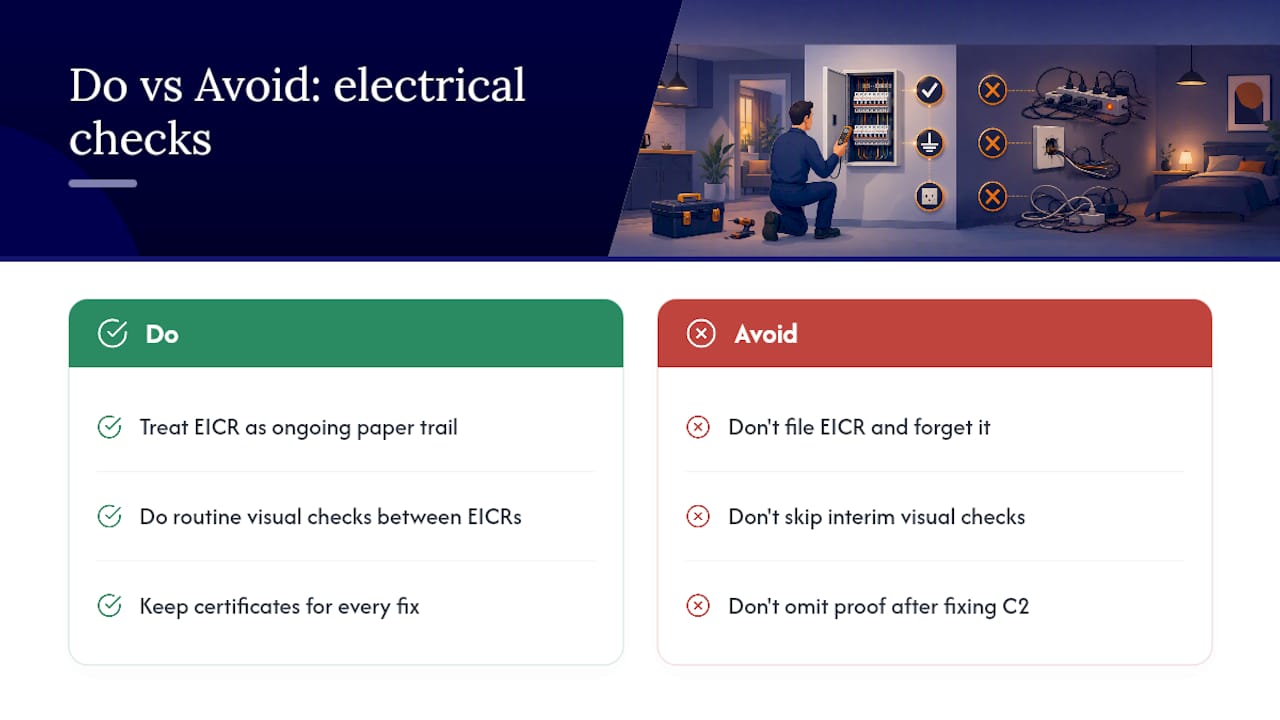
The conventional advice, "book your EICR every five years," undersells the real risk window. Most electrical faults that turn dangerous develop gradually: a socket loosens, a tenant adds an extension lead permanently, a DIY light fitting gets wired incorrectly. None of that shows up until the next formal test, unless you're doing the cheap, informal checks in between. That's the gap routine visual checks exist to close, and it's the part most landlords skip because it feels like duplicated effort.
My honest read: the paperwork matters as much as the physical work. A landlord who fixes a C2 finding but can't produce the certificate proving it is in almost the same position as one who never fixed it at all. Prioritise the documentation trail from day one, not as an afterthought once an inspector asks for it.
— Mike
Get inspections, remedial works and certificates handled by one team
777pcm is the practical alternative to juggling separate tradespeople for every property in your portfolio, one point of contact handles EICR bookings, remedial works and certificate issuing, instead of you coordinating each stage yourself. If you're managing more than a handful of tenancies, that consolidation is usually where the real time savings sit, not in any single inspection, but in never having to chase three different contractors for three different pieces of paperwork.

The service works through in‑house certified electricians rather than subcontracted trades, so scheduling, quality and remedial turnaround stay consistent across every property you own or manage. That matters most for time‑poor landlords, portfolios with recurring remedial needs, or letting agents responsible for multiple owners' compliance at once. Alongside electrical certification, 777pcm also handles gas safety certificates and wider maintenance work, so the same portal and point of contact can cover more than just your electrical obligations. For a live example of how the model works on the ground, the Newbury gas safety service page shows the certification workflow in practice.
If your next EICR is due, overdue, or you've just received a report with C1, C2 or FI codes on it, get in touch with 777pcm to book an inspection or discuss ongoing portfolio compliance.
Sources
- Electrical Safety Standards in the Private and Social Rented Sector (England) Regulations 2020 (and updates)
- Periodic inspection and testing (Electrical Safety First)
- Gov
- Routine visual & operational checklist (Electrical Safety Roundtable)
- Responsibility for electrical safety in rented homes (Shelter England)