Run multi-property maintenance from a single intake channel, a live compliance calendar, and a mix of in-house engineers and vetted trade contractors. That is the whole operating model in one sentence: centralise how problems get reported, track every certificate renewal before it lapses, and route the actual repair work through people you have already checked.
The first move, before anything else, is practical. Set up one inbound channel today, whether that is a portal, a dedicated email address, or a single phone line, and refuse to let reports come in any other way. Then add your next three certificate renewals to a calendar you actually look at.
Two things underpin this: landlords carry a statutory repairing duty under Section 11, and providers like 777pcm run in-house engineers and a compliance portal specifically because informal systems are where that duty quietly breaks down.
- Set one inbound channel (portal, email, or phone) and stop accepting reports elsewhere.
- Add your next three certificate renewals (gas, electrical, EPC) to a compliance calendar this week.
Key Takeaways
Multi-property maintenance works when a single intake channel, a live compliance calendar, and documented trade assignment replace informal, memory-based systems.
| Point | Details |
|---|---|
| One inbound channel | Route every report through a portal, email, or phone line, never informal messaging. |
| Triage by urgency | Emergencies within 24 hours, urgent jobs within days, routine work scheduled, not chased. |
| Legal duty stays with the landlord | Section 11 and fitness for habitation obligations apply regardless of who manages day to day. |
| Track five KPIs annually | Spend versus rent, reactive/planned split, void days, renewal rate, and repair time reveal problems early. |
| Consider a managed partner | 777pcm offers in-house engineers, a compliance portal, and bulk scheduling for portfolios outgrowing DIY systems. |
Table of Contents
- How does multi-property maintenance work for agents?
- Who is legally responsible for repairs across a portfolio?
- What systems replace spreadsheets and WhatsApp threads?
- How should you schedule and prioritise repairs across a portfolio?
- Which KPIs actually reveal a maintenance problem?
- When should you bring in a managed maintenance partner?
- How 777pcm takes multi-property maintenance off your plate
- Sources
How does multi-property maintenance work for agents?
Every well-run portfolio follows the same six-step chain: report, triage, assign, schedule, complete, record. Skip a step and you get exactly the chaos most landlords already recognise, jobs chased by memory, contractors booked twice, and no proof of what was actually done.
Triage decides everything downstream. A gas smell or total heating loss in winter is an emergency, typically requiring attendance within 24 hours. A dripping tap or a sticking door is routine, and a 5 to 10 working day window is reasonable. Getting this split wrong either burns money on urgent-rate callouts for minor jobs or leaves genuine hazards waiting in a queue.
Assignment is a judgement call worth documenting properly. Gas and electrical work has to go to a Gas Safe registered engineer or a competent electrician, no exceptions. For general repairs, in-house engineers give you consistency and faster turnaround; vetted external contractors fill gaps in trades or geography you don't cover directly. Record which you used and why, because that record is your audit trail if a dispute ever lands.
- Report – tenant or inspection flags an issue through the single channel.
- Triage – classify as emergency, urgent, or routine, with photos attached.
- Assign – in-house engineer or vetted contractor, logged against the job.
- Schedule – access confirmed with the tenant, works booked in.
- Complete – work carried out, certificate or invoice issued.
- Record – job closed with photos, cost, and paperwork attached.
Pro Tip: Before booking a plumber for a single dripping tap in a block of flats, check the queue for anything else nearby needing the same trade. Bundling three jobs into one visit routinely costs less than three separate callouts.
Who is legally responsible for repairs across a portfolio?
The landlord is, full stop, and no management arrangement changes that. Section 11 of the Landlord and Tenant Act 1985 places an implied repairing covenant on landlords to keep the structure, exterior, and key installations, gas, water, electricity, sanitation, and heating, in repair and working order. The Homes (Fitness for Human Habitation) Act reinforces this by making a property's basic habitability a legal standard, not a courtesy.
Government guidance is specific: landlords must respond promptly to faults that could affect health, particularly around heating, hot water, and gas appliances. That urgency has to be built into your triage rules, not treated as an aspiration.
Access works both ways. You need reasonable notice, usually 24 hours in writing, before entering a tenant's home, and force is never an option. A managed service should document every access request and refusal.
- Structure, exterior, and installations stay the landlord's legal responsibility, whoever manages day to day.
- Gas work must go to a Gas Safe registered engineer; electrical work to a competent, qualified electrician.
- Access requires proper notice and a written record, not an assumption of entry.
Our Section 11 guide breaks these duties down property by property if you want the fuller detail.
What systems replace spreadsheets and WhatsApp threads?
Spreadsheets and group chats work for two properties. They collapse at ten, because nothing is searchable, nobody owns the follow-up, and half the evidence lives on someone's personal phone. Guidance on scaling portfolios is blunt about this: move to a dedicated portal with a compliance calendar and an audit trail before you feel forced to.
The mechanics are simple. Every report needs a photo and a timestamped log entry, no exceptions, because a job with no photo is a job you cannot defend later. Attach the actual certificate scans, CP12, EICR, EPC, to the property record rather than filing them separately, so renewal dates and repair history sit in one place. Providers who structure their workflow this way attach contractor invoices and photos to every job precisely so nothing gets disputed months later.
A compliance portal with in-house engineers and dedicated account management, the model 777pcm runs, exists to remove the admin layer that usually eats a landlord's evening: chasing engineers for paperwork, hunting for a certificate before a tenancy renewal, or explaining to a new letting agent where the records went.
- One inbound channel; every report carries a photo and a log entry.
- Compliance calendar linked directly to the maintenance log, not a separate file.
- CP12, EICR, and EPC scans attached to the property record, searchable by renewal date.
Pro Tip: If you manage multiple properties on a shared inbox, you risk losing visibility of open jobs. A portal with individual job tracking fixes this within a week of switching.
How should you schedule and prioritise repairs across a portfolio?
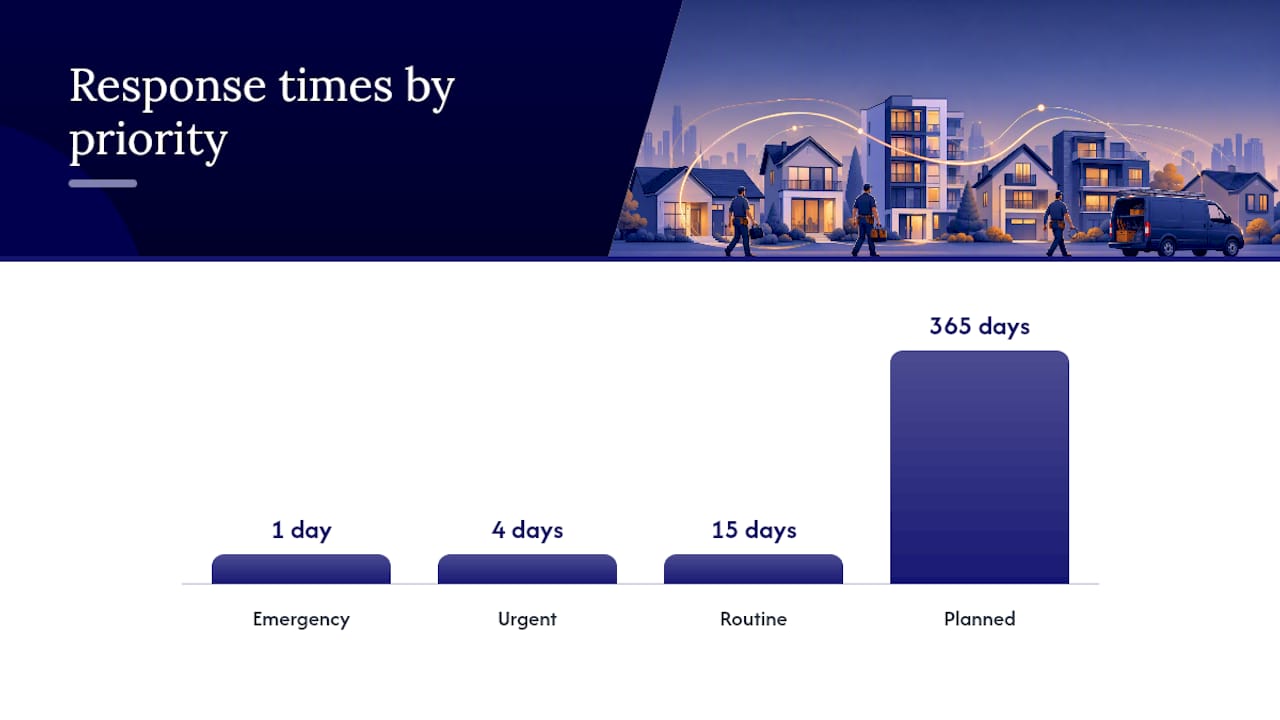
Classify every job the moment it lands, then hold yourself to the response time that classification implies.
- Emergency (gas leak, no heating in winter, flooding) – attend within 24 hours.
- Urgent (partial heating loss, minor leak, broken lock) – attend within 3 to 5 working days.
- Routine (redecoration, minor cosmetic repairs) – attend within 10 to 20 working days.
- Planned (boiler service, gutter clearance, exterior paintwork) – scheduled annually, not reactively.
Bundling is where real savings appear. Group jobs by trade and geography, three electrical snags across properties in the same postcode go to one electrician on one day, rather than three separate visits at three separate call-out rates. Our multi-trade coordination guide covers the mechanics in more detail.
Planned preventive maintenance shifts spend from expensive reactive repairs to predictable, budgeted work, and it protects asset value over time. An annual portfolio review is the right moment to check whether reactive spend is climbing as a share of rent, and whether that trend signals a property needing capital work rather than another patch repair.
Which KPIs actually reveal a maintenance problem?
Five numbers tell you almost everything: maintenance spend as a percentage of rent, the reactive versus planned split, void days, certificate renewal rate, and mean time to repair. Rising maintenance spend against rent is the clearest early warning; a property that regularly leans reactive rather than planned usually needs refurbishment, not another quick fix.
| KPI | What it signals |
|---|---|
| Maintenance spend % of rent | Rising trend suggests a property is ageing out of routine upkeep |
| Reactive vs planned split | High reactive share points to deferred capex, not bad luck |
| Void days | Slow turnarounds often trace back to unresolved maintenance |
| Certificate renewal rate | Missed renewals are a direct compliance and legal exposure |
| Mean time to repair | Longer times usually mean contractor capacity, not job complexity |
Run this review annually, aligned with the checks recommended for portfolio-level reviews, and use it to decide whether a property gets capital investment, gets sold, or needs a different maintenance model entirely. RICS guidance frames this as translating building-level activity into portfolio-level decisions, which is exactly what these five numbers are for.
When should you bring in a managed maintenance partner?
Three signs usually mean it's time: a certificate backlog you can't see the end of, travel time between properties eating hours you don't have, or a simple time-cost calculation showing your own hours are worth more than the fee a managed service charges.
A genuinely good contract or managed service should guarantee in-house engineers rather than a subcontractor lottery, a live compliance calendar you can check yourself, one single point of contact, and bulk scheduling across your properties rather than one booking at a time.
Outsourcing the delivery doesn't mean surrendering oversight. Keep the right to monthly reporting, insist on copies of every certificate as they're issued, and track the same KPIs, spend against rent, void days, renewal rate, whoever does the physical work.
- Certificate backlog, high travel time, or a poor time-cost ratio are the three clearest signs to outsource.
- Insist on in-house engineers, a compliance calendar, one contact point, and bulk scheduling.
- Retain monthly reporting and certificate copies regardless of who delivers the work.
Pro Tip: Ask any prospective provider how they document access refusals and gas safety checks before you sign anything. If they can't show you a sample record, they don't have the audit trail they're claiming.
Practitioner note: where portfolios actually go wrong
Most breakdowns start the same way: a report lands in a personal WhatsApp, gets actioned informally, and never makes it into any record. A portal with in-house engineers fixes this because the job simply can't exist without a log entry.
The fix looks different depending on the portfolio. A cluster of properties on one street can often run on a single trusted local contractor with light-touch tracking. A portfolio spread across three towns needs the calendar and the portal from day one, because nobody is driving between jobs to catch what the system misses.
— Mike
How 777pcm takes multi-property maintenance off your plate
If everything above sounds like the discipline you know you need but haven't had time to build, that's precisely the gap 777pcm exists to close. Rather than juggling a handful of local tradespeople and hoping certificates renew themselves, you get one provider handling CP12 gas safety, EICR electrical certificates, and EPCs alongside general repairs, plumbing, heating, and drainage, all delivered by in-house Gas Safe engineers and certified electricians rather than subcontracted out.

Onboarding is straightforward: your properties and their existing certificate dates go into the compliance portal, bulk scheduling covers any overdue renewals in the first batch, and you get a single point of contact instead of five separate tradespeople's mobile numbers. Most landlords see their backlog cleared within the first 30 to 90 days, with emergency response already running for anything urgent that comes up in the meantime.
If gas safety renewals are the immediate pressure point, start with CP12 landlord gas safety certificates and get your next inspection booked before it becomes a compliance gap.