
A compliant property handover means one thing above all: a signed inventory, a complete audit trail of mandatory certificates, and confirmed transfer of funds or deposit protection evidence, all secured before the keys change hands. Get those three elements right and you have a defensible position. Miss any one of them and you risk losing possession routes, facing financial penalties, or inheriting someone else's liability.
The documents and records you need to secure immediately are:
- Gas Safety Record (CP12): must be provided to new tenants before they occupy, per HSE landlord guidance. Check the engineer's Gas Safe registration number, the inspection date, and the property address.
- Electrical Installation Condition Report (EICR): confirm the issue date, the overall condition code, and any outstanding remedial deadlines under electrical safety guidance.
- Energy Performance Certificate (EPC): verify the rating and expiry date via the national EPC register. An E rating or above is the current minimum for most private rented properties.
- Deposit protection certificate and prescribed information: confirm the scheme name, the protection reference, and the date prescribed information was served.
- Written statement of tenancy terms: for new tenancies from 1 May 2026, this is a legal requirement under the Renters' Rights Act 2026. See the landlord guidance on written information for the required fields.
On day one, take a timestamped photographic inventory, record meter readings, collect all keys and fobs, and obtain a dated handover statement signed by both parties. These are your immediate actions. Everything else builds on this foundation.
Key takeaways
A compliant property handover requires a signed inventory, a complete set of mandatory certificates, confirmed deposit protection, and a written remediation plan for any outstanding works, all secured before the keys change hands.
| Point | Details |
|---|---|
| Certificates come first | Obtain CP12, EICR, and EPC before handover day; missing any one removes legal remedies and risks civil penalties. |
| Written information deadline | From 1 May 2026, new tenants must receive written tenancy terms before the tenancy is agreed; existing verbal tenancies require the RRA information sheet by 31 May 2026. |
| Staged agent handover | Follow the Property Institute's Stage 1 (four weeks before), Stage 2 (handover date), and Stage 3 (within three months) timetable to avoid disputed funds and missing documents. |
| Audit trail is the defence | Timestamped photos, signed handover statements, and portal logs are what make a compliant handover legally defensible, not just administratively complete. |
| 777pcm for portfolio compliance | 777pcm provides CP12, EICR, EPC, and in-house remedials with a central compliance portal, giving landlords and agents a single audit trail across their portfolio. |
Table of Contents
- What does a compliant handover checklist actually include?
- Switching agents or taking back management: what does the staged timetable look like?
- How should you run the compliance workflow from booking to sign-off?
- What does the law require at handover in 2026?
- How do you store and manage handover files across a portfolio?
- What should you do on the day of handover?
- What can you do if documents or funds are withheld?
- What should you prioritise when you have a single handover chance?
- 777pcm handles compliance checks and remedials so you do not have to
- Sources
What does a compliant handover checklist actually include?
A thorough property handover checklist covers three categories: mandatory safety certificates, tenancy paperwork, and property records. Each document carries its own verification requirements, and a gap in any category can undermine your legal position.
Mandatory safety certificates
| Document | Legal basis | What to verify | Typical renewal |
|---|---|---|---|
| Gas Safety Record (CP12) | Gas Safety (Installation and Use) Regulations 1998 | Engineer name, Gas Safe registration number, inspection date, property address | Annual |
| EICR | Electrical Safety Standards (Private Rented Sector) (England) Regulations | Issue date, condition code (C1/C2/C3), remedial deadlines, inspector credentials | Every 5 years |
| EPC | Energy Performance of Buildings Regulations | Rating (E or above), certificate reference, expiry date | Every several years |
| Legionella risk assessment | Health and Safety at Work Act / HSE guidance | Date of assessment, assessor name, any control measures required | As risk changes; typically every 2 years |
| Asbestos management record | Control of Asbestos Regulations | Presence/absence survey, management plan, date of last review | On change of management or works |
| Smoke and CO alarm test records | Smoke and Carbon Monoxide Alarm Regulations | Test date, location of alarms, who tested | At start of each tenancy |

You can organise gas safety checks for tenants well in advance of handover to avoid last-minute delays. For properties built before 2000, treat asbestos records as mandatory rather than optional: HSE asbestos duty guidance places a clear obligation on those responsible for the property to hold and pass on that information.
Tenancy paperwork
- Written statement of tenancy terms: required for all new tenancies from 1 May 2026 under the Renters' Rights Act 2026; must be provided before the tenancy is agreed.
- Tenancy agreement copy: signed by all parties, with any addenda or special conditions included.
- Deposit protection certificate: scheme name, protection reference, and the date the deposit was registered (within 30 days of receipt).
- Prescribed information: served to the tenant within 30 days of receiving the deposit, per gov.uk deposit protection guidance.
- Right to Rent checks evidence: copies of documents checked, date of check, and who conducted it.
- Section 48 notice: landlord's name and address for service of notices (required under Landlord and Tenant Act 1987).
Property records and health and safety documentation
- Inventory and check-in report with dated photographs, signed by the tenant.
- Boiler service history and appliance manuals.
- Warranties and guarantees (including structural warranties for new-build properties and any snagging reports).
- Service charge accounts and ground rent schedules where applicable.
- Legionella risk assessment and monitoring records, per HSE legionella guidance.
Financial and access items
- All keys, fobs, and access codes, with a signed receipt.
- Meter readings (gas, electricity, water) taken on handover day and confirmed in writing.
- Bank account details for incoming rent payments.
- Client money reconciliation and a schedule of any outstanding balances.
Pro Tip: Keep a tribunal-grade audit trail by storing every document with a timestamp, the name of the person who received it, and the method of delivery (email, post, in-person). A signed delivery receipt is worth more than a sent-email record alone.
Switching agents or taking back management: what does the staged timetable look like?
When a landlord changes managing agent or takes back self-management, the handover process carries its own compliance obligations. The Property Institute's staged handover timetable sets out three stages, and following them reduces the risk of disputed funds, missing documents, and broken deposit protection chains.
The three Property Institute stages
Stage 1 (not less than four weeks before handover): The outgoing agent should confirm the termination in writing, provide a schedule of all documents held, and begin reconciling client accounts. The incoming agent or landlord should prepare a new client trust account and issue a handover checklist to the outgoing party.
Stage 2 (on the agreed handover date): Physical transfer of keys, fobs, and original documents. Reconciled accounts and unspent client funds transferred to the incoming trust account. Signed handover statement exchanged between both parties.
Stage 3 (within three months of handover): Any outstanding documents, final reconciled accounts, and residual funds transferred. This stage covers items that could not be resolved on the handover date, such as disputed service charge balances or documents held pending tribunal proceedings.
Numbered steps for both parties
- Confirm the handover date in writing and agree a named overseer for each side.
- Outgoing agent provides a full schedule of documents held, including deposit registration details for every tenancy.
- Incoming party verifies deposit protection status against the schedule and requests written undertakings for any documents that must be retained for tribunal evidence.
- Outgoing agent reconciles client accounts and prepares a transfer schedule for unspent funds.
- On handover day, both parties sign the handover statement and confirm receipt of keys, documents, and funds.
- Incoming party notifies tenants of the change in writing, providing new contact details and rent payment instructions.
- Within three months, confirm all outstanding items from Stage 3 have been resolved and close the action register.
The NRLA guidance on taking over management from an agent adds a practical layer: check the agent's terms of business before serving notice, because some contracts impose notice periods or fees that affect the timing of Stage 1.
Key obligations for the outgoing agent:
- Confirm termination in writing and agree the handover date.
- Pass all tenant files, including historical safety certificates and correspondence.
- Transfer reconciled client funds promptly; withholding funds to enforce disputed fees is contested practice and often challenged.
- Outgoing agents cannot charge for returning documents unless the management contract explicitly permits it.
Pro Tip: Agree the handover overseer and the Stage 1/2/3 dates in a single written document signed by both parties. A strict staged timetable with named milestones is the single most effective way to prevent disputes about what was transferred and when.
How should you run the compliance workflow from booking to sign-off?
The operational workflow for handling property handover compliance checks follows a clear sequence. Skipping steps or running them out of order typically means repeat visits, wasted costs, and gaps in the evidence trail.
Step-by-step compliance workflow
- Pre-handover planning: Complete the full property handover checklist. Identify which certificates are missing, expired, or due for renewal. Create a work order for each outstanding item.
- Book safety checks first: Schedule the CP12 gas safety inspection and EICR before any remedial works begin. This sequencing matters because remedial works sometimes affect gas or electrical installations, which would require re-testing.
- Coordinate access: Confirm tenant access windows in writing. For vacant properties, arrange key-safe or agent access. Document who attended and when.
- Complete remedial works: Urgent remedials (C1 or C2 electrical faults, gas safety failures) within 48–72 hours of identification. Non-urgent items within 14 days. Record the scope of work, the engineer's name, and the completion date on the work order.
- Capture evidence: Dated photographs before and after each remedial. Certificate copies stored immediately in the property file. Engineer sign-off on each completed item.
- Final sign-off: Issue the completed certificates to the tenant (or incoming agent). Obtain a signed acknowledgement. Archive the full file with timestamps.
Example remediation plan structure
A simple remediation plan should include: the defect description, the category (urgent or non-urgent), the responsible engineer or trade, the target completion date, and the sign-off date. For example:
- Defect: C2 electrical fault at consumer unit. Category: Urgent. Target: Within 48 hours. Sign-off: Engineer certificate + dated photo.
- Defect: Dripping kitchen tap. Category: Non-urgent. Target: Within 14 days. Sign-off: Plumber's job sheet + tenant confirmation.
Sequencing gas and electrical checks before final remedials prevents the scenario where a plumber or decorator disturbs an installation that then requires re-inspection. This is a practical point that electrical safety guidance implicitly supports by requiring landlords to act on remedials within specified timeframes and provide evidence of completion.
A central compliance portal changes the economics of this workflow. When engineers log job completion directly into a shared system, certificates are available to landlords and agents within hours rather than days, and the audit trail builds itself. Using in-house engineers rather than subcontractors removes the coordination layer that most commonly causes delays and evidence gaps.
Pro Tip: Photograph every defect and every completed remedial with a device that embeds the date and time in the file metadata. Courts and tribunals treat timestamped photographic evidence as significantly more reliable than written descriptions alone.
For portfolio managers, a landlord portal for letting agents provides the visibility needed to track outstanding certificates across multiple properties without relying on manual spreadsheets.
What does the law require at handover in 2026?
The legal obligations at a property handover are not optional extras. Missing documents have direct consequences for your ability to serve possession notices, recover costs, and defend against tenant claims.
Renters' Rights Act 2026: written information requirements
From 1 May 2026, landlords must provide new tenants with written information about the key terms of the tenancy before the tenancy is agreed. The landlord guidance on written information specifies the required fields, which include the landlord's name and address, tenant names, the property address, the rent amount, and the minimum notice period to end the tenancy.
Existing tenants with verbal-only tenancies must receive the Renters' Rights Act information sheet by 31 May 2026.
Deposit protection obligations
- The deposit must be protected in a government-approved scheme within 30 days of receipt.
- Prescribed information must be served on the tenant within 30 days of receiving the deposit.
- Failure to protect the deposit or serve prescribed information means the landlord cannot serve a valid Section 21 notice (now abolished under the Renters' Rights Act 2026) and faces a penalty of one to three times the deposit amount, per gov.uk deposit protection guidance.
Safety certificate obligations and penalties
- A landlord who cannot provide a valid CP12 at the start of a tenancy is in breach of the Gas Safety (Installation and Use) Regulations 1998. The HSE gas safety record guidance is the primary reference.
- An EICR must be provided to new tenants before they occupy and to existing tenants within 28 days of a new report being issued. Failure to comply with remedial notices can result in civil penalties.
- A missing or invalid EPC affects the landlord's ability to let the property legally and may attract enforcement action from the local authority.
Statutory callout: The 31 May 2026 deadline for serving the Renters' Rights Act information sheet on existing verbal-tenancy tenants is a hard statutory date. Missing it is a breach of the Act, not an administrative oversight.
For a full picture of landlord duties under the 2026 regulatory changes, the landlord compliance checklist 2026 covers the updated requirements in detail.
Pro Tip: Keep a timestamped delivery record for every document served at handover: the date, the method (email with read receipt, recorded post, or in-person with signature), and the name of the recipient. This record is your statutory defence if a tenant later claims they did not receive a document.
How do you store and manage handover files across a portfolio?
Compliance documentation is only useful if you can retrieve it quickly, prove when it was issued, and demonstrate a complete chain of custody. For a portfolio of more than a handful of properties, an ad hoc approach to filing creates gaps that surface at the worst possible moment.
Recommended folder structure and filename pattern
Organise files by property reference, then by document type and date. A consistent filename pattern makes retrieval fast and audit-ready:
[PropertyRef]_[DocumentType]_[YYYY-MM-DD]_[IssuingBody]
For example: SW1A1AA_CP12_2025-11-14_GasSafeEngineer.pdf
| Document | Suggested filename example | Retention period |
|---|---|---|
| Gas Safety Record (CP12) | SW1A1AA_CP12_2025-11-14_GasSafe.pdf | Minimum 2 years; retain all records indefinitely for portfolio audit |
| EICR | SW1A1AA_EICR_NICEIC.pdf | Duration of tenancy + 6 years |
| EPC | SW1A1AA_EPC_AccreditedAssessor.pdf | Several years (certificate validity) |
| Legionella risk assessment | SW1A1AA_Legionella_HSECompliant.pdf | Retain while responsible for property |
| Deposit protection certificate | SW1A1AA_Deposit_MyDeposits.pdf | Duration of tenancy + 6 years |
| Signed handover statement | SW1A1AA_HandoverStatement_Signed.pdf | Indefinitely |
Audit process for incoming files
When you receive a file from an outgoing agent, run a quick verification checklist:
- Cross-reference every certificate against the schedule provided at Stage 1.
- Check certificate numbers, issue dates, and named parties against the tenancy records.
- Flag any missing or expired documents on an action register with a target resolution date and a named responsible party.
- Confirm deposit protection status independently with the scheme administrator, not just from the agent's records.
Capture the minimum metadata for each certificate: certificate number, expiry date, technician name, and at least one timestamped photograph of the physical property condition at the time of issue.
Pro Tip: Set automated calendar reminders 90 days before each certificate expires. A CP12 that lapses during a tenancy creates immediate legal exposure; catching it in advance costs a fraction of the remediation effort.
For a detailed breakdown of what the rental property compliance checklist covers across a full portfolio, the 2026 guide is a practical reference for building your filing system around.
What should you do on the day of handover?
Handover day is where preparation either pays off or falls apart. The physical checks, signatures, and evidence capture that happen on the day create the record that everything else depends on.
On-site walk-round and inventory:
- Walk every room against the inventory/check-in report and note any discrepancies.
- Record meter readings (gas, electricity, water) and photograph the meters with the reading visible.
- Take date-stamped photographs of any snagging items, completed remedials, and the general condition of each room.
- Verify that all smoke and CO alarms are present and functioning; test them and record the result.
Physical items to collect and confirm:
- All keys, fobs, and access codes, with a signed receipt from the outgoing party.
- Appliance manuals, warranties, and guarantees.
- Certificate originals or certified copies: CP12, EICR, EPC, and any other documents from the checklist.
- Boiler service history and any relevant maintenance records.
Signatures and documentation:
- Dated handover statement signed by both parties, listing every document returned and every outstanding item.
- Acknowledgement of any outstanding remedials, with a written remediation timetable attached.
- Confirmation of new contact details and rent payment instructions for the tenant.
Pro Tip: Compile a single dated handover PDF that lists all returned documents as attachments and sign it digitally in front of the tenant or outgoing agent. A single signed document is far harder to dispute than a collection of separate emails and paper records.
For properties where tenant safety responsibilities are shared, the tenant safety responsibility checklist clarifies which obligations remain with the landlord throughout the tenancy.
What can you do if documents or funds are withheld?
Withheld documents and delayed funds are among the most common disputes in agent transitions. The good news is that there is a clear escalation path, and the law and sector guidance are generally on the incoming party's side.
Escalation steps
- Request written confirmation from the outgoing agent of every document and fund they hold, referencing the management agreement and the agreed handover schedule.
- Serve a formal written notice citing the specific clauses of the management agreement that require return of documents and funds by the handover date.
- Request an accountant's reconciliation of all client funds held, and demand transfer of unspent funds to the incoming trust account within a specified deadline.
- If the outgoing agent claims a right to retain documents to enforce unpaid fees, take legal advice: NRLA guidance notes that withholding documents to enforce fees is contested practice and frequently challenged.
- Escalate to the relevant redress scheme (the Property Ombudsman or the Property Redress Scheme, depending on the agent's membership) if the agent fails to comply within a reasonable period.
- For withheld deposit protection records, contact the deposit scheme administrator directly to verify protection status and obtain the scheme's own records.
- If funds are withheld beyond the agreed date, small claims court or a First-tier Tribunal (Property Chamber) are available routes depending on the amount and nature of the dispute.
Evidence to gather at every stage:
- Dated emails and written correspondence with the outgoing agent.
- Screenshots of portal records showing what documents were accessible and when.
- Bank reconciliation statements showing client funds held.
- Copies of the relevant management agreement clauses.
- The signed handover statement (or evidence that one was refused).
The Property Institute's staged timetable is useful evidence in a dispute: if the outgoing agent agreed to Stage 1/2/3 dates and failed to meet them, that agreement and the missed deadlines form the basis of a formal complaint.
Pro Tip: If funds are withheld, instruct the incoming agent to open a compliant client trust account immediately and provide proof of that account to the outgoing party before any rent is redirected. This removes the outgoing agent's most common justification for delay and demonstrates that the incoming party is ready to receive funds correctly.
What should you prioritise when you have a single handover chance?
The reality of most handovers is that you get one window. Access is limited, tenants are moving, and the outgoing agent has already mentally moved on. In that context, the order in which you secure things matters enormously.
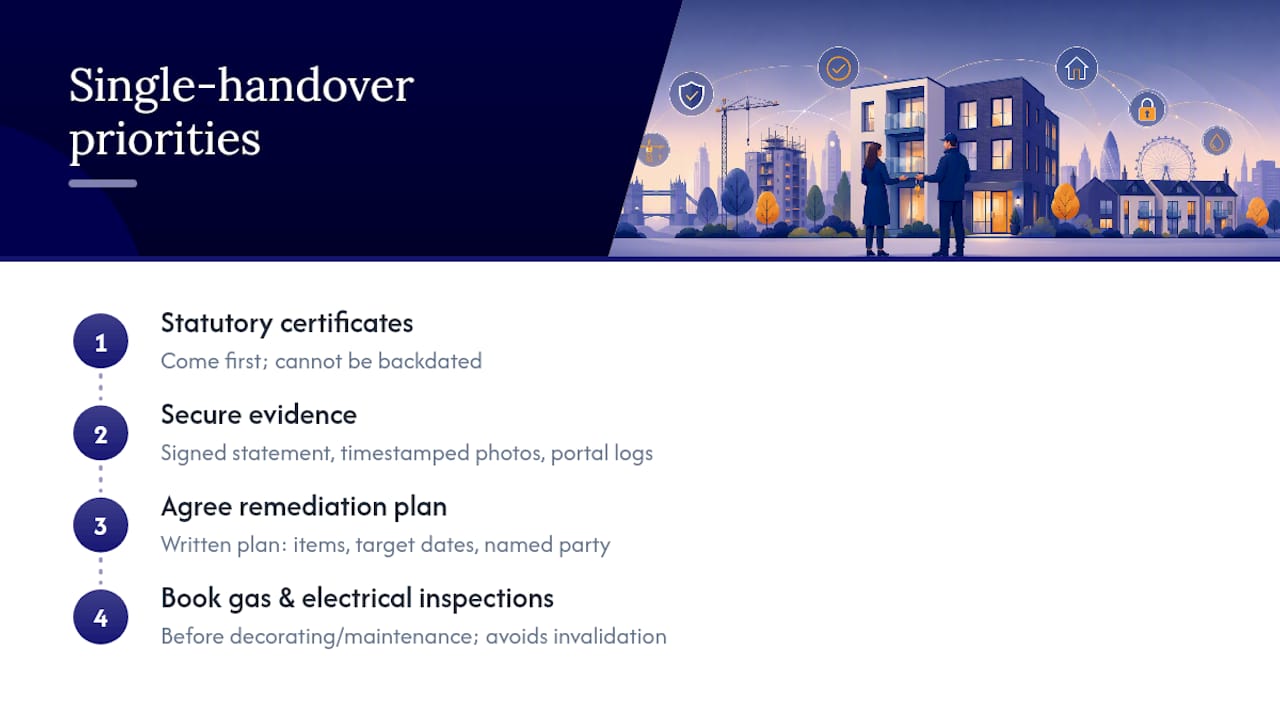
The statutory certificates come first, without exception. A missing CP12 or an expired EICR does not just create an administrative problem; it removes legal remedies and exposes the landlord to civil penalties. Everything else can be chased after the fact. Those certificates cannot be backdated.
Second, secure the evidence that proves delivery. A signed handover statement, timestamped photographs, and portal logs are what turn a compliant handover into a defensible one. The distinction matters when a tenant or outgoing agent disputes what was handed over and when. The evidence does not need to be elaborate; it needs to be dated, signed, and stored somewhere you can retrieve it in 48 hours.
Third, agree the remediation plan in writing before the handover day ends. Outstanding works left without a written deadline and a named responsible party have a way of becoming permanent. A short written plan, even a single page listing each item, the target date, and who is responsible, closes that gap. It also protects the incoming landlord or agent from inheriting liability for works they did not commission.
One practical point from engineers who run these checks regularly: book the gas and electrical inspections before any decorating or general maintenance work begins. A painter who disturbs a cable run, or a plumber who moves a gas appliance, can invalidate a certificate that was perfectly valid the day before. Sequencing the safety checks first removes that risk entirely and avoids the cost of a repeat visit.
777pcm handles compliance checks and remedials so you do not have to
Property compliance at handover is not just about ticking boxes. It is about having the right certificates, the right evidence, and the right remedials completed before a dispute arises. 777pcm provides exactly that: Gas Safe registered engineers for CP12 inspections, qualified electricians for EICRs, EPC arrangements, and in-house trades covering plumbing, heating, drainage, roofing, and general repairs, all managed through a single point of contact.

The operational advantage is straightforward. In-house engineers mean no subcontractor coordination delays, no gaps in the evidence chain, and no finger-pointing when a certificate is late. Every job is logged in a central compliance portal, so landlords and agents have a real-time audit trail that holds up in a tribunal. Urgent remedials are handled within 48–72 hours; non-urgent works within 14 days, matching the workflow described in this guide.
For landlords and agents who need a CP12 booked now, gas safety certificates in Newbury are available with qualified Gas Safe engineers. For a full picture of 777pcm's compliance and maintenance services, visit 777pcm and speak to the team about your portfolio's requirements.
Sources
These primary sources are worth bookmarking for statutory detail, templates, and updates:
- Written information that must be given to tenants - landlord guidance
- Hse
- Gov
- CHANGING MANAGING AGENTS
- Landlord Taking Over From Managing Agent Guidance | NRLA
This article is general information, not a substitute for advice from a qualified lawyer. Consult a qualified legal professional about your own circumstances before acting on anything here.