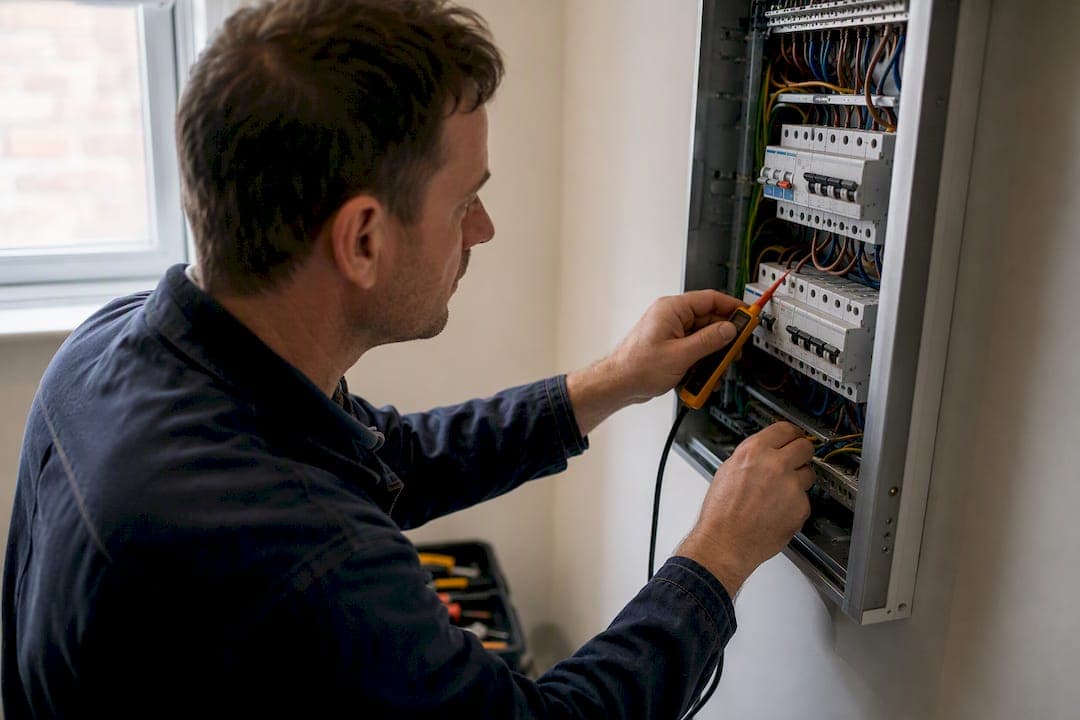
Poor electrical safety compliance creates direct, quantifiable portfolio risk. It shows up as regulatory fines of up to £40,000 per breach, insurance policies that refuse to pay out, tenant liability claims, and delays that stall a sale or remortgage. That risk is not theoretical. Every rental property in England needs a fixed electrical installation inspected at least every five years, and any dangerous fault classed C1 or C2 must be fixed within 28 days.
Miss either deadline and the exposure compounds fast across a portfolio, not just one property.
- Regulatory fines: up to £40,000 per breach, per property
- Insurance exposure: cover can be voided if a fault caused damage and the property wasn't compliant
- Liability: injury or death linked to a known fault exposes the landlord personally
- Transactional friction: missing EICRs stall sales, remortgages and possession claims
Statistic: The maximum civil penalty for breaching the Electrical Safety Standards in the Private Rented Sector Regulations 2020 rose to £40,000 per relevant breach from 1 May 2026.
Key Takeaways
Electrical safety compliance directly determines portfolio risk through fines, insurance exposure, liability and transactional delays, and closing the evidence and scheduling gaps removes most of that exposure.
| Point | Details |
|---|---|
| Know the statutory clock | EICRs are required every five years, with C1/C2 faults fixed within 28 days. |
| Penalties are severe | Breaches can attract civil penalties of up to £40,000 per property. |
| Evidence beats intention | Dated proof of tenant delivery and remedial completion matters more than the certificate alone. |
| Stagger, don't cluster | Spreading renewal dates across the year avoids inspector shortages during peak demand. |
| Managed compliance closes the gaps | 777pcm's in-house electricians and portfolio portal centralise scheduling, remedials and evidence in one place. |
Table of Contents
- Why electrical safety affects portfolio risk under the regulations
- How electrical failures turn into portfolio losses
- The operational gaps that create the biggest exposure
- A priority checklist to cut electrical safety risk
- Building governance that scales across a portfolio
- What the industry gets wrong about electrical compliance risk
- How 777pcm removes the electrical safety guesswork
- Sources
Why electrical safety affects portfolio risk under the regulations
The legal duties are narrower than most landlords assume, and that's exactly why they get missed. Regulation 3 of the Electrical Safety Standards in the Private Rented Sector (England) Regulations 2020 requires landlords to:
- Have the fixed electrical installation inspected and tested by a qualified person at least every five years
- Obtain a report (the EICR) that records the outcome and classifies any faults found
- Supply that report to existing tenants within 28 days, and to new tenants before they move in
- Supply a copy to the local housing authority within seven days if requested
- Complete remedial work classed C1 or C2 within 28 days, or sooner if the electrician specifies an urgent timeframe
The enforcement side has teeth. Under Part 2 of the Regulations, a local authority can serve a remedial notice, arrange the work itself with tenant consent, and recover the cost from the landlord. It can also impose a civil penalty on top of any remedial recovery.
A landlord who ignores a remedial notice doesn't just face a fine. The authority can complete the work, bill the landlord, and still pursue the penalty separately. The exposure stacks.
That £40,000 ceiling applies per breach, per property. On a 30-property portfolio with common failure modes, the theoretical exposure runs into millions, even though no council would pursue every case at that level.
How electrical failures turn into portfolio losses
Electrical non-compliance rarely stays as an isolated cost. It spreads into insurance, financing, and sale timelines, and each one hits cash flow differently.
- Remedial bills scale with neglect. A socket fault caught early costs far less than the same fault left until it damages a consumer unit or triggers a rewire.
- Insurance can lapse at the worst moment. Most landlord policies require compliance with statutory safety standards as a condition of cover. A claim following a fire or electrical fault can be reduced or refused if the property lacked a valid EICR.
- Due diligence catches missing certificates. Buyers' solicitors and mortgage lenders routinely request the current EICR during conveyancing. A missing or expired certificate delays completion, and a delayed sale on a leveraged portfolio has its own cost in lost interest and renegotiated terms.
Across a portfolio, these effects rarely hit one property at a time. A single admin gap, one missed renewal date, tends to repeat itself across every property bought or certified in the same window.
The operational gaps that create the biggest exposure
Most electrical safety failures aren't caused by landlords ignoring the rules. They're caused by scheduling gaps that nobody notices until it's too late.
- The renewal cliff. There's no grace period once an EICR expires. A property is non-compliant the day after the five-year mark passes, not the week after.
- Inspector scarcity during renewal waves. A large volume of EICRs issued in the same period creates a wave of expiries later, and demand for inspectors spikes exactly when supply is tightest.
- Underqualified inspectors. A suspiciously cheap inspection is often a red flag; it's worth checking the electrician's registration before, not after, the report lands.
- Missing delivery evidence. An EICR that was never formally handed to the tenant, with dated proof, is difficult to defend if a council asks for records.
Pro Tip: Keep a rolling forward log of every EICR expiry date across the portfolio, and flag anything due within 90 days. That single habit closes most of the gaps above.
A priority checklist to cut electrical safety risk
Reducing exposure doesn't require a full overhaul. It requires a short list, done in the right order.
This week:
- Pull every EICR on file and check the expiry date against today's date
- Confirm each inspecting electrician's registration (NICEIC, NAPIT or ELECSA)
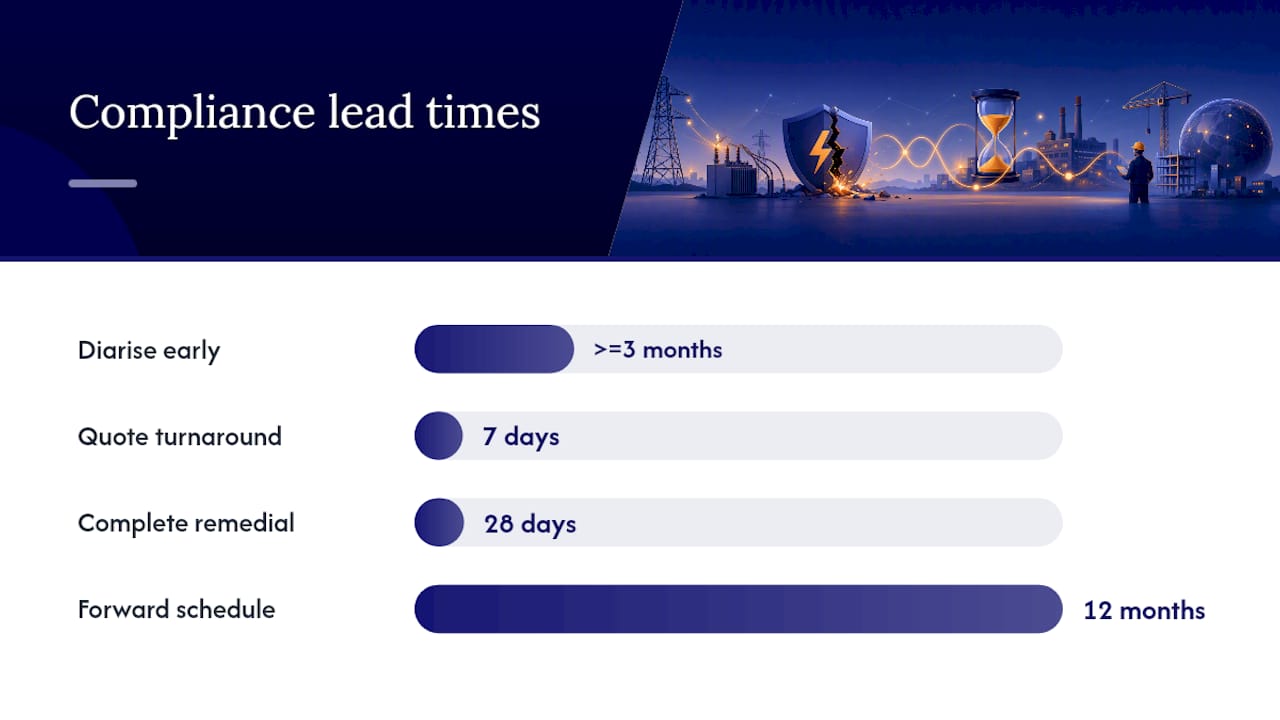
- Diarise every renewal at least three months ahead, not on the expiry date itself
This month: 4. Move to centralised scheduling so renewals across the portfolio don't cluster into one unmanageable wave 5. Set a remedial-work standard: quote within seven days of a fault being flagged, work completed within 28 6. Capture photographic evidence and written confirmation for every remedial job, then store it centrally
This quarter: 7. Reconfirm your insurer's compliance conditions in writing, particularly for any portfolio-wide policy 8. Build a rolling 12-month forward schedule so no single quarter absorbs a disproportionate share of renewals 9. Audit your tenant-delivery process. Signed or electronic proof of receipt matters more than most landlords assume when a council asks for records
Pro Tip: Store the electrician's written confirmation alongside the EICR itself, not in a separate folder. Auditors and buyers' solicitors ask for both, usually at the same time.
| Point | Details |
|---|---|
| Diarise early | Set renewal reminders at least three months before expiry, not on the deadline itself. |
| Vet inspectors | Confirm NICEIC, NAPIT or ELECSA registration before booking, not after the report arrives. |
| Fix the 28-day window | Complete every C1/C2 remedial job within 28 days and document it in writing. |
| Prove delivery | Keep dated proof that tenants and, where requested, the local authority received the EICR. |
Building governance that scales across a portfolio
A handful of properties can survive an ad hoc approach to electrical safety. A growing portfolio can't, because the same admin gap that costs one landlord a single fine costs a portfolio operator dozens.
Effective governance rests on measurable service levels rather than good intentions:
- Inspection lead time: how far in advance is the next EICR booked, and against what benchmark?
- Remedial completion: is every C1/C2 fault closed within 28 days, with a documented escalation path if not?
- Evidence turnaround: how quickly does proof of completion and tenant delivery reach the central record?
- Audit logs: can you produce, in minutes, every certificate and remedial record for any property a council or buyer asks about?
The portfolios that get caught out aren't usually the ones with the worst properties. They're the ones with the worst paper trail.
The choice between managing this in-house, outsourcing it ad hoc job by job, or using a managed compliance model comes down to accountability and speed rather than cost alone. A model built around registered, in-house electricians and a centralised portal removes the two biggest variables: whether the right person did the inspection, and whether the paperwork actually reached the right hands on time.
What the industry gets wrong about electrical compliance risk
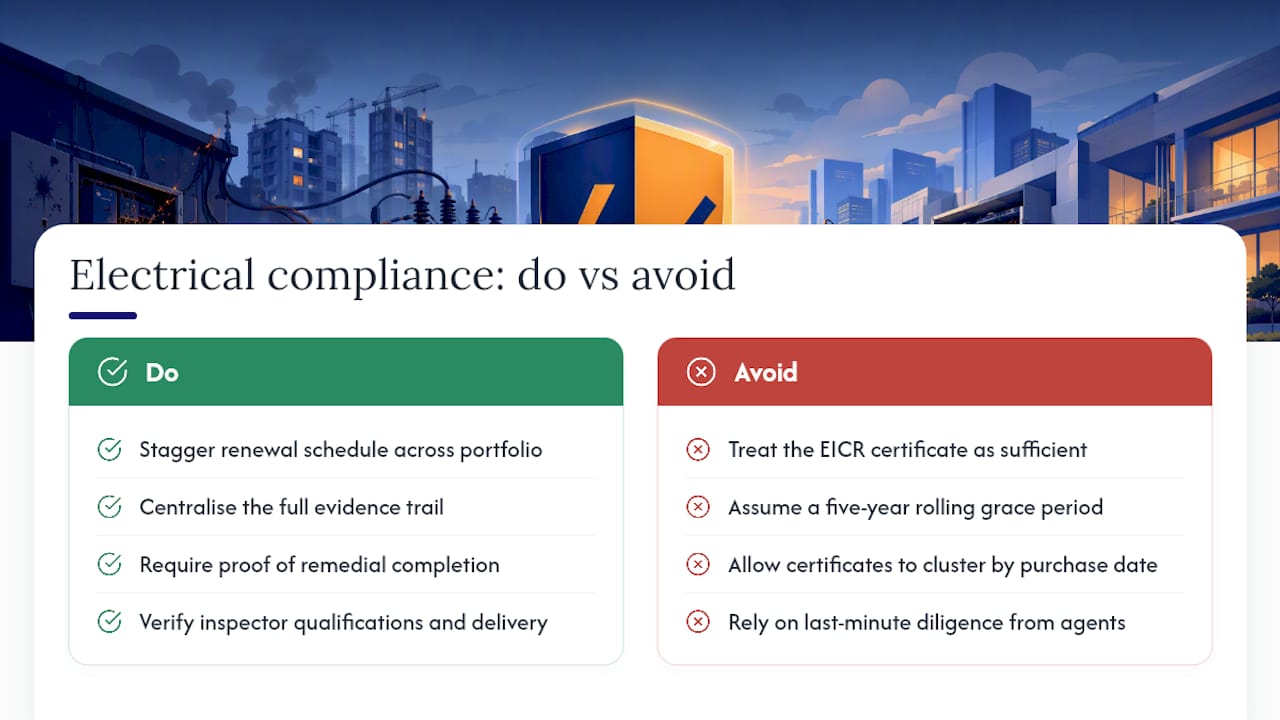
Most advice on this topic treats electrical safety as a certification task: get the EICR, file it, move on. That misses the point. The certificate itself protects nobody. What protects a portfolio is the chain of evidence around it: proof of delivery, proof of remedial completion, and proof that the inspector was actually qualified to sign it off.
I'd go further than most guidance does here. The renewal cliff is the single most underestimated risk in this entire area. Landlords plan for the five-year cycle as if it works like a rolling MOT with some flexibility. It doesn't. There is no grace period, and the properties most likely to slip are the ones bought in a cluster, because their certificates all expire in the same narrow window years later.
The practical fix isn't more diligence from already-stretched landlords and agents. It's structural: stagger the schedule so no single quarter becomes a crisis, and put the evidence trail in one place before anyone asks for it. Portfolios that treat compliance as a governance function, not an annual chore, are the ones that never end up explaining a gap to a council or a buyer's solicitor.
How 777pcm removes the electrical safety guesswork
Everything covered above, the renewal cliff, the evidence gaps, the scramble for a qualified inspector during a renewal wave, is exactly what 777pcm was built to prevent. As a managed compliance partner, 777pcm gives landlords and letting agents direct access to in-house certified electricians and Gas Safe registered engineers, so certification never depends on a subcontractor's availability or a stranger's paperwork standards.

777pcm manages CP12 gas safety certificates, EICRs and EPCs from a single portfolio portal, which means renewal dates, remedial jobs and delivery evidence all sit in one place rather than scattered across emails and spreadsheets. That directly answers the operational gaps in the checklist above: centralised scheduling, a documented 28-day remedial workflow, and evidence stored where an auditor or buyer's solicitor can actually find it.
If your portfolio has EICRs expiring this year or a backlog of remedial jobs you haven't tracked, get in touch with 777pcm to see how a managed approach compares with what you're running now.