
Letting agents in England must, by law, belong to a government-approved redress scheme. This gives tenants and landlords a free, independent way to resolve complaints when things go wrong, without setting foot in a courtroom.
The two approved schemes are The Property Ombudsman and the Property Redress Scheme. If you have a dispute, you complain to the agent first, and if you get no satisfactory resolution within a specified time period (or you're unhappy with their final answer), you escalate to the scheme. Outcomes can include an apology, corrective action, or compensation.
- Membership has been mandatory for lettings agents and property managers since 1 October 2014
- Two schemes cover the whole market: The Property Ombudsman and the Property Redress Scheme
- Complaints go to the agent first, then the scheme after eight weeks or a final response
- Agents who ignore the duty risk council fines of up to £5,000
Key Takeaways
Every lettings agent in England must belong to an approved redress scheme, and complaints follow a fixed path from the agent to the scheme within eight weeks.
| Point | Details |
|---|---|
| Membership is mandatory | All lettings and property management agents in England must join since 1 October 2014. |
| Two approved schemes | The Property Ombudsman and the Property Redress Scheme are the only options. |
| Complain to the agent first | Escalate to the scheme after a final response or eight weeks without one. |
| Fines reach £5,000 | Local authorities can penalise agents who fail to join a scheme. |
| 777pcm fixes root causes | CP12, EICR, EPC, and in-house repairs reduce the maintenance issues that trigger complaints. |
Table of Contents
- What is a redress scheme for letting agents?
- Who has to join a redress scheme?
- Which schemes are approved, and how do you check membership?
- How do you actually make a complaint?
- What can a redress scheme actually award?
- What happens if an agent refuses to join?
- How agents and landlords can stay ahead of complaints
- Keep your properties compliant and complaint-free with 777pcm
- Frequently asked questions
- Sources
What is a redress scheme for letting agents?
A redress scheme is an independent complaints service that sits outside the courts, set up specifically to resolve disputes between letting agents and the people they deal with, tenants, landlords, and sometimes buyers. It exists because chasing a bad agent through the small claims court is slow, stressful, and often disproportionate to the sum involved.
The government introduced the duty to belong precisely to raise standards across a sector that, until 2014, had no consistent complaints route. Shelter notes that these schemes also help spot repeat poor practice across an agent's caseload, not just resolve one dispute in isolation.
- It's free for the person complaining
- It's typically faster than going to court
- Decisions carry real weight, backed by the threat of expulsion from the scheme
Redress schemes don't replace every other route. Local authorities still enforce housing law separately, and genuinely serious financial disputes may still need the small claims court. Think of a redress scheme as the first, cheapest door you knock on.
Pro Tip: Keep every email and message with your agent dated and in one folder from day one. If a dispute ever escalates, that timeline becomes your strongest piece of evidence.
Who has to join a redress scheme?
The legal duty covers anyone carrying out lettings agency work or property management work "in the course of business" in England, a definition set out in the 2014 statutory order that created the whole system. In practice, that means finding tenants, negotiating tenancies, collecting rent, or managing repairs on a landlord's behalf, all count.
A quick checklist to judge whether the duty applies:
- Are you being paid, in any form, to find tenants or manage a let?
- Do you negotiate rent, deposits, or tenancy terms for someone else's property?
- Do you handle repairs, inspections, or rent collection on a landlord's behalf?
- Is this a business activity, rather than a one-off favour for a friend or relative?
If you answered yes to any of the first three and yes to the fourth, you almost certainly need to join a scheme. Purely informal arrangements, a friend managing one property with no fee, generally fall outside scope, but anyone operating as a business, even a sole trader with two properties, is caught.
Which schemes are approved, and how do you check membership?
Only two schemes currently hold government approval: The Property Ombudsman and the Property Redress Scheme. Every letting agent operating legally in England belongs to one or the other, never neither.
Checking is straightforward:
- Look for the scheme's logo on the agent's website footer, usually alongside their membership number
- Check the office window or reception area, membership must be displayed physically as well as online
- Search the scheme's own membership lookup tool if you can't find a number
- Ask the agent directly and request their membership reference in writing
If an agent can't or won't confirm membership, treat that as a warning sign. You can still report them to the local council, who has the power to investigate and fine unregistered agents.
How do you actually make a complaint?
Start with the agent, always. Skipping straight to the scheme rarely works, since both approved schemes require you to exhaust the agent's internal complaints procedure first.
- Write to the agent formally. Set out exactly what went wrong, dates, and what resolution you want.
- Wait for their final response, or eight weeks, whichever comes first. This is the trigger point for escalation.
- Gather your evidence before submitting: your tenancy agreement, all correspondence, invoices, photographs, and any inspection or check-in reports.
- Submit to the correct scheme, matching the agent's actual membership, with your evidence attached.
- Wait for the scheme's decision. Investigations typically involve both sides submitting evidence before an adjudicator reaches a ruling; timescales vary by scheme and case complexity, so check the scheme's own published timelines for your case type.
Common complaints include banned fees, hidden charges, and poor communication, exactly the kind of issues Shelter highlights as typical scheme casework.
Pro Tip: Photograph everything at the point a problem arises, not weeks later. A damp patch or broken boiler documented on day one carries far more weight than a description written from memory.
What can a redress scheme actually award?
Both schemes can order an apology, require the agent to take corrective action, or award compensation up to their published limits. What they cannot do is send anyone to prison, rewrite a tenancy agreement, or order remedies beyond their scheme rules; genuinely large financial claims still belong in court.
- Apology and acknowledgement of fault
- Specific corrective steps, such as returning a wrongly charged fee
- Compensation for financial loss or distress, capped at the scheme's own limit
Compliance isn't optional once a decision is made. Agents who ignore an award risk expulsion, and a memorandum of understanding between the schemes stops an expelled agent from simply switching to the other scheme to carry on trading. That cross-scheme check closes off what used to be an obvious loophole.
What happens if an agent refuses to join?
Local authorities enforce the membership duty directly, and the penalty is real money, not a warning letter that gets filed away. Fines run to £5,000 per breach, and councils can pursue this alongside other housing enforcement action.
- Report a suspected non-member to the relevant local authority housing team
- Include evidence: the agent's advertised services, any fee invoices, and screenshots showing no scheme logo displayed
- Councils publish enforcement guidance explaining exactly how they investigate these reports
Persistent non-compliance can also damage an agent's standing with landlords who check membership before instructing them, a reputational cost that often outlasts the fine itself.
How agents and landlords can stay ahead of complaints
Displaying membership properly, on your website, in your terms of business, and on office signage, isn't box-ticking. It's the first thing a frustrated tenant looks for, and its absence is what pushes people straight to a formal report.
- Build a simple internal workflow: acknowledge within 48 hours, investigate, respond in writing, and log the outcome
- Landlords should agree access arrangements with tenants quickly when repairs are needed, delay is what turns a maintenance issue into a formal complaint
- A landlord portal that logs certificates and repair requests in one place makes this workflow far easier to run consistently
Pro Tip: Most redress complaints trace back to a repair that dragged on too long. Fixing the underlying issue fast is cheaper than defending a complaint later.
Why redress matters more than it looks on paper
Membership is the floor, not the ceiling. Agents who treat it as minimum compliance rather than a reputational safeguard end up fighting avoidable complaints, when good complaint handling would have cost far less.
Keep your properties compliant and complaint-free with 777pcm
777pcm is the direct route to fixing the issues that actually generate complaints, faster than juggling separate contractors for certificates and repairs. Unresolved maintenance issues, a broken boiler, an overdue gas check, a leaking pipe, are exactly what tips a tenant from mild frustration into a formal complaint against your agent. 777pcm removes that risk by running your CP12 landlord gas safety certificates, EICRs, and EPCs alongside in-house plumbing, electrical, and general repairs, all through one point of contact.

Because everything runs through one team of in-house engineers, there's no chasing subcontractors for evidence when a complaint does land, your compliance records and repair history sit in one place. For landlords and agents managing several properties, that alone can shorten a dispute considerably. Read more on landlord repair obligations or get in touch with 777pcm today to see how quickly a compliance issue can be resolved before it turns into a formal complaint.
Frequently asked questions
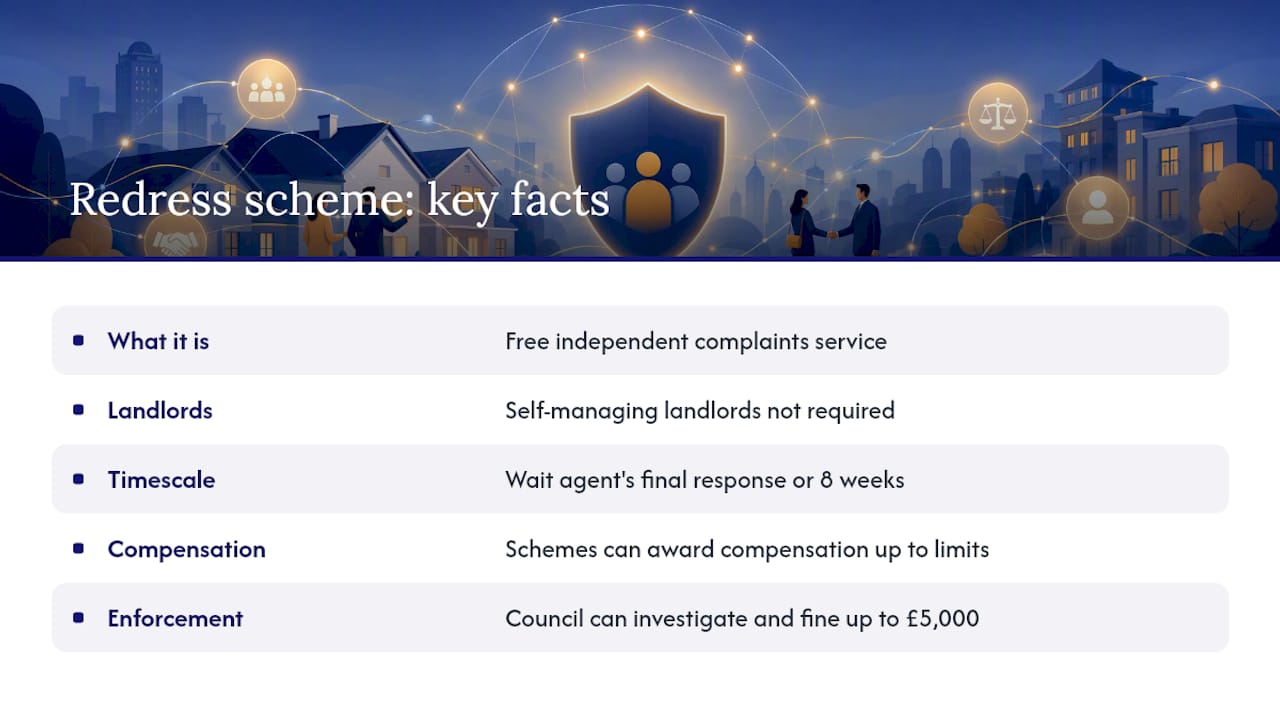
What is a redress scheme for letting agents, in simple terms? It's a free, independent complaints service that letting agents must join by law, giving tenants and landlords a route to resolve disputes without going to court.
Do landlords need to join a redress scheme too? Landlords managing their own properties directly, without paid lettings or management work carried out for others, generally aren't required to join. The duty applies to agents and property managers acting in the course of business.
How long does a redress scheme complaint take to resolve? There's no fixed universal timescale; it depends on the scheme and case complexity. You must wait for the agent's final response or eight weeks, whichever comes first, before escalating.
Can a redress scheme force an agent to pay compensation? Yes, both approved schemes can award compensation up to their published limits, alongside remedies like a formal apology or corrective action.
What happens if an agent isn't a member of any scheme? That's a breach of the law. Local authorities can investigate and fine the agent up to £5,000, and you should report the agent to your council's housing team.
Sources
For the legal text and scheme detail, consult the GOV.UK redress scheme registration guidance and Shelter's explainer on letting agent redress.