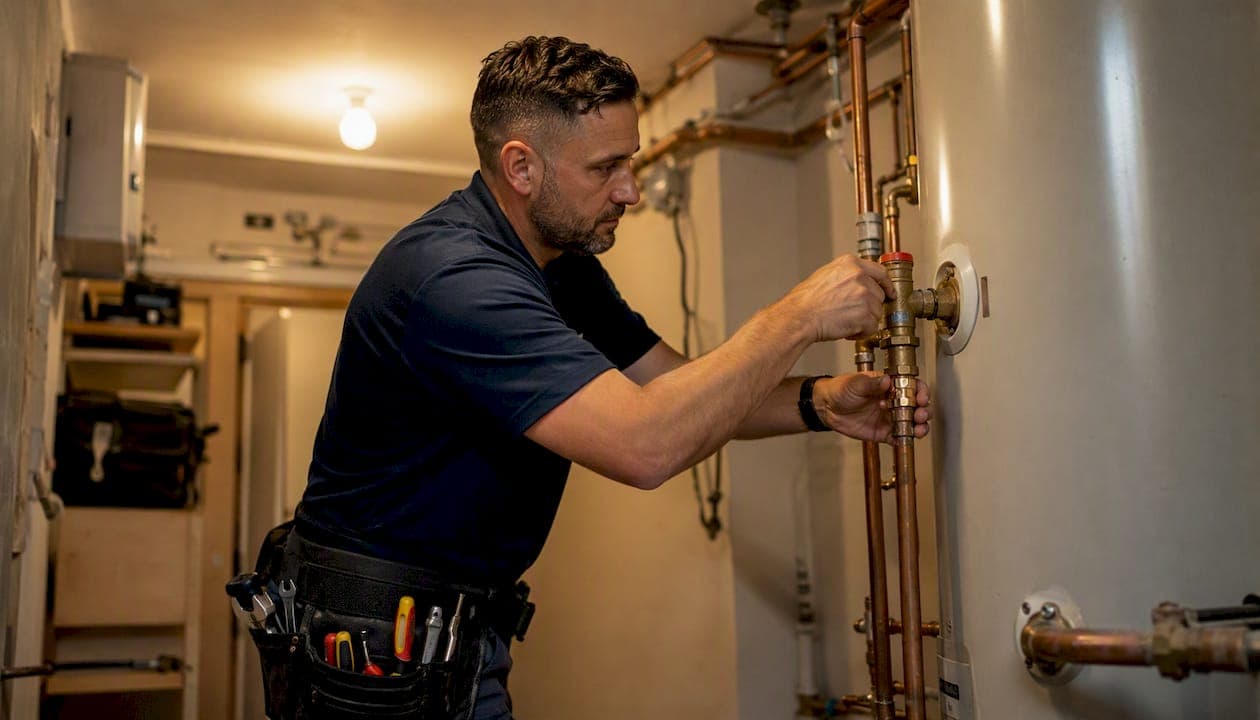
Annual servicing of an unvented hot water cylinder is strongly recommended by manufacturers, required under Approved Document G for safety-device compliance, and typically a condition of keeping your warranty valid. The engineer carrying out the work must hold a G3 qualification; where gas appliances are also involved, Gas Safe registration is required too. Checkatrade data puts the typical UK cost range at £101–£232, with an average near £154.
Before you book, here are the three things to confirm:
- The engineer holds a current G3 competence certificate (ask for the number).
- You have the cylinder's commissioning paperwork or Benchmark record to hand.
- You know whether the heat source is gas, electric, or a heat pump, as this affects which qualifications apply.
Key takeaways
Annual unvented cylinder servicing by a G3-qualified engineer is a legal, safety, and warranty requirement that costs £101–£232 in the UK, with most standard visits averaging around £154.
| Point | Details |
|---|---|
| Annual service is required | Manufacturers, Building Regulations, and warranty conditions all require a yearly service by a G3-qualified engineer. |
| Cost range: £101–£232 | The UK average sits near £154; parts, difficult access, and regional location can push costs higher. |
| G3 qualification is non-negotiable | Only a G3-competent engineer may service an unvented vessel over 15 litres; always verify the card number and expiry. |
| Benchmark record is your proof | A signed Benchmark update at every visit is the evidence landlords need for compliance, warranty, and insurance purposes. |
| 777pcm handles the full process | G3-qualified in-house engineers, Benchmark updates, written reports, and portfolio scheduling in one place. |
Table of Contents
- What does an unvented cylinder service actually include?
- Who can legally service an unvented cylinder in the UK?
- Common faults and when to call an engineer
- How much does an unvented cylinder service cost?
- How to choose the right unvented cylinder service provider
- How 777pcm handles unvented cylinder servicing for landlords and portfolios
- Service plans and how servicing protects your warranty
- What to expect on the day of your service visit
- Why annual servicing is worth taking seriously
- 777pcm: certified unvented cylinder servicing for landlords across the UK
- Sources
What does an unvented cylinder service actually include?
The Hot Water Association's servicing guide specifies annual checks as a safety-critical activity, not a routine tick-box. A properly scoped visit covers all of the following:
- Temperature and pressure (T&P) relief valve: the engineer lifts the lever briefly to confirm it opens freely and reseats without weeping.
- Expansion relief valve: tested for correct operation and inspected for signs of weeping or scale build-up.
- Pressure-reducing valve (PRV): checked for correct set pressure and condition.
- Expansion vessel: pressure tested; a bubble-top cylinder's air gap is verified using the bubble-top procedure.
- Tundish and discharge pipework: inspected for correct routing, unobstructed termination, and compliance with sizing requirements. Discharge pipe sizing and visible tundish termination are common building-control fail points, so this check matters.
- Line strainer: cleaned to remove debris that can restrict flow or cause valve seat damage.
- Thermostat and controls: verified for correct temperature setting, typically 60–65°C.
- Electrical housing and immersion heater connections: inspected for corrosion, security, and safe condition.
- Anode inspection: where the cylinder design includes a sacrificial anode, its condition is checked and replacement recommended if depleted.
- Benchmark/commissioning record: updated and signed to confirm the service has been carried out.
Keeping the Benchmark record current matters beyond warranty. It is the primary evidence for building control that safety devices have been maintained, and it supports any insurance claim following a failure.
Pro Tip: Ask the engineer to demonstrate the T&P valve lift while you watch. A valve that weeps after being lifted, or one the engineer is reluctant to test, is a sign it needs replacing before the next visit.
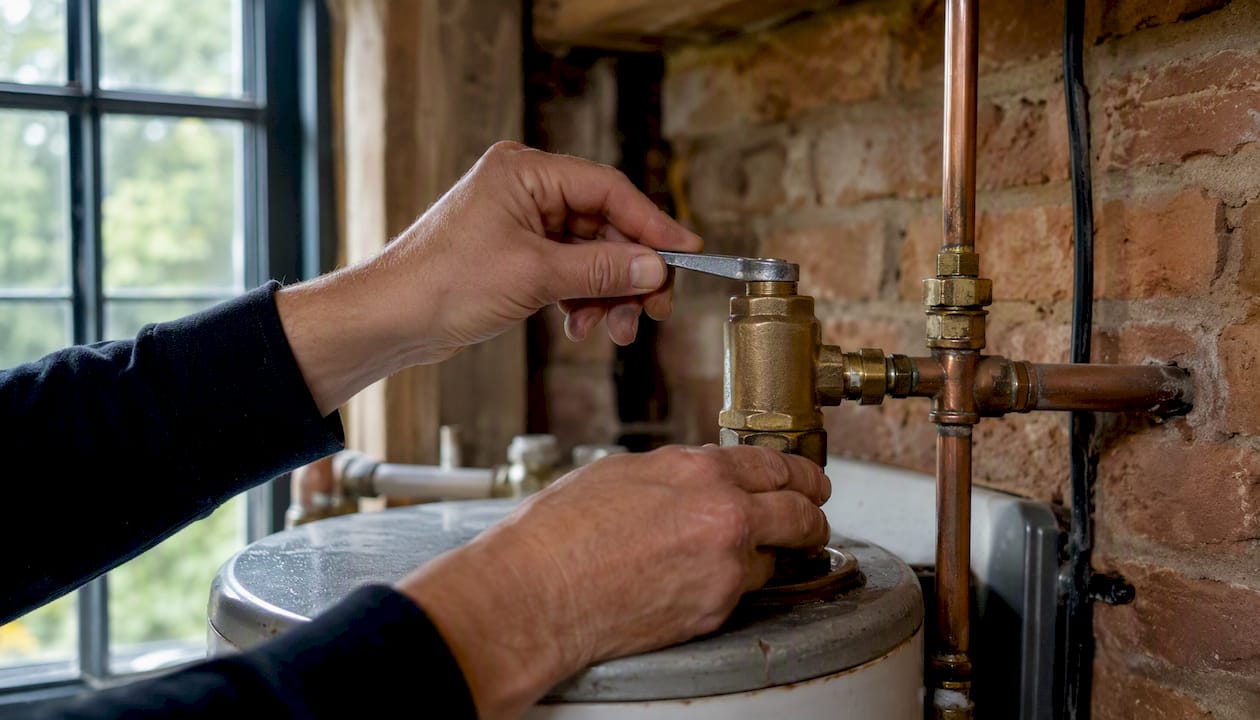
Where manufacturer instructions specify additional checks or shorter intervals, those instructions take precedence over the general annual schedule.
Who can legally service an unvented cylinder in the UK?
Only a G3-qualified engineer may install, commission, or service an unvented hot water storage vessel over 15 litres. BPEC training guidance confirms this competence requirement and offers the recognised qualification pathway. G3 is not a one-time certificate: engineers must renew their competence card periodically to remain current, so always ask for the card number and check its expiry date.
Where the heat source is a gas boiler or gas immersion, the engineer also needs Gas Safe registration. Both qualifications are often held by the same engineer, but not always. Confirm before booking.
Under Approved Document G, unvented systems must incorporate multiple independent safety devices. Servicing by an unqualified person risks invalidating those safety provisions and may constitute a Building Regulations offence.
Landlord obligations go further than simply arranging a move-in and move-out inspection service. Key duties include:
- Maintaining hot water systems in a safe and working condition under the Landlords' Gas Safety Regulations (HSE) where gas is involved.
- Keeping service records and making them available to tenants on request.
- Acting promptly on reported faults; Gov confirms landlords are responsible for repairs to heating and hot water.
- Ensuring any unvented cylinder installed or serviced in a rental property meets Water Supply (Water Fittings) Regulations 1999 requirements for temperature controls, relief valves, and discharge routing.
For landlords managing multiple properties, a tenant safety responsibility checklist can help track which obligations sit with the landlord and which with the tenant.
Common faults and when to call an engineer
Unvented cylinders give clear warning signs before they fail completely. Recognising them early usually means a straightforward repair rather than an emergency call-out.
- Tundish dripping continuously: the T&P or expansion relief valve is weeping, often due to scale on the valve seat or excessive system pressure. Needs prompt attention.
- Persistent pressure loss: the expansion vessel may have lost its pre-charge, or the PRV is passing. Both are on-the-spot fixes for a qualified engineer.
- Inconsistent water temperature: thermostat fault, immersion heater failure, or scale build-up on the heating element.
- Visible leaks around the cylinder body or connections: could indicate corrosion, a failed seal, or a loose fitting. Isolate the heat source and call an engineer.
- Blocked or obstructed discharge pipe: a safety hazard. The pipe must terminate visibly and freely; any blockage prevents the safety valves from doing their job.
- Noisy recovery or slow reheat: often scale accumulation on the immersion element, particularly in hard-water areas. Descaling or element replacement resolves it.
- Stuck or seized safety valves: limescale is the usual cause. Industry guidance specifically highlights this as a risk when annual checks are skipped.
Simple on-the-spot fixes include recharging the expansion vessel, cleaning the line strainer, and resetting the thermostat. Replacement of safety valves, immersion elements, or the expansion vessel itself requires parts and typically adds £30–£80 to the visit cost, depending on the component. A full cylinder replacement, where corrosion or structural failure is found, is a separate job entirely and warrants a written quote before any work proceeds.
Pro Tip: If the tundish is dripping and you cannot reach an engineer immediately, switch off the immersion heater or isolate the boiler feed to the cylinder. Do not ignore a weeping valve — it is the system telling you a safety device is under stress.
For landlords, a guide to heating failures in rental properties covers triage steps and when to treat a fault as an emergency.
How much does an unvented cylinder service cost?
Checkatrade's trade-listing data shows typical UK prices for an unvented cylinder service range from around £100 to above £230, with an average near £150 for a standard annual service. That figure covers labour and the visit itself; parts are usually charged separately.
Several factors push a quote toward the higher end:
- Difficult access (loft-mounted or cupboard-installed cylinders with restricted space).
- Older or bespoke cylinders requiring non-standard parts.
- Replacement of one or more safety valves during the visit.
- Scale-related work in hard-water areas, including descaling or element replacement.
- Out-of-hours or emergency call-out premiums.
- Portfolio or landlord administration: certificate documentation, compliance reporting, or Benchmark record management.
Regional variation is real. London and the South East tend to sit at the upper end of the range; parts of the North and Midlands often come in closer to the average. Always request an itemised quote before the visit so you know what is included and what would be charged as an extra.
How to choose the right unvented cylinder service provider
Choosing an engineer on price alone is one of the more common mistakes property managers make. A cheaper visit that skips valve testing or leaves no written record can cost far more to put right.
Ask these questions before booking:
- Do you hold a current G3 competence certificate? (Ask for the card number and expiry date.)
- Are you Gas Safe registered? (Required if the heat source is a gas appliance.)
- Do you carry public liability insurance?
- Will you update and sign the Benchmark/commissioning record?
- Can you provide an itemised written quote and invoice?
- Will you notify building control if any notifiable work is carried out?
Watch for these red flags:
- Reluctance to test or lift safety valves during the visit.
- No written service report or Benchmark update offered.
- Pressure to replace the cylinder without a clear diagnostic finding.
- Unable or unwilling to provide G3 evidence on request.
To shortlist and book efficiently:
- Gather the cylinder make, model, and installation date before contacting engineers.
- Request at least two itemised quotes, specifying that you want the full annual service scope.
- Verify G3 and Gas Safe credentials independently (Gas Safe has a public register).
- Confirm what paperwork you will receive after the visit.
- Book with a provider who can combine the cylinder service with your annual boiler service to reduce call-out costs and tenant disruption.
BPEC's qualification guidance is a useful reference if you want to understand exactly what a G3-competent engineer should be able to demonstrate.
How 777pcm handles unvented cylinder servicing for landlords and portfolios
777pcm's approach to unvented cylinder maintenance is built around removing the administrative burden from landlords and property managers, not just sending an engineer.
The service flow works like this:
- Booking: arranged online or by phone, with portfolio scheduling available for landlords managing multiple properties. Visits can be combined with CP12 gas safety checks or other compliance work to reduce access requirements.
- On-site checks: G3-qualified engineers carry out the full annual service scope, including all safety valve tests, expansion vessel checks, tundish inspection, and thermostat verification.
- Benchmark update: the commissioning record is updated and signed at every visit, giving landlords documented proof of compliance.
- Report and invoice: a written service report and itemised invoice are issued after every visit. Where remedial work is needed, a separate written quote is provided before any additional work proceeds.
- Remedial follow-up: 777pcm's in-house trades handle repairs without subcontracting, keeping accountability in one place.
777pcm uses only manufacturer-approved parts and G3-qualified engineers, with Gas Safe registration where gas work is involved. Every service produces a signed Benchmark record and a written report — the documentation landlords need for compliance and warranty protection.
For portfolio managers, gas safety oversight across large portfolios is a known compliance risk. 777pcm's centralised compliance portal tracks certificate status, service dates, and remedial actions across properties, reducing the chance of a missed annual visit.
Service plans and how servicing protects your warranty
A one-off annual visit and a service plan both deliver the same core checks, but plans typically add:
- Priority response for faults between scheduled visits.
- Parts discounts or included minor parts (check the specific terms).
- Automatic scheduling so the annual visit does not slip.
- Centralised record retention, useful for portfolio managers.
Warranty protection is the less-discussed reason to keep servicing regular. Most unvented cylinder manufacturers require evidence of annual servicing to honour warranty claims. Without a signed Benchmark record for each year, a manufacturer can decline a claim for a failed component, even when the failure has nothing to do with servicing. Quality Heating's maintenance guide notes this linkage explicitly.
Read plan terms carefully before signing. Some plans exclude safety valve replacement or expansion vessel work, treating these as chargeable extras. The annual visit fee is not the whole cost picture if those components need attention.
When comparing plans, focus on three things: which parts are included versus chargeable, what the guaranteed response time is for emergency faults, and whether the plan provider issues a Benchmark update at every visit.
What to expect on the day of your service visit
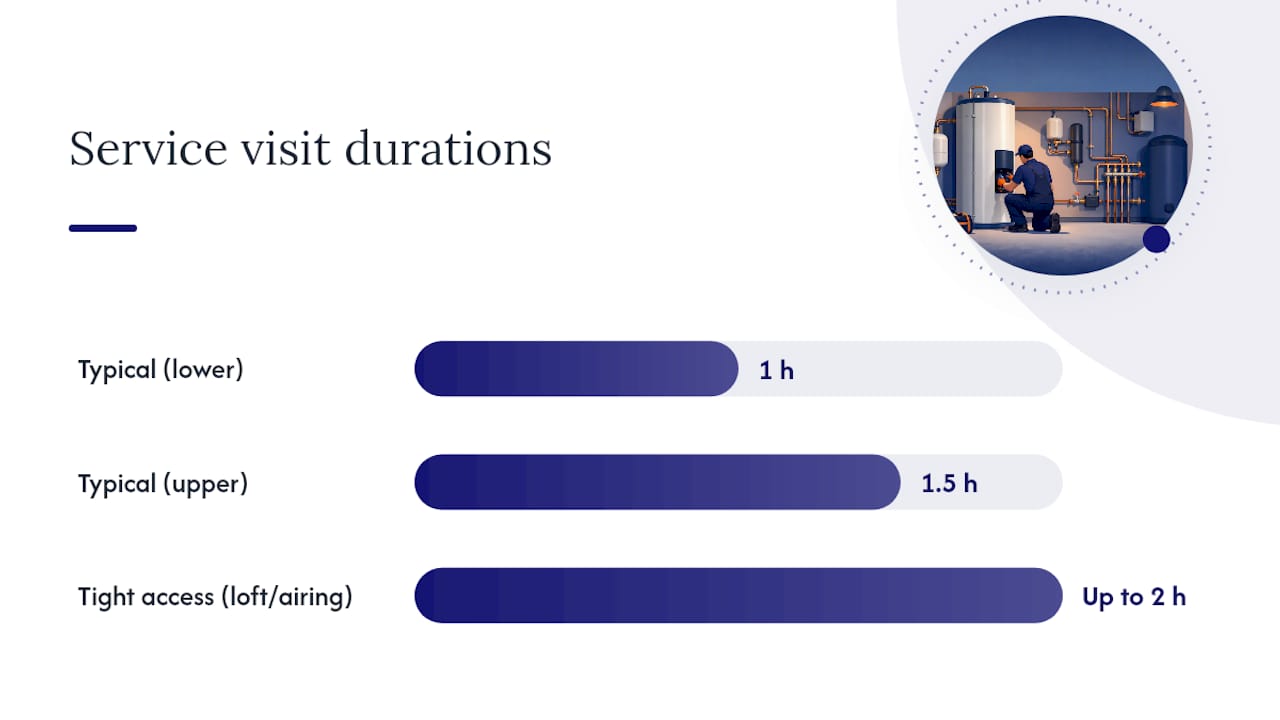
A standard annual service typically takes around an hour to an hour and a half. Visits run longer when repairs are needed, parts must be sourced, or access is restricted. Budget up to two hours if the cylinder is in a loft or a tightly fitted airing cupboard.
Before the engineer arrives:
- Clear access to the cylinder, any associated controls, and the tundish termination point.
- Have the cylinder's make, model, and original commissioning paperwork ready.
- Disable any timer programmes that might trigger heating during the visit.
- Know where the cold-water isolation valve and the electrical isolator for the immersion heater are located.
During the visit:
- Watch the engineer test each safety valve; you should see the lever lifted and the valve reseat cleanly.
- Ask for the Benchmark record to be shown and signed in front of you.
- Request a verbal summary of any findings before the engineer leaves.
What the engineer should leave behind:
- A signed Benchmark/commissioning record.
- A written service report noting all checks carried out and their results.
- An itemised invoice.
- A separate written quote for any remedial work identified, with no obligation to proceed on the day.
Combining the cylinder visit with your boiler service is worth arranging where possible. It cuts call-out costs and means tenants experience one access appointment rather than two. A landlord's guide to organising gas safety checks covers how to coordinate these visits efficiently.
Why annual servicing is worth taking seriously
Annual unvented cylinder servicing is one of those compliance tasks that looks optional until something goes wrong. An unvented system operates at mains pressure and elevated temperature; when a safety valve seizes or an expansion vessel fails, the consequences range from a flooded property to a genuinely dangerous pressure event. The three independent safety layers that Approved Document G requires are only effective if they are tested and maintained. Skipping a year does not just risk the warranty. It risks the safety of the property and everyone in it.
For landlords, the record-keeping dimension matters just as much. A signed Benchmark record is the difference between a defensible compliance position and an exposed one if a tenant or insurer raises a question. 777pcm's model, where every visit produces documented paperwork and remedial follow-up is handled in-house, is exactly the kind of process that removes that exposure.
777pcm: certified unvented cylinder servicing for landlords across the UK
777pcm provides end-to-end unvented cylinder servicing for landlords, letting agents, and property managers across the UK. G3-qualified engineers carry out the full annual service scope, update the Benchmark record, and issue a written report at every visit. Gas Safe registered engineers are deployed where gas appliances are involved.

Key reasons landlords and portfolio managers choose 777pcm:
- In-house G3-qualified and Gas Safe registered engineers, no subcontracting.
- Benchmark/commissioning record updated and signed at every visit.
- Bulk scheduling for portfolios, with CP12 and other compliance certificates managed through one portal.
- Transparent pricing and itemised invoices as standard.
- Emergency response available for urgent faults.
Ready to arrange your next service? Book with 777pcm online or by phone, and get a clear quote with no hidden extras. For landlords needing combined gas safety and cylinder compliance, 777pcm's CP12 and gas safety service covers both in a single coordinated visit.
Sources
The following authoritative sources underpin the guidance in this article:
- Servicing guide (Hot Water Association)
- Approved Document G with 2024 amendments (unvented hot water storage systems)
- Landlords’ duties: Gas Safety (Installation and Use) Regulations 1998 (HSE)
- Unvented Hot Water Cylinder Servicing / Repair in Uk
This article provides general information about unvented cylinder servicing in the UK. It is not a substitute for advice from a qualified engineer or legal professional. Always verify current regulations and qualification requirements with the relevant primary sources or a competent professional before making compliance decisions.