
A void period reduces your effective rental income and keeps most of your costs running. Mortgage interest, council tax, buildings insurance, and letting agent retainers do not pause just because nobody is living in the property. Every landlord should budget for voids, not hope to avoid them entirely.
The planning rule of thumb is straightforward: model a void allowance, or roughly a few weeks a year, against your expected rent. That single adjustment separates a realistic yield forecast from a fantasy one.
Costs that continue during a void typically include:
- Mortgage interest and any secured loan repayments
- Council tax (landlords become liable once a property is unoccupied)
- Buildings insurance premiums, often with unoccupied-property conditions attached
- Utility standing charges for gas, electricity, and water
- Letting agent or management fees on renewal, plus advertising costs
According to Rentalyield, the national average void period runs to a few weeks a year, and prudent investors build in a 5 to 10% allowance on top of that baseline.
Key Takeaways
Void periods cut effective rental income while fixed costs continue, so every landlord should model a void allowance and stress-test deals against at least one month of vacancy a year.
| Point | Details |
|---|---|
| Budget a void allowance | Plan for a prudent void allowance, or two to four weeks a year, against expected rent. |
| Calculate the full cost | Add lost rent, continuing fixed costs, re-let costs, and opportunity cost, not rent alone. |
| Fix controllable causes first | Overpricing, weak marketing, and expired certificates cause more voids than the market does. |
| Stress-test before buying | Reject deals that fail a one-month void stress test with a two to three month cash reserve. |
| Remove compliance bottlenecks | 777pcm's in-house engineers and compliance portal cut the certificate and repair delays that turn short voids into long ones. |
Table of Contents
- What is a void period and why does it happen?
- How do you calculate the true cost of a void period?
- What do void-period statistics actually tell you?
- What causes voids to run longer than they should?
- Your priority checklist for shortening a void
- How do you stress-test a property deal against void risk?
- Which compliance and insurance issues make voids worse?
- What the numbers actually tell landlords to prioritise
- How compliance and maintenance support cuts void time
- Frequently asked questions
- Sources
What is a void period and why does it happen?
A void period is simply the stretch of time a rental property stands empty between tenancies, earning no income. It is distinct from arrears, where a tenant is in place but has stopped paying. Voids and arrears both hurt cashflow, but they need different fixes: one is a marketing and turnaround problem, the other is a legal and payment-recovery one.
Common triggers for a void include:
- A tenant serving notice and moving out at the end of a fixed term
- Refurbishment or repair work needed before the property can be re-let
- A repossession process following a previous tenant's non-payment
- A slower local market meaning fewer applicants at the advertised rent
The clock starts the day the last tenant's rent stops, not the day you list the property. That gap between check-out and re-advertising is where many landlords lose weeks unnecessarily.
How do you calculate the true cost of a void period?
The cost of a void is more than lost rent. A workable formula looks like this:
- Lost rent — monthly rent × number of void weeks ÷ 4.33
- Continuing fixed costs — mortgage interest, council tax, insurance, utilities during the void
- Re-let costs — cleaning, minor repairs, referencing, and any letting agent fee
- Opportunity cost — the return that rent would have earned if reinvested elsewhere
Take a property renting at £1,200 a month with a £600 monthly mortgage interest payment, £120 council tax, and £350 in cleaning and re-let costs. A four-week void costs roughly £1,200 in lost rent plus £720 in continuing costs plus £350 in turnaround costs, which is £2,270 before you even count opportunity cost. Uncommon Deal's worked examples show that one month of void can absorb most of a year's profit on a leveraged buy-to-let once these fixed costs are added up.
This is why a small rent reduction often pays for itself. Cutting rent by £50 a month to secure a tenant two weeks faster saves roughly £600 in lost rent and continuing costs, comfortably outweighing the £600 annual rent reduction if it only applies for part of the tenancy.
What do void-period statistics actually tell you?
National averages put void periods at around three weeks a year, but that figure hides real variation. Landlord Today reports that void losses have climbed in parts of England recently, adding hundreds or thousands of pounds in lost income while compliance and maintenance bills carry on regardless.
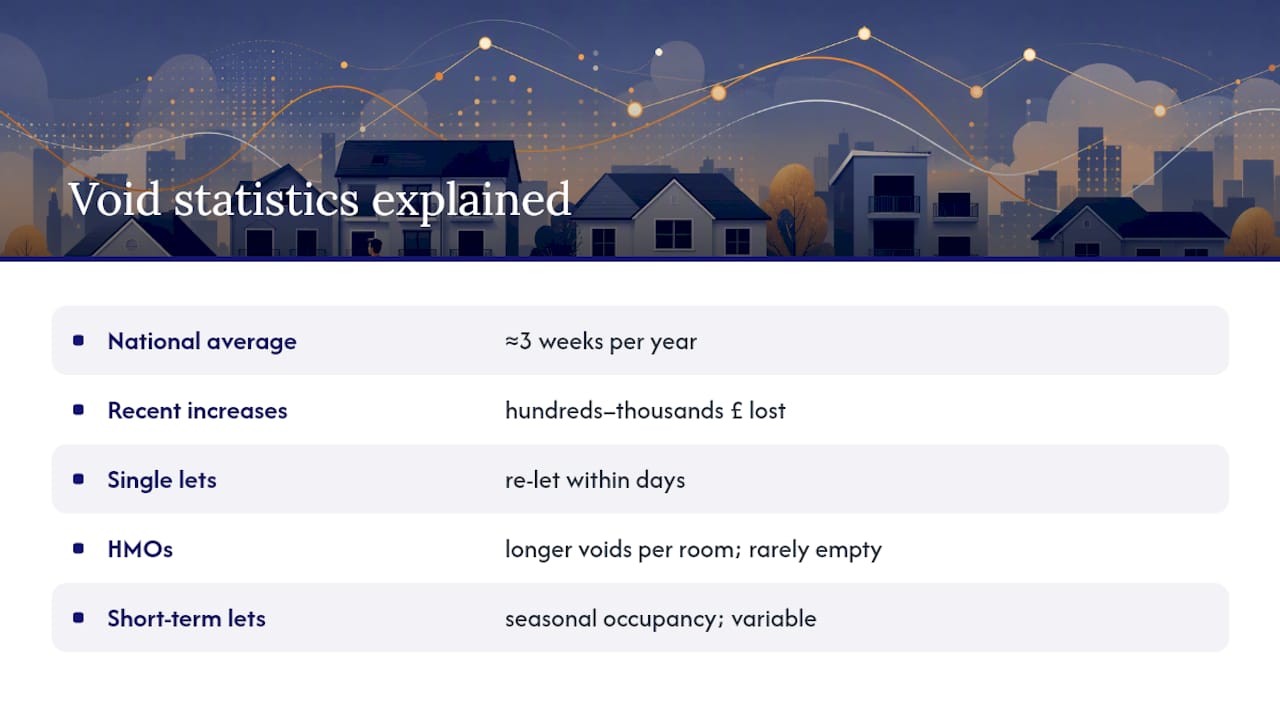
Property type matters enormously. Single lets in strong commuter areas often re-let within days. HMOs can face longer voids per room but rarely stand entirely empty, spreading the risk. Short-term and serviced lets swing the other way, with occupancy tied tightly to seasonal demand. Check local property portals for comparable listings before assuming a national average applies to your street.
What causes voids to run longer than they should?
Some causes are within your control; others are not. Sorting the two is the first step to fixing them.
- Overpricing is the most common self-inflicted cause, with landlords holding out for a rent the market will not currently support.
- Weak marketing — poor photos, a thin listing, or advertising on a single portal — slows applicant flow.
- Deferred maintenance puts off good tenants at viewing stage and drags out negotiations.
- Expired safety certificates can legally block a tenancy from starting on the planned date.
- Seasonal and local demand shifts, such as a slow winter market or a new development flooding supply, sit outside your control but still need planning around.
Your priority checklist for shortening a void
Reducing void time is mostly about sequencing, not spending more money. Work through this order and most voids shrink dramatically.
- Advertise before the tenancy ends. LetCompliance's guidance is blunt on this: a property advertised while still occupied and pre-referenced often has no void at all.
- Price to market, then test. If viewings are slow after a week, a small rent reduction usually saves more in void costs than it loses in rent.
- Book the turnaround in advance. Line up your cleaner, any trades, and safety checks such as EPC and EICR renewals so they happen in the first days of the void, not the third week.
- Use professional photography and multiple platforms. Thin, dark listings on a single portal cost you applicants you never see.
- Keep a waiting list. Interested applicants from previous viewings are often ready to move faster than a fresh search will produce.
- Invest in retention. Responsive maintenance keeps good tenants renewing, and Simply Business's analysis points to retention, not headline rent, as the stronger driver of long-term returns.
Pro Tip: Coordinate your check-out inspection and your re-let safety checks on the same visit where possible. It halves the number of access appointments and often shaves days off the turnaround.
How do you stress-test a property deal against void risk?
Yield calculations that ignore voids are optimistic fiction. Run these steps before you buy, and repeat them annually across your portfolio.
- Convert void weeks to an annual rent adjustment. A four-week void on a £1,200-a-month property removes roughly £1,108 from annual rent, before other costs.
- Add fixed ongoing costs and one-off re-let costs into your net yield, alongside management fees (typically 8 to 12%) and a maintenance budget of around 1% of property value a year, as HomeThink's yield guidance recommends.
- Run a conservative scenario, assuming at least one month of void in the year, and a second scenario where two properties in a small portfolio go void at the same time.
- Apply a decision rule. If a deal's cashflow turns negative under the one-month stress test, reject it or renegotiate the purchase price.
The Intermediary reports that landlords who model at least a month's void per property, and hold two to three months of mortgage payments in reserve, catch fragile deals before they become expensive mistakes.
Which compliance and insurance issues make voids worse?
Certificates and insurance clauses turn a manageable void into a costly one when they are left until the last minute. EPCs, EICRs, and CP12 gas safety certificates all need to be valid before a new tenancy can legally start, and renewing them reactively, once a void has already begun, adds days or weeks you did not need to lose.
Insurance carries its own trap. Many landlord policies include unoccupied clauses that restrict cover once a property has sat empty beyond a set threshold, commonly 30 to 45 days according to Allianz. Failing to notify your insurer of a vacancy can mean a claim gets refused entirely, right when you need to cover most.
- Renew EPC, EICR, and CP12 certificates ahead of expiry, not after
- Log every unoccupied period with your insurer and keep inspection evidence
- Build certificate renewal into your annual maintenance schedule rather than reacting at turnaround
Pro Tip: Set certificate renewal reminders for 60 days before expiry, not 30. That extra month gives you room to book engineers without rushing into a void.
What the numbers actually tell landlords to prioritise
The conventional advice on voids focuses almost entirely on marketing: better photos, faster listings, competitive pricing. That advice is not wrong, but it treats voids as a sales problem when the worked numbers above show it is just as often an operations problem.
A landlord who loses two weeks waiting for an EICR renewal has lost the same money as one who overpriced by £50 a month. The difference is that certificate delays and insurance notification gaps are entirely preventable with a bit of forward planning, while pricing mistakes get corrected by the market anyway once viewings dry up.
What gets underestimated is how much of the void calculation is fixed and unavoidable once the clock starts. Mortgage interest, council tax, and insurance keep running whether you are marketing brilliantly or badly. That means the highest-leverage action is not squeezing extra viewings out of a listing. It is shortening the gap between "tenant gives notice" and "new tenant has keys" through pre-referencing, booked turnarounds, and certificates that never expire mid-void.

How compliance and maintenance support cuts void time
Most of the void costs covered above trace back to one bottleneck: waiting. Waiting for a gas engineer, waiting for an EICR slot, waiting for a plumber to fit you in around three other jobs. 777pcm removes that bottleneck by keeping Gas Safe registered engineers, certified electricians, and plumbing specialists in-house, rather than routing every job through a subcontractor's own diary.

That matters most at turnaround, when you need a CP12, an EICR, and a repair or two completed in the same window rather than staggered across separate visits with separate providers. Coordinating certification and remedial works through one point of contact, via a compliance portal built for portfolio scheduling, means fewer access appointments and fewer days added to the void by administrative delay rather than genuine vacancy.
If you manage several properties, or even one where a delayed certificate has cost you a tenancy before, get a quote from 777pcm and see how a single scheduled visit could replace three separate call-outs at your next turnaround.
Frequently asked questions
Why do void periods affect investment property returns so significantly? Void periods reduce the rent you actually collect while mortgage interest, council tax, and insurance keep running regardless. That combination is why even a short void can erase months of previously earned profit on a leveraged property.
What counts as a reasonable void period for a UK rental? Around three weeks a year is close to the national average, though single lets in strong demand areas often do better and HMOs or short-term lets can vary considerably by season.
Does reducing the rent always shorten a void? Not always, but a small reduction frequently saves more in continuing costs than it loses in rent, particularly when a property has already sat empty for two weeks or more without viewings.
Can an unoccupied property affect my insurance cover? Yes. Many policies restrict cover after a property has been empty for 30 to 45 days, and failing to notify your insurer of the vacancy can lead to a refused claim.
How far in advance should I renew safety certificates to avoid a longer void? Aim to renew EPC, EICR, and CP12 certificates at least 60 days before expiry, giving enough time to book engineers without the pressure of an active void.