
A Section 21 notice is the legal document a landlord in England used to end an assured shorthold tenancy without giving any reason, commonly known as "no-fault eviction." Since 1 May 2026, landlords can no longer serve new Section 21 notices at all, following the Renters' Rights Act abolition. If you were served one before that date, it may still be valid, but only if your landlord met strict form, timing, and paperwork rules, and only if court action started by the correct deadline.
Here's what to check right now:
- Was the notice served before 1 May 2026, and was it still valid immediately before that date?
- Did your landlord start court proceedings by 31 July 2026, or by whatever notice expiry date came first?
- Was the notice on the approved legal form, with the required minimum notice period and supporting documentation?
The court deadline is fixed and unforgiving. Under GOV.UK guidance, any Section 21 notice served before the abolition date that wasn't already the subject of a court possession application by 31 July 2026 is now dead in the water. Your landlord would need to start again using Section 8, with a specific legal ground.
Key Takeaways
A Section 21 notice is now legally obsolete for new use, and any old notice only carries force if court proceedings began by 31 July 2026.
| Point | Details |
|---|---|
| Section 21 is abolished | Landlords cannot serve any new Section 21 notice on or after 1 May 2026. |
| Old notices had a hard deadline | Landlords had until 31 July 2026, or the notice's own expiry if earlier, to apply to court. |
| Paperwork gaps invalidate notices | Missing deposit protection, gas safety, EPC, or 'How to rent' documents commonly defeat possession claims. |
| Don't self-evict | A notice alone is not an eviction order; only bailiffs following a court warrant can lawfully remove you. |
| Free advice exists | Shelter, Citizens Advice, and the Housing Loss Prevention Advice Service offer help at no cost. |
Table of Contents
- What is a Section 21 notice and how do you check if yours is valid?
- The Renters' Rights Act abolition and why the transition dates matter
- If your landlord applied to court, what happens next?
- Your rights: staying put, negotiating, or fighting an invalid notice
- Where to get help and what to bring to your appointment
- What this transition actually reveals about the old system
- Frequently asked questions about Section 21 notices
- Sources
What is a Section 21 notice and how do you check if yours is valid?
Checking validity is mostly a matter of dates and paperwork. Work through these in order.
- Confirm the service date. The notice must have been served before 1 May 2026. Anything dated on or after that day carries no legal weight whatsoever.
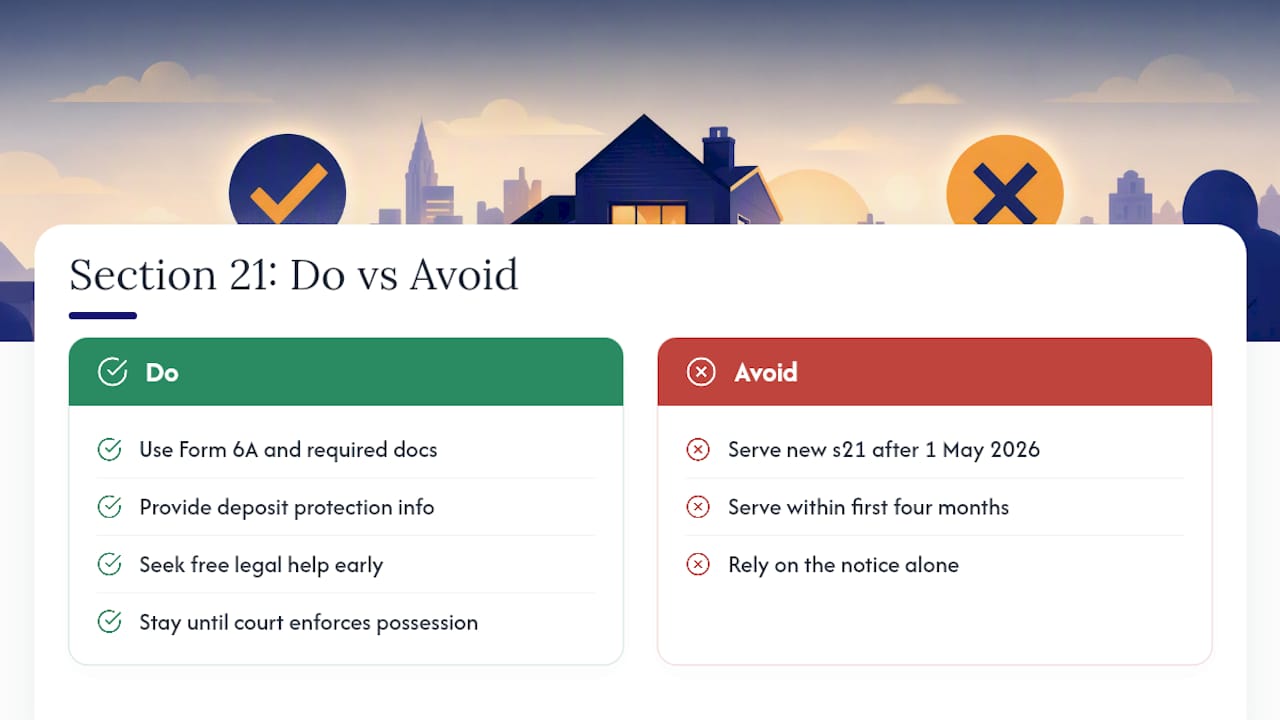
- Check the form. It should be Form 6A, or a document containing the same prescribed information. A letter, an email, or a verbal warning does not count, however firmly worded.
- Check the notice period. Most tenants are entitled to a minimum of two months' notice. Shorter notice periods are usually a fatal defect.
- Rule out the "first four months" trap. A landlord generally cannot serve a Section 21 within the first four months of a tenancy starting. Notices served too early are invalid.
- Check the deposit paperwork. If you paid a deposit, it must have been protected in a government-approved scheme, and you should have received prescribed information about where it's held. Missing this is one of the most common reasons possession claims collapse at court.
- Check for a gas safety certificate (CP12), EPC, and the 'How to rent' guide. Gov confirms all three had to be provided before a Section 21 could be valid. If your landlord never handed these over, that alone can undo the notice.
- Check licensing status. If your property needed a selective licence or HMO licence and your landlord didn't have one, or if the council had served certain enforcement notices, that can also block a valid Section 21.
Pro Tip: Keep every email, text, and letter your landlord ever sent about certificates or the deposit. Landlords frequently claim they provided documents "verbally," but written proof is what tips a court hearing in your favour.
The Renters' Rights Act abolition and why the transition dates matter
Part 1 of the Renters' Rights Act came into force on 1 May 2026, and it ended Section 21 for good. From that date, landlords cannot serve new Section 21 notices under any circumstances, and most assured shorthold tenancies automatically converted into assured tenancies, which come with stronger security of tenure.
For notices served before the cut-off, a strict transition rule applied:
- The landlord could only apply to court for possession by the earlier of the notice's own expiry date or 31 July 2026.
- This became known informally as the "six-month rule," giving landlords a defined window rather than indefinite reliance on an old notice.
- If no court application was made by that point, the notice simply expired with no legal effect.
The practical upshot is reassuring for anyone still holding an old notice. If your landlord never went to court, or missed the deadline, the notice cannot now be used against you. Shelter has described the abolition as a genuine shift in the balance of security toward tenants, and industry guidance from the NRLA confirms the deadline was designed deliberately to draw a firm line under the old system rather than let claims drag on indefinitely.
If your landlord applied to court, what happens next?
Court involvement changes the picture, but it doesn't mean automatic eviction. Here's the typical sequence.
- You'll receive a claim form from the court, and possibly a defence form (variants of Form N11 or N11B, depending on the type of claim). Read the paperwork the moment it arrives; deadlines to respond are usually short and strict.
- Section 21 claims often use the "accelerated possession" procedure, which is largely paper-based and can skip a hearing entirely if the paperwork looks watertight. Section 8 claims, by contrast, almost always involve a hearing where the landlord must prove specific grounds, such as rent arrears or anti-social behaviour.
- Your landlord must prove the notice was valid and correctly served. Common tenant defences include an unprotected deposit, missing safety certificates, an invalid form, or a licensing breach, any of which can see a claim thrown out or adjourned.
- Timelines vary, but a straightforward accelerated claim can result in a possession order within weeks of the hearing (or paper decision), with a further period before bailiffs can attend. Contested cases with a defended hearing generally take considerably longer.
Bailiffs are only ever involved as a last resort, after a possession order and a further warrant. Nobody can lawfully change your locks or remove you without going through this court process, no matter what an old Section 21 notice says on paper.
Your rights: staying put, negotiating, or fighting an invalid notice
Never leave your home just because a Section 21 landed on the doormat. A notice is not an eviction order, and plenty of notices turn out to be defective once examined properly. Your first move should always be to check whether your landlord actually applied to court, and by when.
If you want to try resolving things without a fight, consider:
- Writing to your landlord asking for more time, or proposing a payment plan if arrears are the underlying issue.
- Requesting mediation through your local council or a housing charity before matters escalate.
- Getting any agreement, however informal it feels, confirmed in writing.
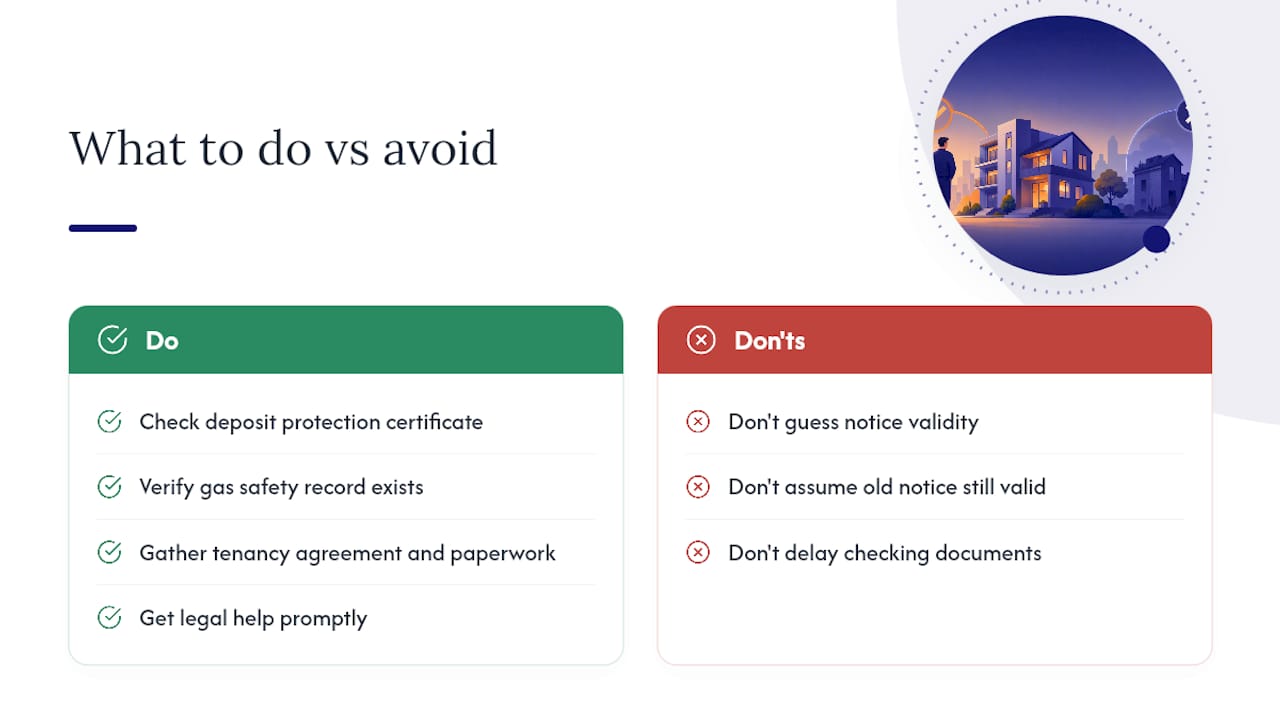
If a court claim does land, start building your defence immediately. Gather your tenancy agreement, deposit protection certificate, all correspondence about repairs or certificates, and copies of your gas safety, electrical, and EPC paperwork. Pro Tip: Photograph the front page of every certificate your landlord ever sent, with the date visible. A missing or expired CP12 has ended more possession claims than tenants realise.
Free, genuinely expert help is available from Shelter, Citizens Advice, and the Housing Loss Prevention Advice Service, which provides free legal advice and representation at court for anyone facing possession proceedings.
Where to get help and what to bring to your appointment
Don't wait until the week of a hearing to seek advice. Shelter and Citizens Advice both run free helplines and webchat services, and the Housing Loss Prevention Advice Service can arrange a duty solicitor at your local court, often at no cost regardless of income. Your local council's housing team can also intervene directly if licensing or enforcement issues are involved.
Bring the following to any appointment:
- The Section 21 notice itself, with the envelope or email showing the date it arrived.
- Your tenancy agreement and any deposit protection certificate.
- Copies of gas safety, electrical, and EPC certificates, plus the 'How to rent' guide if you received one.
- All written correspondence with your landlord or agent, especially anything about repairs or the deposit.
Act the moment court papers arrive; response deadlines are often just 14 days, and missing one can weaken your position significantly.
Why missing compliance paperwork so often invalidates a notice
Working across compliance for landlords day to day, one pattern keeps recurring: possession claims fail more often over paperwork than over the tenancy itself. A missing CP12 gas certificate, an out-of-date EICR, or an EPC that was never handed over are exactly the gaps that give a defended claim its teeth.
- Landlords who can't evidence deposit protection frequently lose at the first hurdle.
- A 'How to rent' guide that was never issued, or issued in the wrong edition, has the same effect.
Tenants checking their own position, and landlords wanting to avoid these pitfalls entirely, can find practical detail in 777pcm's guides on landlord compliance requirements and the different types of safety certificates a rental property needs.
What this transition actually reveals about the old system
The speed of the abolition tells you something the years of debate over Section 21 never quite managed to: the system was always more fragile than landlords assumed. A notice that looked watertight on paper routinely fell apart the moment someone checked the deposit protection certificate or asked whether the gas safety record actually existed. That was true long before the Renters' Rights Act, and it remains the single most useful thing a tenant can do today with any notice still sitting in a drawer.
The conventional advice, "get legal help immediately," is right but incomplete. Legal help matters most when you arrive at it already holding your tenancy agreement, your deposit paperwork, and copies of every certificate you were ever given. Advisers can work faster, and courts respond better, to tenants who've done that homework themselves.
If there's one priority above all others, it's this: don't guess whether your notice is valid, check it against the actual dates and documents. The abolition gives tenants leverage that didn't exist a year ago. Use it properly rather than assuming an old piece of paper still has power it may never have held.
Frequently asked questions about Section 21 notices
Is a Section 21 notice still legal to use? No. Landlords cannot serve any new Section 21 notice on or after 1 May 2026. Notices served before that date may still be enforceable only if court proceedings started by the earlier of the notice's expiry or 31 July 2026.
What's the difference between Section 21 and Section 8? Section 21 was a no-fault route requiring no stated reason. Section 8 requires the landlord to prove a specific legal ground, such as rent arrears or breach of tenancy, and usually involves a court hearing rather than a paper-based process.
What should be included in a Section 21 notice for it to be valid? It needed to be on Form 6A, served with the correct minimum notice period, accompanied by deposit protection information, a valid gas safety certificate, an EPC, and the 'How to rent' guide, and not served within the first four months of the tenancy.
Can I stay in my home if I've been served a Section 21 notice? Yes, until a court grants a possession order and, if necessary, bailiffs enforce it. A notice alone gives your landlord no legal right to remove you or change the locks.
Where can I get free help if I'm facing eviction? Shelter, Citizens Advice, and the Housing Loss Prevention Advice Service all offer free advice and, in many cases, free representation at court, regardless of income.
This article is general information, not a substitute for advice from a qualified lawyer. Consult a qualified legal professional about your own circumstances before acting on anything here.
Sources
For the primary rules, see GOV.UK's guide for tenants and the Renters' Rights Act information sheet. Shelter's Section 21 guidance covers practical next steps, and 777pcm's article on tenant safety rights explains the certificates worth checking.