
What are the top UK alternatives to safehouseservices.co.uk?
Four providers stand out when landlords and letting agents evaluate property maintenance alternatives to safehouseservices.co.uk. The differences between them are meaningful, particularly around compliance depth, engineer staffing, and how much control you retain over quality.
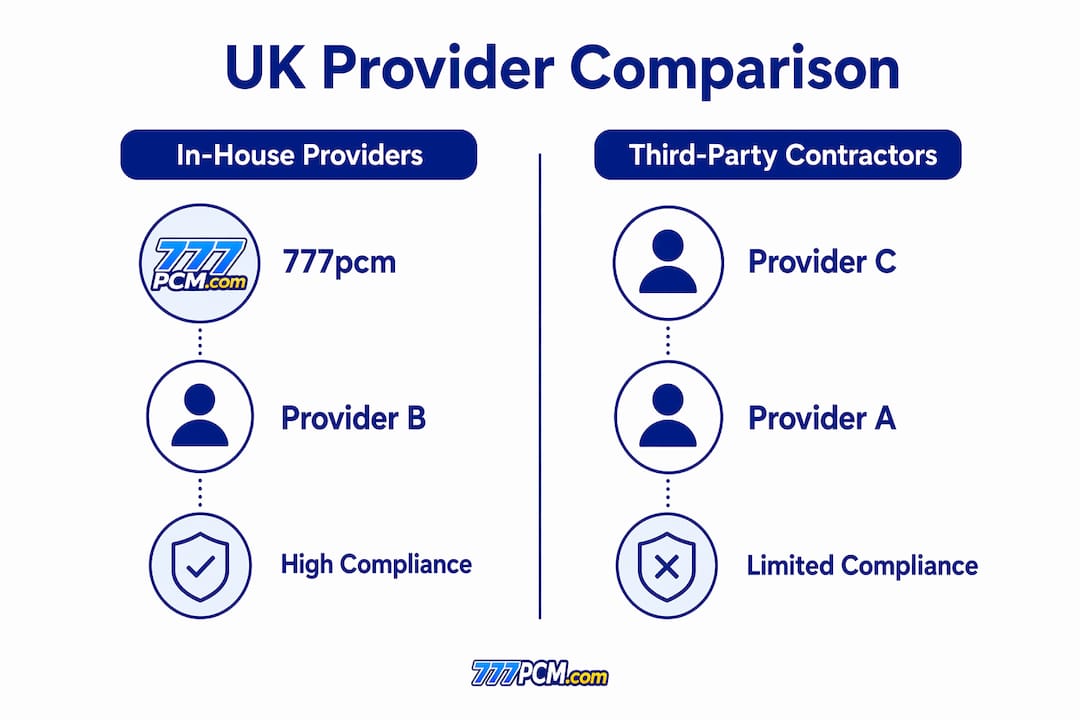
| Provider | Service scope | Pricing model | Compliance expertise | Response times | Engineers | Best for |
|---|---|---|---|---|---|---|
| Provider A (Generic entry-level field app) | Basic repairs and reactive maintenance | Low-cost, per-job | Limited; minimal certification support | Variable; no SLA guarantee | Subcontracted | Small landlord portfolios, budget repairs |
| Provider B (Mid-tier national maintenance platform) | Maintenance plus partial compliance management | Mid-range, tiered plans | Moderate; some certification handling | Defined SLAs for most jobs | Mixed in-house and subcontracted | Medium portfolios needing compliance oversight |
| Provider C (Full-service outsourced contractor network) | Broad national coverage, reactive and planned | Variable; volume-based | Compliance possible but reliant on third parties | Generally fast but inconsistent | Fully subcontracted | Large portfolios prioritising coverage over control |
| 777pcm | End-to-end compliance and maintenance, CP12, EICR, EPC, plumbing, drainage, electrical, roofing | Transparent, portfolio-based | Full; in-house Gas Safe engineers and certified electricians | Fast scheduling with direct engineer allocation | Fully in-house | Landlords and property managers needing total compliance accountability |
Geographic coverage varies considerably across these providers. Provider C offers the widest national footprint, while Provider A typically operates within defined local or regional boundaries. 777pcm covers residential and commercial portfolios across the UK, with in-house engineers deployed directly rather than sourced through third-party networks.

Emergency response is another dividing line. Provider A rarely commits to guaranteed out-of-hours attendance. Provider B offers structured SLAs for urgent jobs. Provider C can mobilise quickly but depends on subcontractor availability. 777pcm allocates directly employed engineers, which removes the coordination delay that subcontracted models introduce.
How do these alternatives compare on compliance and service scope?
Compliance capability separates these providers more sharply than price. Contractor paperwork gaps account for approximately 67% of property insurance claim issues, which means the staffing model behind your maintenance provider is a direct financial risk, not just an operational preference.
Provider A covers reactive repairs adequately for a small portfolio, but its compliance offering is thin. Certification management, Gas Safe checks, and EICR scheduling are rarely included as standard. For landlords with straightforward portfolios and low compliance exposure, that may be acceptable. For anyone managing multiple tenancies under the Renters' Rights Act, which came into force on 1 May 2026, it creates real gaps.
Provider B occupies a more useful middle ground. It handles some certification work and employs a proportion of its engineers directly, which improves consistency. The limitation is that subcontracted trades still handle a share of jobs, and accountability can blur when something goes wrong across a mixed workforce.
Provider C scales well for large portfolios but relies entirely on third-party contractors. Defining clear KPIs and structured review processes before appointing any contractor-dependent provider is particularly important here, because without them, service accountability becomes difficult to enforce across a dispersed network.
777pcm employs all its engineers directly, covering Gas Safe registered engineers, certified electricians, and plumbing specialists under one roof. That direct employment model means every job carries a clear accountability chain, from scheduling through to certification and any remedial work.
Pro Tip: Before appointing any maintenance provider, verify engineer credentials directly against official registries such as Gas Safe, NICEIC, or PASMA rather than relying on documents the contractor supplies. Forged or expired certifications are more common than most landlords expect.
How do you choose the right property maintenance provider?
Choosing well comes down to matching the provider's actual capabilities to your portfolio's compliance demands, not just its size or price point.
- Compliance credentials first. Confirm that any provider holds current Gas Safe registration, NICEIC accreditation for electrical work, and relevant trade certifications. Check these directly against the official registries, not through the provider's own documentation.
- Geographic coverage. Verify the provider can reach all your properties within its stated response times. A national brand with thin engineer density in your region will underperform its headline SLAs.
- In-house versus subcontracted engineers. Providers using fully subcontracted workforces introduce credential and accountability risks. Vendor management that treats contractors as critical compliance control points, rather than a convenient admin task, protects your legal and financial standing.
- Reporting transparency. Ask specifically how job completions, certification renewals, and compliance status are reported. Cloud-based systems with live dashboards and automated renewal alerts reduce admin time and improve audit readiness considerably.
- Pricing relative to scope. A low per-job rate from Provider A may cost more in the long run if compliance gaps generate insurance disputes or enforcement action. Assess total cost against the full service scope, including certification management and remedial works.
- Emergency availability. Confirm whether out-of-hours cover is guaranteed or best-efforts, and whether the provider deploys its own engineers or calls out subcontractors in emergencies.
For a practical compliance checklist covering the full range of landlord obligations in 2026, including EICR, EPC, and gas safety requirements, that is a useful starting point before you begin comparing providers in detail.
What do landlords and agents say about these providers?
Feedback patterns across these provider types reveal consistent themes worth knowing before you commit.
Provider A attracts positive reviews for speed and cost on straightforward repair jobs. Where landlords report frustration is around compliance follow-through: certificates arrive late, renewal reminders are absent, and communication drops off after the initial job is complete. For a single property, that is manageable. Across a portfolio, it compounds quickly.
Provider B receives generally solid feedback for its account management and structured reporting. Letting agents in particular value the ability to track job status across multiple properties. The recurring criticism is inconsistency when subcontracted trades are involved, particularly for specialist compliance work such as electrical certification or gas safety inspections.
Provider C draws mixed responses. Large portfolio managers appreciate the coverage and speed of mobilisation. The concern that surfaces repeatedly is accountability when something goes wrong: with a fully subcontracted model, responsibility can become unclear, and framework agreements with defined SLAs are essential to hold the provider to account.
777pcm's positioning as a fully in-house provider appeals directly to landlords and property managers who have experienced the compliance gaps that subcontracted models create. The combination of Gas Safe engineers, certified electricians, and dedicated account management addresses the specific pain points that drive landlords to seek alternatives to providers like safehouseservices.co.uk in the first place.
777pcm: full compliance and maintenance without the subcontractor risk
Landlords and property managers who have cycled through entry-level and mid-tier providers often arrive at the same conclusion: the real cost of a cheaper provider is the compliance exposure it leaves behind.

777pcm is built specifically to close that gap. Every engineer is directly employed, covering Gas Safe registered gas work, NICEIC-standard electrical services, plumbing, drainage, roofing, and general maintenance under one accountable structure. CP12 gas safety certificates, EICRs, and EPCs are managed as part of the core service, not bolted on as extras. For estate agents and letting agents managing multiple landlord portfolios, that single point of contact for both maintenance and compliance removes the coordination overhead that comes with juggling several contractors.
- In-house Gas Safe registered engineers for CP12 certificates and boiler work
- Certified electricians for EICRs and electrical remedial works
- EPC assessments coordinated directly
- Plumbing, drainage, roofing, and decorating covered without subcontracting
- Dedicated account management with real-time job tracking
- Fast scheduling with direct engineer allocation, no third-party delays
For landlords ready to move away from providers that leave compliance gaps, 777pcm's property compliance services offer a straightforward alternative built around direct accountability.
Key takeaways
The strongest alternative to safehouseservices.co.uk for compliance-focused landlords is a provider with fully in-house engineers, direct certification management, and structured reporting across the full maintenance scope.
| Point | Details |
|---|---|
| Compliance gaps carry real cost | 67% of property insurance issues involve contractor paperwork or credential failures, making staffing model a financial risk. |
| In-house engineers outperform subcontracted models | Direct employment gives clearer accountability for quality, response times, and certification accuracy. |
| Verify credentials independently | Check Gas Safe, NICEIC, and PASMA registries directly rather than accepting contractor-supplied documents. |
| KPIs and reporting matter | Define measurable service standards before appointing any provider; structured reviews hold partners accountable. |
| 777pcm covers the full scope | In-house Gas Safe engineers, electricians, and compliance management in one service for landlords and property managers. |