
Fire safety in property management is the set of legal and practical duties landlords and property managers must fulfil to protect residents and comply with UK law. Get it wrong and you face civil penalties, enforcement action, and, most seriously, preventable harm to the people living in your properties. The legal framework is built on four key pieces of legislation: the Regulatory Reform (Fire Safety) Order 2005, the Fire Safety Act 2021, the Building Safety Act 2022, and the Fire Safety (England) Regulations 2022. Together, they define who is responsible, what must be done, and what happens when it is not.
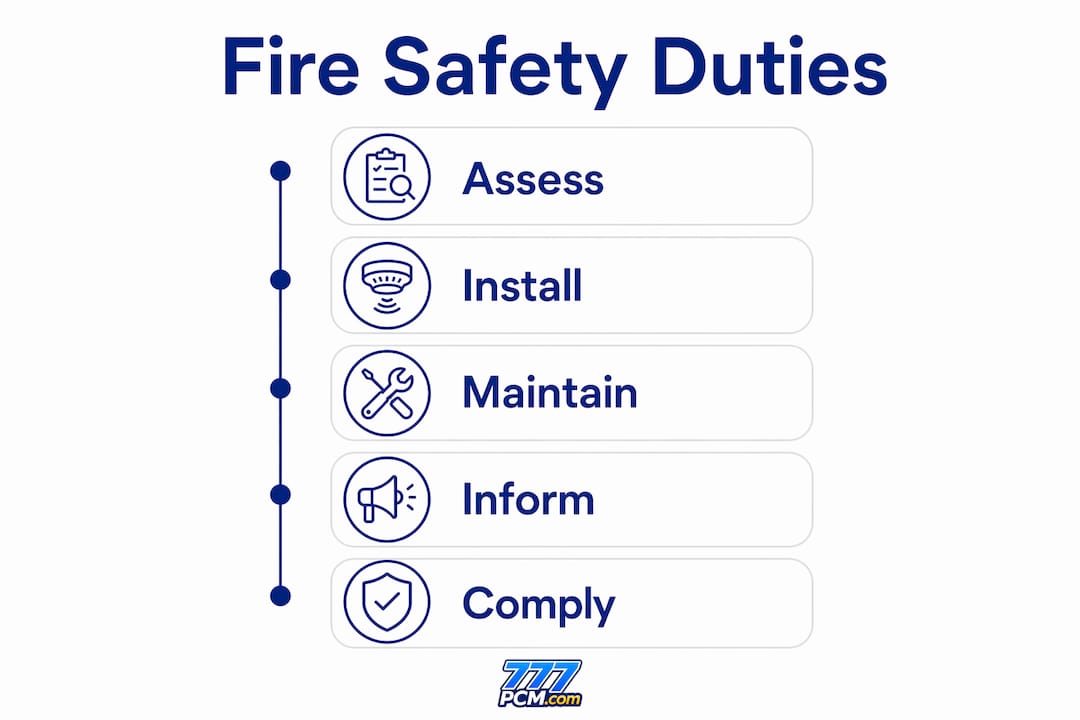
Your core duties as a landlord or property manager include:
- Carrying out and recording a fire risk assessment for each property and its common areas
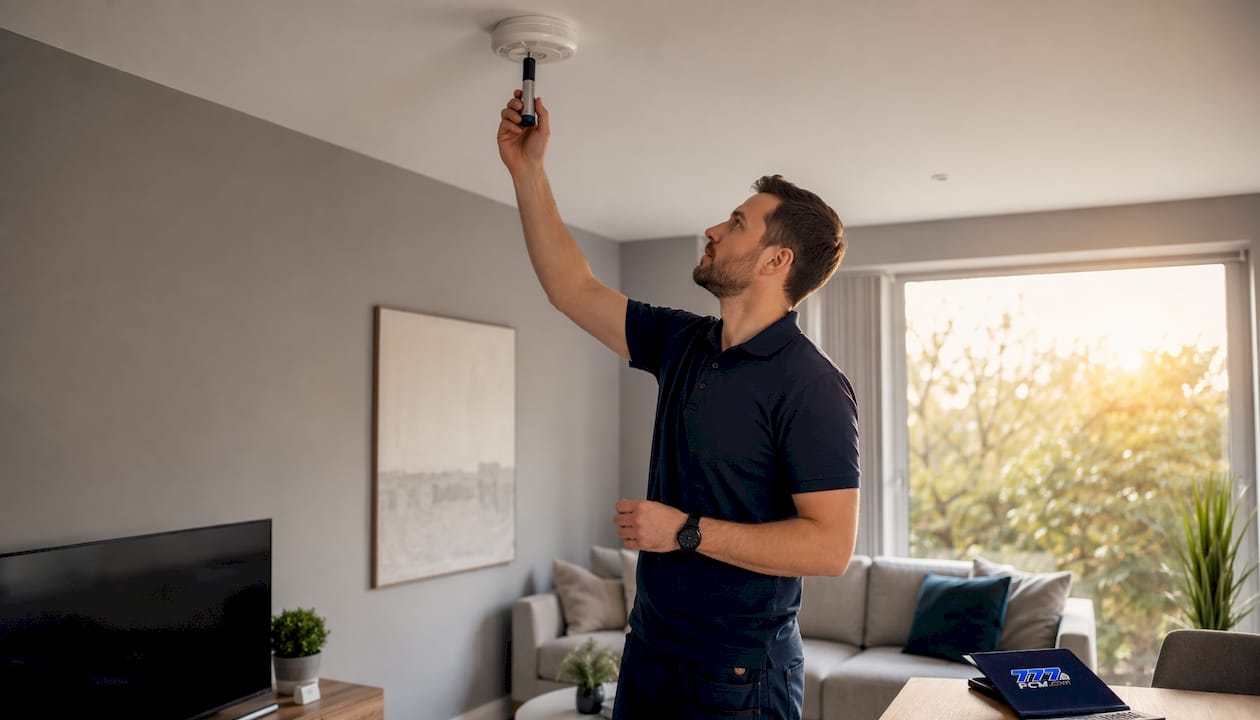
- Installing and maintaining smoke alarms on every storey and carbon monoxide alarms where required
- Keeping fire escape routes clear, signed, and lit at all times
- Maintaining fire doors, compartmentation, and fire safety equipment
- Providing residents with clear fire safety information and evacuation instructions
- Reviewing and updating your fire risk assessment after any material change to the building
Failure to meet these obligations can result in civil penalties up to £5,000 per property for alarm failures alone, with more serious non-compliance leading to prosecution.
What does the legal framework actually require of you?
The Regulatory Reform (Fire Safety) Order 2005 (FSO) is the foundation of fire safety law in England and Wales. It applies to all workplaces and the common parts of any building containing two or more domestic premises, placing legal duties on the "Responsible Person," typically the freeholder, managing agent, or residents' management company.
Three significant updates have strengthened these duties in recent years:
- Fire Safety Act 2021: Clarified that external walls, flat entrance doors, and the structure of a building are all covered by the FSO and must be included in fire risk assessments.
- Building Safety Act 2022: Introduced additional duties under Section 156, requiring Responsible Persons to cooperate with each other where multiple parties share responsibility in the same building.
- Fire Safety (England) Regulations 2022: Added specific requirements for residential buildings, with further obligations for higher-risk buildings above 11 metres. These Regulations came into force on 23 january 2023.
Since 1 october 2023, all fire risk assessments for non-domestic and multi-occupied residential buildings must be recorded in writing, regardless of building size. This is a significant shift: previously, smaller buildings were exempt from the written record requirement.
The Responsible Person cannot delegate legal accountability. You may appoint contractors, fire risk assessors, or specialist engineers to assist, but the duty remains yours. In a block of flats, that person is almost always the freeholder or managing agent. Where a concierge is employed or parts of the building serve commercial purposes, additional Responsible Persons may exist, each with duties limited to the extent of their control.
Key fire safety duties every landlord and property manager must meet
The scope of your responsibilities is broader than many landlords assume. A common misconception is that your duty stops at the flat entrance door. In reality, common parts and flat entrance doors are legally included in your obligations under the Fire Safety Order, and maintenance failures in corridors, stairwells, and communal areas are among the most frequent causes of enforcement action.
Smoke and carbon monoxide alarms
Landlords must install at least one smoke alarm on every storey of living accommodation. A carbon monoxide alarm is required in any room containing a solid fuel or gas boiler appliance. Alarms must be tested and confirmed working at the start of each new tenancy. For detailed guidance on installation standards, the smoke alarm requirements guide covers the current rules in full.
Fire risk assessments
Every property you manage requires a suitable and sufficient fire risk assessment. The assessment must cover common parts, external walls, the building structure, and flat entrance doors. You must:
- Identify fire hazards and the people at risk
- Evaluate and act on the findings
- Record the assessment in writing
- Review it regularly and after any material change
- Communicate relevant findings to residents
Fire escape routes and signage
All escape routes must be kept clear of furniture, storage, and combustible materials at all times. Fire doors on corridors and staircases must be self-closing. Escape signage must be displayed throughout common areas, and emergency lighting must illuminate escape routes where natural or street light is insufficient.
Fire doors and compartmentation
Fire doors stop the spread of heat and smoke, giving residents time to evacuate. All flat entrance doors and doors opening onto escape routes must meet at least a 30-minute fire resistance standard and be fitted with self-closing devices. Compartmentation, achieved through fire-resisting walls, floors, and properly sealed service risers, is equally critical. Utility companies running new cables between flats frequently breach fire stopping, and those gaps must be resealed with fire-resisting material.
Tenant information and evacuation plans
You must display fire safety instructions in a prominent location, in a form residents can reasonably understand. This includes non-English speakers. Place fire action notices on the inside of residents' front doors and in all communal areas. For high-rise buildings, you must also prepare floor plans and provide them to the local fire and rescue service electronically.
How to keep fire safety systems maintained and compliant
Maintenance is where compliance is won or lost. A fire alarm installed correctly but never tested offers little real protection. The law requires that all fire safety measures are kept in an efficient state, in efficient working order, and in good repair.
| System or equipment | Minimum check frequency | Who records it |
|---|---|---|
| Smoke and heat detectors | Monthly visual check; annual service | Responsible Person |
| Fire alarm system | Monthly check; annual service by contractor | Responsible Person |
| Fire doors (common areas, buildings over 11m) | Quarterly inspection | Responsible Person |
| Flat entrance fire doors (buildings over 11m) | Annual inspection | Responsible Person |
| Emergency escape lighting | Regular checks; annual test | Responsible Person |
| Firefighter lifts and evacuation lifts | Monthly checks | Responsible Person |
| Rising mains, smoke control, suppression systems | Monthly checks | Responsible Person |
For high-rise buildings, any fault in a critical system must be reported to the local fire and rescue service by electronic means within 24 hours of discovery. You must then notify them again once the fault is rectified. Keep a log of every check, fault, and remedial action. These records are your primary defence during any enforcement inspection.
Practical guidance for managing fire safety compliance day to day
Good fire safety management is less about dramatic interventions and more about consistent, documented routine. The landlords and property managers who avoid enforcement action are those who treat compliance as an ongoing process rather than a periodic tick-box exercise.
Pro Tip: Hiring a competent fire risk assessor or specialist contractor is strongly advisable, but remember that legal accountability stays with you as the Responsible Person. Delegation of tasks is permitted; delegation of responsibility is not.
Practical steps that make a measurable difference:
- Update your fire risk assessment promptly after any building change, including redecorating communal areas, replacing fire doors, or alterations to service risers. Material changes invalidate an existing assessment if it is not reviewed.
- Inspect communal areas regularly for items stored in corridors, stairwells, or riser cupboards. Tenants storing belongings in escape routes is one of the most common and preventable fire risks in residential blocks.
- Communicate with residents proactively. Hold periodic meetings, write to each resident individually, and display clear notices explaining your fire safety policies, including smoking rules and how to report defects.
- Coordinate with other Responsible Persons in shared buildings. Where a building has multiple duty holders, each must take reasonable steps to identify the others, share information about risks, and align their fire safety measures.
- Document everything meticulously. Inspection logs, contractor reports, remedial works, and resident communications all form part of your compliance record. A rental property compliance checklist can help you track obligations across a portfolio.
- Engage your local fire and rescue service proactively, particularly for higher-risk buildings. They can advise on evacuation strategies and flag concerns before they become enforcement matters.
Insurance is another practical consideration. Insurers increasingly require evidence of current fire risk assessments and maintained fire safety equipment as a condition of cover. A gap in your records can affect not just your legal standing but your ability to make a valid claim following a fire.
Key takeaways
Fire safety compliance in UK property management is a continuous legal duty, not a one-off task, and the Responsible Person retains accountability regardless of who carries out the work.
| Point | Details |
|---|---|
| Legal duty is ongoing | Fire safety obligations under the FSO and related legislation apply continuously, not just at the start of a tenancy. |
| Written records are mandatory | Since october 2023, all fire risk assessments for multi-occupied residential buildings must be recorded in writing. |
| Common parts are your responsibility | Corridors, stairwells, and flat entrance doors fall within your legal duties, not just the interior of individual flats. |
| Assessments must be reviewed after changes | Any material change to the building, including redecoration or door replacement, requires a fire risk assessment review. |
| Penalties apply for alarm failures | Failure to install or maintain required smoke and carbon monoxide alarms can result in civil penalties up to £5,000 per property. |
Why compartmentation deserves more attention than it gets
Most landlords understand that smoke alarms and fire doors matter. Fewer appreciate just how fragile the compartmentation that holds a building's fire strategy together actually is. A single unsealed cable penetration through a fire-resisting wall, or a fire door wedged open by a frustrated resident, can undermine the entire evacuation strategy for a block of flats.
The Responsible Person cannot delegate legal accountability, and that is precisely why a passive approach to compartmentation is so risky. Utility companies routinely breach fire stopping when running new services between flats, and those breaches are rarely flagged unless someone is actively looking for them. A compartmentation survey by a competent specialist, carried out after any significant works, is one of the most underused tools in property management safety.
The coordination requirement in buildings with multiple Responsible Persons is another area where practice often falls short of the law. Each duty holder managing their own area in isolation is not sufficient. Escape routes pass through spaces controlled by different parties, and a failure in one section affects everyone. The Building Safety Act 2022 makes this cooperation a legal requirement, not a courtesy.
What this means in practice is that fire safety compliance is as much a management discipline as a technical one. The landlords who handle it well tend to have clear documentation, regular communication with residents and contractors, and a genuine understanding of where their building's vulnerabilities lie. 777pcm works with landlords and property managers across the UK to keep properties compliant and tenants safe, with in-house engineers who understand both the technical and regulatory dimensions of fire safety in residential buildings.