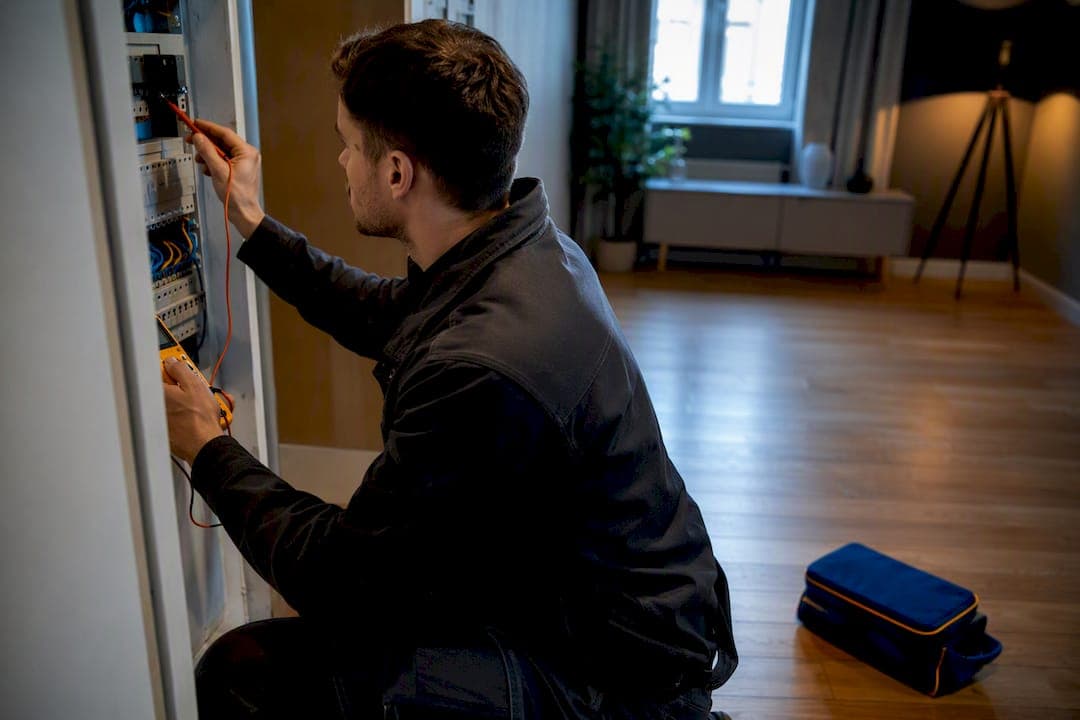
A standard EICR for a domestic rental property typically costs £100–£350 for the inspection alone, rising for larger homes, HMOs and properties outside the tested range. Real cost swings comes from remedial work and where the property sits, not the inspection fee itself. Landlords must repeat this check at least every five years under current regulations.
TL;DR:
- The cost of an EICR inspection ranges from £120 to £600 depending on property size, location, age, and circuit complexity, with larger and more remote properties costing more.
- The final invoice varies based on circuit count, wiring condition, access issues, and travel charges, making regional price differences significant.
- Remedial costs after a failed EICR can range from £100 for minor repairs up to £3,000 or more for full rewires, with a legal deadline of 28 days for completion.
- Hiring registered, qualified electricians from reputable schemes ensures compliant testing and accurate reporting, avoiding low-cost, potentially unsafe inspections.
- Comparing three detailed quotes and scheduling inspections early can save landlords up to 28%, while managed in-house services simplify compliance tracking across portfolios.
Table of Contents
- How much is an EICR? Price bands by property size
- What affects the cost of an EICR?
- What happens if an EICR fails, and what does it cost to fix?
- Who can carry out an EICR, and what should the report include?
- How to get reliable EICR quotes and budget across a portfolio
- How 777pcm approaches EICRs and portfolio compliance
- What repeat and follow-up inspections actually cost
- What pushes up the price: urgent visits and out-of-hours callouts
- Why the cheapest EICR quote is rarely the right one
- Managed EICRs without the chasing and guesswork
- Sources
How much is an EICR? Price bands by property size
Ask five electricians for a quote on the same three-bed semi and you'll likely get five different numbers. That's not a scam. It reflects genuine differences in circuit count, access, and how thorough the electrician actually is once they're inside the fuse board.
Industry cost guides put typical 2026 inspection-only fees at roughly £120–£180 for a flat, £180–£300 for a three-bed house, and £250–£400 or more for larger properties. HMOs usually sit above standard houses because inspectors test more circuits, more consumer units in some conversions, and often more sockets per habitable room.
Here's how the bands typically break down:
- 1–2 bed flat: £120–£180, usually 1–2 hours on site.
- 2–3 bed house: £180–£300, typically 2–3 hours on site.
- 4+ bed house: £250–£400, often 3–4 hours depending on extensions and outbuildings.
- HMO (per unit or shared circuit basis): £350–£600+, frequently half a day or more given the number of tenancies and communal circuits.
A thorough inspection on a typical two to three bed house genuinely takes several hours on site, not twenty minutes. If someone quotes you £70 and promises to be finished before lunch, ask what they're actually testing.
Location matters more than most landlords expect. Regional pricing data sampled across 12,300 EICR jobs found a very large price spread between Bradford and inner London for near-identical inspections. London and the South East consistently sit at the top of every band, driven by electrician overheads and travel time rather than any difference in the electrical work itself. If you manage a mixed-location portfolio, budgeting off a single national average will leave your London properties underfunded and your northern ones over-quoted.
What affects the cost of an EICR?
The headline price bands are a starting point, not a quote. What actually lands on your invoice depends on a handful of variables the electrician assesses before they even open the consumer unit.
Circuit count drives testing time more than anything else. Each circuit needs to be isolated, tested for insulation resistance, earth continuity and polarity, then reconnected safely. A flat with eight circuits takes less time than a converted house with eighteen, even if the floor area is similar.
Age and condition of the wiring matters too. Older installations with rewireable fuses, no RCD protection, or outdated consumer units generate more findings and take longer to document properly. A newer property with a modern split-load consumer unit is usually quicker to pass through.
Access issues push costs up in ways landlords rarely anticipate:
- Locked lofts, boxed-in meter cupboards, or furniture blocking sockets add time.
- Tenants who aren't home for the appointment force a second visit and a second charge.
- Outbuildings, garages, and separate annexes with their own supply add extra circuits to test.
Commercial factors also shape the final figure. Travel charges for rural properties, and whether the electrician needs to review a previous EICR before starting, all feed into the final number. A previous satisfactory report with clear circuit charts genuinely speeds things up, because the inspector isn't starting from zero.
Pro Tip: Keep a folder (digital or paper) with every previous EICR, EIC and consumer unit upgrade certificate for each property. Handing this to your electrician before they arrive can shave real time off the visit, because they're not guessing at circuit history.
What happens if an EICR fails, and what does it cost to fix?
An EICR that comes back "unsatisfactory" isn't the end of the process, it's the start of a legal countdown. Codes C1 and C2 (danger present, or potentially dangerous) trigger a mandatory duty to act, while an FI code (further investigation) means more diagnostic work is needed before anyone can price the fix.
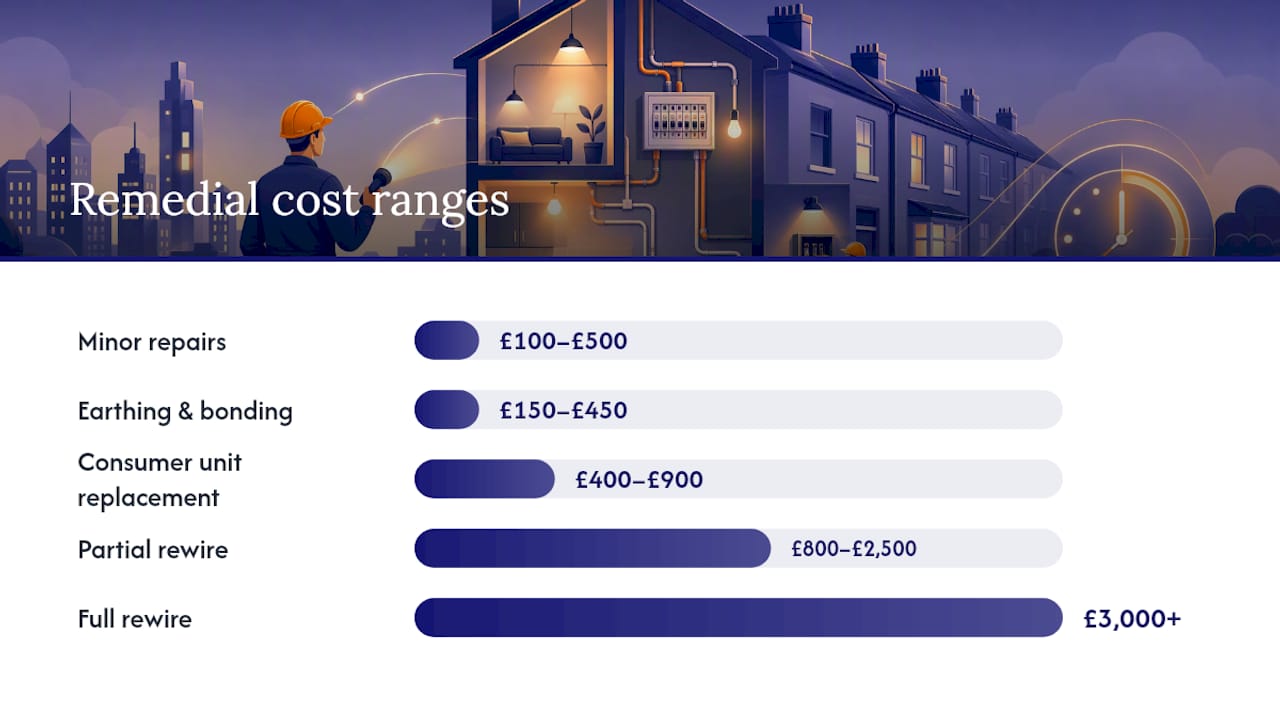
Remedial costs vary enormously depending on what's actually wrong:
- Minor repairs (loose connections, damaged sockets, missing covers): typically £100–£500.
- Consumer unit replacement (outdated fuse boards, missing RCD protection): commonly £400–£900.
- Partial rewire (one or two circuits, damaged cabling in specific rooms): often £800–£2,500.
- Full rewire (entire property, usually on older housing stock): £3,000 or more, depending on size and access.
- Earthing and bonding upgrades (bringing older properties up to current standards): typically £150–£450.
The legal clock matters as much as the price. Under Regulation 3 of the 2020 Electrical Safety Standards Regulations, landlords in England must complete any remedial work identified in an EICR within 28 days, or sooner if the report specifies an earlier date. Written confirmation that the work has been completed must then go to the tenant and the local housing authority.
Ignore this and the risk isn't just a fine on paper. Local authorities can serve remedial notices, arrange the work themselves and recover the cost from the landlord, alongside civil penalties of up to £40,000. Get a separate, itemised quote for remedial work rather than accepting a bundled figure. Inspection and remediation are two different jobs, and pricing them separately makes it easier to spot inflated charges.
Who can carry out an EICR, and what should the report include?
Not everyone holding a screwdriver can legally sign off an EICR. The regulations require inspection by a "qualified person", someone competent to assess a property's wiring against BS 7671, the IET Wiring Regulations, the technical standard that defines safe electrical installation and testing practice in the UK.
In practice, this usually means checking registration with a recognised competent person scheme, most commonly NICEIC, NAPIT, or ELECSA. Any of these bodies will confirm registration if you call them directly, and it's worth doing before booking rather than after.
Before you commit to a quote, ask:
- Are you registered with NICEIC, NAPIT or ELECSA, and can I verify that directly with the scheme?
- Does the quote include VAT, and is it inspection-only or does it bundle remedials?
- How many circuits will you be testing, and roughly how long will you be on site?
- Can you provide a sample report so I can see how findings are coded?
A proper EICR report lists every circuit tested, any observations coded C1, C2, C3 or FI, an overall satisfactory or unsatisfactory verdict, and a recommended date for the next inspection. If a quote arrives suspiciously low with no mention of circuit count or scheme registration, treat that as a red flag rather than a bargain.
How to get reliable EICR quotes and budget across a portfolio
Getting three quotes isn't just good practice, it has a measurable payoff. Landlords who compare multiple quotes typically save between 12% and 28% on the same job compared with accepting the first price offered.
A proper quote should specify:
- The inspection-only fee, separate from any assumed remedial costs.
- The number of circuits being tested, so you can compare like for like.
- Whether VAT is included.
- A rough estimate of common remedial costs based on the property's age, even if final pricing depends on findings.
12–28% is the typical saving landlords report simply by comparing quotes rather than booking the first electrician available, according to regional pricing data sampled across thousands of UK jobs.
Bundling helps too. Scheduling your EICR alongside your CP12 gas safety check or other landlord certificates often reduces call-out charges, since the electrician or engineer is already on site. Booking roughly two months before your current certificate expires also avoids the premium that comes with urgent, same-week requests.
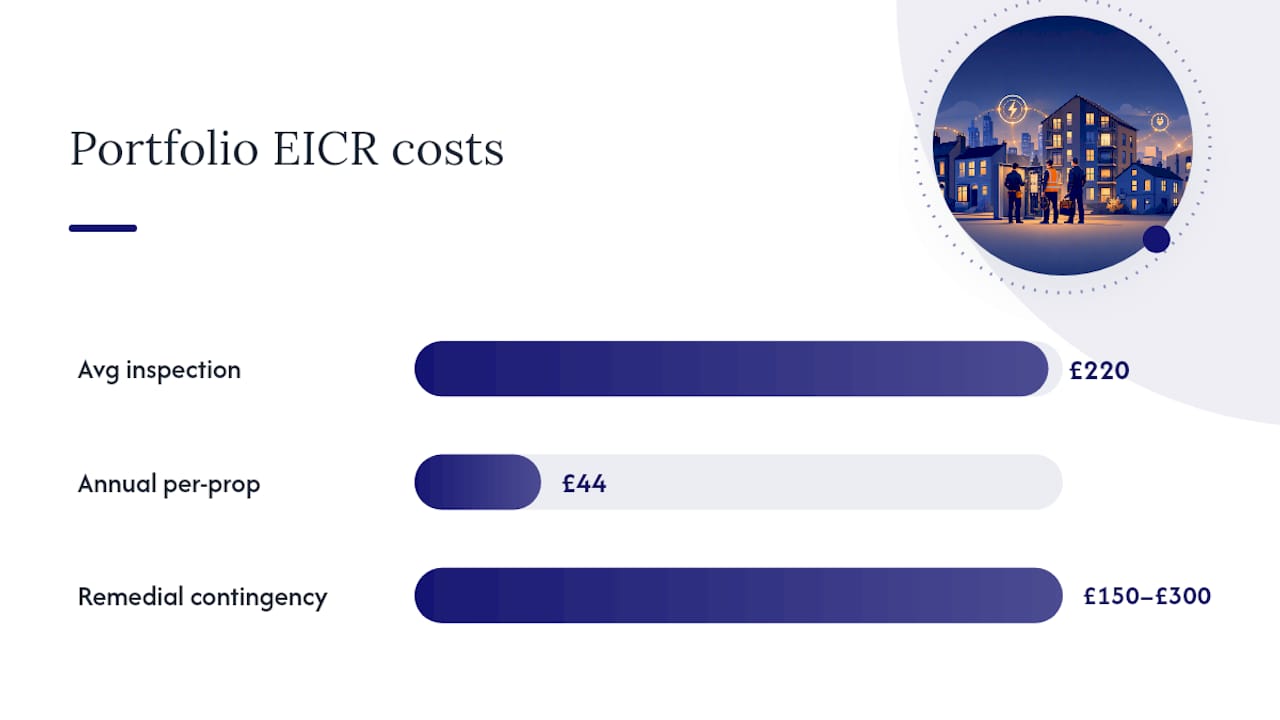
For portfolio budgeting, a rough annualised figure works better than treating each EICR as a surprise cost. If your average inspection runs £220 and you divide that across a five-year cycle, that's roughly £44 per property per year, plus a remedial contingency of perhaps £150–£300 annually to cover the odd consumer unit swap or socket repair. The inspection fee itself is deductible against rental income as a revenue expense, though any enforcement penalty for missing the 28-day deadline is not.
How 777pcm approaches EICRs and portfolio compliance
Landlords managing more than a handful of properties quickly discover that the inspection fee is rarely the hard part. Chasing electricians, tracking which property is due, and coordinating access with tenants eats far more time than the actual test.
777pcm runs certified in-house electricians rather than farming work out to subcontractors, which means one point of accountability from booking through to remedial sign-off. When a report comes back with C1 or C2 findings, the same team that inspected the property can quote and complete the fix, rather than a landlord starting a fresh search for a separate contractor against a 28-day clock.
A dedicated portal can track certificate expiry dates across a portfolio, so inspections get scheduled ahead of the five-year deadline rather than in a last-minute scramble that tends to invite urgency pricing. That structure, one provider, one record, one timeline, is what tends to separate landlords who manage compliance smoothly from those who are perpetually catching up.
What repeat and follow-up inspections actually cost
An unsatisfactory EICR doesn't automatically mean paying for a second full inspection once the work is done. Under current government guidance, landlords can satisfy their legal duty by obtaining written confirmation of the completed remedial work, typically an Electrical Installation Certificate (EIC) or Minor Electrical Installation Works Certificate (MEIWC), rather than commissioning a fresh full EICR.
This distinction matters for your budget. A full re-inspection at £180–£300 is unnecessary if the only issue was a single faulty circuit; a targeted remedial certificate covering that specific fix usually costs a fraction of that, often in the £50–£150 range depending on the work involved.
Where repeat costs genuinely bite is with FI (further investigation) findings. These require additional diagnostic work before anyone can even quote the fix, and that diagnostic visit is usually billed separately from both the original inspection and the eventual repair. If your electrician flags several FI codes on one report, ask upfront whether the investigation fee will be credited against any resulting remedial work, since not all contractors do this automatically.
The next full EICR still falls due five years after the original test date regardless of remedial work carried out in between, so keep that date fixed in your records rather than resetting it after a repair.
What pushes up the price: urgent visits and out-of-hours callouts
Standard EICR pricing assumes a booked appointment with reasonable notice, usually a week or more. Step outside that window and the price moves with it.
Out-of-hours visits, evenings or weekends, follow a similar pattern, since most independent electricians charge overtime-equivalent rates outside a standard working week.
Emergency remedial work sits in a different category again. If a C1 finding (danger present) requires immediate isolation of a circuit, that's a genuine emergency callout, priced accordingly, rather than a scheduled remedial job. It's worth checking whether your existing electrician or provider offers any form of emergency response as part of an ongoing arrangement, since booking a stranger for a genuine emergency at short notice tends to be where landlords see the steepest one-off charges.
The simplest way to avoid all of this is scheduling ahead of your five-year deadline, roughly two months before expiry, which keeps you firmly inside standard pricing and gives you time to gather proper quotes.
Why the cheapest EICR quote is rarely the right one
Landlords have been trained by years of comparison sites to hunt for the lowest number on a quote. With EICRs, that instinct works against you. A test that's genuinely thorough takes hours, and an electrician quoting a fraction of the standard price for a three-bed house is almost certainly cutting corners on circuit testing, not working more efficiently.
The conventional advice, "get three quotes and pick the cheapest", is only half right. Get three quotes, yes, but compare them on circuit count, scheme registration and whether remedials are itemised separately, not just the bottom-line figure. Two quotes that look £80 apart might reflect a £300 difference once you factor in what's actually being tested.
What I'd prioritise first, above hunting for savings, is fixing your inspection date well ahead of the five-year deadline. Nearly every horror story about "urgent" EICR pricing traces back to a landlord who left it too late and got squeezed by a tight timeline. Get the timing right and the pricing conversation becomes far easier to win.
— Mike
Managed EICRs without the chasing and guesswork
Some services give landlords a fixed point of contact for EICRs instead of juggling separate electricians for every property in a portfolio. Where an independent quote leaves you managing the inspection, the remedial fix, and the paperwork trail separately, In-house certified electricians can handle inspection through to remedial completion under one booking, with results tracked through a single compliance portal.

That matters most in the moments that usually cost landlords the most money: a failed report against a 28-day deadline, or a portfolio where certificate expiry dates have quietly drifted out of sync. Bundling your EICR alongside other landlord certificates, such as a CP12 gas safety check, through the same provider also cuts down on repeat call-out charges.
If you're due a renewal, managing a portfolio across multiple properties, or simply want one team accountable for the whole process, request a quote from 777pcm and see how managed provision compares with your current setup.
Sources
The legal duties and 28-day remedial timeline referenced throughout come directly from gov.uk's guidance on electrical safety standards and Regulation 3 of the 2020 Statutory Instrument, the definitive legal texts governing landlord electrical compliance in England. Regional price variation and quote-comparison savings are drawn from TradeMatch's 12,300-job pricing dataset. Price band examples and remedial cost ranges reference trade cost surveys from SparkCerts and tax treatment notes from Property Tax Partners.
- Electrical safety standards in the private and social rented sectors: guidance
- The Electrical Safety Standards in the Private Rented Sector and Social Rented Sector (England) Regulations 2020 — Regulation 3
- UK EICR Electrical Inspection Cost By Postcode 2026 | TradeMatch UK Data
- How much does an EICR cost in 2026? Honest numbers from the trade | SparkCerts
- EICR Certificate Cost 2026: Landlord Prices & Tax Relief | Property Tax Partners