
Landlords and property managers can hand the entire statutory compliance cycle to a single agency that audits their portfolio, schedules qualified engineers, carries out inspections, issues digital certificates and delivers proof of service to tenants. The outcome is a centralised compliance record, automated renewal reminders and legally defensible evidence that protects possession rights. Here is what a well-run batch booking service delivers:
- CP12 Gas Safety Certificates issued annually by Gas Safe registered engineers
- EICRs on a five-year cycle, with remedial quotations where defects are found
- Energy Performance Certificates (EPCs) valid for ten years, with minimum-standard guidance
- Smoke and carbon monoxide alarm checks at tenancy start and as required
- Legionella risk assessments and PAT testing where the property warrants them
- Digital certificate packs, inspection reports, remedial quotes and a renewals calendar uploaded to a centralised portal
Table of Contents
- What does batch booking safety certificates actually mean for landlords?
- Which statutory certificates can you batch-book in the UK?
- Why correct record-keeping matters as much as the checks themselves
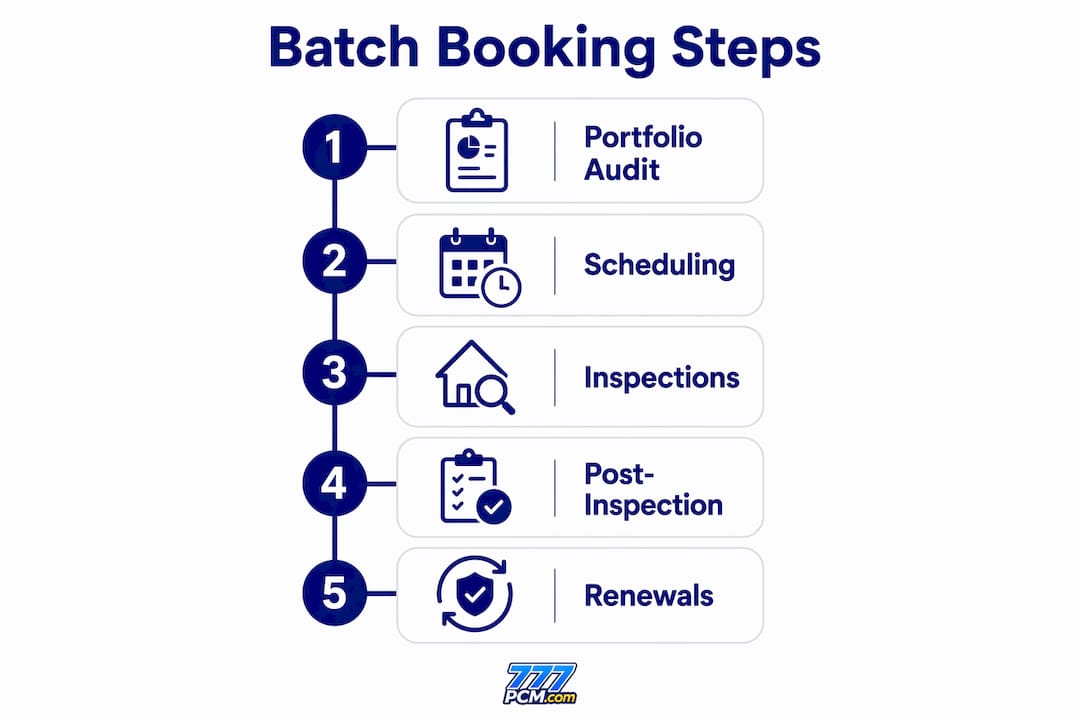
- How does a batch-booking agency work, step by step?
- How do agencies price batch booking, and what drives the cost?
- How to choose the right agency for your portfolio
- How 777pcm handles batch booking and portfolio compliance
- Key takeaways
- Get a portfolio compliance audit from 777pcm
- Useful sources and reference pages
What does batch booking safety certificates actually mean for landlords?
Batch booking means combining audits, scheduling and inspections across several properties into coordinated blocks, rather than booking each check individually as expiry dates arrive. The result is fewer site visits, lower per-property cost and a single compliance record covering the whole portfolio.
Multi-property landlords and managing agents are the primary users. A portfolio with multiple properties can generate numerous critical compliance dates per year across gas, electrical, EPC and other obligations. Tracking those dates manually, across different engineers and different tenants, is where compliance gaps typically appear.
An agency handles the operational steps: portfolio audit, appointment scheduling, tenant access coordination, inspections and certificate issuance. The landlord receives a consolidated renewals calendar and a portal where every certificate and proof-of-service document is stored. For letting agents, the arrangement also clarifies accountability, since legal liability always rests with the landlord regardless of who arranges the work.
Which statutory certificates can you batch-book in the UK?
| Certificate | Frequency | Key legal point |
|---|---|---|
| Gas Safety Record (CP12) | Annual | Gas Safe registered engineer required; serve to tenants within 28 days or before move-in |
| EICR | Every 5 years | Remedial works within 28 days or shorter period specified in report |
| EPC | Every ten years | Minimum band E for rental stock; stricter targets apply |
| Smoke/CO alarm checks | At tenancy start | Smoke alarm on each storey; CO alarm in rooms with solid-fuel appliances |
| Legionella risk assessment | Every 2 years (recommended) | Duty of care; no formal certificate mandated |
| PAT testing | Every 1–2 years | Required where landlord supplies electrical appliances |
Agencies can only issue certificates through appropriately qualified engineers. Gas Safety Records require a Gas Safe registered engineer. EICRs require a qualified electrician, typically accredited through NICEIC or an equivalent scheme. EPCs require an accredited domestic energy assessor. Any agency that cannot confirm these credentials for each certificate type should be disqualified immediately.
Pro Tip: Ask every prospective agency to share the Gas Safe registration number and NICEIC accreditation certificate before signing anything. Legitimate providers produce these without hesitation.
Why correct record-keeping matters as much as the checks themselves
A completed inspection that cannot be proved to have been served to the tenant is, legally, almost as problematic as no inspection at all. Compliance failure can render a Section 21 notice invalid if there is no evidence that certificates were served. That means losing the right to a no-fault possession route, often at the worst possible moment.
Criminal liability applies to gas safety breaches under the Gas Safety (Installation and Use) Regulations 1998. Civil penalties for EICR failures can reach significant sums under the 2020 Electrical Safety Standards Regulations. Councils can issue remedial notices and fines for non-compliance, and insurers may reject claims where certificates had lapsed.
Proof of service must go beyond keeping a copy of the certificate. Service evidence includes a dated email with a read receipt, a signed handover form or a portal-generated delivery confirmation. Best practice is to retain certificates and proof of issue for six years to cover contractual claims and enforcement inspections.
How does a batch-booking agency work, step by step?
Stage 1: Portfolio audit. The agency collects current certificate dates, property addresses, access arrangements and tenant contact windows. Properties with expired or near-expired certificates are flagged as priority.

Stage 2: Scheduling and date alignment. Gas Safety Certificates can be renewed up to two months early without losing the original anniversary date. A good agency uses this window to cluster nearby properties into single engineer days, reducing travel time and cost.
| Stage | Typical timeframe |
|---|---|
| Portfolio audit and prioritisation | 1–3 days |
| Scheduling and tenant notification | 3–7 days |
| Inspection phase (per cluster) | 1–2 days per 4–6 properties |
| Certificate issuance and portal upload | Same day or next working day |
| Remedial quotation (where required) | Within 48–72 hours |
| Renewals calendar live | On completion of first cycle |
Stage 3: Inspections. Engineers typically cover four to six properties per day depending on property type and geographic spread. Each visit produces a certificate or a report with any defects graded and remedial timescales stated.
Stage 4: Post-inspection deliverables. Digital certificates are issued, proof-of-service documents are generated, and remedial quotes are sent. Everything is uploaded to the centralised portal.
Stage 5: Renewals management. Tiered reminders at 60, 30 and 7 days before expiry keep the portfolio current without manual tracking.
How do agencies price batch booking, and what drives the cost?
Most agencies use one of three models: per-property pricing for individual certificates, a portfolio day rate where an engineer covers multiple properties in a single visit, or an annual subscription covering all renewals across the portfolio. Urgent or fast-response bookings carry a surcharge on any model.
Bulk bookings with the same engineer typically deliver notable savings per inspection compared with one-off jobs. The main cost variables are geographic spread (properties scattered across a wide area cost more to cluster), property accessibility, the number of units per visit and whether remedial work is found during inspection.
Watch for quotes that separate call-out fees from the inspection fee, or that exclude VAT from headline figures. Remedial work is always additional, but a reputable agency will provide a fixed quote before proceeding rather than billing time and materials.
How to choose the right agency for your portfolio
- Confirm Gas Safe registration for all gas engineers the agency deploys. Ask for the registration number and verify it on the Gas Safe Register website.
- Confirm NICEIC or equivalent accreditation for electricians carrying out EICRs. Unaccredited electricians cannot legally issue compliant reports.
- Check public liability insurance is in place and ask for the certificate. This protects you if an engineer causes damage during an inspection.
- Establish whether engineers are in-house or subcontracted. In-house teams give the agency direct quality control; fully subcontracted models introduce a layer of accountability risk.
- Ask about geographic coverage. Confirm the agency can reach all your properties, not just those in its core area.
- Request a sample compliance pack. This shows you exactly what the certificate, inspection report and proof-of-service document look like before you commit.
- Clarify the proof-of-service process. How does the agency document that each certificate was served to the tenant? What format is the evidence in?
- Ask about access management. What happens when a tenant refuses access or is uncontactable? A credible agency has a documented escalation path.
Red flags: vague deliverables, no proof-of-service workflow, inability to name the accreditation body for their electricians, or reluctance to provide portfolio references.
How 777pcm handles batch booking and portfolio compliance
777pcm operates as a one-stop compliance service for landlords, letting agents and property managers across the UK. The model is built around in-house engineers rather than subcontractors, which means direct accountability at every stage of the process.
- In-house Gas Safe registered engineers carry out annual CP12 inspections and can manage remedial gas work in the same visit.
- Certified electricians conduct EICRs to the 18th Edition Wiring Regulations (BS 7671) standard
- Portfolio audit and scheduling handled from the first contact, with properties clustered by geography and expiry date
- Centralised portal for certificate storage, proof-of-service records and renewals calendar
- Remedial quotations issued within 48–72 hours of inspection, with in-house trades available to carry out the work
- Automated renewal reminders at tiered intervals, so no expiry date is missed
For property managers overseeing large portfolios, 777pcm's capacity to coordinate access, manage tenant communication and issue certificates across multiple properties in a single scheduling cycle is the practical differentiator.
Key takeaways
Hiring a qualified batch booking agency is the most reliable way to keep a rental portfolio compliant, legally protected and administratively manageable across all statutory certificate types.
| Point | Details |
|---|---|
| Proof of service is critical | A completed inspection without documented tenant service can invalidate a Section 21 notice. |
| Early renewal allowance | Gas Safety Certificates can be renewed up to two months early, enabling date clustering across properties. |
| Bulk inspection savings | Portfolio bookings typically deliver notable savings per inspection versus individual one-off jobs. |
| Six-year retention | Retain certificates and proof-of-service evidence for six years to cover enforcement and contractual claims. |
| 777pcm's offer | 777pcm provides in-house Gas Safe and certified electrical engineers, centralised portal records and automated renewals for UK portfolios. |
Why managed batch booking is the right call
The landlords who end up in possession disputes or facing enforcement notices are rarely those who skipped the inspections entirely. More often, they carried out the checks but could not prove the certificates were served, or they let one property slip through the net because they were managing renewals manually across a spreadsheet.
Managed batch booking solves both problems at once. Aligning expiry dates through early-renewal allowances, then deploying an in-house engineer across a cluster of properties in a single day, reduces both the administrative overhead and the per-inspection cost. The proof-of-service workflow is built into the process rather than bolted on as an afterthought.
The agencies worth working with are those that treat the compliance record as the product, not just the certificate. A certificate filed away with no evidence of service is a liability waiting to surface.
Get a portfolio compliance audit from 777pcm
Portfolio compliance does not have to mean a different engineer for every property and a different spreadsheet for every certificate. 777pcm covers the full cycle from initial audit to renewals management, with in-house Gas Safe and certified electrical engineers deployed across the UK.

To get started, supply your property list, current certificate dates, tenant contact windows and any known access constraints. 777pcm will return a consolidated renewals calendar, a proposed inspection schedule and a sample compliance pack so you can see exactly what you will receive before committing. For portfolios where compliance admin is consuming operational time, this is the practical next step.
Request a portfolio audit and receive a proposed inspection schedule within one working day.
Useful sources and reference pages
| Resource | What it covers |
|---|---|
| GOV.UK: Landlord safety responsibilities | Gas safety, electrical safety, alarms and fire safety duties for private landlords |
| GOV.UK: Electrical safety standards guidance | EICR requirements, remedial timescales and tenant service obligations |
| Electrical Safety Regulations 2020 | Primary legislation for EICR duties in the private rented sector |
| 777pcm: Certificate renewal timeline guide | Scheduling renewals and aligning dates across a portfolio |
| 777pcm: Landlord safety checklist | Legal duties and documents that must be supplied and retained |
| 777pcm: Compliance checklist 2026 | Step-by-step compliance checklist for landlords and property managers |
This article provides general information about UK landlord compliance obligations and is not legal advice. Confirm current statutory requirements with GOV.UK or a qualified legal professional for your specific circumstances.