
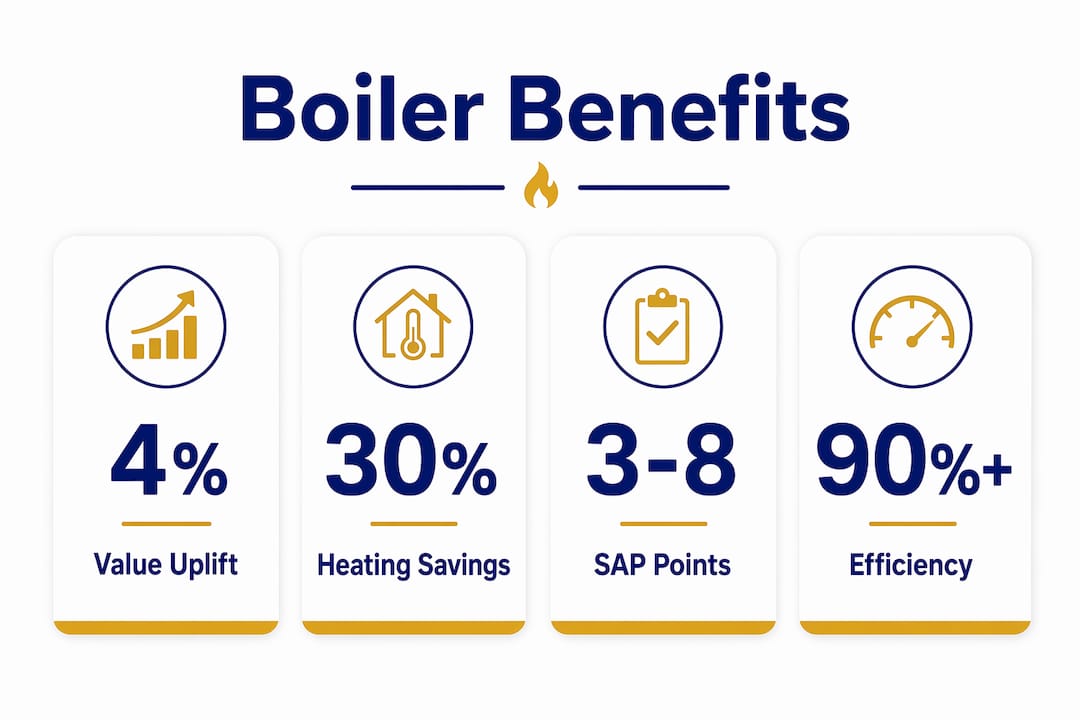
Boiler replacement is one of the most direct ways to raise a property's market value, because it removes the single biggest mechanical risk buyers price into their offers. Replacing an old boiler can increase a property's sale value by roughly 4%, driven by reduced buyer anxiety and lower perceived near-term costs. Modern condensing boilers also improve Energy Performance Certificate ratings, cut annual heating bills, and come backed by manufacturer warranties that give buyers genuine confidence. For property owners preparing to sell, understanding why boiler replacement affects property value is not an academic exercise. It is a practical decision with measurable financial consequences.
Why boiler replacement affects property value through EPC and SAP ratings
The Energy Performance Certificate is the single document buyers, mortgage lenders, and letting agents use to judge a property's running costs at a glance. Its score is calculated using the Standard Assessment Procedure, known as SAP, which pulls boiler efficiency data directly from the Product Characteristics Database, or PCDB. This is where older boilers create a hidden problem.
Older boilers missing from the PCDB are assigned pessimistic default efficiency values by SAP assessors. That means your EPC score is artificially low, not because your boiler performs badly, but because the software has no record of it and assumes the worst. Replacing a pre-2000 unit with a modern A-rated condensing boiler typically improves the SAP score by 3–8 points. Those points can shift a property from EPC band E to D, or D to C, which matters enormously to buyers.

A band C or above is increasingly the threshold mortgage lenders and buy-to-let investors look for. Properties below band C face growing buyer resistance, particularly as energy costs remain high and government minimum standards for rental properties tighten. An EPC uplift from a boiler replacement is not cosmetic. It directly affects the pool of buyers willing to make a full offer.
| EPC band | Typical SAP score range | Buyer eligibility impact |
|---|---|---|
| A | 92–100 | Maximum mortgage and buyer appeal |
| B | 81–91 | Strong appeal, preferred by lenders |
| C | 69–80 | Acceptable to most buyers and lenders |
| D | 55–68 | Reduced appeal; some lenders add conditions |
| E | 39–54 | Restricted for rental; buyer resistance common |
Pro Tip: Ask your EPC assessor to run a provisional SAP calculation before and after a proposed boiler replacement. This shows you the exact band change you will achieve, so you can decide whether the upgrade is worth the spend before committing.
What are the financial benefits for buyers and sellers?
A modern condensing boiler operates at 90% or above efficiency, compared to older non-condensing units that often fall below 70%. That gap translates directly into lower gas bills. Buyers understand this, and they factor anticipated running costs into what they are willing to pay.
The financial case for sellers rests on several connected points:
- Lower annual bills. Modern condensing boilers save homeowners around 30% on heating costs, equivalent to roughly £580 per year in typical households. Buyers see this as an immediate benefit from day one of ownership.
- Reduced maintenance risk. New boilers come with manufacturer warranties, typically five to ten years. Buyers know they are unlikely to face a costly breakdown in the near term, which removes a significant mental objection.
- Lower total ownership cost. The combination of reduced energy bills and lower repair risk means the true cost of owning the property is lower. Buyers price this in, even if they do not articulate it explicitly.
- Warranty as a selling point. A recent installation certificate and active warranty function like a guarantee on a new appliance. They signal that the heating system has been professionally handled and is not a liability.
"New boilers reduce operational breakdown risk and repair costs, which buyers anticipate and capitalise on during price negotiation, thus raising effective offer levels." — Heatco Scotland
The indirect value gain is just as real as the direct one. A buyer who does not need to budget for a new boiler in year two or three will stretch further on the purchase price.
How does a new boiler change buyer perception and negotiation?
Buyers approach property purchases with a mental checklist of risks. The boiler sits near the top of that list because replacing one is expensive, disruptive, and urgent when it fails. A new boiler removes that risk entirely, and buyers see new boilers as eliminating "next-works" uncertainty before they even move in.
The negotiation dynamic shifts in a measurable way. Here is how the process typically plays out when a boiler is old versus new:
- Survey flags the boiler. A surveyor notes an ageing or poorly maintained boiler as a risk item. The buyer uses this to request a price reduction, often citing replacement costs of £2,000 to £4,000.
- Buyer requests evidence. Without service records or a recent installation certificate, buyers demand further documentation or a specialist report, adding delay and uncertainty to the transaction.
- Sale stalls or price drops. Surveyors flagging old boilers frequently trigger late-stage renegotiations. In competitive markets, sellers often concede rather than risk losing the buyer.
- Deal collapses. In some cases, particularly where the boiler is very old or shows signs of carbon monoxide risk, buyers walk away entirely.
A new boiler short-circuits this entire sequence. Replacing an old boiler protects the asking price by preventing late-stage survey issues and enabling a smoother sale, especially in competitive markets like London. The boiler becomes a positive talking point rather than a liability.
Pro Tip: Keep the boiler installation certificate, Gas Safe registration number, and warranty documents in a dedicated folder with the property's legal pack. Solicitors and buyers' surveyors will ask for these, and having them ready signals a well-managed property.
Properly installed new boilers with tidy pipework and active warranties reduce survey risk and make properties more attractive to buyers. Installation quality matters as much as boiler age. A new boiler with messy pipework or missing commissioning paperwork still raises questions.
Boiler replacement vs other home improvements: which adds more value?
Boiler replacement sits within a broader set of energy improvements sellers can make. Understanding where it ranks helps you spend wisely.
| Improvement | Typical SAP gain | Approximate cost | Notes |
|---|---|---|---|
| A-rated condensing boiler | 3–8 SAP points | £2,000–£4,000 | Best value when replacing pre-2000 unit |
| Loft insulation (top-up) | 2–5 SAP points | £300–£600 | Low cost, high return |
| Cavity wall insulation | 3–6 SAP points | £500–£1,500 | Depends on wall construction |
| Air source heat pump | 8–15 SAP points | £8,000–£15,000 | Grants available via Boiler Upgrade Scheme |
| Double glazing | 1–3 SAP points | £3,000–£8,000 | Lower SAP return relative to cost |
Boiler replacement alone rarely achieves a large EPC band jump without improvements to insulation or heating controls. The SAP model rewards the whole building fabric, not just one component. A new boiler in a poorly insulated house will still score poorly because heat loss through walls and roof offsets the efficiency gain.
The recommended sequence is insulation first, then boiler replacement. Insulation reduces the heat demand the boiler must meet, which amplifies the efficiency gain and produces a better SAP score than either improvement alone. Heat pumps deliver the largest SAP uplifts but require significant upfront investment. The Boiler Upgrade Scheme offers grants to reduce this cost, but heat pumps also require adequate insulation to perform well. For most sellers working within a realistic budget, a new condensing boiler combined with loft insulation delivers the best return per pound spent.
Key takeaways
Boiler replacement raises property value primarily by removing buyer risk, improving EPC ratings through SAP, and reducing the total cost of ownership for the incoming buyer.
| Point | Details |
|---|---|
| Value uplift of roughly 4% | Replacing an old boiler reduces buyer risk and near-term replacement costs, supporting a stronger asking price. |
| SAP and EPC improvement | A new A-rated boiler typically adds 3–8 SAP points, which can shift the EPC band and widen buyer eligibility. |
| Negotiation protection | New boilers prevent late-stage survey renegotiations that commonly reduce sale prices by thousands of pounds. |
| Insulation amplifies the gain | Combining boiler replacement with loft or cavity wall insulation produces the best EPC uplift per pound spent. |
| Installation quality counts | Tidy pipework, Gas Safe certification, and warranty documents directly influence buyer confidence and transaction speed. |
What I have learned about boilers and property value after years in the field
The 4% value uplift figure gets quoted a lot, and I understand why. It is a clean number that makes the case for spending £3,000 on a new boiler feel straightforward. But the reality I have seen repeatedly is more nuanced than that.
The biggest gain from a new boiler is not the price increase. It is the sale that does not fall apart. I have watched transactions stall for weeks because a surveyor flagged a 15-year-old boiler with no service history. The buyer panicked, the seller refused to drop the price, and both parties lost time and money. A £2,500 boiler replacement before listing would have prevented the entire standoff.
What I find most sellers underestimate is the role of installation quality. A new boiler fitted by a Gas Safe registered engineer, with clean pipework and a proper commissioning certificate, tells a buyer something important about how the property has been managed. It signals care. An old boiler with a recent service and tidy records can sometimes achieve a similar effect, though not always. The gas safety certification is not just a legal requirement. It is a trust signal in a transaction where trust is everything.
My honest advice: do not replace a boiler purely to chase a percentage uplift. Replace it because it removes a genuine obstacle to a clean, full-price sale. Pair it with loft insulation if the budget allows. Then make sure every document, certificate, and warranty is in order before the first viewing.
— Mike
How 777pcm supports boiler replacement and property compliance
Property owners who want to act on a boiler upgrade before listing need more than a new unit. They need Gas Safe registered installation, proper commissioning, and the paperwork that surveyors and solicitors will ask for.

777pcm provides professional boiler installation and gas safety certification through in-house Gas Safe registered engineers, with no third-party subcontractors involved. Every job is managed from scheduling through to certification, so there are no gaps in the documentation trail. For sellers working with estate agents who need to present a property at its best, 777pcm's compliance services cover CP12 gas safety certificates, EPCs, and heating system maintenance in a single managed process. Getting the heating system right before viewings start is one of the most effective steps a seller can take.
FAQ
Does a new boiler always increase property value?
A new boiler typically raises value by around 4% by reducing buyer risk, though the exact impact depends on the property, the local market, and the quality of installation.
How much does a new boiler improve an EPC rating?
Replacing a pre-2000 boiler with an A-rated condensing model typically adds 3–8 SAP points, which can shift the EPC band upward and improve buyer eligibility.
Will a new boiler reduce my heating bills?
Modern condensing boilers operate at 90% or above efficiency and can cut heating costs by around 30%, saving roughly £580 per year compared to older non-condensing units.
Can an old boiler cause a property sale to fall through?
Yes. Surveyors who flag old or poorly maintained boilers frequently trigger price renegotiations or sale delays. In some cases, buyers withdraw entirely if the boiler presents a safety or reliability concern.
Is boiler replacement better value than other home improvements?
For most sellers, a new condensing boiler combined with loft insulation delivers the best EPC improvement per pound spent. Heat pumps offer larger SAP gains but cost significantly more, even after available grants.