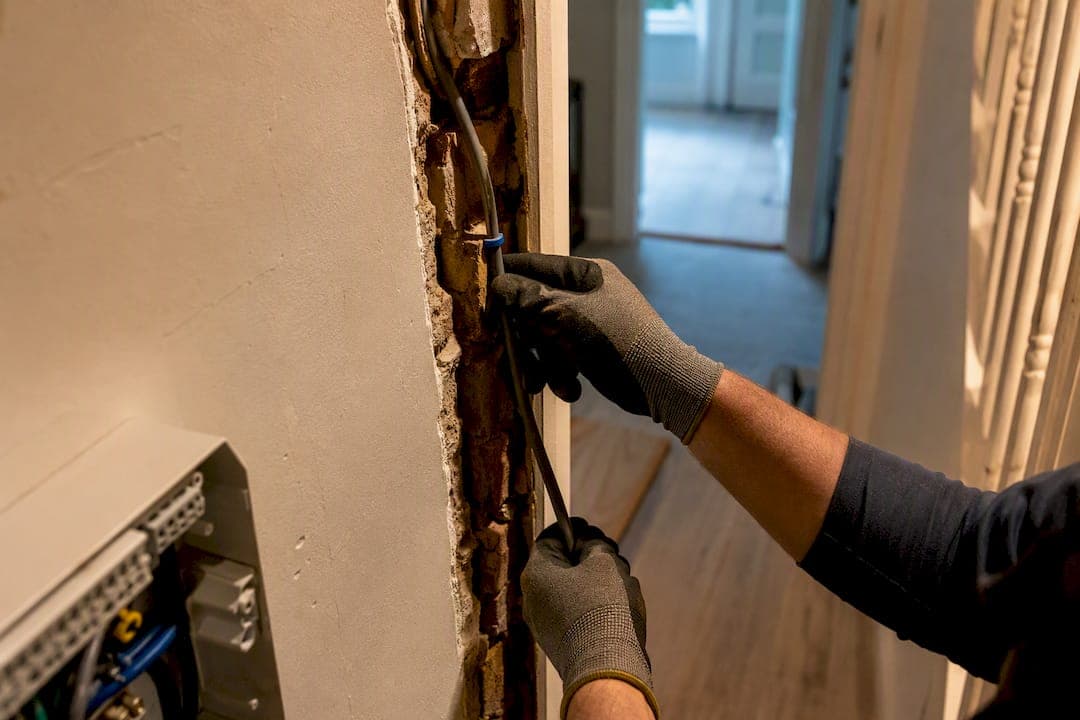
A full house rewire in the UK typically costs between £3,500 and £9,000 in 2026, depending on property size, age and location, with London and the South East sitting at the top of that range. If your home is showing warning signs, the immediate next step is a proper survey or an Electrical Installation Condition Report from a certified electrician, not a guess at a budget. Build in extra for make-good plastering and a regional uplift before you commit to any quote.
TL;DR:
- A typical full house rewire in the UK costs between £3,500 and £9,000 in 2026, depending on property size, age, and location, with London and the South East on the higher end.
- Construction type, house age, and complexity of circuits, such as high-current appliances, significantly influence the rewire quote difference.
- An Electrical Installation Condition Report (EICR) before rewiring costs around £120 to £400 and guides whether a full or partial rewire is necessary.
- Regional variation can add 10 to 30% to the cost, with older, solid-wall properties or listed buildings costing more due to increased labor and material challenges.
- Choosing an itemised, surveyed quote with certification included reduces relaxation in price and quality risks compared to low-ball or uncertified estimates.
Table of Contents
- How much does a rewire cost by property size in the UK?
- What actually pushes a rewiring quote up or down?
- Do you need an EICR before you rewire?
- How long does a rewire take and how disruptive is it?
- How do you budget properly and avoid a lowball quote?
- How do you choose the right electrician for a rewire?
- How does managed compliance support handle rewires for landlords?
- Why the "cheapest quote" mindset gets rewiring wrong
- Get your rewire quoted and certified without the chasing
- Sources
- FAQ
How much does a rewire cost by property size in the UK?
Price bands scale fairly predictably with the number of bedrooms and circuits, though age and layout can push individual quotes well outside the average. National market guides put a full rewire cost UK average at roughly £3,500 to £9,000, with the lower end covering a one or two-bed flat and the top end reflecting a large period house with complex wiring runs, according to TradeCost's 2026 market data.
A typical breakdown looks like this:
- 1 bed flat: typical cost range for a small flat, usually one or two days of core electrician work.
- 2 bed house: typical cost range for a small house, often including kitchen and bathroom circuits.
- 3 bed house: typical cost range for a common semi-detached or terraced home.
- 4 bed house: typical cost range for a larger family home, with more circuits and sockets.
- 5 bed or period property: generally higher cost due to solid walls, lath and plaster ceilings, or listed building constraints.
A full rewire quote should normally cover a new consumer unit, all new circuits from the fuse board outward, replacement sockets and switches, new cabling throughout, and the testing and certification that confirms the installation meets BS 7671, the 18th edition wiring regulations. If a quote is silent on certification, that is worth querying before you sign anything.
Partial rewires are the more common reality for many homeowners. Rather than stripping the whole property, an electrician replaces the circuits and cabling that have actually failed, or upgrades just the kitchen, one floor, or the consumer unit and its immediate circuits. TotalSkills' domestic rewire guide notes that partial work can save 30 to 50% compared with a full rewire cost, though savings shrink fast if the untouched circuits still need testing and cross-checking against the new work.
Regional variation is real and worth planning for. London and the South East routinely add 10 to 30% onto the national average, driven by higher electrician day rates and pricier access to properties, according to Squote's pricing breakdown. A rewire that costs £5,000 in the Midlands can easily reach £6,500 in inner London for an identical job.
What actually pushes a rewiring quote up or down?
Two identical-looking houses can attract wildly different quotes, and the gap almost always comes down to a handful of specific factors rather than the electrician simply charging more.
Construction and age matter more than most homeowners expect. Solid brick or stone walls take far longer to chase cabling into than modern plasterboard partitions, and period features like coving, panelling or lath-and-plaster ceilings slow every stage of the job. The English Housing Survey shows a substantial share of UK homes predate modern wiring standards, which is exactly why older housing stock generates a disproportionate number of rewire enquiries.
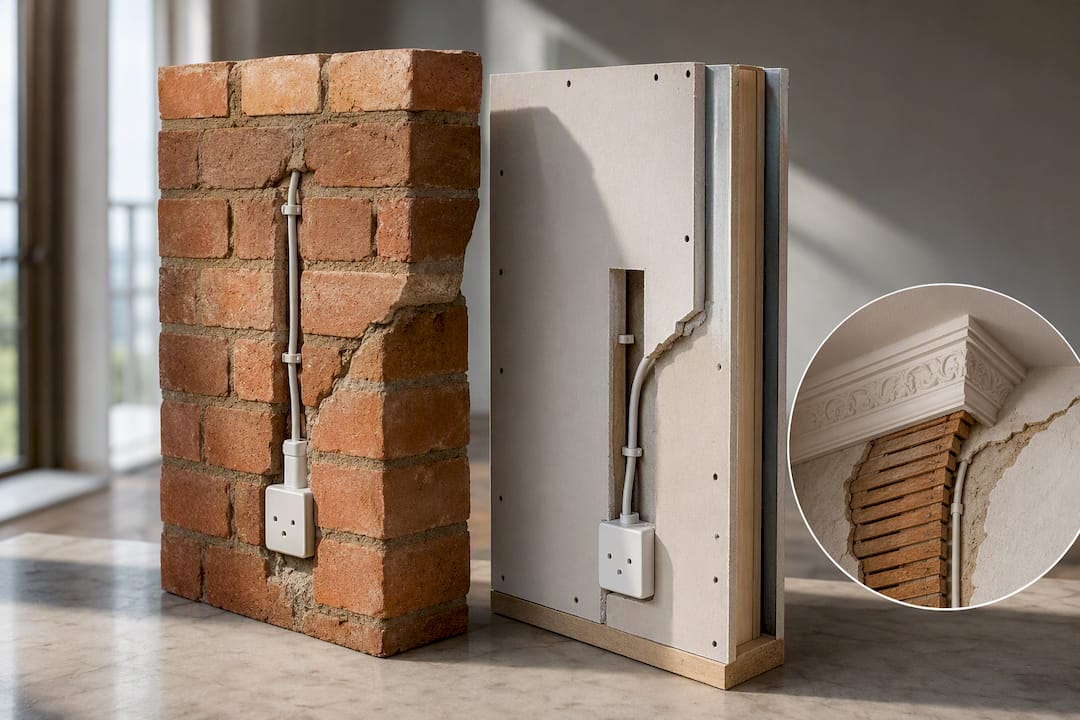
Circuit count and dedicated supplies are the next big lever. A house with an electric shower, an induction hob, and EV charging prep needs several dedicated high-current circuits, each adding materials and testing time that a basic two-bed doesn't require.
Other factors worth naming:
- Access: chasing cable into solid walls costs more than running it through accessible stud partitions or a boarded loft.
- Consumer unit choice: a basic unit with standard breakers costs less than a full board of RCBOs, though RCBOs reduce nuisance tripping and align with current BS 7671 recommendations.
- Fittings: premium sockets, dimmers, and designer switch plates add up quickly across a whole house.
- Make-good: replastering chased walls and redecorating afterwards is routinely quoted as a separate line item, not folded into the electrical price.
Pro Tip: Ask every electrician quoting your job to specify whether RCBOs or a standard split-load board is included. The price difference is often £200 to £600, and it's one of the easiest places for a "cheap" quote to hide a downgrade.
Do you need an EICR before you rewire?
An EICR costs roughly £120 to £180 for a small flat and £180 to £400 for a larger house, according to SparkCerts' 2026 trade pricing data, and it's the sensible first step before committing to any rewire spend. The report inspects your existing installation against current standards and grades any faults it finds, giving you evidence rather than guesswork about what actually needs fixing.
An "unsatisfactory" result does not automatically mean a full rewire. According to Voltimum's guidance on EICR codes, the required remedy depends entirely on what's recorded: a single dangerous socket might need a targeted fix, while widespread degraded cabling across multiple circuits points toward a genuine rewire.
Certification then follows one of two routes:
- Competent person self-certification, through schemes like NICEIC, NAPIT, or ELECSA, where the installer notifies and certifies the work themselves.
- Local Authority Building Control inspection, required if your electrician isn't registered with a competent person scheme, under Part P of the Building Regulations.
Whichever route applies, get it agreed at survey stage. A quote that doesn't mention notification or certification is missing a legal requirement, not just a nice-to-have.
How long does a rewire take and how disruptive is it?
Timescales vary by property size, but there are consistent patterns worth planning around:
- 1 to 2 bed property: typically 3 to 5 working days for the electrical first fix, plus 1 to 2 days for testing and second fix.
- 3 to 4 bed house: usually 5 to 8 working days, extending to 10 or more if plaster make-good is extensive.
- Large or period properties: often phased over 2 to 3 weeks, room by room, particularly if you're living in the property throughout.
- Occupied homes: expect scheduled power-off periods each day, usually a few hours at a time, plus dust from chasing walls and drying time after any plastering.
Coordinating trades sensibly cuts weeks off the process. Booking a plasterer to follow immediately behind the electrician, rather than waiting weeks, avoids a half-finished house sitting idle.
How do you budget properly and avoid a lowball quote?
A realistic rewire budget covers more than the headline labour and materials figure.
Per-socket or per-room rules of thumb circulate widely online, but they're unreliable in practice. A "£150 per socket" estimate ignores whether that socket sits on an easy stud wall or needs chasing through solid brick, so treat these figures as a rough sanity check at best, never as a quote substitute.
Legitimate ways to trim cost without cutting corners:
- Phase the work across rooms if cash flow is tight, provided the electrician confirms each phase is independently safe to leave.
- Choose standard sockets and switches over premium finishes; swap them later if budget allows.
- Combine the rewire with other renovation work, since TotalSkills notes that plastering and decorating done once, alongside other structural work, is more cost-effective than doing it twice.
- Insist on fixed-price, itemised quotes rather than day-rate estimates that can drift upward.
A useful benchmark: industry pricing guides suggest that itemised, on-site surveys materially reduce the risk of surprise extras appearing mid-job, according to Squote's analysis of rewire pricing patterns. If a quote arrives without a site visit, treat it as provisional at best.
Red flags to walk away from: a single lump-sum figure with no breakdown, no mention of certification or notification, and a completion date that seems too fast for the scope described.
How do you choose the right electrician for a rewire?
Vetting properly at the survey stage saves far more money than shopping on price alone.
- Ask what the site survey will cover and insist on seeing the property in person before any final figure is issued.
- Check credentials directly, not just a logo on a van: confirm active membership of a Part P competent person scheme such as NICEIC or NAPIT, plus current public liability insurance.
- Request an itemised quote covering consumer unit, circuits, testing, certification, and make-good, so you can compare providers on genuinely equivalent terms.
- Ask for references or recent job examples, particularly for a property of similar age and construction to yours.
- Agree payment stages upfront, typically a modest deposit, a payment at first-fix completion, and the balance only once certification and test results are handed over.
Pro Tip: Never pay the full balance before you have the Electrical Installation Certificate in hand. A completed rewire without paperwork isn't actually finished in the eyes of building control or your home insurer.
How does managed compliance support handle rewires for landlords?
Landlords and portfolio managers face a different problem to homeowners: it's not just one rewire, it's dozens of properties each needing coordinated inspection, certification and remedial follow-up on a schedule. That's where a single point of contact for compliance genuinely earns its keep.
Some managed compliance services handle this through in-house certified electricians rather than subcontracted third parties, which can help keep quality and communication consistent across a portfolio. Key elements of that approach include:
- In-house engineers carrying out EICRs, remedial works and certification directly, rather than passing jobs to external contractors.
- A compliance portal giving landlords and letting agents visibility over certificate status, upcoming inspections and completed remedial work across every property.
- Coordinated handling of the 28-day remedial window that follows an unsatisfactory EICR, so fixes get scheduled and certified before the deadline lapses rather than after.
- Single account management, meaning one contact tracks a job from initial survey through to final certification, instead of chasing multiple subcontractors for updates.
For a landlord managing several properties, that consolidation removes a genuine administrative burden that a one-off domestic rewire simply doesn't carry.
Why the "cheapest quote" mindset gets rewiring wrong
Most advice on rewire costs focuses obsessively on getting the lowest number, and that's precisely where homeowners get burned. The research here points somewhere more useful: the biggest cost risk isn't paying too much, it's paying for work that turns out to be incomplete, uncertified, or wrongly scoped in the first place.
An EICR costing £150 to £400 looks like an unnecessary expense next to a £6,000 rewire quote, until you realise it's the only thing standing between a genuine safety problem and a wasted rewire on circuits that didn't need touching. Skipping it to save money is the single most common false economy in this whole process.
The conventional advice to "get three quotes and pick the middle one" also misses the point. Three quotes that all skip an on-site survey and none mention certification aren't three genuine options, they're three versions of the same risk. Prioritise itemised, surveyed quotes over cheap ones, and prioritise certification over speed. Everything else, including the final price, sorts itself out once those two things are right.
— Mike
Get your rewire quoted and certified without the chasing
If you'd rather not spend weeks coordinating an electrician, a plasterer, and the paperwork trail yourself, Some providers offer a managed alternative built specifically for landlords and letting agents juggling compliance across multiple properties, with in-house electricians handling everything from the initial EICR through to remedial works and final certification, plus a dedicated account manager rather than a rotating cast of subcontractors.

That matters most when the 28-day remedial window is ticking on an unsatisfactory EICR. Instead of sourcing a new electrician under time pressure, 777pcm's portal keeps certificate status, scheduled works and completed jobs visible in one place across your whole portfolio. If your rewire needs are tied to a specific certificate deadline, the EICR cost and 28-day compliance breakdown is worth reading alongside your survey.
For homeowners dealing with a single property, or letting agents managing dozens, the next step is the same: request a survey with 777pcm to get an itemised, certificated quote before any work starts.
Sources
- English housing survey 2022 to 2023: housing quality and condition
- The Building Regulations 2010 (as amended) — relevant statutory instrument (Part P context)
- BS 7671 18th edition wiring regulations (IET)
- Full house rewire cost UK (2026) — prices by city (TradeCost)
- How much does an EICR cost in 2026? Honest numbers from the trade | SparkCerts
FAQ
Does a 30-year-old house need rewiring?
Not automatically. Older wiring can still be sound, but it's worth an EICR to check insulation condition and whether the consumer unit meets current BS 7671 standards, especially if you've never had one done.
How can you get your house rewired for free?
There's no general free rewiring scheme for private homeowners, though some local authority or energy company grant schemes occasionally cover electrical safety work for low-income or vulnerable households; check with your council directly rather than relying on a generic online claim.
Is it illegal to sell a house that needs rewiring?
No, selling a house with outdated wiring isn't illegal, but sellers must disclose known electrical safety issues if asked directly, and an unsatisfactory EICR can affect a buyer's mortgage offer or insurance terms.
Is rewiring a flat a big job?
It's usually smaller than a house rewire, often 2 to 4 working days for a one or two-bed flat, though shared access, leasehold permissions, and building management coordination can add time beyond the electrical work itself.