
Renewing a CP12 gas safety certificate is the process by which landlords arrange an annual gas safety inspection by a Gas Safe registered engineer, receive updated documentation, and distribute it to tenants within legally defined timeframes. The CP12, formally known as the Landlord Gas Safety Record, is not optional. Under the Gas Safety (Installation and Use) Regulations 1998, every landlord with gas appliances in a rented property must renew cp12 gas safety certificate obligations every 12 months without exception. Missing that deadline exposes you to criminal prosecution, unlimited fines, and the loss of your right to serve a valid Section 21 notice.
What are the legal requirements for CP12 renewal?
The Gas Safety (Installation and Use) Regulations 1998, specifically Regulation 36, sets the legal framework every landlord must follow. The law is unambiguous: annual checks within 12 months are mandatory for every relevant gas appliance and flue in a rented property. That 12-month cycle is fixed from the date of the previous inspection, not from when you remember to book one.
One of the most useful provisions in the regulations is the two-month early inspection window. The early check window allows you to book an inspection up to two months before the current certificate expires, and the next renewal date is calculated from the original expiry date rather than the new inspection date. This means you can act early without compressing your annual cycle. For landlords managing multiple properties, this window is not a convenience. It is the mechanism that keeps your entire portfolio on a predictable schedule.
Once the inspection is complete, the clock starts on your distribution obligations:
- Existing tenants must receive the new gas safety record within 28 days of the inspection being carried out.
- New tenants must receive a copy before they move in, with no grace period permitted.
- Prospective tenants who request a copy of the record are entitled to receive one.
Key legal point: Failing to serve the gas safety record within the statutory deadline is itself a compliance breach, separate from the inspection obligation. Courts and local authorities treat the two as distinct duties, and both must be met.
The CP12 renewal process is therefore not simply about retaking the check. Managing the full evidence trail proving timely inspection, record issuance, and tenant receipt is what genuine compliance looks like.
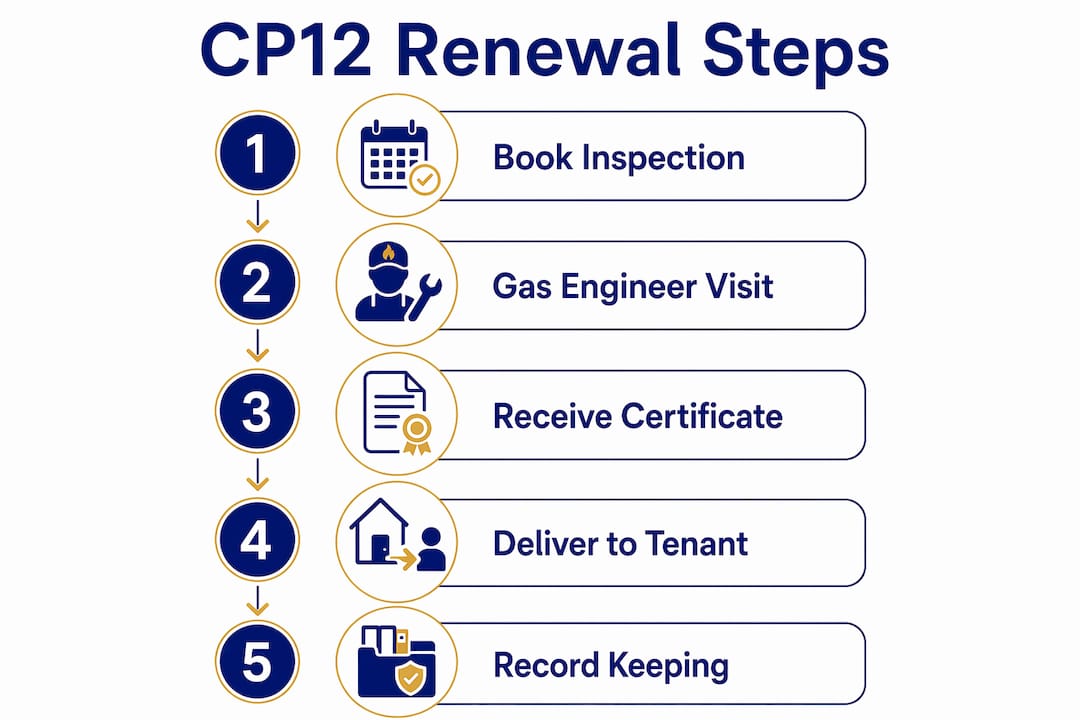
How to renew your CP12 certificate step by step
A well-managed gas safety certificate renewal follows a clear sequence. Deviating from it, even with good intentions, creates gaps in your compliance record.
-
Identify your renewal date. Check the expiry date on your current CP12 certificate. Count back ten weeks from that date to set your booking target. This gives you a buffer before the two-month early window opens and time to resolve any scheduling difficulties.
-
Book a Gas Safe registered engineer. Only engineers listed on the Gas Safe Register are legally authorised to carry out landlord gas safety checks in Great Britain. Verify the engineer's registration number on the Gas Safe Register website before confirming any appointment. Scheduling inspections 6 to 8 weeks before expiry is recognised best practice, as it leaves room to rebook if access problems arise without losing your original renewal date.
-
Prepare the property. Confirm access with your tenant in writing well in advance. Ensure all gas appliances and flues are accessible. If the property has a gas boiler in a locked cupboard or a flue in a loft space, arrange access before the engineer arrives.
-
The inspection itself. The engineer will check each gas appliance and flue for safe operation, adequate ventilation, correct gas pressure, and the absence of dangerous defects. Any unsafe appliance will be labelled and, in serious cases, disconnected. The engineer records all findings on the certificate.
-
Receive and verify the certificate. Once issued, check that the CP12 contains all legally required details. The certificate must include the inspection date, property address, landlord details, a description and location of each appliance and flue, any defects identified, remedial actions taken or required, and the engineer's name and Gas Safe registration number. A certificate missing any of these elements is not legally compliant.
-
Distribute to tenants. Send the record to existing tenants within 28 days. For new tenancies, issue it before the tenancy begins. Keep dated proof of delivery for every distribution.
Pro Tip: Electronic delivery of gas safety records is legally acceptable provided the tenant can access the document and has agreed to receive it this way. Sending via email with a read receipt or a property management portal with a logged timestamp gives you verifiable proof of delivery, which is far stronger than a posted copy with no confirmation.
What are the common challenges in the CP12 renewal process?
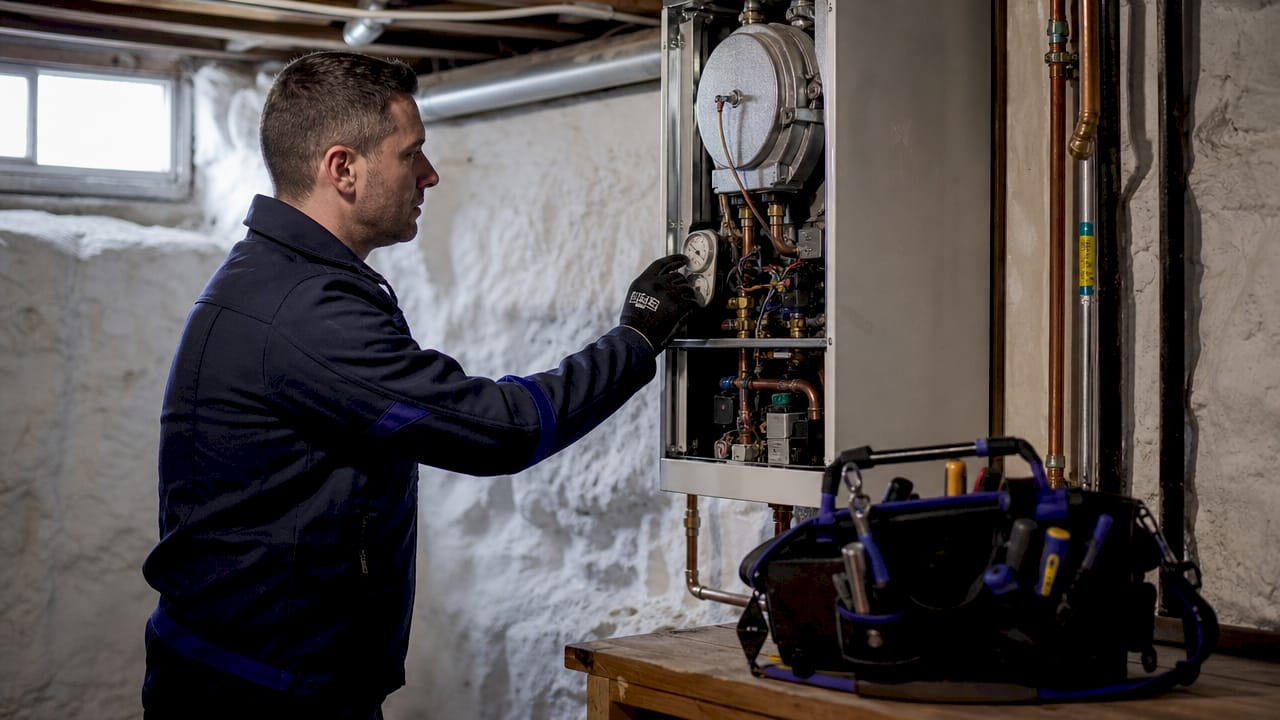
Even experienced landlords and property managers encounter recurring obstacles during gas safety certificate renewal. Recognising them in advance is the most reliable way to avoid them.
Tenant access refusals are the most frequently cited problem. If a tenant refuses entry, you cannot simply record a failed attempt and move on. Access denials require documented proof of repeated reasonable attempts, and the compliance obligation remains yours regardless. Write to the tenant formally, offer multiple appointment slots, and keep copies of all correspondence. In persistent cases, seek legal advice before the certificate expires.
Late booking leading to a lapsed certificate is a risk that compounds quickly. Once a certificate lapses, you are in breach of Regulation 36. Any new inspection resets your renewal date to the new inspection date rather than the original one, disrupting your annual cycle. Booking within the two-month window prevents this entirely.
Incomplete or incorrectly issued certificates create a different kind of risk. A certificate that omits the engineer's Gas Safe registration number or fails to record a noted defect is not compliant, even if the inspection was carried out properly. Always review the document before filing it.
For portfolio managers, the challenge is scale. Tracking renewal dates across dozens of properties manually is where lapses occur. Consider these approaches:
- Use property management software such as Arthur Online, Fixflo, or a dedicated compliance platform to set automated reminders at 60 and 30 days before each certificate expires.
- Assign a named person in your team as the compliance lead for gas safety, with authority to escalate access issues.
- Maintain a central compliance register updated immediately after each inspection and distribution.
Pro Tip: Software-driven reminders set at 30 and 60 days before CP12 expiry reduce last-minute engineer availability problems significantly. Engineers in high-demand areas are often booked two to three weeks out, so early scheduling is not just good practice. It is often the only way to guarantee a compliant inspection date.
How should you manage record keeping for CP12 compliance?
Record keeping is where many landlords underestimate their obligations. The Gas Safety Regulations require retention of gas safety records for a minimum of two years from the date of issue. In practice, keeping records for longer is strongly advisable, particularly where possession proceedings or insurance claims may arise.
The table below summarises what each CP12 record must contain and why each element matters:
| Certificate element | Why it matters |
|---|---|
| Date of inspection | Proves the 12-month cycle was observed |
| Property address and landlord details | Ties the record to the correct tenancy |
| Appliance descriptions and locations | Confirms all relevant items were checked |
| Defects noted and remedial actions | Demonstrates duty of care was exercised |
| Engineer name and Gas Safe number | Validates the inspection was legally authorised |
Beyond the certificate itself, evidence of delivery to tenants is critical. In possession disputes, courts have ruled Section 21 notices invalid where landlords could not prove the gas safety record had been served. Emails with timestamps, portal delivery logs, or signed receipts all serve as acceptable proof. A certificate filed away without a delivery record is only half the compliance picture.
Maintaining property-level histories rather than isolated annual certificates also reduces risk when appliances are removed or replaced. If a boiler is decommissioned mid-tenancy, having a continuous record of that appliance's inspection history is far more useful in an audit than a single current certificate.
Key takeaways
Renewing a CP12 gas safety certificate requires timely inspection by a Gas Safe registered engineer, legally compliant documentation, and verified delivery to tenants within 28 days.
| Point | Details |
|---|---|
| Annual renewal is a legal duty | Regulation 36 of the Gas Safety Regulations 1998 mandates checks every 12 months without exception. |
| Use the two-month early window | Book up to two months before expiry to preserve your original renewal date and avoid lapses. |
| Verify certificate contents | Check that engineer details, appliance descriptions, and any defect notes are all present before filing. |
| Serve tenants within 28 days | Existing tenants must receive the record within 28 days; new tenants must receive it before moving in. |
| Keep records and proof of delivery | Retain certificates for at least two years and store dated evidence of every tenant notification. |
Why the renewal process deserves more attention than most landlords give it
Most landlords treat the CP12 renewal as a box-ticking exercise. Book an engineer, get the certificate, file it away. That approach works until it doesn't, and when it fails, the consequences are disproportionate to the oversight.
What I've seen repeatedly is that the inspection itself is rarely the problem. Gas Safe engineers are thorough and the process is well-established. The failures happen in the margins. A certificate issued on the right date but never served to the tenant. A renewal booked two weeks late because the diary reminder was set to the wrong month. A certificate that lists the boiler but omits the gas fire in the living room because the engineer wasn't told it existed.
The two-month early booking window is genuinely underused. Landlords who build it into their standard operating procedure, booking at the ten-week mark as a rule rather than a reaction, almost never lapse. Those who wait until the month of expiry regularly find themselves scrambling for an available engineer or, worse, discovering a defect that requires remedial work before the certificate can be issued.
Digital record keeping changes the risk profile entirely. When every certificate is stored in a cloud-based system with a logged delivery timestamp for each tenant, the compliance audit becomes a five-minute task rather than a stressful search through email threads. Well-organised digital records have saved landlords in possession proceedings where a paper trail would have been impossible to reconstruct.
The simplest advice I can offer is this: treat the CP12 renewal cycle as a property management system, not an annual chore. Build the reminders, verify the certificates, and document every delivery. The legal risk of getting it wrong is simply too significant to leave to memory.
— Mike
How 777pcm makes CP12 renewal straightforward for landlords
Managing gas safety certificate renewals across a property portfolio takes time, coordination, and reliable engineers. 777pcm removes that burden by handling the entire CP12 renewal process in-house, from scheduling Gas Safe registered engineers to issuing compliant certificates and supporting tenant communication.

777pcm's in-house engineers cover residential and commercial properties, with no third-party subcontractors involved. That means consistent quality, direct accountability, and faster turnaround when remedial work is needed after an inspection. For landlords managing multiple properties, the 777pcm compliance portal gives you a single view of all certificate statuses, upcoming renewals, and completed records. Whether you manage a handful of buy-to-let properties or a large portfolio, 777pcm provides the structure to keep every property compliant without the administrative strain. Estate agents looking to support their landlord clients can also explore dedicated agent services built around portfolio compliance management.
FAQ
What is a CP12 certificate and when must it be renewed?
A CP12, formally called a Landlord Gas Safety Record, is the document issued after an annual gas safety inspection by a Gas Safe registered engineer. It must be renewed every 12 months under the Gas Safety (Installation and Use) Regulations 1998.
Can I book the gas safety check before the current certificate expires?
Yes. You can book the inspection up to two months before the current certificate expires, and your next renewal date will be calculated from the original expiry date rather than the new inspection date, preserving your annual cycle.
How long do I have to give tenants the new CP12 certificate?
Existing tenants must receive the new gas safety record within 28 days of the inspection. New tenants must receive a copy before they move into the property.
What happens if a tenant refuses access for the gas safety check?
You must document all reasonable attempts to gain access in writing and continue making efforts before the certificate expires. Compliance remains your legal obligation regardless of access difficulties, so seek legal advice early if a tenant persistently refuses entry.
How long must I keep CP12 records?
Gas safety records must be retained for a minimum of two years from the date of issue. Keeping records for longer is advisable, particularly as evidence in possession proceedings or insurance disputes.