
Heating system compliance is defined as the legal obligation for landlords to maintain, inspect, and certify every heating installation across their rental properties to protect tenant safety and meet statutory requirements. For property managers overseeing multiple units, understanding how heating system compliance works across portfolios is not optional. The Gas Safety (Installation and Use) Regulations 1998 and Section 11 of the Landlord and Tenant Act 1985 form the twin pillars of this framework. The 2026 extension of Awaab's Law adds strict investigation and repair deadlines, making compliance a year-round operational priority rather than an annual formality.
How does heating system compliance work across rental portfolios?
Heating system compliance, known formally as gas safety and heating maintenance management, requires landlords to satisfy specific legal checks at every property, every year. The CP12 gas safety record sits at the centre of this obligation. A Gas Safe registered engineer must inspect all gas appliances, pipework, and flues annually, and failure to comply is a criminal offence carrying unlimited fines and custodial sentences of 6–15 years for serious neglect cases. That is not a theoretical risk. Prosecutions under these regulations do happen, and courts treat gas safety breaches with severity.

Beyond the CP12, Section 11 of the Landlord and Tenant Act 1985 requires landlords to keep heating and hot water installations in repair and proper working order throughout the tenancy. This covers boilers, radiators, pipework, and controls. The scope is broad, and the standard is higher than many property managers assume.
What the CP12 inspection actually covers
The annual gas safety check examines every gas appliance in the property, the integrity of all pipework, and the condition of flues and ventilation. Engineers classify defects into two categories: Immediately Dangerous and At Risk. An Immediately Dangerous finding requires the appliance to be disconnected on the spot. An At Risk finding requires prompt remedial work before the next tenancy begins or, in occupied properties, within a defined timeframe.
The CP12 is a safety check, not a service. A boiler can pass its annual inspection and still be running inefficiently, accumulating wear that will cause a breakdown mid-winter. Combining the CP12 with an annual boiler service is the only way to satisfy both the legal requirement and the practical duty of care.
Landlords must provide tenants with a copy of the CP12 within 28 days of the inspection, or before a new tenancy begins. Proof of delivery matters as much as the certificate itself. Missing proof of service can invalidate possession notices and undermine a landlord's position in any legal dispute.
Pro Tip: Keep a signed receipt or a timestamped email confirming the tenant received their CP12. A certificate without proof of delivery offers far weaker legal protection.
How to manage compliance across multiple properties
Portfolio compliance management is the practice of tracking, scheduling, and documenting every legal obligation across all properties in a landlord's portfolio. Managing portfolios requires tracking 15 or more critical compliance dates per property annually. That figure multiplies fast across even a modest portfolio of ten properties. Manual tracking using paper files or basic spreadsheets creates gaps that are almost impossible to avoid at scale.
Building a compliance calendar
A compliance calendar assigns every certificate expiry, inspection date, and tenant notification deadline to a specific date in the year. Property managers who build this calendar at the start of each tenancy year gain a clear view of workload and can avoid the dangerous clustering of expiries in autumn and winter, when engineer availability tightens.
The most effective scheduling approach groups properties by location. Grouping properties into compliance clusters by postcode area allows a single engineer visit to cover multiple properties in one trip. This reduces travel costs, simplifies logistics, and cuts the administrative burden of coordinating multiple separate appointments.
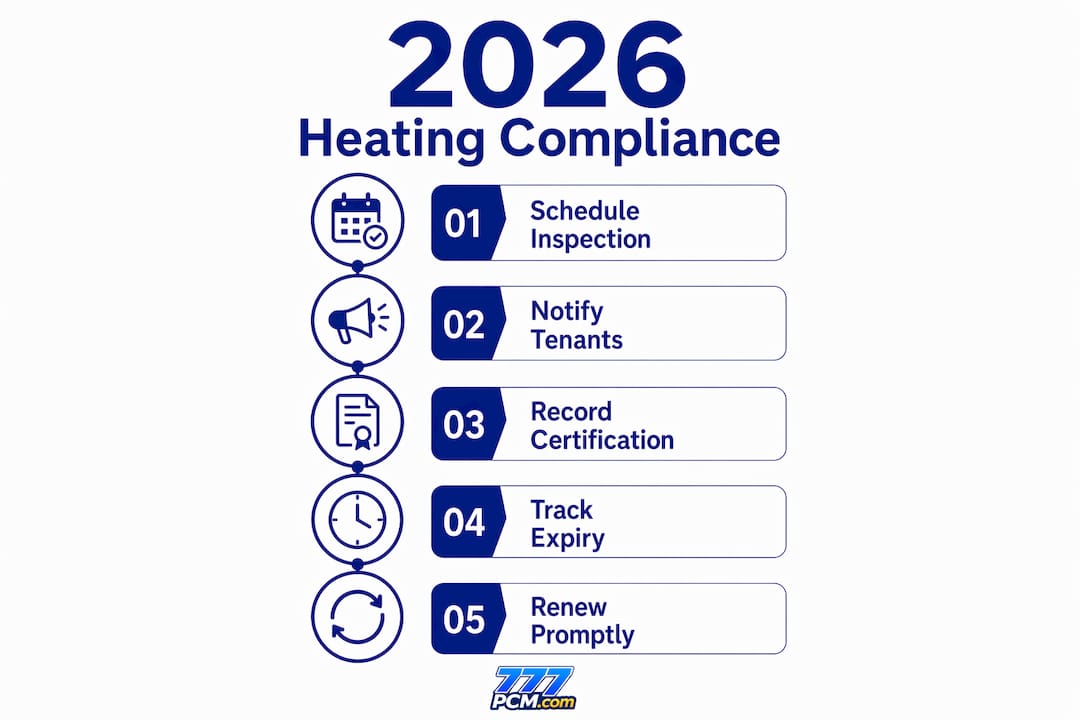
The steps below outline a practical portfolio compliance process:
- Audit all current certificates. List every property, its gas appliances, and the expiry date of its CP12, EICR, and EPC.
- Build a 12-month compliance calendar. Assign renewal dates at least eight weeks before each expiry.
- Group properties geographically. Cluster inspections by postcode to reduce engineer travel and scheduling complexity.
- Book within the early renewal window. The CP12 can be renewed up to eight weeks early without losing the anniversary date. Use this window to avoid winter peak demand.
- Log tenant notifications. Record every certificate delivery with a timestamp and the tenant's acknowledgement.
- Review the calendar quarterly. Compliance dates shift when tenancies change. A quarterly review catches gaps before they become breaches.
Pro Tip: Set automated reminders at 10 weeks, 6 weeks, and 4 weeks before each certificate expiry. Three touchpoints give you time to rebook if an appointment falls through.
| Task | Recommended timing |
|---|---|
| Book annual gas safety inspection | 10 weeks before expiry |
| Confirm engineer appointment | 8 weeks before expiry |
| Issue CP12 to tenant | Within 28 days of inspection |
| Log proof of delivery | Same day as issue |
| Review full compliance calendar | Every quarter |
What are the risks of non-compliance for heating systems?
Non-compliance with heating system regulations carries consequences that extend well beyond a fixed penalty notice. The legal, financial, and operational risks compound quickly across a portfolio.
Missing a single CP12 expiry is not an administrative oversight. It is a criminal offence that can void insurance, invalidate possession proceedings, and expose a landlord to prosecution. Across a portfolio, the risk multiplies with every property that falls out of date.
The specific consequences include:
- Criminal prosecution. Failure to hold a valid CP12 is a criminal offence. Courts can impose unlimited fines and, in cases of serious neglect, custodial sentences of 6–15 years.
- Civil penalties. Local authorities can issue improvement notices and civil penalties. Non-compliance risks penalties of up to £30,000 per breach for electrical safety failures, and gas breaches carry equivalent severity.
- Voided insurance. Most landlord insurance policies require valid safety certificates as a condition of cover. A lapsed CP12 can void a claim entirely.
- Invalid possession notices. A Section 8 notice served without valid compliance documentation is vulnerable to challenge. Courts have struck out possession claims on this basis.
- Lost deposit disputes. Safety certificates are foundational in tenancy deposit adjudications. Adjudicators routinely check for valid documentation, and missing records frequently cause landlords to lose disputes they would otherwise win.
How do 2026 regulatory updates affect heating compliance in portfolios?
The regulatory environment for rental property heating compliance tightened significantly in 2026. Property managers who have not updated their processes face real exposure.
The key changes affecting portfolios are:
- Awaab's Law extended to private rentals. Originally applied to social housing, Awaab's Law now covers private rented properties. Landlords must acknowledge a reported hazard, including excess cold caused by heating failure, within a defined period, investigate within 14 days, and complete repairs within seven weeks. These investigation and repair deadlines are statutory, not advisory.
- Section 21 abolition and possession reform. The removal of Section 21 "no-fault" evictions means landlords must rely on Section 8 grounds for possession. Valid compliance documentation is now a prerequisite for any successful possession claim. A lapsed CP12 or missing EICR can derail proceedings entirely.
- Private Rented Sector (PRS) Database. The launch of the PRS Database creates a central register where compliance records, including gas safety certificates, will be subject to verification. Property managers must maintain accurate, up-to-date records that can withstand external scrutiny.
- Ongoing documentation expectations. Regulators and courts now expect a continuous compliance record, not just a current certificate. Repair logs, tenant notifications, and inspection histories all form part of the evidence base a landlord may need to produce.
Compliance should be continuous, year-round, not just an annual event. The 2026 changes make that principle a legal reality.
What are the best practices for heating compliance across a portfolio?
Effective compliance portfolio management rests on three foundations: reliable engineers, good systems, and consistent documentation.
- Work with engineers who have portfolio capacity. A Gas Safe engineer who handles single properties may not have the scheduling flexibility a portfolio requires. Establish relationships with firms that can commit to multi-property programmes and respond quickly to emergency callouts. 777pcm employs in-house Gas Safe registered engineers specifically to serve landlords and portfolio managers at scale.
- Combine CP12 inspections with boiler servicing. Scheduling both on the same visit saves time and money. It also satisfies the proactive maintenance standard required under Section 11, where a boiler requiring frequent callouts may breach legal obligations before it actually breaks down.
- Use a centralised digital compliance register. Automation and digital tools enable reliable compliance tracking as portfolio size grows. A digital register should capture certificate expiry dates, inspection reports, tenant notification logs, and repair records in one place.
- Handle access issues proactively. Missed appointments are one of the most common causes of compliance lapses. Give tenants advance notice, offer flexible appointment windows, and document every access attempt. If a tenant repeatedly refuses access, seek legal advice promptly.
- Schedule early and cluster visits. Book inspections within the eight-week early renewal window to avoid expiry and engineer shortages during winter. Group properties by postcode to make each engineer visit count.
Pro Tip: Ask your engineer to flag any appliances approaching the end of their serviceable life during the CP12 visit. Replacing a boiler on your terms costs far less than an emergency replacement mid-tenancy.
For a detailed breakdown of what the annual inspection involves, the gas safety check explained guide covers the process step by step.
Key takeaways
Heating system compliance across a rental portfolio requires continuous, property-by-property adherence to annual CP12 inspections, prompt repair obligations under Awaab's Law, and rigorous documentation of tenant notifications and certificate delivery.
| Point | Details |
|---|---|
| CP12 is a legal requirement | Every gas property needs an annual inspection by a Gas Safe registered engineer. |
| Proof of delivery matters | Handing over the certificate is not enough; record the tenant's receipt every time. |
| Cluster and book early | Group properties by postcode and book within the eight-week window to avoid winter gaps. |
| 2026 rules add repair deadlines | Awaab's Law now requires hazard investigation within 14 days and repairs within seven weeks. |
| Non-compliance has criminal consequences | Unlimited fines and custodial sentences apply; voided insurance and lost possession claims follow. |
Why I think most landlords are still underestimating portfolio compliance
The property managers I see struggling most with compliance are not the ones who ignore it. They are the ones who treat it as a box-ticking exercise rather than a live operational process. They get the CP12 done, file it somewhere, and move on. Then a tenancy changes, an expiry date shifts, and six months later they are chasing an engineer in november with a lapsed certificate and a tenant who has reported a cold home.
The 2026 changes make this approach genuinely dangerous. Awaab's Law deadlines are not flexible. A 14-day investigation window does not pause because your usual engineer is booked up. The PRS Database will make it harder to paper over gaps retrospectively. The landlords who will manage this well are the ones who build compliance into their monthly operations, not their annual diary.
My honest view is that the cost of a proper digital compliance system, whether that is a dedicated platform or a well-maintained register, pays for itself the first time it prevents a missed expiry. The cost of a missed expiry, in legal fees, lost possession proceedings, or a voided insurance claim, is orders of magnitude higher. Compliance is not overhead. It is risk management, and at portfolio scale, the risk is real.
— Mike
How 777pcm supports portfolio heating compliance
Property managers overseeing multiple rental units need a compliance partner who understands the operational reality of portfolio management, not just individual property servicing.

777pcm provides CP12 gas safety inspections, annual boiler servicing, and heating system repairs through in-house Gas Safe registered engineers, with no third-party subcontractors involved. The service covers scheduling, access coordination, certification, and remedial works, giving portfolio managers a single point of contact for every heating compliance requirement. For landlords who need fast response alongside planned maintenance, the 777pcm commercial service is built to handle multi-property demands with the speed and accountability that portfolio compliance requires.
FAQ
What is a CP12 certificate and who needs one?
A CP12 is the annual gas safety record required for every rental property with gas appliances. Landlords must arrange the inspection with a Gas Safe registered engineer and provide a copy to tenants within 28 days.
How often must heating systems be inspected in rental properties?
Gas safety inspections are required annually. The CP12 can be renewed up to eight weeks early without losing the anniversary date, which helps avoid scheduling conflicts during winter.
What are the Awaab's Law deadlines for heating repairs in 2026?
Landlords must acknowledge a reported heating hazard, investigate within 14 days, and complete repairs within seven weeks. These deadlines apply to private rented properties as of 2026.
Can a missing CP12 affect a possession claim?
Yes. Courts and adjudicators check for valid compliance documentation. A lapsed or unserved CP12 can invalidate a Section 8 possession notice and cause landlords to lose tenancy deposit disputes.
What is the best way to track compliance across a large portfolio?
A centralised digital compliance register that captures certificate expiry dates, inspection reports, and tenant notification logs is the most reliable method. Automated reminders set at 10 weeks, 6 weeks, and 4 weeks before expiry prevent lapses at scale.