
A certificate of occupancy rental is an official legal document issued by local authorities confirming that a property complies with building codes, safety standards, and approved use classifications for residential rental occupancy. Without it, renting out a property is not merely risky. It is unlawful. For property owners and investors, understanding this document is as fundamental as understanding a tenancy agreement, and the consequences of overlooking it can be severe.
What is a certificate of occupancy rental and why does it matter?
A certificate of occupancy, commonly abbreviated as CO, is the formal authorisation that a building is safe, structurally sound, and approved for its intended use. The City of Spokane states clearly that a CO is required before any building can be used or occupied, and again whenever there is a change in occupancy classification. This is not a bureaucratic formality. It is the legal gateway between a completed or converted property and a lawfully tenanted one.
For rental properties specifically, the CO confirms that the building meets the standards required for residential occupation. Think of it as the property's permission slip. A landlord may own the bricks and mortar, but without the CO, the local authority has not sanctioned anyone living there. South Australia's planning authority, PlanSA, reinforces this point: occupancy cannot begin until the final certificate is issued following all required inspections and approvals.

The document also carries weight in property transactions. Investors purchasing rental properties must verify CO status before exchange, since an absent or expired certificate creates immediate compliance liability. Confirming the approved use classification in local records is the first line of due diligence for any acquisition.
How does a CO differ from a rental occupancy permit?
Many property owners assume a certificate of occupancy covers all their compliance obligations. It does not. The distinction between a CO and a rental occupancy permit is one of the most commonly misunderstood areas in rental property management.
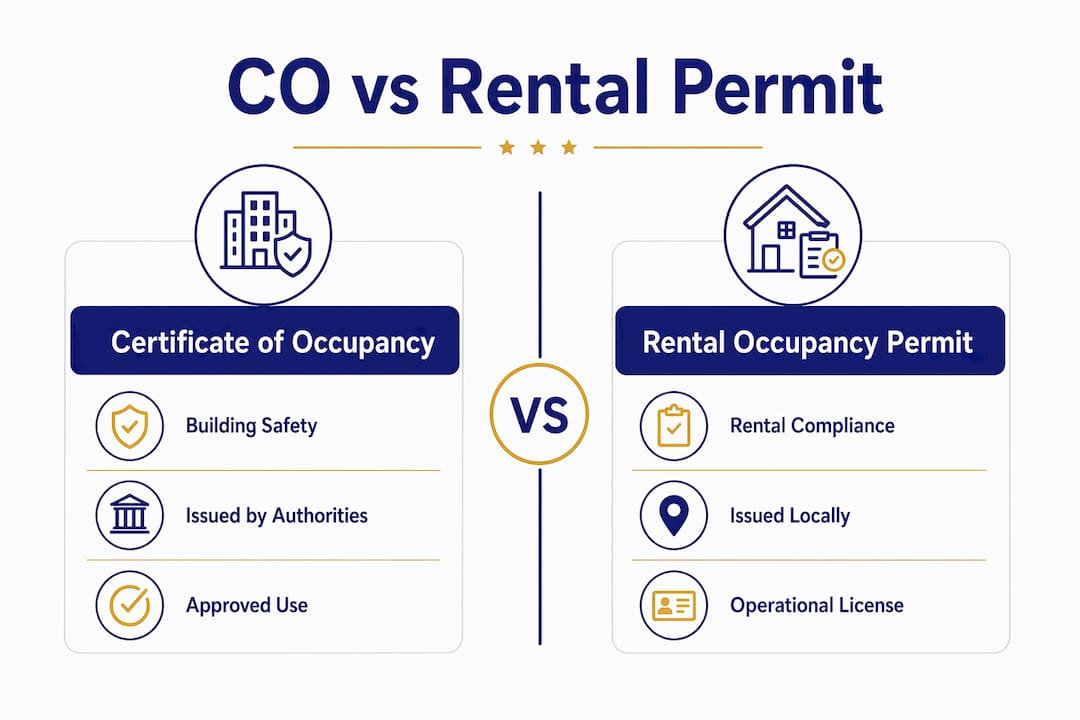
A CO addresses the physical building. It confirms the structure meets building codes and is approved for a specific occupancy class, such as residential, commercial, or mixed use. A rental occupancy permit, by contrast, is a separate registration and inspection requirement imposed by some local authorities to regulate the ongoing operation of rental properties.
Bloomington, Indiana, provides a clear illustration of this layered system. The city requires rental registration and periodic inspections, with multi-year permits that must be posted visibly inside each rental unit. A landlord there could hold a valid CO and still be non-compliant if they have not obtained the separate rental occupancy permit. This distinction matters enormously for investors acquiring properties in jurisdictions with dual requirements.
| Document | What it covers | Who issues it |
|---|---|---|
| Certificate of occupancy | Building safety, structure, approved use class | Local building or planning authority |
| Rental occupancy permit | Rental registration, ongoing inspections | Local housing or licensing department |
| Temporary CO (TCO) | Limited occupancy during final completion works | Local building authority |
Pro Tip: Before purchasing a rental property, request both the CO and any local rental permit documentation. Confirming both are current and correctly classified prevents costly surprises after completion.
Temporary certificates of occupancy add another layer of complexity. A TCO permits occupancy for a limited period, typically around 90 days, while minor outstanding works are completed. Scheduling tenant move-ins against a TCO rather than a permanent CO introduces real legal and financial risk. If the outstanding items are not resolved within the TCO window, the property reverts to unauthorised occupancy status.
How do you obtain a certificate of occupancy for a rental property?
The process for obtaining a CO varies by jurisdiction, but the core sequence is consistent across most local authorities. Understanding the steps in advance prevents delays that push back rental income.
- Submit a formal application. Applications are typically submitted through official portals. South Australia's PlanSA platform, for example, facilitates CO applications electronically, coordinating submissions and tracking approvals across relevant departments.
- Coordinate inspections. Multiple inspections are usually required, covering structural elements, electrical systems, plumbing, fire safety, and ventilation. Each inspection must be passed before the next stage proceeds.
- Obtain departmental sign-offs. Building, zoning, fire, and environmental health departments may all need to approve the property before the CO is issued. Missing a single sign-off stalls the entire process.
- Receive the certificate. Once all inspections pass and approvals are granted, the authority issues the CO. In South Australia, this is done electronically through the PlanSA portal.
- Confirm occupancy classification. The issued CO will specify the approved use class. For rental properties, confirm this explicitly states residential use. A CO issued for a different use class does not authorise residential tenancy.
Pro Tip: Appoint a dedicated CO coordinator or use a compliance service early in the process. Coordinating multiple inspections and departmental approvals without a clear point of contact is one of the most common causes of delays.
Timing is the factor most landlords underestimate. The issuance of a CO must precede occupancy, not run concurrently with it. Scheduling a tenant move-in before the certificate is confirmed is a compliance breach, regardless of how minor the outstanding items appear. Build a realistic buffer of at least two to four weeks between the anticipated inspection date and the planned tenancy start date.
What are the risks of renting without a valid certificate of occupancy?
Operating a rental property without a valid and appropriate CO is not a grey area. Building regulations prohibit occupancy until a CO or TCO is issued, and violations attract fines, enforcement notices, and in serious cases, orders to vacate.
The practical consequences for landlords include:
- Financial penalties. Local authorities issue fines for unauthorised occupancy. These vary by jurisdiction but can accumulate rapidly if the breach continues.
- Tenant liability. If a tenant is injured in a property that lacks a valid CO, the landlord's liability exposure increases significantly. The absence of the certificate signals that the property was not confirmed as safe for occupation.
- Void tenancy agreements. In some jurisdictions, a tenancy agreement signed for a property without a valid CO may be unenforceable. This can leave landlords unable to recover rent or enforce lease terms.
- Impact on property sales. Selling a rental property with an absent or incorrect CO is difficult. Buyers and their solicitors will identify the gap during due diligence, and the sale may fall through or be renegotiated at a lower price.
"Investors should confirm CO status and address data with local records to avoid compliance issues." — Legal Clarity
The risk compounds when investors acquire properties without verifying CO status. A property may have been operating as a rental for years without a valid certificate, and the new owner inherits the liability. Pre-purchase verification of the CO, including its occupancy classification and any outstanding conditions, is not optional due diligence. It is the minimum standard.
When does a rental property need an updated certificate of occupancy?
A CO is not a permanent, unconditional document. Changes to a property's use, structure, or occupancy class can invalidate an existing certificate and require a new one. Spokane's guidelines confirm that a CO is required whenever there is a change in a building's existing occupancy or use, not only at initial construction.
The following table outlines common scenarios that trigger a CO update requirement:
| Scenario | CO update required? | Notes |
|---|---|---|
| Converting a commercial unit to residential | Yes | New occupancy class requires fresh approval |
| Adding a self-contained annexe or flat | Yes | New occupancy unit requires separate authorisation |
| Significant structural renovation | Usually | Depends on scope and local authority requirements |
| Change of tenants with no structural change | No | Existing CO remains valid if use class unchanged |
| Temporary works during refurbishment | Possible | TCO may be issued for partial occupancy |
Occupancy classifications are the mechanism through which local authorities control how buildings are used. A property approved for single-family residential use does not automatically carry approval for multi-unit rental use. Investors converting houses into houses of multiple occupation (HMOs) in the UK context, or converting commercial premises into residential units, must treat the CO update as a non-negotiable step in the conversion process.
Working proactively with local planning and building control officers during any conversion or renovation reduces the risk of delays. Submitting CO applications at the earliest opportunity, rather than waiting until works are complete, keeps the compliance timeline aligned with the project schedule.
Key takeaways
A certificate of occupancy rental is the legal foundation of any compliant rental property, and its absence or incorrect classification creates liability that no landlord or investor can afford to ignore.
| Point | Details |
|---|---|
| CO defines approved use | A certificate of occupancy confirms the property is legally authorised for residential rental occupation. |
| CO and rental permits are separate | Some jurisdictions require both a CO and a separate rental occupancy permit; holding one does not satisfy the other. |
| Occupancy cannot precede the CO | Tenants must not move in until the final certificate is issued, not a temporary one unless all risks are managed. |
| Changes trigger new requirements | Converting use, adding units, or significant renovation typically requires an updated or new certificate of occupancy. |
| Pre-purchase verification is critical | Investors must confirm CO status and occupancy classification before acquiring any rental property. |
Why I treat the CO as the first question, not the last
I have seen experienced investors spend months negotiating a property acquisition, only to discover at the eleventh hour that the existing CO was issued for commercial use, not residential. The deal did not collapse, but it was renegotiated at a significant discount, and the buyer faced six months of compliance work before the first tenant moved in. That is an expensive lesson in what happens when the CO is treated as a formality rather than a foundation.
The most common mistake I observe is the assumption that a property that has been rented for years must have a valid CO. Local authorities do not always pursue enforcement proactively. A property can operate in breach for years before a complaint, a sale, or a mortgage application triggers scrutiny. By that point, the liability has accumulated quietly in the background.
My practical advice is straightforward. Treat the CO as the first question you ask about any rental property, whether you are acquiring it, converting it, or simply reviewing your existing portfolio. Verify the occupancy classification matches the actual use. Confirm whether your local authority requires a separate rental occupancy permit alongside the CO. And if you are undertaking any works that change the property's use or structure, engage with building control before the works begin, not after.
Proactive CO management is not about bureaucratic compliance for its own sake. It is about protecting the rental income, the tenants, and the long-term value of the investment.
— Mike
How 777pcm supports rental property compliance

Maintaining a compliant rental property means staying ahead of inspections, certificates, and safety requirements across every trade. 777pcm provides a complete compliance service for landlords, letting agents, and property investors, covering gas safety certificates, EICRs, EPCs, and the full range of maintenance works that support building safety standards. With in-house Gas Safe registered engineers, certified electricians, and plumbing specialists, 777pcm manages the entire process from scheduling and access coordination through to certification and remedial works. For estate agents and property managers handling portfolios, that means one point of contact and no third-party subcontractors. Getting compliance right from the outset is far less costly than resolving it under pressure.
FAQ
What is a certificate of occupancy for a rental property?
A certificate of occupancy is an official document issued by local authorities confirming a rental property complies with building codes and is approved for residential occupation. Without it, renting the property is unlawful.
Is a certificate of occupancy the same as a rental occupancy permit?
No. A CO confirms the building's approved use and structural compliance, while a rental occupancy permit is a separate registration and inspection requirement imposed by some local authorities, such as Bloomington, Indiana. Both may be required simultaneously.
What happens if you rent a property without a valid CO?
Operating without a valid CO exposes landlords to fines, enforcement notices, potential liability for tenant injuries, and in some jurisdictions, unenforceable tenancy agreements.
Does a temporary certificate of occupancy allow tenants to move in?
A TCO permits limited occupancy for approximately 90 days while outstanding minor works are completed. Landlords must convert the TCO to a permanent CO within that window or risk the property reverting to unauthorised occupancy status.
When does a rental property need a new certificate of occupancy?
A new or updated CO is required whenever the property's use class or occupancy classification changes, such as converting commercial premises to residential use or adding a self-contained unit. Spokane's guidelines confirm this applies to any change in existing occupancy or use.